The most dangerous part of many big-city residencies is not the trauma bay or the night float. It is the commute you refused to think about.
You are about to build your entire life around a schedule you do not control, in a city you do not yet understand, with call logistics you have probably romanticized or ignored. That combination can break even very strong residents. I have watched it happen.
This is the mistake: treating “commute and call logistics” like a side detail instead of a core part of your training environment. In big-city programs, that is delusional. Logistics are the job.
Let’s make sure you do not learn that the hard way.
The Fantasy vs. The Reality Of Big-City Training
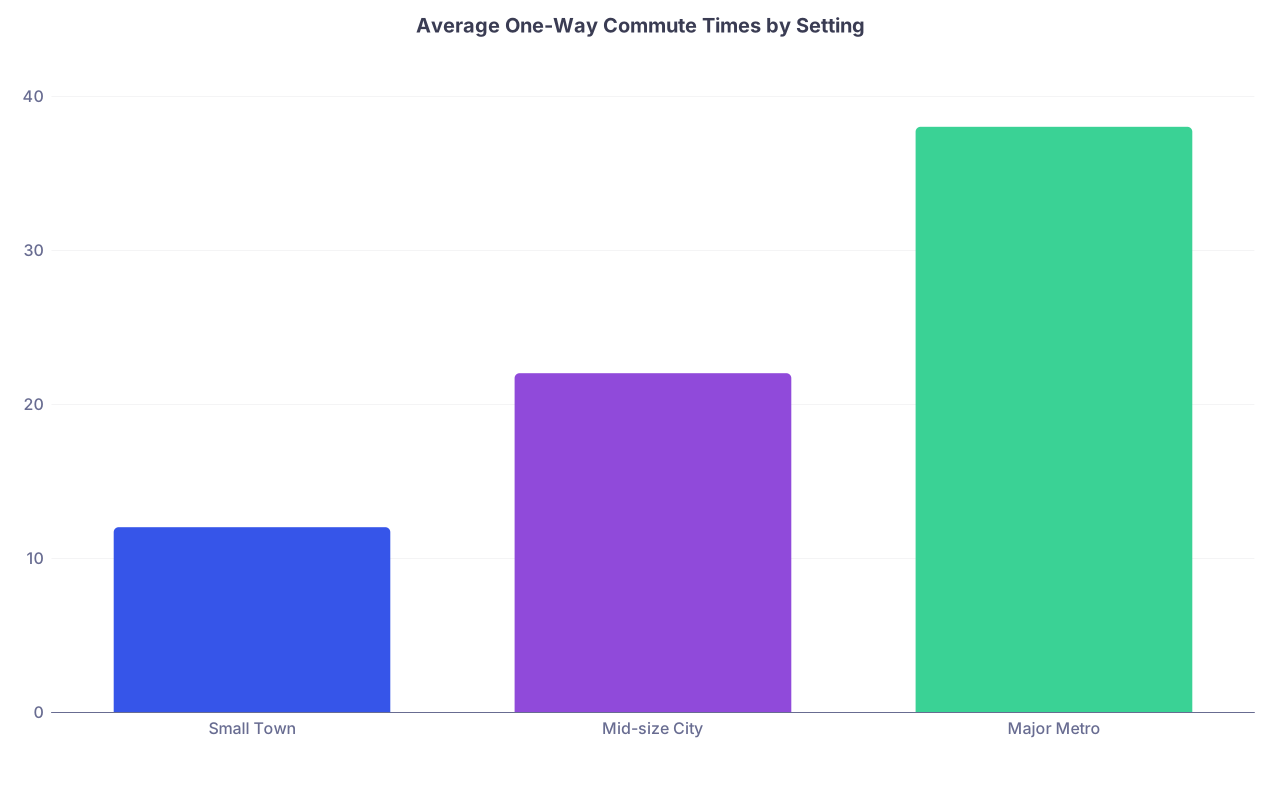
| Category | Value |
|---|---|
| Small Town | 12 |
| Mid-size City | 22 |
| Major Metro | 38 |
Here is the script I see over and over on interview days:
- Applicant: “Oh, I do not mind commuting. I studied for the MCAT on the subway.”
- Resident (forces smile): “Yeah, the commute is not too bad.”
- PD: “Many of our residents live in [trendy but actually distant neighborhood].”
What nobody spells out for you:
- You will be commuting at 4:45 a.m., not 9:00 a.m.
- You will be leaving the hospital at 9:00 p.m. post-call, not 4:30 p.m.
- You will need to get in fast when you are on home call and something explodes.
- Transit is less reliable exactly when you most need it to work.
The cost of getting this wrong is not “you will be mildly annoyed.” The cost is:
- Chronic sleep debt because your door-to-door time steals an extra 60–90 minutes daily.
- Getting written up for late arrivals that are “your responsibility” even when trains fail.
- Unsafe driving home post-call through dense, unpredictable traffic.
- Ruling out fellowships or electives at other sites because you literally cannot get there.
Big-city prestige makes people blind. They see “Brand Name Hospital” and stop asking hard questions. They do not map actual routes, call schedules, and worst-case scenarios. That is a rookie error.
The Commute Trap: Why “I’ll Just Live Farther Out” Backfires

The classic mistake in NYC, Chicago, LA, SF, Boston, Toronto, London—pick your monster metro—is this:
“I will live where it is cheaper and nicer, and I will just commute. People do it all the time.”
Yes. Office workers with flexible start times and remote options do it all the time. You are not them.
How Commutes Quietly Destroy Residents
Pattern I have seen again and again:
- PGY‑1: Lives 45–60 minutes away (one-way) to save on rent.
- First 2–3 months: “It is fine, I listen to podcasts.”
- Month 6: They are falling asleep on public transit and in conference.
- Month 12: They actively avoid research, moonlighting, or leadership roles because any extra time on-site makes getting home unbearable.
The hidden problem: resident schedules are already compressed. You do not have slack for:
- Train delays that add 20–30 minutes.
- The bus that never shows when you are post-call.
- The “signal issue” that stops your subway in a tunnel for 40 minutes.
A 45-minute commute on paper is frequently a 60–75-minute door-to-door reality once you add walking, transfers, and waiting. Twice a day. Six days a week. For years.
Why Driving Is Often Worse Than Transit
People think, “I will just drive, I like driving.” That usually means:
- Paying for parking that quietly eats hundreds per month.
- Sitting in gridlocked traffic while your circadian rhythm is already ruined.
- White-knuckle driving home post-call, in the dark, through aggressive city drivers.
And the big one people ignore:
- On home call you must be able to get in fast and predictably. “It should be 25–30 minutes with no traffic” is a fantasy sentence. You will never see “no traffic” when it matters.
If you cannot reliably reach the hospital in the promised time, you are out of compliance and potentially in trouble. The hospital will not accept “I hit traffic” as a long-term excuse.
Multi-Site Programs: The Silent Killer Of Your Time
Many big-city residencies are not “one hospital.” They are a network:
- Main academic hospital
- Affiliated community hospital
- VA hospital
- Children’s hospital
- City or county facility
If you do not explicitly ask about this, you will get blindsided.
| Site | Typical Rotation | Distance From Main | Transit Time (Peak) |
|---|---|---|---|
| Main Academic | Wards, ICU, Night Float | — | — |
| Community Affiliate | Outpatient, ED | 8–10 miles | 35–60 min |
| VA Hospital | Inpatient, Consults | 5–7 miles | 25–45 min |
| Children’s Hospital | Peds, NICU | 3–5 miles | 20–40 min |
The Worst-Case Pattern
You live reasonably close to the main hospital. You think you are set.
Then:
- Your VA rotation: suddenly your commute is doubled or tripled.
- Your community hospital: is in a transit dead zone that requires 2 transfers and a 15-minute walk at 5:30 a.m.
- Your night float month: is at a different campus with terrible parking and sketchy late-night transit.
I have seen residents effectively “move” for a month—crashing on couches, paying for short-term Airbnbs—because their normal housing becomes unusable for a specific rotation.
That is not something you want to discover after signing a 12-month lease.
Direct Questions You Must Ask On Interview Day
If you skip these, you are gambling with your sanity:
- “How many different sites do you rotate through, and which years?”
- “What is the farthest site from where most residents live?”
- “Is there a shuttle? What is the real travel time door-to-door?”
- “Do residents ever have to go between sites in the same day or same call shift?”
If residents hesitate or give hedged, vague answers—assume it is worse than they are admitting.
Call Logistics: Home Call, In-House Call, and the Lies You Tell Yourself

| Step | Description |
|---|---|
| Step 1 | Long Commute |
| Step 2 | Less Sleep |
| Step 3 | Higher Fatigue |
| Step 4 | Slower Drive Home |
| Step 5 | Safety Risk |
| Step 6 | Delayed Response to Pages |
| Step 7 | Call Coverage Issues |
| Step 8 | Program Friction |
People obsess over “q4 call vs night float” but skip the unsexy, crucial issue: where you are sleeping relative to where you must appear, half-awake, at awful hours.
The Home Call Myth
Home call sounds great to applicants.
“You mean I get to sleep in my own bed?”
Sure. As long as:
- You can reach the hospital in the required time (often 20–30 minutes door-to-door).
- You can actually fall back asleep after getting called in at 2:00 a.m.
- You are not stacking a brutal commute on top of unpredictable overnight work.
What usually happens with a long commute + home call:
- You stay at the hospital longer “just in case” something happens.
- You do not go home between cases or admissions that might need you.
- You end up physically present almost as much as in-house call, but with no call room, no clear off-duty time, and a worse bed.
In other words: it becomes the most exhausting version of both worlds.
In-House Call With A Long Commute
In-house call at least caps your chaos to one location. But if your commute is long, everything around call days becomes distorted:
- Night before call: You go to bed extra early, but you waste an hour commuting just to get there.
- Post-call: You leave late (because sign-out never ends on time), and the difference between a 15-minute commute and 75 minutes is the difference between “nap and recover” and “lose the day.”
This compounds over the year. An extra 60–90 minutes of transit on call days hits much harder because you are already operating on fumes.
Safety Red Flags You Are Probably Ignoring
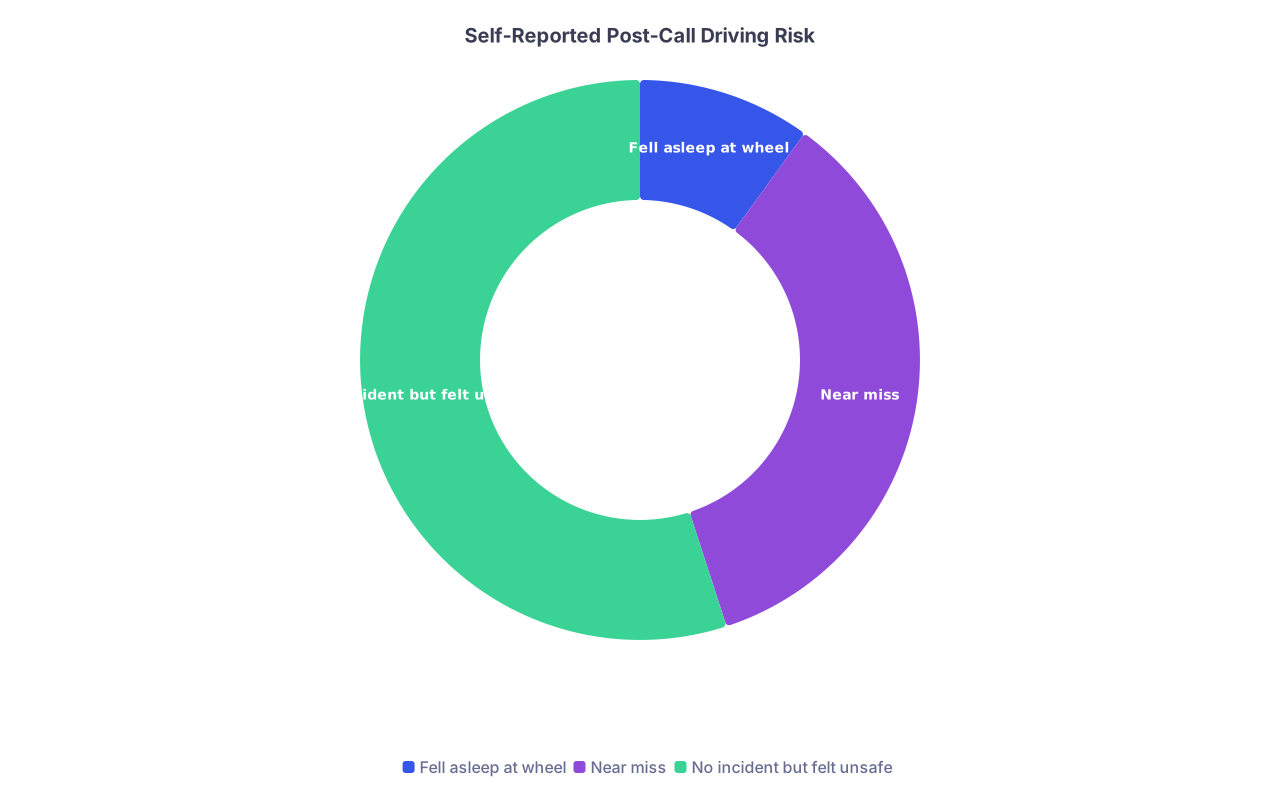
| Category | Value |
|---|---|
| Fell asleep at wheel | 10 |
| Near miss | 35 |
| No incident but felt unsafe | 55 |
There is a quiet, open secret in big-city residencies: a nontrivial number of residents have near-miss accidents—or actual accidents—related to fatigue and commute time. People talk about it off the record, in call rooms, not in front of program leadership.
Things you should not shrug off:
- “Oh yeah, I sometimes nap in the parking garage before driving.”
- “I just blast music and roll the windows down to stay awake.”
- “I take the long local train so if I pass out it is not the end of the world.”
Those are not normal lifestyle quirks. Those are adaptations to an unsafe baseline.
High-risk patterns to watch for:
- Commute requires highway driving with intense traffic at times you will be exhausted.
- No safe overnight transit options when you finish late.
- Neighborhood around the hospital or train station is unsafe to walk in at 11:30 p.m. with a backpack and badge.
- You are already a marginal sleeper—insomnia, anxiety—and your plan depends on “I will just power through.”
Residency is demanding enough. Trying to be a hero on the road on top of that is reckless.
How To Properly “Audit” A Program’s Logistics Before You Rank It
You would not accept a job without knowing your hours and paycheck. Stop accepting residencies without knowing your realistic commute and call logistics.
Here is the actual work you should do.
1. Map Realistic Commutes, Not Fantasy Routes
Pick two or three likely neighborhoods where residents actually live. Then:
- Use Google Maps or similar with:
- Departure time: 4:30–5:30 a.m. on a weekday.
- Evening: 7:00–9:00 p.m.
- Late night: 10:30 p.m.–12:30 a.m.
- Check:
- Driving vs public transit times.
- Variability (best/worst times).
- Whether routes require multiple transfers or walking in isolated areas.
Do this for every major training site, not just the flagship hospital.
2. Ask Residents Specific, Non-Polite Questions
Residents will often try to be optimistic or avoid trashing their program. You need to get past that.
Ask:
- “Where do you live and how long does it honestly take you door-to-door?”
- “Tell me about your worst commute day last month.”
- “On your ICU or trauma months, how does your commute affect your sleep?”
- “Do people ever move closer to the hospital after intern year because they underestimated this?”
Listen for:
- Laughs before they answer.
- “It’s not that bad, but…” followed by a horror story.
- “If I could do it again, I would live…” statements. Those are gold.
3. Understand Call Rooms, Parking, and Shuttles
Details that separate survivable from miserable:
- Are there call rooms you can actually sleep in?
- Is parking guaranteed for residents on nights and weekends?
- Are shuttles on a real schedule, or “sort of when they show up”?
Ask:
- “On a bad weather day—snow, heavy rain—what does your commute look like?”
- “How many people have had to Uber to work because transit failed? Is that common?”
If residents describe elaborate hacks (sleeping in empty offices, using ED stretchers, paying for Uber multiple times a week), logistics are not well supported.
Housing Choices: Do Not Trade Rent For Sanity

Everyone is afraid of big-city rent. Understandable. But if your response is “I will just move 45–60 minutes away,” you are making the wrong trade.
Priorities, in order:
Safety
Can you safely get to and from work at weird hours, including walking segments?Proximity
Aim for:- 20–30 minutes or less door-to-door on your most frequent site.
- Accept 35–40 minutes for rare rotations only if absolutely necessary.
Simplicity of Route
Fewer transfers, fewer modes. Straight shot > “bus to train to bus.”Cost
Only after the first three are acceptable.
If you have to:
- Get roommates.
- Live in a smaller place.
- Pick a less glamorous neighborhood.
Do that. Better a slightly cramped apartment 15–25 minutes away than a large place an hour out that slowly grinds you down.
The Future: Hybrid, Telehealth, and Why It Still Does Not Save You (Yet)
This is the “future of medicine” section, so let us be honest.
People like to fantasize that:
- Telemedicine
- Remote charting
- Virtual handoffs
…will eventually make physical proximity less critical.
Reality, right now:
- The core of residency is still physical presence—rounds, procedures, codes, family meetings.
- Even telehealth clinics frequently require you to be on-site.
- Remote work might help attendings and fellows long before it trickles down to residents.
Where it might help you:
- Some programs are experimenting with remote didactics where you can log in from home.
- A small number of documentation-heavy tasks can sometimes be done off-site.
But if you are planning your residency around a hoped-for future of remote work, you are building on sand. You cannot commute from two hours away and assume “telehealth will cover me.” It will not.
If anything, as hospitals centralize and systems merge, multi-site logistics get worse before they get better. Shuttles, different EHRs, fragmented teams. All of that makes proximity more, not less, important.
Do Not Be The Resident Who Quits Over Something This Predictable
I have seen residents absolutely crushed by work. That is part of the job.
What bothers me more is watching smart, capable people broken by something as avoidable as a bad commute and naive housing.
They:
- Show up late often enough to get on probation.
- Drift into depression from relentless fatigue and isolation.
- Lose any spare time and energy that might have gone to research, side projects, relationships.
- Start to resent a program they might have genuinely enjoyed—if they had just lived closer or chosen differently.
All because they underestimated how much “getting there and back” would cost them, day after day, for three or more years.
Do not idolize the big-city name so much that you ignore the very real geography and transit that will define your actual life.
FAQs
1. Is a 45–60 minute commute ever reasonable for residency?
Only in narrow circumstances. If it is rare (e.g., a once-a-week clinic at a distant site), and your day is otherwise light, it can be tolerable. As a daily, year-round commute for core rotations, it is a bad idea. You are stacking 8–10 extra hours of transit per week on top of an already overloaded schedule. That time comes directly out of sleep and recovery.
2. Should I prioritize living close to the main hospital even if my partner’s job is far away?
For the duration of residency, usually yes. When one partner is a resident, their schedule is the least flexible and most punishing. Splitting the difference in commute times sounds fair, but often leads to the resident being chronically exhausted and unsafe. If anyone should have the shorter, simpler commute, it is the person taking 24‑hour call and working 60–80 hour weeks.
3. How close is “close enough” to safely take home call?
In most big cities, you should aim to be able to reach the hospital in 20–30 minutes door-to-door at the exact hours you are likely to be called in (not Sunday noon). That means physically testing or mapping the route at night or early morning, including parking or transit wait times. If your best realistic time is already 30 minutes on a good day, you have no margin for traffic, delays, or bad weather, and that is a red flag.
Key points:
- In big-city programs, commute and call logistics are not side details; they are central to your well-being and performance.
- Long, complex commutes compound with call demands to create unsafe, unsustainable lifestyles.
- Before you rank a program, audit real-world routes, multi-site rotations, and housing options with the same seriousness you give to case volume or fellowship match lists.