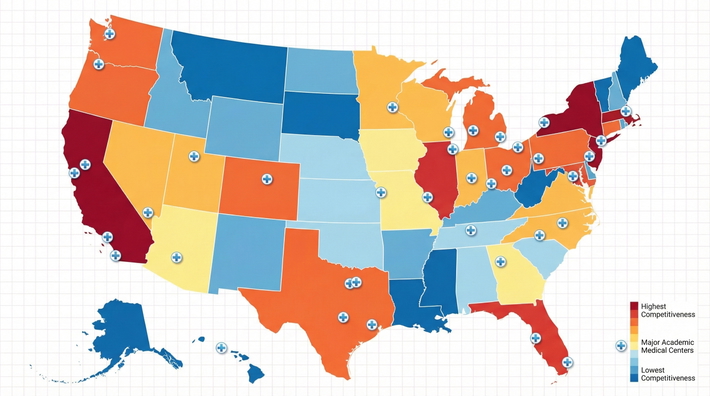
What happens when you rank every community program in one region as if they are interchangeable backups?
You end up in the wrong place, for the wrong reasons, with the wrong expectations. And by the time you realize it, you are post-match, contract signed, and explaining to your co-interns why you misjudged everything.
Let me be blunt: treating all community programs in a given region as “basically the same” is one of the most dangerous mental shortcuts applicants make. I have watched strong residents waste a year being miserable in a poorly aligned program while a better-fit community program 30 minutes away went under-ranked because “they’re all similar anyway.”
They are not.
Below is how people get burned by this assumption, the red flags you’re missing if you think that way, and how to actually compare community programs in a region without lying to yourself.
The core mistake: confusing geography with similarity
Programs in the same city or state share one thing: a map location. That is it. Training quality, workload, autonomy, procedures, and fellowship outcomes can differ wildly.
You see this pattern all the time:
- “I just want to be in Chicago / Dallas / SoCal. Any community IM spot there is fine.”
- “All the community FM programs in my state are similar. I will just rank them by distance from family.”
- “If I get any community psych program in this metro area I am good. They all send to the same fellowships, right?”
Wrong on every level.
Here is the quiet disaster that follows:
- You over-rank a “name-adjacent” community hospital (affiliated with a big academic center in the city but functionally isolated) because it sounds safe.
- You under-rank or ignore a smaller, lower-traffic program that actually has better teaching, saner call, and better board pass rates.
- You end up at the one with:
- No real didactics
- Unsafe workloads
- Toxic leadership
- No meaningful subspecialty exposure
Same region. Same pay band. Completely different life.
How community programs in one region secretly differ
On a website, they all claim:
- Strong clinical training
- Diverse patient population
- Robust didactics
- Graduates succeed in fellowship or practice
Copy-paste nonsense. If you trust that, you will get burned.
Let’s walk through the key axes where “similar-looking” community programs can be night-and-day different.
1. Volume and acuity are not interchangeable
Do not assume “busy community hospital” means the same thing across town.
- Some places:
- Constant high-acuity ED flow
- Real ICU pathology
- Complex comorbidities
- Others:
- Mostly low-acuity, poorly insured frequent fliers
- Very limited high-complexity cases
- Everything hard gets shipped out
Programs rarely advertise how much they ship out. Residents talk about it constantly. Because it affects your training.
| Category | Value |
|---|---|
| Program A | 18 |
| Program B | 8 |
| Program C | 3 |
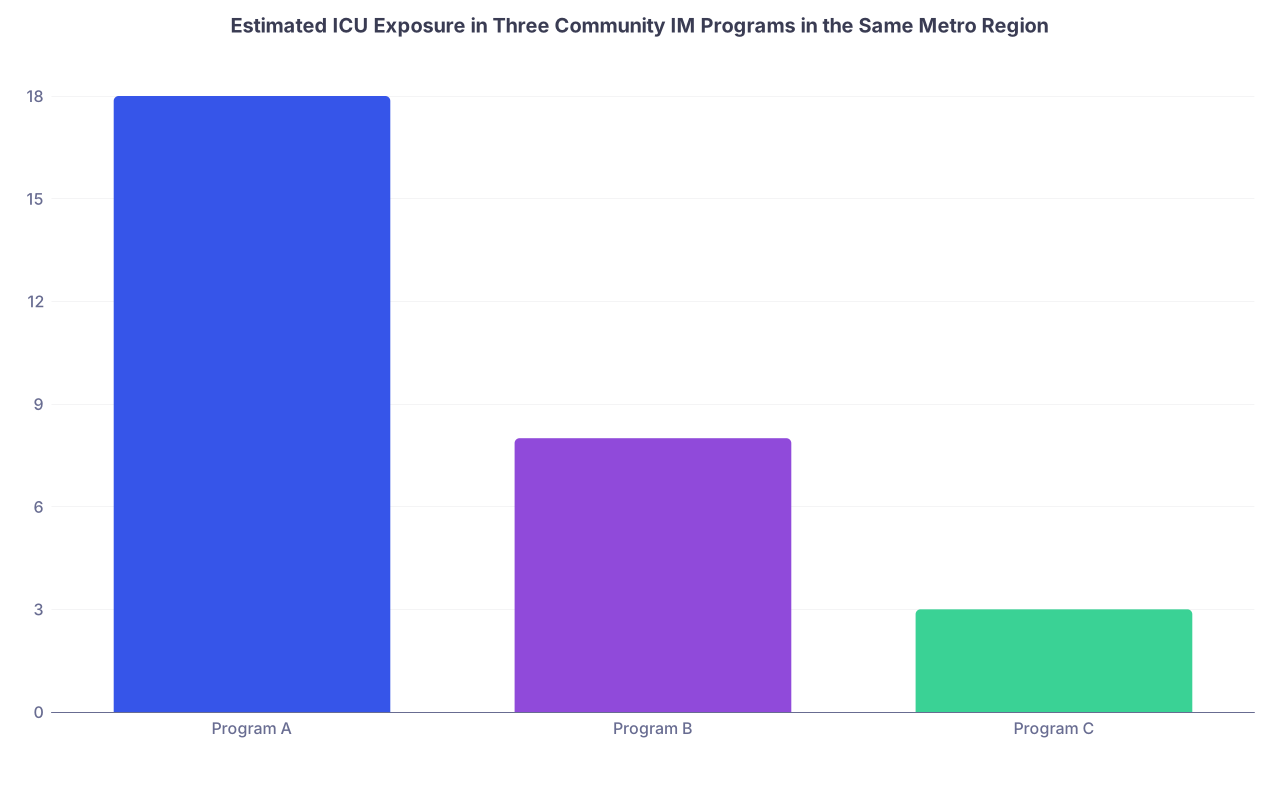
Hours per week on ICU during ICU rotations (average PGY-2/3):
- Program A: 18 hours / week on real ICU patients, strong vent management, pressors, procedures
- Program B: Mixed ICU/step-down, some meaningful exposure, many sick cases transferred
- Program C: “ICU” is essentially a monitored floor; serious cases go to the nearby academic center
All three will say “robust critical care experience” on their websites.
The mistake: You choose solely based on “I like this city block better” or “this one has a prettier lobby” instead of asking:
Who actually manages the sick patients—residents, hospitalists, or intensivists who do not let you touch anything?
2. Resident role: scut-worker vs real physician
Two hospitals, 20 minutes apart:
At Hospital X, residents:
- Write most notes
- Coordinate all discharges
- Spend hours dealing with fragmented EMR, pointless order sets, transport issues
- Rarely get protected time for bedside teaching
At Hospital Y, residents:
- Have decent ancillary support
- Run codes, present on rounds, do procedures, see admissions
- Watch attendings model real clinical reasoning at the bedside
Both are “community internal medicine programs.” Same region. Same zip code range. Completely different training value.
If you treat them as equal just because they are both suburban community programs, you risk three years as an undertrained task-doer.
The hidden structural differences you are probably ignoring
Community programs vary in several structural dimensions that most applicants barely investigate. That is laziness you cannot afford.
Academic affiliation: real or decorative?
Some common illusions:
- “This community program is affiliated with Big Name University. Must be decent.”
- “The faculty have clinical instructor titles at Prestigious Med School. That means something, right?”
Often, no.
You must figure out whether the affiliation is:
Substantive
- Residents rotate at the main university hospital.
- University faculty directly teach and evaluate you.
- You can join research projects with academic mentors.
- Fellows from the university actually know your name.
Cosmetic
- The hospital sends students there for clerkships.
- A handful of attendings hold unpaid volunteer titles.
- Zero meaningful research pipeline.
- Fellowship PDs at the academic center barely recognize your program.
| Program | Affiliation Type | Resident Rotations at University | Research Access |
|---|---|---|---|
| A | Substantive | 3–6 months / year | Strong |
| B | Limited | 1 elective month | Moderate |
| C | Cosmetic | None | Minimal |
| D | None | None | None |
All four programs might list the same university logo on their website. You assume “same region, same university, similar.” You are wrong.
Fellowship pipeline: hand-wavy vs documented
Residents love to say “people match into cards and GI from here.” Ask for receipts.
You want:
- A recent (last 3–5 years) list of where people matched by specialty.
- Not just “we’ve had people go to cardiology.”
Where? How many? Year by year?
If a program dodges when you request it, that is not a small thing. It tells you:
- They do not track outcomes well.
- Or they know the data will disappoint you.
- Or they actually have almost no fellowship matches and rely on vague anecdotes.
The ugly mistake here:
You assume all community IM programs in one large coastal city have “similar fellowship chances” because “the city is academic-heavy.” Then you discover your specific hospital is invisible to the region’s fellowship PDs.
Culture, leadership, and stability: the regional trap
Another quiet assumption: if several community programs are in the same health system or market, their culture must be similar. No.
Toxic vs functional leadership… in the same system
I have seen this pattern in big hospital systems:
- Hospital 1: PD is engaged, fights for residents, shields them from admin nonsense.
- Hospital 2: PD is burned out, checked out, or terrified of the C-suite.
- Hospital 3: PD turns over every 2 years, coordinators are constantly new, program structure resets annually.
Same parent system. Same region. Total chaos in one, stability in the other.
The dangerous applicant mindset:
“I liked the vibe at Hospital 1, same health system means Hospital 3 is probably similar.” Then you match at 3, not 1.
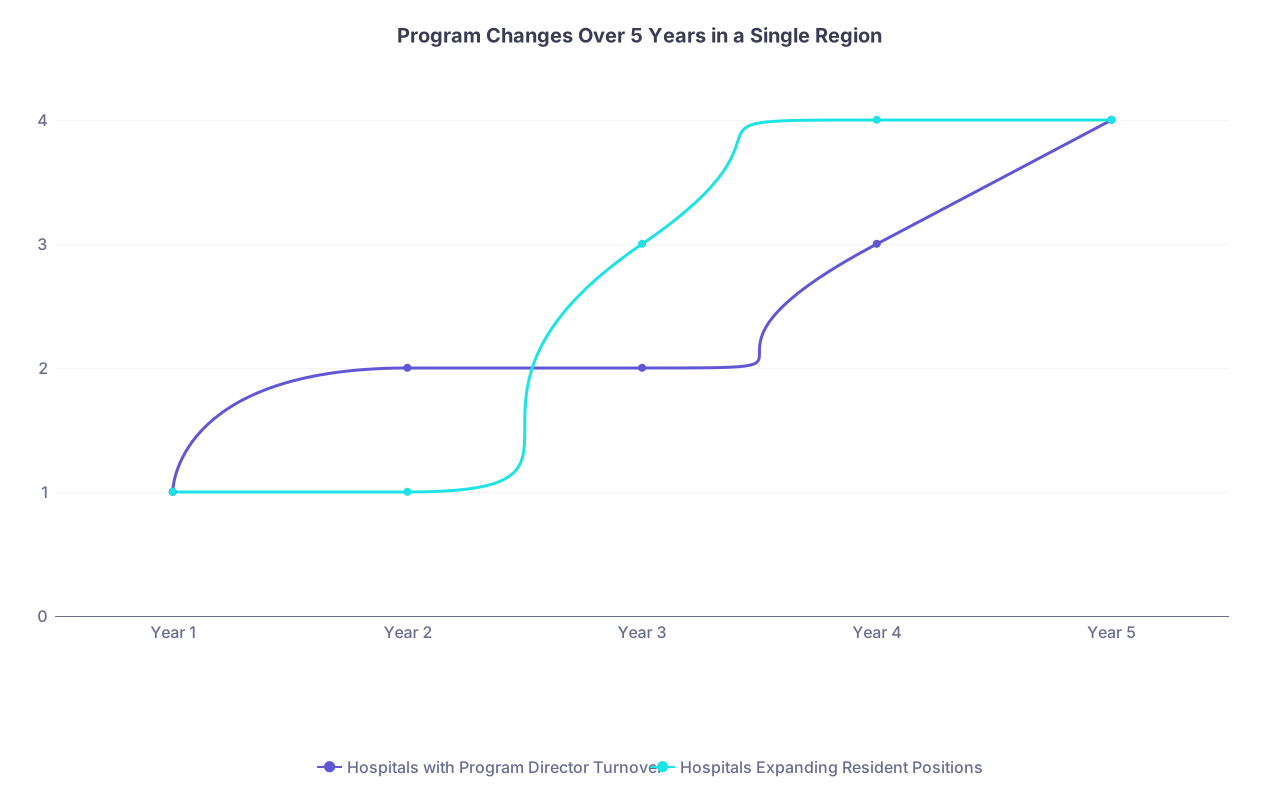
Program stability: expansions, closures, and mergers
Community programs are more vulnerable to:
- Rapid expansion of resident complement without proper faculty growth.
- Merger-driven chaos (new EMR, new admin, changing call structures).
- Sudden closure of services that were key for your training (e.g., OB, NICU, cath lab moving to another campus).
| Category | Hospitals with Program Director Turnover | Hospitals Expanding Resident Positions |
|---|---|---|
| Year 1 | 1 | 1 |
| Year 2 | 2 | 1 |
| Year 3 | 2 | 3 |
| Year 4 | 3 | 4 |
| Year 5 | 4 | 4 |
The mistake:
You only ask, “Is the program accredited?” instead of, “What has actually changed in the last 3–5 years, and what is about to change next year?”
Region-specific pitfalls: same city, different lives
“Regional guide” does not mean “everything near each other is interchangeable.” Let’s talk about some region-based traps.
Trap 1: Urban vs exurban vs rural in the same “metro”
Example: A large metro area with:
- Downtown community hospital: high trauma, dense pathology, often under-resourced.
- Inner-ring suburb hospital: solid volume, more stable staff, decent subspecialty coverage.
- Outer-ring exurban hospital: lower volume, heavily outpatient-focused, lots of transfers out.
- Rural-affiliate hospital 90 minutes away but still branded under same “metro system.”
All listed under one regional cluster on FREIDA. You call them all “community programs in the city.” That is lazy, and it will wreck your expectations.
Ask:
- Who are the typical patients?
(Urban underserved vs insured commuters vs rural elderly) - How many transfers out? For what?
- How many sites do residents commute to, and how far?

Trap 2: State vs across-the-border assumptions
Border regions are notorious. One side of a state line:
- Different malpractice climate
- Different payor mix
- Different Medicaid expansion status
- Different reimbursement and staffing
Applicants say “I want to stay in the region” and treat both sides of the border as equivalent. Yet the training reality, staffing levels, and burnout risk can diverge wildly across that line.
You are not just choosing a geography; you are choosing a regulatory and financial environment that shapes your entire day-to-day practice.
How to actually compare community programs in a region (without lying to yourself)
Here is how to avoid the “they’re all the same” trap and do the work others skip.
Step 1: Build a regional comparison grid
Pick your region. List every community program you are realistically considering. Now force yourself to fill in a grid with specific data points.
| Factor | Program A | Program B | Program C |
|---|---|---|---|
| ICU months (PGY-2/3) | 4 | 2 | 1 |
| Night float months | 3 | 4 | 2 |
| Fellows on site? | Yes | No | Limited |
| Board pass rate 5y | 96% | 89% | 100% |
| PD tenure (years) | 8 | 1 | 5 |
If you cannot fill this out with reasonable accuracy after:
- Reading the website carefully
- Checking ACGME and FREIDA
- Talking to at least one resident per program
…then you do not understand your region as well as you think. Keep digging.
Step 2: Ask residency-specific, region-aware questions
Stop with the generic “tell me about your program” nonsense. You need pointed questions that expose differences between programs in the same region.
Examples:
- “I know Hospital X and Hospital Y are both community IM programs in this metro area. How would you say your ICU exposure compares to theirs?”
- “For residents interested in cardiology, which fellowships have your graduates matched at in the last 5 years? Are most placements in-state or out-of-state?”
- “How often are patients transferred to the nearby academic center, and which conditions typically trigger transfer?”
- “What major changes are planned in the next 1–2 years—new ownership, service expansions, or GME growth?”
If the answer is vague, rehearsed, or defensive, that tells you almost as much as the content itself.
Step 3: Read between the lines of resident comments
Residents usually cannot say on-record, “This place is a mess,” but they leak plenty of signals.
Red flag phrases:
- “We are in a transition phase.”
(Translation: chaos.) - “Administration is still figuring some things out.”
(You are the experiment.) - “We are working on getting more subspecialty exposure.”
(You will not have it during your training.) - “We are starting to take more residents next year.”
(Ask: same number of faculty? Same ICU? Same clinics?)
Green-ish signals:
- “Our PD has been here for 6–10 years and knows every resident by name.”
- “When call schedules changed, residents had real input and admin listened.”
- “Our board pass rate is consistently high, and they give us dedicated board prep time.”
| Category | Value |
|---|---|
| Prog 1 | 1,40 |
| Prog 2 | 3,55 |
| Prog 3 | 5,80 |
| Prog 4 | 7,82 |
| Prog 5 | 10,90 |
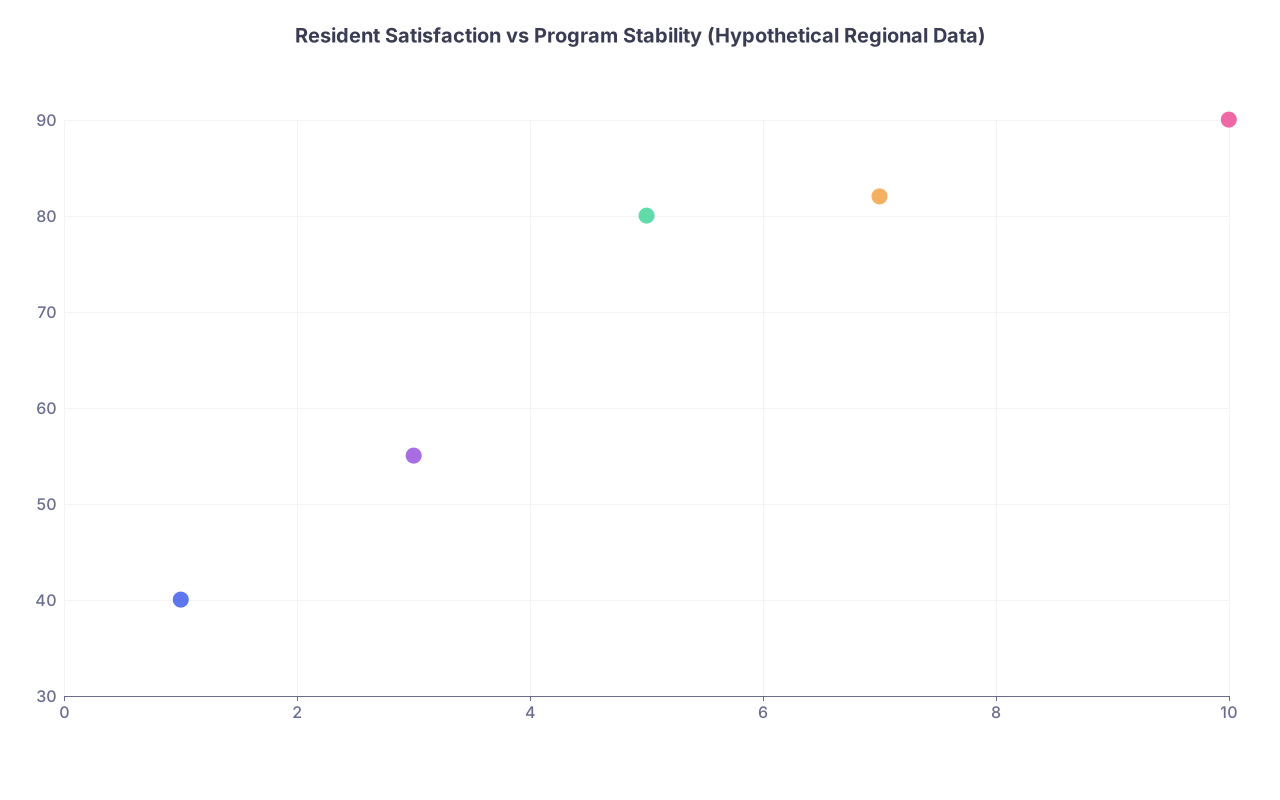
X-axis: PD tenure in years
Y-axis: Overall resident satisfaction percentage
You want to be at the right-side of that chart, not gambling on the “we just opened / just expanded” place just because it is in your preferred suburb.
When it is actually reasonable to treat programs similarly
Not every micro-difference matters. The mistake is ignoring the big differences, not refusing to obsess over tiny ones.
Treat programs as roughly similar if:
- Their board pass rates, fellowship outcomes, and duty hours are comparable.
- Their ICU exposure, call, and autonomy are within the same range.
- You have spoken with residents at each and their lived experiences sound genuinely parallel.
- You have confirmed no major looming changes (ownership shifts, mass expansion, service closure).
Even then, break ties thoughtfully:
- Commuting time and call schedules matter over 3+ years.
- Support systems (family, partners) are not trivial.
- Some people thrive in slightly quieter settings; others want nonstop pathology.
Just do not skip the comparison and jump straight to “same region = same program.”
Future of medicine twist: regional consolidation is making this worse
Healthcare is consolidating. Large systems are swallowing smaller hospitals. Community programs are multiplying, merging, rebranding. Names change; training quality does not necessarily improve.
What this means for you:
- More programs in one region with nearly identical branding but drastically different realities.
- More “new” or “restructured” residencies where the future is genuinely uncertain.
- More pressure from systems to expand resident numbers without proportionate faculty growth.

| Step | Description |
|---|---|
| Step 1 | Small Community Hospital |
| Step 2 | Joins Big Health System |
| Step 3 | Residency Program Starts |
| Step 4 | More Residents Added |
| Step 5 | Stable Size |
| Step 6 | Potentially Strong Program |
| Step 7 | Overworked Residents |
| Step 8 | System Expands GME? |
| Step 9 | Faculty Also Grow? |
If you treat all programs in that expanding system as equal because they share a logo and an area code, you are ignoring where in that lifecycle each one sits.
You want to land at H, not I.
FAQ (exactly 3 questions)
1. If I care mainly about staying near family, is it really that bad to treat all local community programs as similar?
It is risky. Family proximity matters, but not enough to ignore major differences in training quality, culture, and stability. If you rank purely by ZIP code without understanding call schedules, ICU exposure, leadership, and board pass rates, you may end up close to home but professionally miserable and undertrained. A better approach is to group only truly comparable programs together, then let geography break ties within that smaller, vetted set.
2. How can I get honest information when residents sound guarded on interview day?
Stop asking bland questions. Ask specific, answerable ones: number of ICU months, how often they transfer patients out, recent fellowship matches, PD turnover, schedule changes in the last 2 years. Compare answers across programs in the same region. Guarded residents will still usually reveal patterns—hesitation before answering, vague language, or contradictions between what different residents say. If the data are inconsistent or mysteriously unavailable, that is a serious red flag.
3. Are new or expanding community programs in a strong region automatically bad choices?
Not automatically. But they are higher risk. Early cohorts absorb the chaos of new curricula, untested leadership, and shifting rotations. In a competitive region, there may be mature programs that offer equal or better geography with far more stability. If you consider a newer program, you must dig harder: who are the faculty, how many FTEs per resident, what concrete protections exist for resident education, and what changes are already planned for the next 1–2 years. Do not rank them highly just because they share a city name with programs that have already proven themselves.
Key points to remember:
- Geography does not equal similarity. Programs in the same region can be radically different in volume, autonomy, culture, and outcomes.
- Stop using “community program in X city” as a single category. Force yourself to compare specifics: ICU exposure, leadership stability, fellowship results, and system changes.
- Treat only truly comparable programs as interchangeable; everything else demands real discrimination, or you risk matching into a three-year mistake you could have easily avoided.