The biggest lie applicants tell themselves is that “a Level 1 trauma center is a Level 1 trauma center.” It is not. Region dictates your trauma volume and case mix more than most people want to admit.
You already know trauma is not evenly distributed across the country. But the patterns are more systematic than most residents, and frankly some faculty, realize. If you care about becoming genuinely comfortable running a trauma bay at 3 a.m., the difference between an urban Northeast Level 1 and a Southern border Level 1 is not academic. It changes your training, your fatigue, and your competence.
Let me break this down by region, by mechanism, and by what it actually means for residency experience.
The foundation: what “high-volume trauma” actually means
Before we start comparing regions, anchor on what “busy” even is.
The American College of Surgeons (ACS) verification criteria do not mandate a hard minimum number of trauma activations for Level 1 status. But in practice, real high-volume trauma centers share a pattern:
- Thousands of trauma admissions per year
- Hundreds (often > 1,000) of highest-level activations
- A substantial proportion of penetrating trauma
- 24/7 in-house attending coverage from surgery, anesthesia, and often emergency medicine
To give you a mental scale:
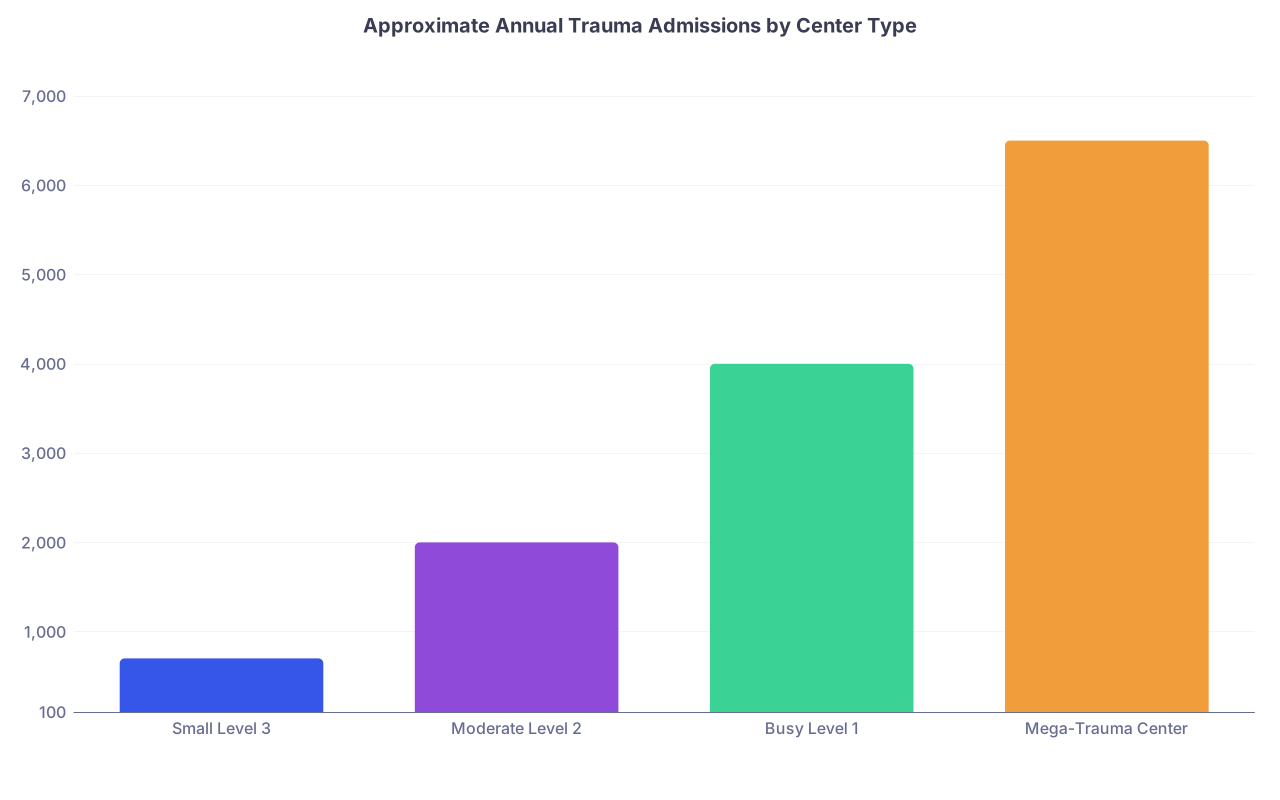
| Category | Value |
|---|---|
| Small Level 3 | 700 |
| Moderate Level 2 | 2000 |
| Busy Level 1 | 4000 |
| Mega-Trauma Center | 6500 |
Those “mega-trauma” centers (think: major county hospitals, some border trauma centers, a few dense urban cores) are where residents often feel like they live in the trauma bay.
But a key point: two ACS-verified Level 1 centers can both hit 2,000–3,000 trauma admissions a year and still feel completely different if one is 80% blunt MVC/falls and the other is 40% penetrating gunshot and stab wounds.
Volume is not just how many. It is:
- How sick
- How fast they arrive
- How often you actually operate versus tube, scan, admit, and discharge
And that is where regional variation comes in.
Regional overview: where the trauma lives
Here is the high-yield, blunt summary first, then we will unpack it.
- Northeast: Dense population, plenty of blunt trauma, scattered penetrating pockets, but highly regionalized and often shared across many centers.
- Midwest: Mixed pattern; significant blunt (MVCs, agriculture, industry), moderate penetrating in specific metro areas; large catchment areas.
- South / Southeast: Higher overall trauma burden, more penetrating than Midwest/Northeast; lots of motor vehicle trauma and high-speed rural mechanism.
- West Coast: Massive variability; some of the busiest high-acuity centers in the country, but also multiple Level 1s in close proximity that cannibalize volume.
- Southwest / Border: Outsize volume, high penetrating percentage in several systems, extreme polytrauma, long-distance transfers.
To visualize how mechanism shifts by region, something like this is a reasonable conceptual pattern (not absolute numbers, but directionally right):
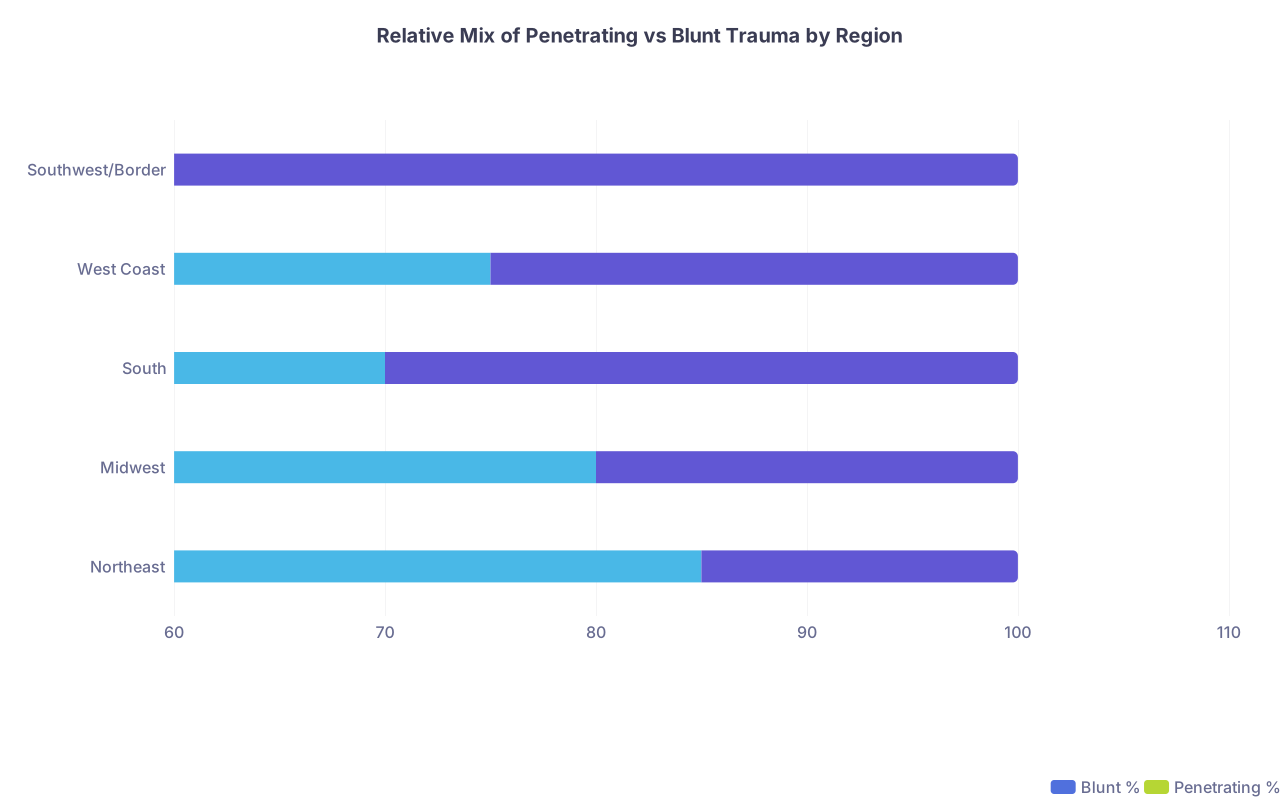
| Category | Blunt % | Penetrating % |
|---|---|---|
| Northeast | 85 | 15 |
| Midwest | 80 | 20 |
| South | 70 | 30 |
| West Coast | 75 | 25 |
| Southwest/Border | 60 | 40 |
Again—ballpark, not gospel. But the trend holds: penetrating trauma tends to increase as you move south and toward certain western/border zones.
Now let us go region by region and talk about what this actually means for your training.
Northeast Level 1 trauma centers: density, regionalization, and politics
Think Boston, New York City, Philadelphia, Baltimore, DC corridor. Lots of Level 1’s. Lots of politics. Lots of turf.
You will see trauma. But it is fragmented.
Typical pattern
- High population density
- Many hospitals in relatively small geographic area
- Regional trauma systems that funnel the worst trauma preferentially to specific centers, but often still spread the volume
What this means:
Blunt-heavy case mix
High-speed MVCs on interstates. Falls from height and low-level falls in older adults. Occasional industrial or construction injuries.
Penetrating exists (NYC, Philly, Baltimore know gun violence), but the share of penetrating at any single academic Level 1 is often moderate because:- EMS bypass policies
- Neighborhood proximity to certain “gunshot hospitals” versus “everything else” hospitals
- Historical referral patterns
Multiple Level 1’s sharing a city
Boston, NYC, Philadelphia each have multiple Level 1 trauma centers within a few miles. That divides volume. You can have 2–3 different residencies all calling themselves “high-volume trauma” but competing for essentially the same citywide pool.Prehospital sophistication
Many Northeast systems have relatively advanced EMS, aggressive prehospital triage, and short transport times. Blunt polytrauma will still present very sick. But you may see a smaller share of true prehospital “barely alive” exsanguinating patients compared with certain Southern or border systems where transport distances are longer and triage pathways are rougher.
So for an EM or surgery resident choosing in the Northeast, you want to look beyond the marketing brochure.
Ask programs directly (and do not accept vague answers):
| Question | Why it matters |
|---|---|
| Annual trauma activations (highest level) | Tells you real critical volume, not just “trauma consults” |
| Penetrating trauma percentage | Drives emergent operative exposure and resuscitation intensity |
| Number of OR trauma cases per PGY year | Shows whether you scrub or just stand at the head of the bed |
| Night float vs 24h call structure | Dictates how you experience high-acuity overnight trauma |
| Competing Level 1 centers in same catchment | Helps explain why marketing may not match volume |
A recurring pattern I see: some Northeast residents finish feeling very solid on blunt polytrauma, CT-based decision-making, and ICU management, but underexposed to repeat penetrating laparotomies and truly uncontrolled hemorrhage management.
It is not “bad” training. It is a specific flavor. You need to know if that is what you are signing up for.
Midwest Level 1 trauma centers: large catchment, blended mechanisms
The Midwest is more heterogeneous than people think. Cleveland vs rural Missouri vs Chicago vs Minnesota are not the same universe.
But there are a few shared themes.
Large geographic catchment
Many Midwestern Level 1’s are referral centers for entire multi-county or multi-state regions. That means:
- Long-distance helicopter and ground transfers
- Late presentations of injuries first “stabilized” at small community hospitals
- A lot of complex multi-system trauma landing at a single hub center
The volume can be deceptively high, especially at the region’s main academic center.
Mechanism mix
Blunt dominates, but not “just” city MVCs.
You get:
- Farm machinery injuries
- Crush injuries and industrial trauma
- Snowmobile / ATV accidents
- Ice-related falls and winter driving trauma
Penetrating trauma is variable. Chicago, parts of St. Louis, Detroit, Cleveland—trauma residents there know gunshot wounds extremely well. Move a few hundred miles and your penetrating exposure may fall off a cliff.
For many Midwestern Level 1’s, the breakdown might feel roughly:
- 75–85% blunt
- 15–25% penetrating
But the volume of really sick blunt trauma, especially with long prehospital or interhospital delays, can be extremely high.
So you trade fewer GSW laparotomies (at some centers) for more brutal high-energy blunt multi-trauma and complex ICU courses. If you want to be outstanding at ventilator management, ARDS, and multi-organ failure after trauma, this is not a bad place to train.
South & Southeast: where the trauma machine rarely stops
If you talk to people who have rotated at large Southern Level 1 centers—think Houston, Dallas, Atlanta, parts of Florida—you hear the same things:
- “Trauma never stopped.”
- “Night shifts were constant.”
- “Half my memories are in the trauma bay.”
That is not an accident.
Why the South is often busier
A few structural features tend to coexist:
- Higher rates of motor vehicle collisions per capita
- Higher rates of firearm-related injury in several states
- More motorcycles, ATVs, and recreational vehicles
- High-speed rural highways feeding into major metro centers
- Sunbelt growth and sprawl without proportional trauma center saturation in some regions
Put simply: more mechanisms + fewer trauma centers per capita in some zones.
This often yields:
- High annual trauma admissions (4,000–6,000+ at some flagships)
- A higher percentage of penetrating trauma than Northeast/Midwest overall
- More polytrauma arriving in short bursts—multiple simultaneous activations
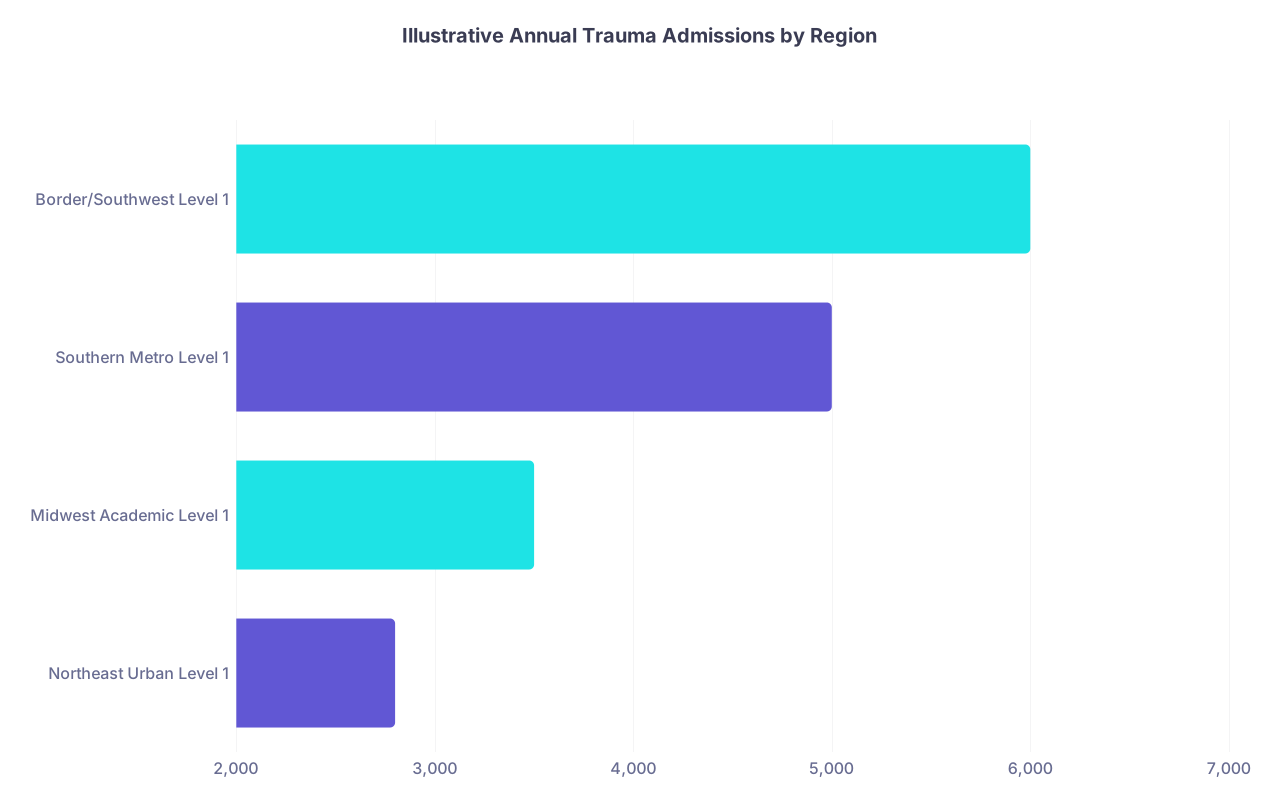
| Category | Value |
|---|---|
| Northeast Urban Level 1 | 2800 |
| Midwest Academic Level 1 | 3500 |
| Southern Metro Level 1 | 5000 |
| Border/Southwest Level 1 | 6000 |
Again, these are representative magnitudes, not hard numbers, but the hierarchy tracks reality more often than not.
What it feels like as a resident
You will:
- Run more trauma activations per shift
- See more uncontrolled hemorrhage and massive transfusion protocols
- Participate in more emergent laparotomies, thoracotomies, and damage-control procedures
- Have more shifts where you do not sit down for hours
For EM, this means comfort quickly triaging and resuscitating multiple severely injured patients simultaneously. For surgery, this means accumulating a much higher number of index trauma cases by the end of residency.
But there is a trade-off: burnout risk. High-volume Southern programs can grind you down if the schedule is abusive and staffing is thin. Do not be seduced only by “we see everything.” Ask how many bodies are actually there at 2 a.m. to help.
West Coast: enormous variability behind the same “Level 1” label
Lumping California, Washington, Oregon, and adjacent states together is messy, but the main point stands: West Coast trauma is wildly variable by city and by system design.
You have:
- Obscenely busy county systems with massive homeless, substance use, and violence burdens
- Affluent suburban academic Level 1’s with high blunt trauma, lots of falls, and lower penetrating percentages
- Strong trauma networks in some states that distribute patients across multiple centers, softening volume at each site
Examples of influences on volume:
- State firearm laws
- Density of trauma centers in a metropolitan area
- Geography (mountains, coastline, highways) feeding specific mechanisms (falls, MVCs, recreational injuries)
Residents at some California county hospitals will tell you they feel like they train in a quasi–South/Southwest penetrating environment. Residents 20 miles away at a different Level 1 will have a more geriatric-blunt-heavy experience with major volume but lower acuity mix.
The key on the West Coast is not to trust regional stereotypes. Trust local data. Insist on it.
Ask:
“How many trauma laparotomies does a graduating chief average in the last 3 years?”
Not: “Are you a busy trauma center?”
You will be surprised how often the answer does not match the hype.
Southwest & border trauma: the extreme edge of volume and acuity
Border and near-border Level 1 systems (think southern Arizona, parts of Texas, parts of California and New Mexico) often live in a different reality.
I have seen schedules where services list:
- 6,000+ trauma admissions per year
- Penetrating percentages pushing into the 35–45% range
- Regular use of massive transfusion protocols
- Frequent cross-border or long-distance transfers
Several factors collide here:
- High-speed highway corridors with catastrophic MVCs
- Migrant-related injuries (desert exposure, falls from border barriers, vehicle rollovers)
- Firearm and interpersonal violence patterns in specific regions
- Long prehospital or interhospital transports with late arrivals in extremis

For residents, this can be phenomenal operative and resuscitation training. You will:
- Run endless penetrating trauma resuscitations
- Gain comfort with damage-control surgery and rapid decision-making
- Manage profoundly sick patients with shock, coagulopathy, and multi-organ failure
But again, cost: lifestyle and psychological load. Watching that many young patients die or survive with devastating injuries is not a neutral experience.
If you want maximal trauma volume and you can tolerate intensity, border Level 1’s are where you look very closely.
How regional trauma volume shapes actual residency training
Enough geography. Let us translate this into what you will feel as a resident in different regions.
1. Procedural and operative volume
Regions with more penetrating trauma and higher overall trauma numbers will tend to produce:
- More emergent laparotomies, thoracotomies, vascular repairs
- More chest tubes, central lines, resuscitative procedures performed under pressure
- Greater repetition of the same high-yield trauma procedures (you do not want your first truly “hard” trauma laparotomy to be in your first job)
In primarily blunt-trauma regions with high volume, you still get a ton of procedure exposure, but more of it may be:
- Intubations
- Chest tubes for rib fractures / hemothorax / pneumo
- External fixation coordination with ortho
- Complex ICU procedures (tracheostomies, PEGs, etc.)
So the difference is not “good vs bad.” It is “resuscitation-heavy, OR-heavy penetrating trauma” vs “ICU-heavy, complex blunt polytrauma.”
2. Cognitive and systems training
High-volume regions (South, Southwest, some West Coast, some Midwest metros) force you to:
- Run multiple trauma activations simultaneously
- Prioritize resources: one CT scanner, two crashing patients, five things happening at once
- Coordinate with blood bank, OR, interventional radiology, neurosurgery, ortho in chaos
Lower-penetrating but still busy blunt regions push you to excel at:
- Imaging-based decision-making
- Anticoagulation reversal and geriatric trauma care
- Long-term coordination of rehab, SNF placement, and complex discharge planning
You need to decide which skillset you value more.
How to interrogate programs about trauma volume (without sounding clueless)
Do not ask, “Are you a busy trauma center?” Everyone will say yes.
Ask for numbers and distributions:
- Annual trauma admissions and highest-level activations
- Percentage blunt vs penetrating
- Average number of emergent trauma laparotomies per resident by graduation (for surgery)
- Average number of major trauma resuscitations led as primary provider by graduation (for EM)
- How many other Level 1/2 centers are in your catchment area?
Then correlate with region.
If a Northeast urban Level 1 tells you they see 3,500 traumas per year with 10% penetrating and 5 other Level 1’s within 15 miles, that is a very different environment than a Southern or border Level 1 with 5,500 traumas and 35% penetrating and a 200-mile catchment.
The future: how trauma volume by region will likely evolve
Trauma systems are not static. Three big forces are already changing regional trauma volume patterns.
1. Demographics and aging
The U.S. population is aging. That hits certain regions harder (Florida, Northeast, parts of the Midwest).
Result:
- More low-level falls with catastrophic outcomes (subdural hemorrhages, hip fractures, rib fractures in frail patients)
- More anticoagulated trauma
- Less classic young-male blunt or penetrating profile at some centers
Level 1 centers in older regions will get busier, but with a more geriatric trauma flavor.
2. Violence and firearm trends
Violent crime and firearm injury trends cycle, but many Southern and some Western/urban centers have not seen the decline that old textbooks like to reference. Some areas have seen sustained or rising firearm injury rates.
So that North–South gradient in penetrating trauma is unlikely to flatten in the short term. It might sharpen.
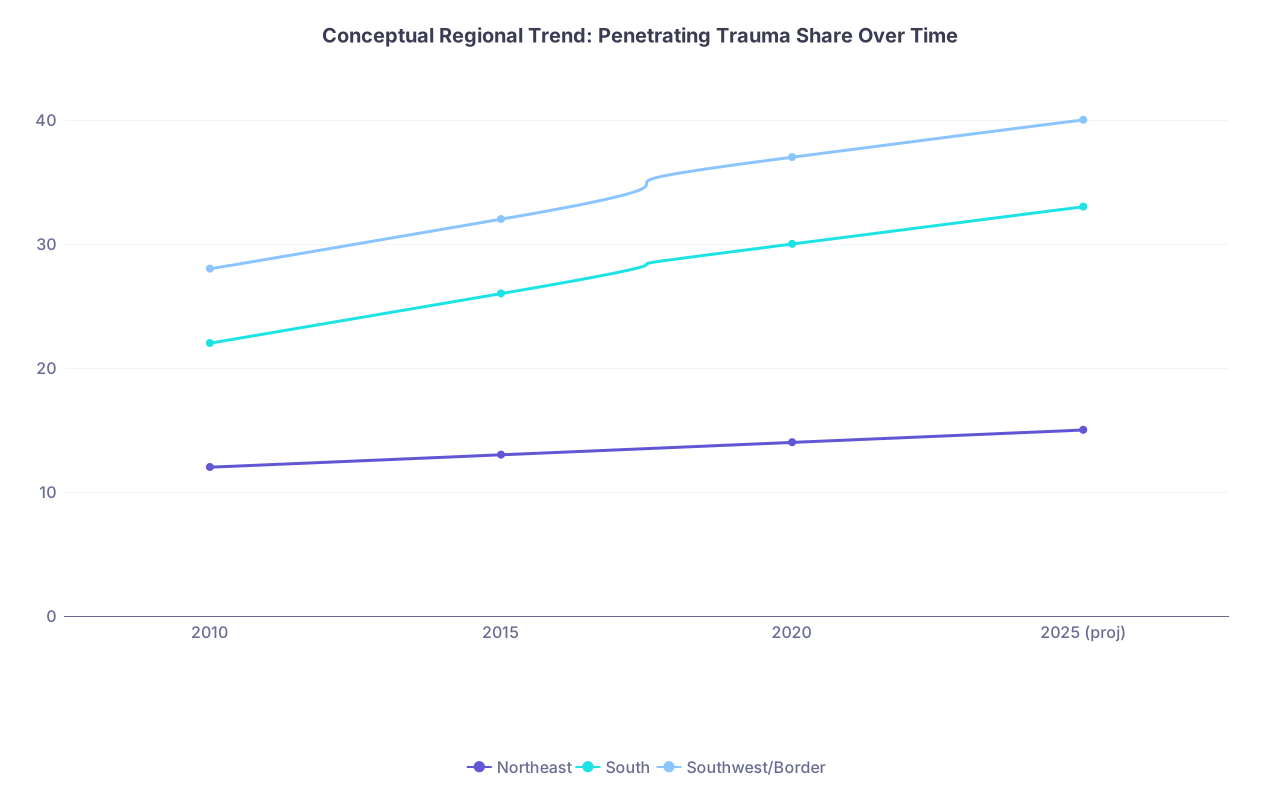
| Category | Northeast | South | Southwest/Border |
|---|---|---|---|
| 2010 | 12 | 22 | 28 |
| 2015 | 13 | 26 | 32 |
| 2020 | 14 | 30 | 37 |
| 2025 (proj) | 15 | 33 | 40 |
This is conceptual, not actual registry data—but it reflects the trajectory many centers report anecdotally.
3. Trauma center proliferation and verification tightening
Some regions have added new Level 2 or even Level 1 centers, which dilutes volume at the preexisting flagships. ACS verification standards are also tightening expectations for quality and structure, which can drive regionalization but also political battles over who gets to be the “big dog.”
Expect:
- Urban regions with multiple competing Level 1/2’s to have more fragmented trauma volume, even in high-injury states
- Rural and border hubs to continue to shoulder outsize loads
- Some mid-volume centers to lose ACS verification or downgrade if they cannot sustain volume, while others absorb more
For applicants, this means you cannot rely on old reputations. A center that was “the busiest” 15 years ago may now share half its historical catchment with newer trauma centers down the road.
You have to ask what the last 3–5 years look like, not what the alumni from 2003 remember.
Putting it together: choosing by region with open eyes
Here is the blunt framework I would use if trauma volume is high on your priority list.

If you want:
Maximal penetrating trauma and resuscitation-heavy training
You look strongly at:- Southern metros with historically high violence and fewer adjacent Level 1’s
- Southwest / border centers with huge catchments
- Specific West Coast county systems with known gun violence and homelessness burden
High-volume blunt trauma with complex ICU care and long-term multi-organ management
You prioritize:- Midwest academic hubs with large rural catchment
- Northeast and some West Coast academic centers serving older, complex populations
Balanced trauma with both mechanisms but not insane lifestyle
You look for:- Regions with moderate violence, strong trauma networks, and a few but not ten Level 1’s
- Mid-sized cities where one or two hospitals handle the bulk of trauma, not six
Then you drill down on actual numbers.
One more nuance: do not chase volume so aggressively that you ignore culture. A malignant, understaffed “trauma factory” will burn you out, and your learning will plateau. A very high-volume trauma center with good teaching and protected time beats a slightly higher volume center where you are just a warm body plugging call holes.

| Step | Description |
|---|---|
| Step 1 | Want strong trauma experience |
| Step 2 | Target South / Border Level 1 |
| Step 3 | Target Midwest / Northeast hubs |
| Step 4 | Target mid-size city Level 1 |
| Step 5 | Rank highly |
| Step 6 | Move to next regional option |
| Step 7 | Primary goal? |
| Step 8 | Program culture OK? |
FAQs
1. Does Level 1 vs Level 2 matter more than region for trauma volume?
Usually, yes—Level 1 centers are structurally designed to receive more of the sickest patients. But once you are only comparing Level 1 to Level 1, region and catchment density start to matter more than just the numeric designation. A high-functioning Level 2 that is the only game in 150 miles can feel busier and more intense than an urban Level 1 surrounded by four competitors.
2. How can I get real trauma volume data if programs are vague?
Be specific and polite but firm. Ask for approximate annual trauma admissions and percentages of penetrating trauma for the last year. Also ask about the average number of trauma laparotomies a graduating chief logs, or how many highest-level activations the EM seniors lead per month. If they cannot answer, that tells you something about how much they actually track and value trauma education.
3. Is more penetrating trauma always better for my training?
No. More penetrating trauma gives you more emergent OR time and more exposure to exsanguinating patients. That is very useful if you want to be a trauma surgeon or a high-acuity EM doctor. But excessive focus on penetrating mechanisms can underexpose you to complex multi-system blunt trauma and long ICU courses. You want enough penetrating experience to be competent, not necessarily the maximal possible.
4. I want to do EM, not surgery. Should I still care about regional trauma volume differences?
Yes, but differently. For EM, the key questions are: How often will you be the one running the trauma resuscitation? How early are you given that responsibility? And how many high-acuity activations per shift do you see? Whether those are blunt or penetrating matters less than whether you are actually leading and making decisions rather than just calling surgery and stepping back.
5. Are big-name academic hospitals always better for trauma training?
Not automatically. Some big-name hospitals in wealthy urban areas see a lot of trauma by absolute numbers but relatively low acuity or low penetrating percentages, heavily managed by subspecialty services. A county or border hospital with less prestige on paper might offer far more raw trauma experience and autonomy. Prestige, research, and trauma intensity do not always line up. You decide which mix matters for your career.
Key takeaways:
- “Level 1” is not a volume guarantee; region and catchment structure determine what you actually see.
- The South and Southwest/border zones tend to offer the highest penetrating and overall trauma volume; Northeast and much of the Midwest skew more blunt and ICU-heavy.
- Ignore generic labels—ask for specific trauma numbers, mechanism mix, and resident-level case logs before you buy the marketing.