The romanticized vision of “training in the mountains” hides something blunt: Mountain West residencies live and die on altitude physiology, transfer logistics, and hard resource ceilings that coastal programs never think about.
You are not just picking a scenic backdrop. You are picking a system with very specific operational constraints.
Let me break this down specifically.
1. What We Actually Mean by “Mountain West” — and Why It Matters
People throw “Mountain West” around like a vibe. It is not a vibe. It is a geography plus an infrastructure problem set.
For residency purposes, think mainly:
- Colorado
- Utah
- New Mexico
- Wyoming
- Montana
- Idaho
- Nevada (the inland part, not just Vegas)
- Parts of Arizona’s high country (Flagstaff, not Phoenix)
Most of these states share a few brutal constants:
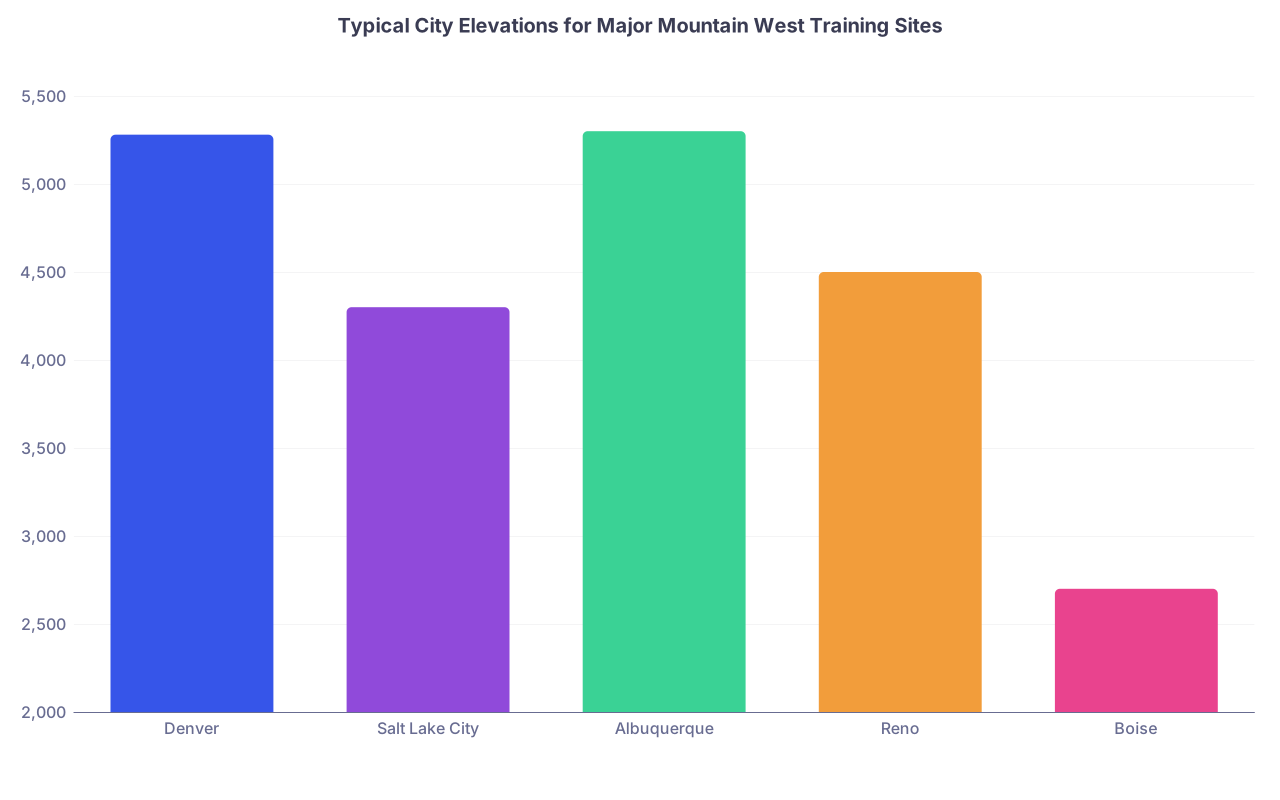
- High altitude for major population centers (Denver, Salt Lake City, Albuquerque, Reno).
- Huge catchment areas with low population density.
- Severe weather, rugged terrain, and real transport delays.
- A small number of tertiary / quaternary centers supporting vast rural networks.
So when you see “University of Colorado,” “University of Utah,” “UNM,” “UNR,” “Montana Family Medicine,” you are not just comparing logos. You are comparing:
- How far the nearest neurosurgeon is.
- How many helicopters your ED actually gets.
- How much of your “ICU experience” is stabilizing and shipping versus definitively managing.
| Program Type | Example Region | Altitude (approx) | Role in Network |
|---|---|---|---|
| Big Tertiary Academic | Denver, CO | 5,200 ft | Regional referral hub |
| State Academic + Rural Outreach | Salt Lake City, UT | 4,300 ft | Multistate catchment |
| Safety Net / County Style | Albuquerque, NM | 5,300 ft | High acuity, limited subspecialties |
| Tertiary in Smaller Metro | Reno, NV | 4,500 ft | Mix of local and regional referrals |
| Rural Training Track | Eastern MT / WY | 3,000–4,000 ft | First-line rural care, heavy transfers |
You will feel all three pillars in the title—altitude, transfers, resource limits—from day one. They warp case mix, workflow, call, and even your personal health.
2. Altitude: Not Just “You’ll Get Used to It”
Most MS4s underestimate altitude. They think it is just “a bit winded on hikes.” Then they move from sea level to 5,000+ feet, start 80-hour weeks, and wonder why they feel wrecked for the first month.
2.1 What altitude does to you as a resident
At 5,000–6,000 feet (Denver, SLC, Albuquerque):
- Mild baseline hypoxia for sea-level natives.
- Resting HR up. Sleep quality down.
- Headaches, lightheadedness, “brain fog” for the first 1–3 weeks.
- Exercise tolerance tanks at first.
Now layer this on top of:
- Swing shifts and nights.
- Poor nutrition.
- Dehydration in bone-dry air.
- 28-hour calls with no consistent sleep.
I have watched very fit interns from Boston and Houston absolutely wiped in their first month in Denver or SLC. They are not deconditioned; they are under-oxygenated and dehydrated.
You need to think of altitude acclimatization as part of your onboarding.
Practical takeaways:
- If possible, arrive 1–2 weeks early. Give your body time.
- Push fluids shamelessly. Humidity is low year-round; you are losing water faster than you think.
- Be conservative early with caffeine and alcohol. They both make altitude headaches and sleep worse.
- Re-think your commute. A 30-minute bike ride uphill at 5,300 ft after a 26-hour call will break you.
2.2 What altitude does to your patients
Here is where it gets clinically interesting. The altitude signal is all over your wards and ED, especially at programs like:
- University of Colorado (Denver, Aurora)
- University of Utah (SLC)
- UNM (Albuquerque)
- Denver Health / VA systems at altitude
Patterns you will see more often and more severely:
- COPD + OSA + obesity at 5,000 ft → chronic hypoxia that looks “normal” on the floor but would be abnormal at sea level.
- HFpEF / HFrEF patients who decompensate with very mild exertion.
- Pulmonary hypertension and cor pulmonale not as rare zebras, but as routine pathology.
- High-altitude pulmonary edema (HAPE) and high-altitude cerebral edema (HACE) from tourists and skiers in places like Summit County, Tahoe, Jackson.
Managing oxygen targets becomes more nuanced. Patients may walk around at 88–90% with no distress, and the hospital’s “normal” ranges adapt to that. You will have to unlearn some reflexes from low-altitude training.
That said, altitude is not an excuse to tolerate hypoxia. You just learn to interpret:
- Baseline home SpO₂.
- Longitudinal trends over admission.
- The difference between “altitude-adjusted normal” and “this is early decompensation.”
For ED and ICU residents, ventilator management in chronic CO₂ retainers at altitude becomes a genuine skill. You will see more of them.
| Category | Value |
|---|---|
| Denver | 5280 |
| Salt Lake City | 4300 |
| Albuquerque | 5300 |
| Reno | 4500 |
| Boise | 2700 |
2.3 Clinics and chronic disease at altitude
Longitudinal care is different too:
- Diabetics with limited access to endocrine specialists.
- COPD and ILD patients living in remote high-altitude towns with no RT support.
- Sickle cell patients traveling to altitude—very rare but memorable.
You will adjust your anticipatory guidance. You will talk about home oxygen, CPAP adherence, and altitude travel way more than your peers in, say, Chicago.
3. Transfers: You Are Practicing Hub-and-Spoke Medicine
Mountain West healthcare is basically a hub-and-spoke model. A few big centers; huge radius; many small outposts. Transfers are the bloodstream.
3.1 The transfer ecosystem you will live in
Here is the rough structure:
- Primary spokes: Critical access hospitals with minimal imaging, very limited labs, and maybe one general surgeon or none.
- Secondary spokes: Small regional hospitals with basic ICU capability, general surgery, ortho, maybe limited cardiology.
- Hubs: University or large regional centers where you match. They carry trauma, neurosurgery, advanced cardiology, ECMO, transplant.
Examples of hubs:
- University of Colorado / Denver Health
- University of Utah / Intermountain
- UNM in Albuquerque
- University of Nevada Reno for parts of northern Nevada
- University of Arizona – for some high-country AZ patients, but many still go to Phoenix/Tucson
As a resident at a hub, you will be on the receiving end of a constant transfer stream. You will do:
- ICU and medicine admission triage overnight: “We have a 68-year-old with GI bleed in Durango; Hgb 5.2, on pressors, no GI coverage.”
- Trauma alerts from 2–4 hours away by ground or air.
- Neonatal transfers from hospitals with no NICU.
- Neuro emergencies (SAH, large strokes) coming in from EDs that do not have neurosurgery or even 24/7 CT.
At some programs, you will also staff or at least hear the transfer center calls. It changes how you think about “ideal” versus “possible” care.
3.2 The delays are not theoretical
In New England, “transfer” often means a 45-minute ambulance ride to the academic center. In the Mountain West, it can mean:
- 3–5 hours by ground over ice.
- Flight grounded by a sudden snowstorm, high winds, or smoke from wildfires.
- A single aircraft covering half the state, currently busy on another run.
So you will see:
- SAH patients arriving 10–16 hours after worst headache of life.
- Bowel ischemia already necrotic.
- STEMIs thrombolysed at a rural hospital because cath is 6 hours away.
- Trauma patients partially stabilized, with limited imaging done, then arriving sicker than the paper handoff suggests.
That constant time-lag shapes your clinical mindset. You become very focused on:
- Prioritization: What must be done now in the spoke versus what can wait for the hub.
- Recognizing futility earlier. Families have driven 6 hours; they expect miracles. You will sometimes be the one saying there are none.
3.3 If you train at the spoke: rural tracks and small regional residencies
Not everyone will be at the hub. Some of you will match to:
- Rural training tracks linked to bigger universities.
- Standalone community programs in places like Billings, Casper, Twin Falls.
Your transfer experience then looks different. You are the one:
- On the phone with the accepting facility, selling the case.
- Stabilizing with limited respiratory therapy, no in-house ID, no IR.
- Figuring out what to do when the nearest trauma surgeon is 3 hours away and the patient is unstable now.
You will learn to use telemedicine aggressively when it exists. Stroke neurology, ICU teleintensivists, tele-psych—Mountain West systems actually pushed this earlier and harder than many coastal regions because there was no alternative.

| Step | Description |
|---|---|
| Step 1 | Patient in Frontier Clinic |
| Step 2 | Critical Access Hospital |
| Step 3 | Local Management and Discharge |
| Step 4 | Regional Hospital |
| Step 5 | Admit to Regional Hospital |
| Step 6 | Academic Hub ICU |
| Step 7 | Needs Subspecialist Care |
| Step 8 | Higher Level Needed |
If you want genuine broad-spectrum competency and comfort practicing without a specialist in the next room, these environments will give it to you fast.
4. Resource Limits: The Quiet Force Behind Everything
You will notice fast: this is not Boston. It is not LA. It is not Houston.
The Mountain West has:
- Fewer physicians per capita.
- Fewer subspecialists.
- Fewer residency positions relative to population needs.
- Lower hospital margins in many markets, especially safety-net and rural facilities.
Which translates into very specific daily realities.
4.1 Subspecialty access is not guaranteed
Common scenario on call:
- You are the medicine senior.
- The ED has a decompensating ILD patient.
- There is one on-call pulmonologist covering two hospitals, currently bronching a different ICU patient.
- Estimated time to bedside: 3–4 hours.
Result: you make more initial decisions yourself. You may talk to the pulmonologist by phone, but you are not “just paging consults” and waiting passively.
Same thing for:
- GI in small regional hospitals.
- Neurology in off-hours.
- Interventional radiology at 3 am.
- ENT / OMFS for airway issues.
At big hubs, you will usually have coverage—but they are stretched. At smaller sites, they simply do not exist in-house. You learn to:
- Do more bedside procedures (lines, taps, chest tubes, emergent airways).
- Think more carefully before ordering exotic imaging that needs a subspecialist to interpret or act on.
- Accept that a “gold standard” intervention may not be available tonight, or at all.
4.2 Imaging, labs, and beds are finite in a way many students have never seen
You might be used to:
- Stat CT any time.
- MRI within 24 hours, tops.
- Multiple ICU beds opening up each day.
In the Mountain West, especially in winter surges or wildfire seasons:
- CT may be backlogged, and the scanner might be down at your spoke.
- MRI might be only on certain days; overnight neuro MRI is fantasy outside hubs.
- ICU is perpetually full. Boarders in ED for days. Step-down is a parking lot.
So you train your brain differently:
- Which imaging actually changes management today?
- Which labs are necessary vs medicolegal decoration?
- How do you manage ICU-level patients on the floor for 6–12 hours waiting on a bed?
If you want to develop genuine triage judgment, this environment is unforgiving but effective.
4.3 Workforce and burnout: your reality, not a headline
Shortage of nurses, RTs, techs, social workers is not an abstract policy problem. It is you and your co-intern picking up slack.
Common realities:
- You are placing more IVs, drawing more labs, sometimes transporting patients yourself at 2 am.
- Discharge planning is slower because social work and case management are thinly staffed.
- Transfers to SNFs or LTACHs stall because there are fewer of them and they are full.
You will also see more locums attendings, especially in:
- Hospitalist medicine.
- Emergency medicine.
- Some surgical subspecialties.
This can be good or bad. Good for exposure to varied practice styles, bad for continuity and mentorship.
These hospitals rely on residents heavily. Expect substantial responsibility starting early PGY-2 at many of these programs—sooner at some.
5. Training Quality: What You Actually Gain (and What You Give Up)
Let me be blunt: if you are chasing a hyper-subspecialized niche with a guarantee of certain fellowships, Mountain West is uneven. But if you want to be a capable, broadly competent physician who can function almost anywhere, these residencies are underrated.
5.1 The upside: autonomy and breadth
You will:
- Manage very sick, very complex patients—often with late presentations.
- Learn to stabilize in resource-limited settings before definitive care is available.
- Perform procedures yourself instead of watching a fellow.
- See a broad case mix: trauma from outdoor sports, occupational injuries, ranching accidents, rural pathology, plus bread-and-butter medicine.
Example: An IM resident at UNM or Utah is far more likely to put in central lines, do emergent paracenteses, and manage sepsis aggressively on their own than a counterpart at an East Coast program where fellows sit between them and the decision.
Surgical residents in Denver, SLC, Reno, or Albuquerque handle plenty of real operative volume—with the caveat that some ultra-esoteric procedures go elsewhere or to niche centers.
5.2 The downside: ultra-high-end niche exposure may be limited
If your goal is:
- Ped cardiothoracic surgery.
- NIH-level basic science research in a micro-field.
- A narrow oncologic subspecialty with heavy lab emphasis.
Then you need to actually inspect what each Mountain West program offers:
- Does it have transplant?
- Does it have a dedicated cancer center with all subspecialties?
- Are there real NIH-funded labs in your area of interest, or is the research mostly QI / clinical?
Some Mountain West hubs are strong here—Colorado and Utah especially in certain fields. Others are more clinically focused.
If you are thinking about future fellowship:
- Cards, GI, pulm/crit, heme/onc from these programs? Very feasible.
- Elite derm, ENT, plastics, or CT from a small regional program with little research? Much harder.
You are not doomed by geography, but you are constrained by the density of mentors and opportunities.
6. Transfers and Mobility: Can You Move Once You Are There?
Now to the “transfers” part that applicants quietly obsess about: residency mobility.
6.1 Switching programs within the Mountain West
Residents sometimes want to move:
- From small community/rural to larger academic center.
- From one state to another for partner/family/job reasons.
Reality:
- Transfers are rare but possible.
- They tend to happen for very specific reasons: spouse relocation, program closure / serious instability, or sometimes a very clear academic fit issue.
- Moving from small to big is easier than big to small; the large hubs sometimes pick up community residents who have proven themselves.
But do not plan your match strategy on “I will just transfer later.” That is fantasy. Assume you will be there for the full program.
6.2 Out-of-region fellowships and jobs after Mountain West training
Here is the good news: Graduates from strong Mountain West programs do perfectly fine in national fellowship matches when they have:
- Strong letters from known faculty.
- Solid research or QI work.
- Clear narrative—“I trained in a resource-limited setting, here is what I learned, here is why I now want to specialize.”
Programs in the Northeast and West Coast understand that Mountain West residents tend to be gritty and autonomous. That reputation helps.
Job-wise, if you train in the Mountain West and then want to work:
- In the region: trivial. You are gold. They need you.
- On the coasts: quite doable for most core specialties, especially if you complete fellowship at a well-known institution.
The only group that struggles sometimes:
- Graduates of very small, newly accredited community programs with minimal national footprint and weak mentorship toward fellowship. They may need an extra research year or networking to break into top-tier fellowships.
7. Lifestyle, Politics, and the Non-Clinical Reality
You need to think about more than mountains and skiing.
7.1 Cost of living and housing
Compared with New York or San Francisco, Mountain West is “cheap.” That narrative is dated.
Denver, Salt Lake, and increasingly Boise and Reno have seen housing costs explode.
- You will still pay less rent than in SF or Manhattan.
- But you will not be living in a spacious mountain chalet 10 minutes from work on a PGY-1 salary.
Smaller cities and rural areas remain more affordable—but then you may have less access to:
- Partners’ job markets.
- Non-outdoors hobbies, cultural life, or diversity that some trainees want.
7.2 Culture and politics
The Mountain West is politically and culturally heterogeneous:
- Colorado and New Mexico: more liberal-leaning centers, especially in cities.
- Utah and Idaho: more conservative, heavily influenced by local religious culture.
- Wyoming and Montana: rural, sparse, often strongly conservative.
This affects:
- Reproductive health training. Some states have strict abortion laws; others are training hubs for complex OB care.
- LGBTQ+ trainees’ experience. Some cities are very welcoming; some small towns can be isolating.
- Gun culture and trauma patterns (you will see firearms injuries; you will also see ranching and ATV trauma).
Be honest with yourself. If you will be miserable socially or politically, that matters.
7.3 Outdoors and mental health
The upside people rave about is real:
- Easy access to hiking, skiing, biking, climbing, river sports.
- Open space. Real darkness at night. Actual stars.
For many residents, this is their coping mechanism. A half-day post-call ski. A Sunday long run in the foothills. It offsets some of the burnout risk baked into resource-limited environments.
Just remember the altitude and fatigue. Do not be the intern who tries a 12-mile high-altitude hike post-call and ends up a trauma admit.
8. What Kind of Resident Actually Thrives Here?
Let me be specific. Mountain West residencies are ideal for you if you:
- Want autonomy and are comfortable making decisions without ten consultants in the room.
- Care about underserved and rural populations.
- Are willing to accept resource constraints as a training feature, not a bug.
- Can live with geographic isolation and extreme weather.
- Like or can at least tolerate outdoor-focused culture.
They are less ideal if you:
- Need dense subspecialty research infrastructure in a very narrow field as an MS4 already.
- Hate cold, dry weather and long winters.
- Are deeply averse to driving, snow, or fire season.
- Want to be in a major coastal city at all costs.
9. How to Vet Mountain West Programs Specifically
Do not just read their glossy websites. Ask targeted questions during interviews and second looks.
9.1 Altitude and case mix
- What is your ICU volume and typical pathology?
- How much chronic pulmonary and cardiac disease at baseline?
- Do you see high-altitude emergencies (HAPE, HACE) and how often?
- For ED/ICU: What are your typical SpO₂ targets; do you have altitude-adjusted norms?
9.2 Transfers and regional role
- What percentage of your admissions are transfers from outside hospitals?
- Do residents participate in transfer triage or calls?
- What is your service’s actual role: local care vs regional referral vs national niche center?
- For rural tracks: How far is your typical transfer and how often are flights canceled?
9.3 Resource limitations and autonomy
- How often are you boarding ICU patients in the ED or on the floor?
- What in-house subspecialties do you lack or have limited coverage for?
- What procedures are resident-performed vs fellow-performed?
- Have you had periods of critical staffing shortages for nursing or RT, and how did that affect residents?
You are not being “difficult” asking these. You are assessing the training reality.
Key Takeaways
- Mountain West residencies are defined by three hard realities: altitude physiology, hub-and-spoke transfers over huge distances, and genuine resource limits that force you to think and act differently.
- Training here builds autonomy, procedural skill, and triage judgment fast—but may offer less density of ultra-niche subspecialty and laboratory research opportunities compared with coastal giants.
- You will thrive if you want real responsibility, can tolerate environmental and cultural extremes, and see resource constraint as a training advantage rather than a defect.