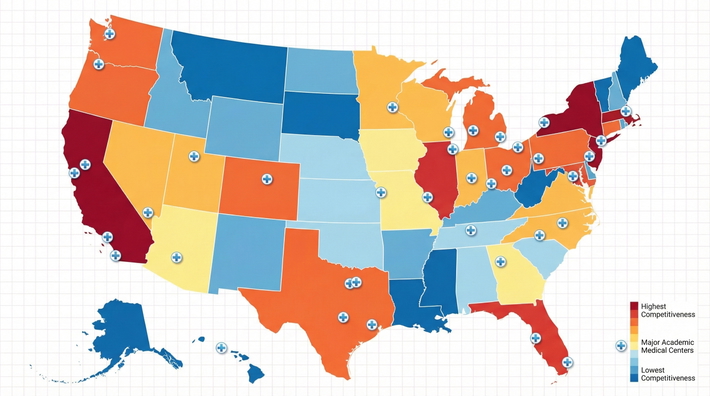
Border-state residency is not just “the same medicine but hotter weather.”
It is structurally different work. Different patients, different systems, different stressors.
If you match in places like El Paso, Tucson, San Diego, Laredo, Brownsville, McAllen, Nogales, or the Rio Grande Valley, you are not just signing up for more Spanish. You are stepping into a cross-border healthcare ecosystem with unique legal, logistical, and cultural landmines.
Let me break this down specifically: immigration status, language, and call change the texture of your training in very real ways.
1. The Border Reality: What Changes When You Train There

| Step | Description |
|---|---|
| Step 1 | Border Residency |
| Step 2 | High uninsured |
| Step 3 | Cross border care |
| Step 4 | Immigration involvement |
| Step 5 | Heavy language needs |
| Step 6 | Limited follow up |
| Step 7 | Fragmented records |
| Step 8 | Legal and ethical tension |
| Step 9 | Interpreter dependence |
If you trained in a typical midwestern program and then rotate at a border institution, a few things slap you in the face immediately:
- The percentage of uninsured and underinsured is massive.
- Cross-border care is normal, not rare.
- Immigration enforcement, consulates, and detention facilities intersect with your patient list.
- Language discordance is constant, not an occasional nuisance.
Patient mix and acuity patterns
Border hospitals see a weirdly bimodal pattern you need to be ready for:
Chronic, under-treated disease that has been brewing for years without consistent care:
- Diabetes with A1c of 12–14, peripheral vascular disease, and end-stage renal disease.
- Rheumatic heart disease that should have been fixed a decade ago.
- Advanced cirrhosis in people who never had a PCP, just sporadic urgent care in two countries.
Acute trauma and border-specific emergencies:
- Falls from the border wall with high-energy polytrauma but bizarre injury patterns (feet/ankle bursts, calcaneal fractures, lumbar spine).
- Hyperthermia / dehydration from desert crossings.
- Vehicle rollovers and high-speed chases near checkpoints.
- Injuries from law enforcement or crowd-control situations.
Day to day, that means more complexity, more systems-level dysfunction, and more “we have to improvise follow-up” conversations than in many inland programs.
2. Immigration Nuances: Status, Custody, and Clinical Boundaries

Immigration status is not an abstract social determinant on a PowerPoint slide. It is in your HPI, your disposition planning, your code status discussions. Every day.
Patients in custody: CBP, ICE, local law enforcement
In border regions, you will routinely see:
- People detained by U.S. Customs and Border Protection (CBP) after crossing.
- Individuals in Immigration and Customs Enforcement (ICE) custody.
- Patients shackled, with corrections officers or border agents at bedside.
You will have to reconcile three realities:
- The patient is your patient. Not “CBP’s detainee” first.
- The officers believe they are in charge of the situation.
- Hospital administration is terrified of liability and political blowback.
You need to be crystal clear on:
- Who can be present during exams (often not officers, especially for sensitive exams).
- Who consents for procedures.
- When you can and must say, “Please step out; this is confidential.”
Common real-world issues I have seen:
- Agents trying to listen in on every conversation and answer for the patient.
- Requests to clear someone medically for prolonged detention in clearly unsafe conditions.
- Demands to stop evaluations early because “we need to transport now.”
You need a mental script for these. Something like:
“I hear your concern about timing. From the medical side, I am not comfortable clearing this patient for transfer until we have completed [CT / labs / observation period]. If you’d like, we can bring in risk management or the house supervisor to discuss.”
Firm. Professional. Not apologetic.
Documentation and legal landmines
Your note suddenly has policy implications. Border programs quickly learn that wording matters when your chart may be subpoenaed or scrutinized.
A few practical points:
- Document clinical facts, not speculation about immigration details.
- Write: “Patient arrived in CBP custody with bilateral ankle pain after reported fall from wall.”
- Do not write: “Illegal immigrant fell while escaping border patrol.”
- Be careful about labeling “noncompliant” in a setting where follow-up was structurally impossible (no insurance, no transport, no legal right to drive).
- For detainees, document clearly:
- Custody status.
- Who received discharge instructions (patient + officers).
- Explicit medical limitations (e.g., “Patient must remain non–weight-bearing on right leg for 6 weeks; requires access to crutches or wheelchair”).
You are not writing for yourself anymore. You’re writing for lawyers, auditors, and sometimes reporters 18 months from now.
Confidentiality and fear of deportation
Another predictable pattern: patients are afraid to answer questions honestly because they think you will report them.
You will hear lines like:
- “No quiero problemas con migración.”
- “No quiero que me manden de regreso.”
- Or an immediate silence when you ask anything that sounds administrative.
Make it standard to say, early and clearly, in their language:
“Soy su doctor. No trabajo para migración. Lo que hablamos aquí es confidencial, como con un abogado, excepto si hay peligro grave para usted o para otros.”
Translated: You are their physician, not immigration enforcement.
Pro tip: You only gain that trust if you say it before they hesitate. Not after.
3. Language: Beyond “You Should Learn Medical Spanish”
| Category | Value |
|---|---|
| Non-border IM | 25 |
| Border IM | 80 |
| Non-border EM | 30 |
| Border EM | 90 |
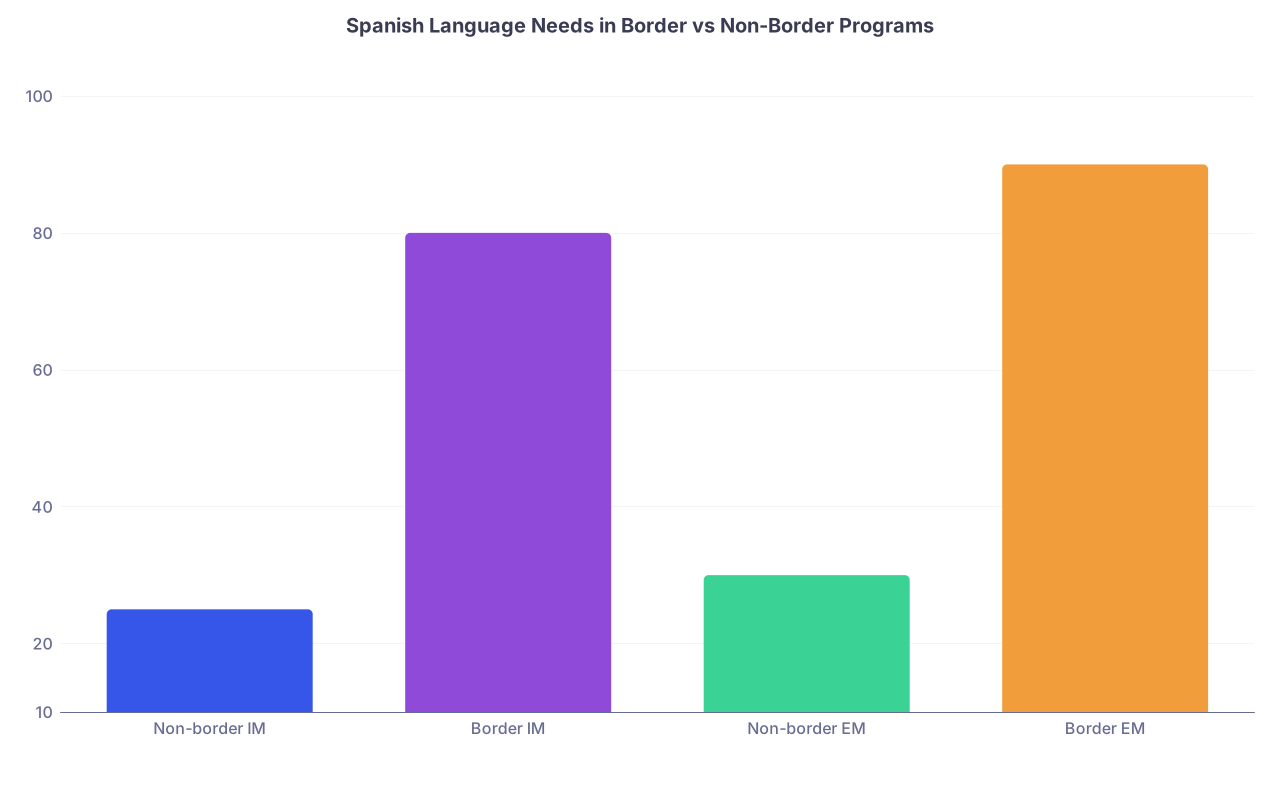
Everybody likes to say “Spanish is helpful.” In border programs, that is embarrassingly understated. For some services, Spanish is basically a core competency. Or you rely on interpreters every hour of your workday.
Realistic language percentages
Typical ranges you will see in border-state hospitals near the line:
- Inpatient general medicine: 50–80% primarily Spanish-speaking.
- OB/Gyn L&D triage at night: often 70–90% Spanish-dominant.
- ED: depends on catchment, but 40–70% is not unusual.
- Outpatient community clinics: often majority Spanish preferred.
If you come in with zero functional Spanish, you will survive. But your cognitive load will be higher, your efficiency lower, and your empathy will feel filtered. Every. Single. Encounter.
Interpreters: Phone, video, in-person
You will use interpreters constantly. That is fine. But you must use them correctly.
Three patterns that separate the good residents from the mediocre:
You do not let the nurse, MA, or random bilingual tech “interpret on the side” for serious conversations. For anything with risk:
- Code status
- Informed consent for procedure
- Discharge instructions for high-risk meds
- Reporting intimate partner violence or sexual assault
You use a certified interpreter. Period.
You own the pacing. The rookie mistake:
- You talk for 45 seconds.
- The interpreter gives a 5-second summary.
- Nuance is gone.
Instead, speak in short segments. Pause. Let interpretation happen. Look at the patient, not the phone.
You still learn core phrases. Even if your grammar is awful, opening with:
- “¿Dónde le duele más?”
- “Voy a revisarle el corazón y los pulmones.”
- “Ahorita regresamos para platicar del plan.”
…signals respect. The interpreter does the heavy lifting, but you anchor rapport.
If you want to actually improve your Spanish during residency
Structured improvement is possible, but only if you stop relying on “osmosis” and get deliberate.
What works:
- Dedicated 20–30 minutes a day with spaced repetition (Anki decks for medical Spanish, e.g., “Spanish for Health Professions” or your own phrase decks).
- One language partner (nurse, tech, or fellow resident) who will correct you in real time during slow moments on the floor.
- Pick one domain per week:
- Week 1: Pain and ROS phrases.
- Week 2: Explaining imaging and labs.
- Week 3: Discharge instructions, meds, and follow-up.
- Week 4: End-of-life and bad news language.
What does not work:
- Random Duolingo in the call room between pages.
- Hoping your ear will “just adapt” over years (it partially will, but you will fossilize errors and bad habits).
Navigating multiple languages beyond Spanish
Border does not always mean Spanish-only. There are regions with:
- Indigenous languages from Mexico and Central America (Mixtec, Nahuatl, K’iche’).
- Refugees from non–Latin American countries (Middle East, Africa, Asia) settled in cheaper border regions.
You will eventually meet the triad from hell:
- Patient speaks mostly an indigenous language.
- Family speaks some Spanish.
- You speak English with a phone interpreter toggling Spanish and English.
Clinical tip: when you see the confusion pileup, slow down. Use visuals. Demonstrate with pill bottles, drawings, printed pictures. Otherwise you are just translating misunderstanding three times.
4. Call and Workload in Border Programs: What Actually Feels Different
| Category | Non-border IM | Border IM |
|---|---|---|
| 20:00 | 4 | 6 |
| 22:00 | 6 | 9 |
| 00:00 | 5 | 8 |
| 02:00 | 3 | 7 |
| 04:00 | 2 | 6 |
| 06:00 | 3 | 5 |
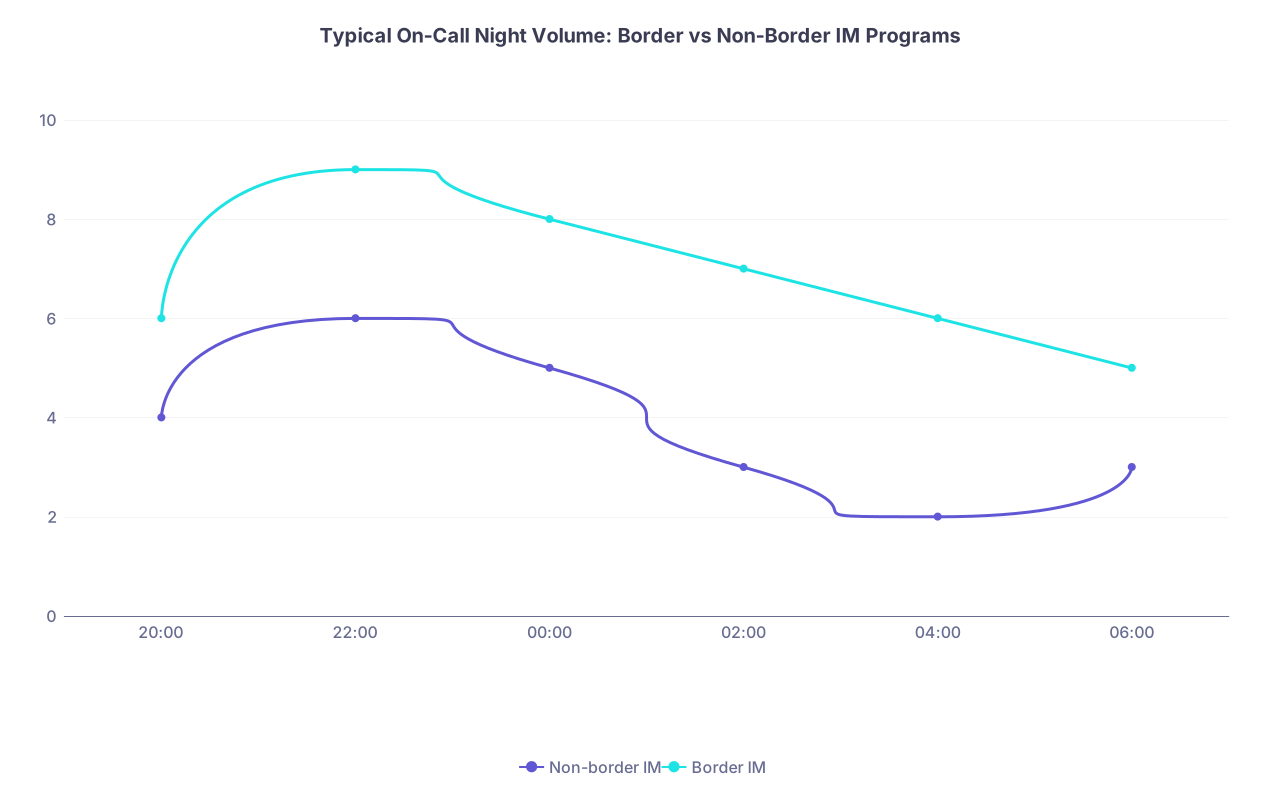
Let’s talk call. This is where the border really shows up in your lifestyle, not just your patient panels.
ED volume and “border surge” nights
In many border cities, volumes spike when:
- Weather is tolerable for crossings (cooler nights in desert).
- Policy shifts happen (change in Title 42, new enforcement initiative).
- Caravans or group migration events hit the news.
You are not following CNN, but you will feel it on your pager.
Patterns you will notice:
- Sudden waves of similar cases:
- Multiple patients with rhabdomyolysis, AKI, heat injury.
- Groups brought in by CBP after a single event (rollover, wall fall, mass dehydration).
- ICD chaos:
- Mechanism is convoluted: walked 3 days, then fell from 20-foot structure, then vehicle crash.
- Half the story is in Spanish slang and the other half in incomplete officer reports.
On a brutal call night in a border IM or EM service, you may be simultaneously managing:
- DKA with no prior diabetes diagnosis and no prior labs anywhere in the U.S.
- GI bleed in someone with cirrhosis who lives primarily in Mexico and crossed just for care.
- Trauma consult for a jump/fall from the border structure.
- Rhabdomyolysis and hyperkalemia from desert exposure.
All with interpreters. All with unclear payers. All with dispo nightmares.
Detention centers and off-site calls
Some programs have formal or informal relationships with:
- Detention facilities.
- Private prisons.
- Short-term CBP holding areas.
You may be:
- Doing telehealth or in-person consults for these facilities.
- Accepting transfers back-and-forth when they decide a case is “too sick” or “cleared.”
The nuance:
You have to maintain the same standard of care and documentation even when you know, bluntly, that the environment the patient is going back to is medically inadequate.
On call, that often translates to more:
- Admissions “just to be safe” when you are not confident they will have appropriate monitoring.
- Battles with external providers who want quick clearance without real evaluation.
“Frequent cross-border flyers” and fragmented care
You will have patients who:
- Live in Mexico.
- Work part-time in the U.S. or have relatives who do.
- Bounce between health systems based on:
- Which country’s pharmacy is cheaper this month.
- Where they have a ride.
- Which side of the border is currently less dangerous politically.
On call, that means:
- More “no prior records in our system” even for people with advanced conditions.
- Dependence on family-carried records, phone photos of labs, handwritten medication lists in Spanish.
You cannot fix the structural fragmentation. But you can:
- Be explicit in your discharge instructions, anticipating they will hand them to a doctor in another country.
- Print medication lists with generic names, not just U.S. brand names.
- Avoid assuming “no prior workup” because you do not see it on Epic.
5. Ethical Tensions: Deportation, Access, and Your Role

If you train on the border and you never feel ethically uncomfortable, you are not paying attention.
“Medically cleared for deportation”
You will be asked, explicitly or implicitly, to “medically clear” people for:
- Deportation flights or bus transfers.
- Long-distance ground transport under custody.
- Return to detention centers.
Two problems:
- The question is often framed vaguely: “Is he good to go?”
- The conditions on the other side (whether detention or home country) are unknown or clearly inadequate.
How to handle this like a physician, not a bureaucrat:
- Define in your mind what you are certifying:
- “At this time, patient is hemodynamically stable, not in acute distress, and no emergent intervention is required.”
- Document explicitly:
- “Patient is medically stable for transport with the following requirements: [wheelchair, O2, medications, wound care].”
- Avoid language like:
- “Fit for deportation” or “cleared for removal.” That is not a medical term; it is a legal/political one.
You are not the deportation officer. Your role is to define clinical stability and limitations, not to legitimize policy decisions.
Deferred care and moral injury
Repeated scenario:
- Young adult with a fixable issue (e.g., cholecystectomy, hernia repair, valve surgery).
- No insurance. Unstable housing. No realistic way to pay for elective surgery.
- You treat the acute flare. You know it will be back.
Border hospitals often act as safety nets, but the economic and immigration policies create dead zones where primary or elective care is practically inaccessible.
This produces textbook moral injury:
- You know what the patient needs.
- The system will not provide it.
- You discharge them with a piece of paper and hope they can find a way.
You are not going to fix U.S. immigration or cross-border health policy during residency. But you can:
- Stop labeling people as “noncompliant” when the barrier is structural.
- Work closely with social workers who know the cross-border resources (charity clinics, Mexican-side specialists, consulate-linked programs).
- Advocate within your institution for realistic follow-up arrangements (e.g., flexible charity care, cross-border tele-visits where legal).
6. Choosing and Succeeding in a Border-State Residency
| Factor | Border Programs | Non-Border Programs |
|---|---|---|
| Spanish usage | Daily, often majority of patients | Variable, often minority of patients |
| Immigration-custody cases | Common | Rare to occasional |
| Trauma patterns | Falls from wall, desert exposure, CBP | More local traffic, interpersonal |
| Uninsured rate | High | Moderate (depending on region) |
| Call-night complexity | High systems complexity, fragmented care | More straightforward continuity |
Border residencies are not for everyone. They are demanding, politically charged, and linguistically intense. But they are exceptional training grounds if you want to be clinically sharp and systems-aware.
Who tends to thrive
Residents who do well in these environments usually:
- Are comfortable with uncertainty and partial information.
- Actually enjoy using another language, even imperfectly.
- Have some tolerance for moral ambiguity and systemic injustice, without collapsing into cynicism.
- Want strong exposure to:
- Advanced presentations of common diseases.
- Trauma and acute care.
- Social medicine and structural determinants in real time.
If your ideal training environment is tidy continuity clinics with fully insured patients who bring organized medication lists and MyChart messages, you will be miserable.
If you want raw medicine with policy and humanity mashed together, the border will force you to grow quickly.
How to assess programs during interviews
Do not ask the generic “What’s your patient population like?” You will get fluff.
Instead, ask:
- “What proportion of your inpatient / ED patients are primarily Spanish-speaking?”
- “How often do you care for patients in CBP or ICE custody, and what support do residents have in those situations?”
- “How does your program handle cross-border follow-up care?”
- “Is there structured teaching about immigration law, detention medicine, and documentation for these patients?”
Listen carefully to how attendings and residents talk:
- Do they sound burnt out and hostile toward migrants?
- Or realistic but respectful: “It is hard. These patients have been through a lot. We try to do right by them within the constraints.”
The tone matters. A lot.
Protecting your own bandwidth
Because the cases are intense, burnout risk is real. A few specific habits help:
- Debrief ethically challenging cases with trusted peers or mentors, not just joking about them in the workroom.
- Learn the boundaries of your role. You are not immigration counsel. You are not a social worker. You collaborate; you do not try to do everything yourself.
- Build routines outside work that are not border-politics-saturated. Many residents end up living in neighborhoods or communities where every conversation is about policy. That gets draining fast.
7. Future of Medicine on the Border: Where This Is Going
| Period | Event |
|---|---|
| Past - 1990s | Charity care focus |
| Past - 2000s | Growing cross border volume |
| Present - 2010s | Detention health issues rise |
| Present - 2020s | Policy volatility and surges |
| Future - 2030s | Telehealth cross border growth |
| Future - 2030s | Integrated binational care pilots |
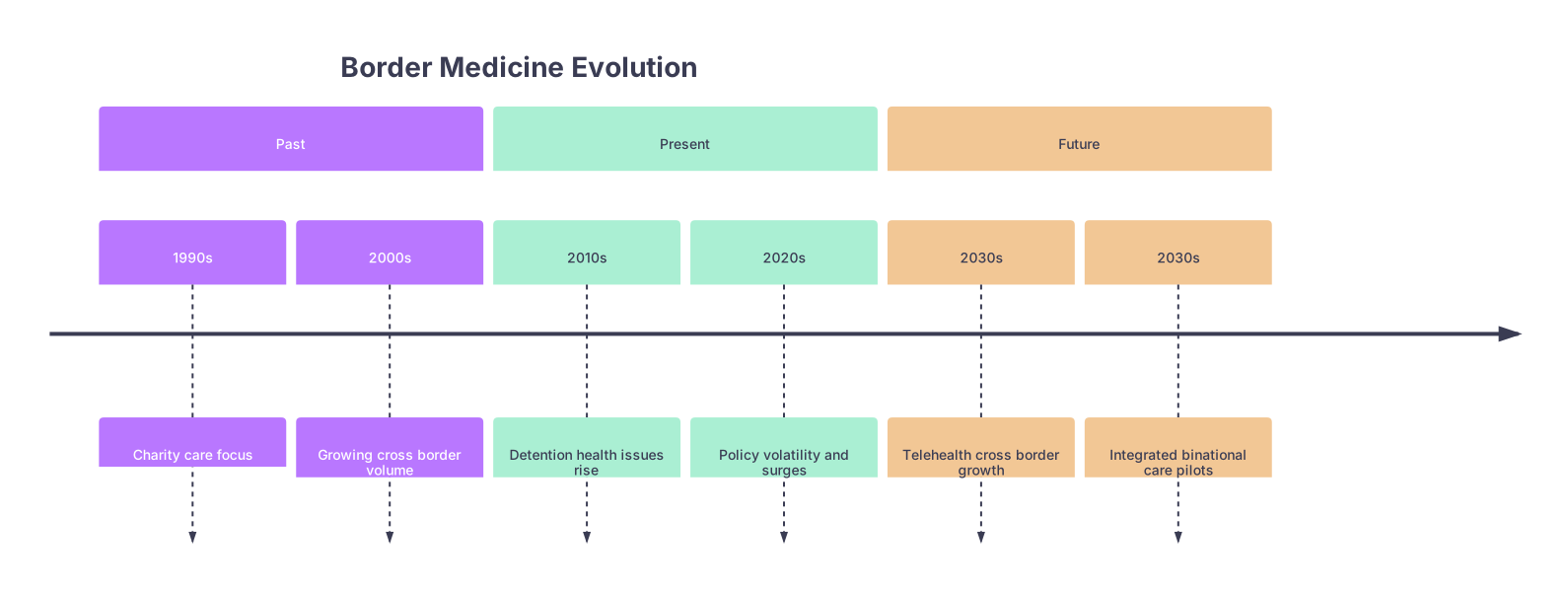
Border medicine is not going away. If anything, it is a preview of what more regions will experience as migration, climate, and politics intensify.
Trends I expect to define the next decade of border-state residencies:
- More telehealth with patients physically in another country, especially follow-up after U.S. hospitalizations.
- Increased formalization of detention medicine training, including electives in carceral health and human rights.
- Integration with binational public health efforts (e.g., coordinated TB, HIV, and maternal health programs across the border).
- Data-driven scrutiny:
- How many deaths, complications, or readmissions are tied to border policies or detention conditions?
- How often are “medically cleared” detainees rehospitalized soon after?
For you as a trainee, that means:
- More research opportunities in migrant health, cross-border care, and detention outcomes.
- More need to understand not just pathophysiology, but policy and law at a working level.
- And an uncomfortable but real truth: your notes, your decisions, and your attitude may influence future policy debates, because border medicine is political fuel.