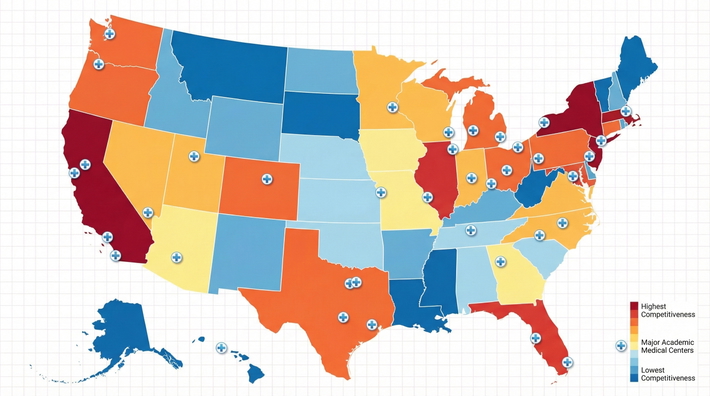
It’s late November. You’re staring at your ERAS spreadsheet and your interview map. There’s a weird pattern: 18 interviews, scattered across the Midwest—Michigan, Ohio, Wisconsin, Minnesota—but your personal statement is all about “my deep roots on the coasts” and “my long-term plan to return to California.”
You’re about to walk into a program director’s office in Cleveland and say you have a “strong geographic preference for the Midwest.”
If you handle that wrong, you’ve just thrown away an otherwise solid application.
Let’s walk through the most common red-flag mistakes people make with “geographic fit” in the Midwest, so you do not become the applicant everyone quietly crosses off at the rank meeting.
1. Treating the Entire Midwest Like One Interchangeable Blob
If you’re talking about “the Midwest” like it’s a single town, programs notice. And they do not like it.
The Midwest is not one vibe. It’s a dozen different ecosystems:
- Chicago vs Iowa City vs Duluth vs Detroit vs Omaha vs Madison vs Wichita
- Rust belt cities vs wealthy suburbs vs rural critical access hospitals
- Union-heavy industrial communities vs upscale college towns vs agriculture-based economies
Programs see this mistake constantly:
- Applicant: “I really love the Midwest culture.”
- PD (in their head): “You have never been here.”
Red flag behaviors:
- Saying the exact same “Midwest” line at every interview (and it shows).
- Not knowing basic facts about the city you’re interviewing in (e.g., talking about “big city life” in Rochester, MN).
- Confusing states or institutions (mixing up University of Minnesota and Mayo, or thinking Kansas City is in Kansas only).
- Acting surprised by winter. In Minnesota. In January.
You do not have to be a regional expert. But if you act like the region is one vague cornfield, you look unserious.
How to avoid this:
- Talk city- or state-specific, not “Midwest” generic:
- “I’m drawn to Minneapolis because…”
- “I went to undergrad in Wisconsin and really liked…”
- Name concrete things:
- Types of patients: Somali refugee population in MN, auto-industry families in MI, farming communities in IA.
- Health systems: Cleveland Clinic vs Henry Ford vs Froedtert vs Mayo.
- Know your basics before each interview:
- Size of the city
- Major hospitals / health systems
- Urban vs suburban vs rural feel
- Weather (yes, this matters—pretending winters don’t exist is childish)
Programs don’t need you to be from the Midwest. They do need to believe you understand where you’re applying and won’t bolt at the first snowstorm.
2. Faking “Midwest Ties” You Don’t Actually Have
This one gets people burned.
You’re told: “Programs in the Midwest really want geographic ties.”
You don’t have any. So you start stretching.
- “My great-uncle lived in Indiana for a few years.”
- “I flew through O’Hare once and loved Chicago.”
- “I watched Friday Night Lights so I know the culture.” (Yes, I’ve heard variants of this. It lands terribly.)
Here’s what happens: Programs do cross-check your story.
- They see your ERAS demographic info.
- They ask about your background in the interview.
- They hear you tell a completely different story to a resident in the pre-interview social.
And then you go in the “not credible” bucket.
Red flag phrases:
- “I have strong Midwest ties” when your entire life is West Coast + zero real examples.
- “I’ve always wanted to live in the Midwest” but you’ve never visited and can’t name a single realistic reason.
- “Family in the area” — and it turns out that’s a second cousin 6 hours away whom you’ve never met.
Programs are tired of being the backup plan for applicants who will leave at the first chance.
How to do it right if you truly have weak ties:
Be honest. You can still signal interest without lying.
You can say:
- “I don’t have deep geographic ties here, but I’m actively looking for programs in cities with X/Y/Z features, which this one has.”
- “My partner and I are most excited about training in a low cost-of-living city with strong academic resources; that’s why we’re focused on the Midwest.”
- “I’ve lived most of my life on the coast, but I want more exposure to rural and working-class patients. That’s what pulled me toward this region.”
Specific, believable, and not fake.
3. Ignoring the “Would You Actually Live Here?” Question
Geographic fit is not abstract. PDs are literally asking:
“If we match this person, will they be miserable and leave?”
They worry about:
- Withdrawal before starting
- Switching programs after PGY-1
- Chronic dissatisfaction → poor performance, bad culture
Think of it from their side. They look at your application:
- All life in LA/NYC/Miami
- Social media (yes, people see it) full of “could never live anywhere cold”
- Zero history of living outside major coastal cities
And then you claim you’d happily do residency in Fargo or Toledo or Peoria with no explanation.
That is a credibility problem.
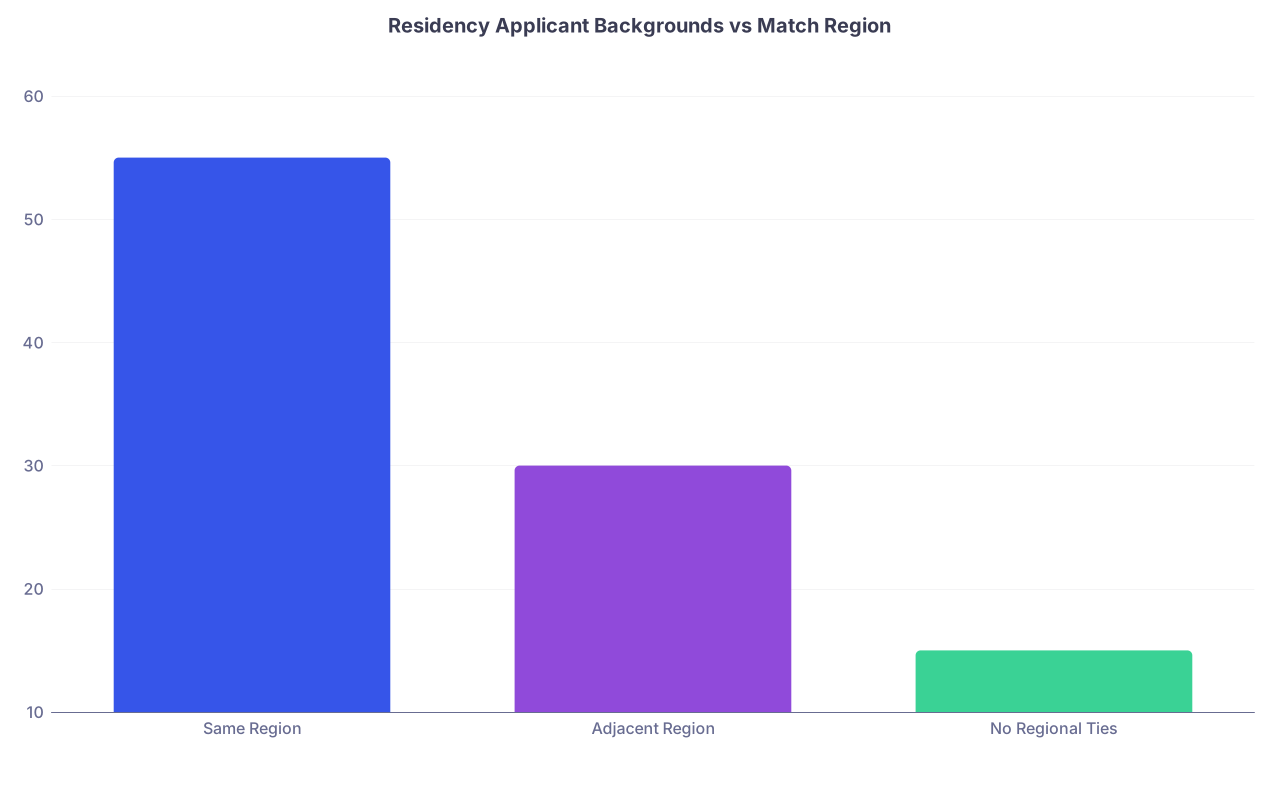
| Category | Value |
|---|---|
| Same Region | 55 |
| Adjacent Region | 30 |
| No Regional Ties | 15 |
Big mistake: Not having a real, thought-out answer to:
- “How do you feel about moving to a smaller city?”
- “You’ve lived in big coastal cities—what draws you to [Midwest city]?”
- “Have you spent any time in this part of the country?”
If you stumble, they assume you haven’t thought it through. And that you might hate it.
How to avoid the trap:
Before interview season, be brutally honest with yourself:
- Could you realistically handle:
- 5–6 months of real winter?
- Driving-based culture vs walkable dense city centers?
- Less nightlife / fewer “big city” distractions in some locations?
- Would your partner/spouse/family situation realistically tolerate this move?
Then build a truth-based narrative that explains why you still want it:
Examples:
- “My medical school was in a huge city; I realized I prefer a slower pace and easier access to outdoor activities. That’s a big reason I’m looking at the Midwest.”
- “Cost of living matters. I don’t want to be sharing a tiny apartment with three roommates during residency. Cities like this give me more breathing room.”
- “I’ve always wanted a training experience with more continuity in a stable community instead of a constantly transient patient population.”
If none of those are true for you? Stop applying there just because “Midwest = backup.” That attitude leaks out.
4. Using “Midwest” as Code for “Less Competitive Backup Zone”
Programs can smell this from a mile away.
There’s a quiet but common applicant strategy:
- Aim high on the coasts (“dream” academic programs in Boston/NYC/California).
- Spray the Midwest with a ton of applications as “safeties.”
- Put minimum effort into understanding the region or the programs.
- Use them mostly for interview practice and leverage.
That strategy backfires now. PDs are not naive. They talk.
Red flag signs you’re treating Midwest programs as backup:
- Your personal statement screams “I must live in [very specific coastal city]” with zero flexibility.
- Your “Why this program?” answer is vague and could fit anywhere in the country.
- You emphasize “big city, diverse nightlife, and major coastal access” as non-negotiables elsewhere, but pretend those don’t matter here.
- You ask residents questions like “So what do people do here?” in a condescending tone.
If a program even suspects they’re just a placeholder on your list, guess what? They’ll rank you accordingly—if at all.
What to do instead:
If you apply to the Midwest, treat those programs like deliberate choices, not consolation prizes.
That means:
- Research them thoroughly: unique training strengths, fellowships, hospital system quirks.
- Be able to name one or two Midwest-specific reasons this region works for you:
- Long-term plan to work in primary care or hospital medicine in a non-coastal setting
- Interest in underserved rural communities, agricultural health, or industrial injuries
- Desire for lower debt stress → lower cost-of-living city
You do not have to say, “I love the Midwest more than anything.” You do need to show that you are not insulted by the idea of training there.
5. Mishandling the “Where Do You Want to End Up Long-Term?” Question
This one kills people quietly.
You’re in an interview in Nebraska or Wisconsin. You get asked:
“Where do you see yourself practicing after residency?”
You answer:
“Oh definitely back in California near my family.”
You just signaled:
- Zero intention to stay in the region
- Limited buy-in to the local community
- That they’re just a stepping stone until you get where you really want to be
Midwest programs—especially community and smaller academic centers—care a lot about retention. Some of them are desperate for physicians who will actually stay.
| Your Answer Type | How Many PDs Interpret It |
|---|---|
| "Definitely back to the coasts" | Flight risk, low local interest |
| "Open, but maybe back to my home state" | Mild risk, maybe flexible |
| "Open, would love Midwest if it fits" | Genuine possibility to stay |
| "Plan to stay in this region if possible" | Strong retention potential |
| "Have no idea, honestly" | Neutral, depends on other signals |
How to answer without lying or sabotaging yourself:
Don’t say you’re committed to practicing in rural Iowa forever if you are absolutely not. But don’t make yourself sound like you’d never consider staying.
Better options:
- “I’m open, but I could absolutely see myself staying in the Midwest if I find the right position and community.”
- “I want strong training first. If I build good mentoring relationships and like the community, staying in this region is very much on the table.”
- “I don’t have a fixed city in mind. I care more about practice environment and patient population than geography, and this region offers a lot of what I’d like long-term.”
You’re allowed to be honest and strategic. Just don’t paint yourself into the “I’m leaving the second I graduate” corner.
6. Over- or Under-Playing Lifestyle Differences (Especially Weather and Culture)
Nothing screams “I didn’t think this through” like joking all interview day about:
- How you “might die in the snow”
- How you’re “not really a car person” in a city with no real public transit
- How “there’s not much to do here, right?”
These come across as:
- Disrespectful to the people who actually live there
- Unprepared for real life in that setting
- High-maintenance and disinterested
On the flip side, pretending everything is perfect and ignoring obvious lifestyle factors also looks fake.
Here’s the balance:
Acknowledge the difference without trashing it.
Examples that work:
- “Winters will be an adjustment for me—I’ve lived in the South my whole life—but I’ve talked to a lot of residents about how they manage and honestly the tradeoff in cost of living is worth it to me.”
- “I know this is a more car-dependent city than I’ve lived in before. I’ve factored that in, and I’m fine with that for these three to four years if it means I get robust clinical training.”
Where people screw it up:
- Saying they’re “totally fine” with something they clearly haven’t thought about (commute, weather, isolation), then contradicting themselves later.
- Making repeated jokes about how “there’s nothing here” while interviewing in places like Milwaukee, St. Louis, Cincinnati, which are… not tiny.
- Acting as if every Midwest city is the same politically, culturally, and demographically.
You don’t need to love snow or hunting or football. You just need to show you respect the community you might serve.
7. Not Aligning “Geographic Fit” With Program Type
Another subtle but costly mistake: ignoring how geography interacts with type of program.
In the Midwest, you’ll see:
- Huge tertiary centers: Mayo, Cleveland Clinic, University of Michigan, University of Wisconsin
- Mid-sized academic/community hybrids: Froedtert/MCW, OSU, University of Iowa, University of Kansas
- Community and rural programs that serve truly underserved populations
Your geographic story needs to match the kind of work they actually do.
Examples of mismatch:
- Telling a small rural program in Kansas you’re here because you “love the energy of big cities.”
- Telling a major quaternary referral center you’re “mostly interested in outpatient primary care in a tiny town” and never mention academia.
- Claiming passion for “urban underserved” and then only applying to suburban community programs in Ohio and Indiana.
Programs listen for that mismatch and see it as:
- Lack of insight
- Poor self-awareness
- Or, worst, “I’ll say anything you want to hear”
Fix it: anchor your geographic fit in the patient population and practice style.
For example:
Rural-heavy program in Iowa:
“I want to train where residents get real autonomy with rural and farming communities; I like the idea of being one of the core physicians that town relies on.”Big academic center in Minnesota:
“I’m drawn to a place where I’ll see rare, complex referrals alongside bread-and-butter pathology. Being in a regional referral center in the Midwest offers that mix.”Mid-sized rust-belt city in Ohio:
“I’m interested in caring for patients affected by economic transitions, industrial work, and chronic disease. This city’s patient population lines up with that.”
Tie place → patients → your training goals. That’s how you sound like someone who belongs there.
8. Sloppy, Generic, or Contradictory Messaging Across Applications
Programs read across your story:
- Personal statement
- Supplemental ERAS responses
- Geographic preferences (if you marked them)
- Interview answers
- What you say to current residents
If your story about “why the Midwest” changes every time, that’s a red flag.
Common contradictions:
- Supplemental: “Strong preference to stay in the Southeast.”
- Personal statement: “My long-term plan is to return to New York.”
- In Minnesota interview: “I’ve always wanted to end up in the Midwest.”
You think they won’t notice. They do.
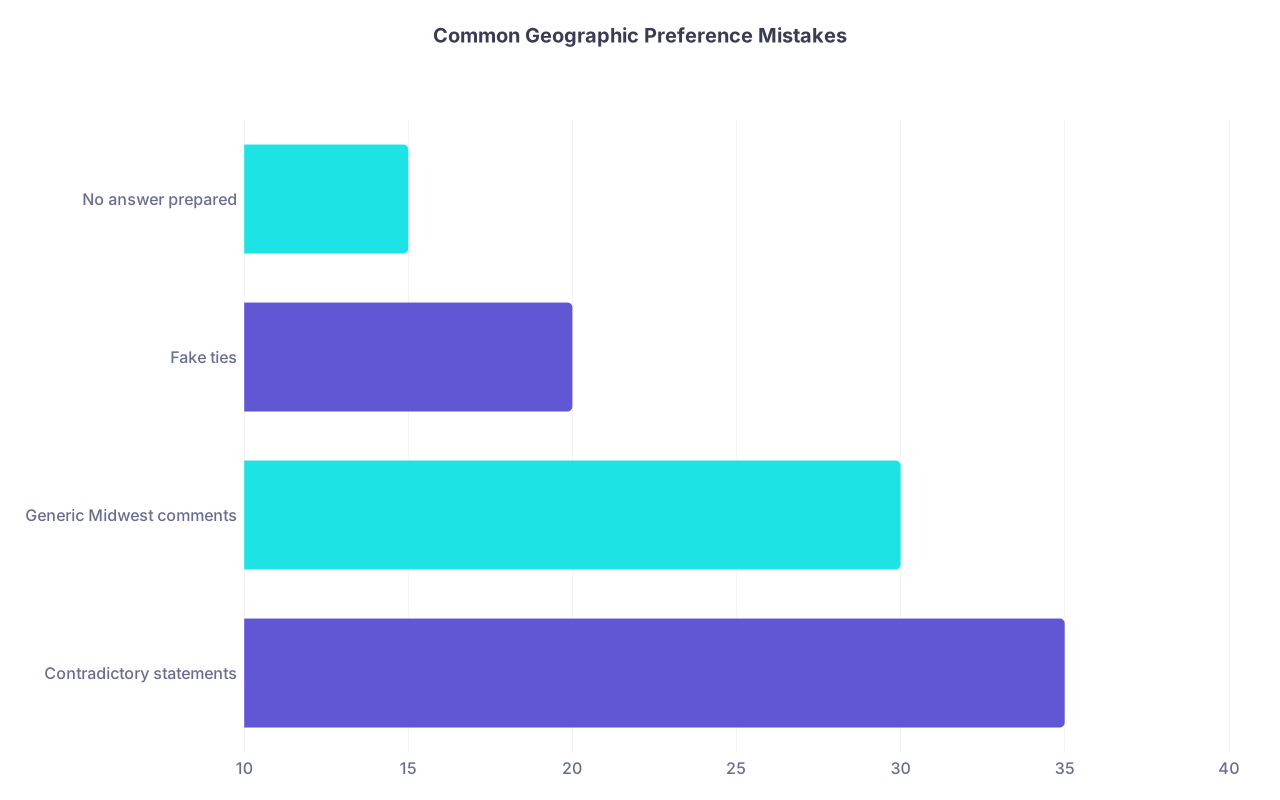
| Category | Value |
|---|---|
| Contradictory statements | 35 |
| Generic Midwest comments | 30 |
| Fake ties | 20 |
| No answer prepared | 15 |
How to avoid this mess:
Decide your true hierarchy of needs:
- Family proximity?
- Training quality?
- Cost of living?
- Specific patient populations?
- Climate?
Build one coherent, flexible narrative:
- “I’m applying broadly, but I’m especially interested in [X], which the Midwest offers through [Y, Z].”
- Use the same core logic everywhere, tuned slightly for each program.
Audit your materials:
- Does your personal statement directly contradict what you’re telling Midwest programs?
- Are your geographic preference boxes aligned with where you’re interviewing?
- Do you have “canned” lines that sound different from your actual life story?
Consistency doesn’t mean scripted. It means not undermining yourself with lazy contradictions.
FAQ (Exactly 5 Questions)
1. I have zero real ties to the Midwest. Should I even bother applying there?
You should if you can build a truthful and specific case for why training there fits your goals. Lack of ties is not a deal-breaker. Faking ties is. If all you want is “somewhere cheap for three years until I run back to the coasts,” programs eventually smell that. But if you can honestly say, “I want high-volume training in a lower cost-of-living region with more exposure to X patient population,” that’s enough—provided your story is consistent and you’ve done basic homework on where you’re applying.
2. Do Midwest programs really care more about geographic fit than coasts?
Some of them do, especially smaller, community, and rural programs that struggle with retention. Big name centers (Mayo, UMich, Cleveland Clinic) care more about your training fit but still prefer people who won’t be miserable in their location. The mistake is assuming none of them care. They absolutely discuss: “Is this person actually going to come here and stay for three years?” If your app screams “lifelong Miami beach person” with no explanation, expect skepticism.
3. What if I genuinely want to end up back on the coast long-term? Do I hide that?
You do not need to confess your 10-year plan in extreme detail. You do need to avoid saying, “There’s no way I’d ever stay here long-term.” The safe lane: “I’m open. Right now I’m prioritizing strong training and the right program culture. If I find the right opportunity after residency, I’d absolutely consider staying in this region.” That’s honest (unless you’re truly 0% open, in which case yeah, applying there is a bad idea) and doesn’t brand you as a guaranteed flight risk.
4. How do I avoid sounding fake when I say I’m interested in the Midwest?
Anchor everything in specifics you can actually back up:
- Particular patient populations
- Lifestyle tradeoffs you’ve thought through (cost of living, pace, community feel)
- Concrete experiences (rotations, trips, friends’ experiences) that pushed you to consider the region
If your “interest” is just word salad—“I love the values and culture and people”—with no detail, it reads as fake. One or two grounded, believable reasons beat a long, flowery paragraph of nothing.
5. Is it a red flag if I rank a mix of Midwest and non-Midwest programs?
No. That’s normal. What becomes a red flag is when your stated preferences wildly contradict your actual list. If you tell every Midwest program, “This is my dream region, I only want to be here,” and your rank list is mostly coasts with two Midwest backups tacked on, your behavior and messaging didn’t match. Balance your story: “I’m applying broadly, but I’m particularly interested in programs that offer X/Y/Z, which I’ve found in several Midwest and non-Midwest locations.” That way, your rank list can include both without looking incoherent.
Key things to remember:
- Don’t fake ties or over-generalize “the Midwest.” Programs see straight through that.
- Have a consistent, believable narrative about why you’d actually live and train there for 3+ years.
- Tie geography to patients and training goals, not just vague lifestyle fluff.