The way most applicants talk about “regional commitment” is lazy and unconvincing.
“I really like the city.”
“My partner has family nearby.”
“I want to settle in the Midwest.”
Programs hear this a hundred times a day. It does nothing for you.
You want a residency spot in a specific region? Then you need to prove you are likely to show up in July and stay for three or four years. Not just say it. Prove it with receipts, details, and behavior that screams: “I have already built part of my life here.”
Let me show you exactly how to do that on interview day.
1. Understand What Programs Actually Mean by “Regional Commitment”
Start here or you will miss the mark completely.
Programs do not care whether you can recite fun facts about their state. They care about risk.
Their fear is simple:
- You rank them as a “backup region”
- You match there
- You are miserable, disengaged, and trying to transfer by PGY2
So when they ask about “regional ties” or “why this region,” they are really asking:
- How likely are you to rank us high enough to match?
- How likely are you to finish residency here?
- Will you be happy and functional in this environment (climate, culture, patient population)?
- Are you a flight risk if something closer to home opens up?
Your goal on interview day is to reduce their uncertainty on those four points.
Think of regional commitment on three levels:
- Concrete connections
- Family, partner, prior schooling, military stationing, property, long-term friends
- Repeated behavior
- Multiple rotations in the region, prior job there, research or QI with local institutions, repeat visits over years
- Credible future plans
- Spouse/partner job search, desire to practice in that region long-term, alignment with local patient population or pathology
You may not have all three. Most people do not. But you can usually build at least one strong storyline out of what you already have.
Then present it properly.
2. Fix Your Story: Build a Tight Regional Narrative Before Interview Day
If you walk into an interview “winging it” on regional questions, it shows. Your answers come out vague, repetitive, and forgettable.
You need one clear, coherent regional narrative that you will adapt slightly for each program. Not 15 different half-stories.
Step 1: Choose your primary regional theme
Pick the strongest anchor you have and orient your story around it:
- Family: “I am anchored here because my parents and siblings are in [City/Region].”
- Partner: “My partner is from here and is building a career in [Industry] in this region.”
- Training pipeline: “I went to college/medical school here and want to stay in this ecosystem.”
- Long-term goal: “I intend to practice in this region as a [community / academic / rural] physician serving [X] population.”
- Lifestyle preference: “I want to be in a place with [urban/rural/suburban, climate] because I actually know it works for me long term.”
Weak theme: “I just really like the city vibe.”
Stronger theme: “I grew up two hours away, did undergrad in [City], and have been coming back here for holidays and summers for over a decade. My family is still here, and this is where my support system and future plans are centered.”
Step 2: Build 3–4 specific supporting “receipts”
Vague = weak. Specific = believable.
Turn each anchor into something concrete:
- “My sister lives in [neighborhood] and works as a [job] at [Company]. I have stayed with her multiple times this year when visiting.”
- “My partner is applying to [X University law school / [Y] tech companies / [Z] nursing positions] in [City]. We have already started apartment hunting in [Neighborhood].”
- “I completed my sub-I at [Regional Hospital] and joined their weekly [clinic / QI meeting] for two months.”
- “I have visited [City] twice a year for the past five years because my parents relocated here. I know the winters, the commute patterns, and the cost-of-living tradeoffs. I am still choosing it.”
Write these down. Out loud they should sound natural, but you should not be inventing them mid-interview.
Step 3: Link your narrative to this program’s region
Do not just say “the Midwest” or “New England.” Programs want to know why their city or area, not just the time zone.
Bad: “I want to be in the West Coast.”
Better: “I am specifically focused on the Puget Sound region because my partner is based in Seattle and my closest friends live in Tacoma and Olympia. I have built my support system here.”
Target your narrative like a laser, not a shotgun.
3. Convert Your Story into Interview-Day Talking Points
You will not get an essay prompt. You will get fragmented questions across the day:
- “Why this region?”
- “Do you have any ties to the area?”
- “How did we end up on your list?”
- “Where do you see yourself practicing after residency?”
- “Would you consider staying around here long term?”
You need modular answers that snap together cleanly.
Core structure for any regional answer
Use this 3-part skeleton and plug in your details:
- Anchor – “My main connection to this region is…”
- Evidence – “Here is what that has actually looked like…”
- Future – “That is why I see myself staying here for…”
Example:
“My main connection to this region is family. My parents and younger brother moved to [Suburb] eight years ago, and I have been coming here 3–4 times a year ever since. I know the area well enough that it already feels like home, from the winters to the commute into the city. Long term, I see myself practicing general internal medicine in this metro area so I can be close to them and stay in the community I already know.”
Notice: simple, specific, forward-looking.
Prepare 3–5 short “micro-stories”
Have a few quick anecdotes ready. Not long monologues—just 20–30 seconds each.
Examples:
Rotations
“During my month at [Local Hospital], I realized how much I enjoy the patient mix here—especially the [immigrant/rural/underserved] communities. I could see myself doing continuity clinic with this same population long term.”Winters / climate (for Midwest / Northeast / very hot areas)
“People always warn about the winters here. I grew up in [cold climate] and did undergrad in [similar region], so this is familiar. I actually prefer it to [other climate] because I know how to build a life around the seasons.”Partner / spouse
“My partner is a [profession] at [Company] downtown. They have a stable, long-term position and are very invested in this city. We have already talked through staying here for the next 5–10 years.”
These micro-stories give your regional commitment weight. They also make you sound like a real person instead of a script.
4. Use Your Behavior on Interview Day to Signal Commitment
Programs do not just listen to your words. They watch what you choose to talk about, what you ask, and how much you clearly know already.
You can signal “I am serious about this region” with your behavior in several ways.
A. Ask location-specific questions that show homework
Most candidates ask the same lazy questions:
- “What do residents do for fun?”
- “How is the call schedule?”
You can do better. Ask questions that:
- Reference specific neighborhoods, commutes, or housing options
- Show awareness of local issues (transport, patient population, health system politics)
- Reflect long-term thinking
Examples:
- “Several residents have mentioned living in [Neighborhood A] vs [Neighborhood B]. How do people decide between them, and how does the commute feel from each?”
- “I saw that [local health system] is expanding into [X area]. How has that changed your referral patterns or clinic catchment area?”
- “For residents with families, how have schools or childcare options worked out in [city or suburb]?”
This tells them: you are not looking at a map for the first time. You already see yourself living there.
B. Reference concrete travel and presence
If you have been to the area multiple times, say so casually but clearly.
Examples:
- “On my last visit here in October, I spent time in [Neighborhood] and was struck by how many of your patients actually live there.”
- “I have flown in and out of [local airport] a lot visiting my parents, so I know how easy it is to get to [other city] if needed for conferences or family.”
Small details. Big credibility.
C. Avoid obvious “this is a backup region” signals
Things that scream “I do not care about this region”:
- Telling a Midwest program you are ranking “only West Coast and Northeast” otherwise
- Admitting you have not really looked at housing or cost of living
- Saying “I am open to living anywhere” with no specifics
- Constantly comparing them unfavorably to another city or coast
You can be honest without being self-sabotaging. Structure your language carefully:
Bad:
“I am applying all over because I just want to match anywhere.”
Better:
“I cast a fairly wide net initially, but as I have interviewed, I have realized the programs and regions I feel most at home in are places like [this region] with [specific features]. That is why this program has moved toward the top of my list.”
5. Leverage Your Background: How to Show Regional Commitment in Different Scenarios
You are not starting from zero. You probably just have not framed your story correctly. Let’s fix that by situation.
Scenario 1: You truly have strong ties to the region
This is the easiest case. Most people still underuse it.
Concrete actions:
Name the relationships
“My parents are in [Suburb]. My sister is in [neighborhood]. My closest friend from college is in [nearby city].”Mention duration
“My family has been here 10+ years.”
“I have been coming here since high school.”Connect to daily life
“I already know which neighborhoods I would realistically live in and have stayed in [X] multiple times.”Project into the future
“I could absolutely see myself staying here after residency and practicing in [subspecialty / setting] near [city].”
Do not be shy or vague. Lean into it.
Scenario 2: You have some ties, but they are not obvious
Maybe you did a rotation there, have one friend, or visited often. You think it is thin. It is not, if you frame it correctly.
Build a “progressive connection” narrative:
“My initial connection to this region was [college roommate / cousin / first rotation]. Over the last [X] years, I have kept coming back—for vacations, for rotations, for conferences—and every time, I liked it more. I now know the city well enough that it feels familiar, and I can see myself building a long-term life here.”
You are showing a trajectory toward this region, not a random fling.
Scenario 3: You have almost no ties but genuinely want to move there
This is common for people chasing geography (mountains, coasts, big cities) or lifestyle.
You cannot fake family. So stop trying. Instead, emphasize:
Prior similar environment
- Grew up in a similar climate or culture
- Trained in a similar sized city
- Used to rural / urban / suburban mix
Deliberate choice
- “I have thought hard about where I want to train and live, and this region checks the boxes that matter to me long term: [specifics].”
Concrete research
- Aware of neighborhoods, cost-of-living, transit, weather
- Mention specific features: public transit, outdoor access, arts scene, religious communities
Example:
“I do not have family here yet, but this region looks a lot like where I grew up—mid-sized city with strong community hospitals and easy access to the outdoors. I have spent a lot of time researching where I want to build my adult life, and places like [this city] with [X, Y, Z features] are exactly what I am looking for. I am not treating this as a temporary stop. I would be very open to staying in this region after training.”
That is honest and still reassuring.
Scenario 4: You need to move because of a partner or spouse
This is one of the strongest forms of regional commitment, if delivered correctly.
You must show:
- Their connection is real and stable, not hypothetical
- You have actually had serious conversations about staying
- You have considered logistics – housing, commutes, jobs
Bad:
“My partner might move here for work so I am applying here too.”
Better:
“My spouse is an engineer who recently accepted a long-term position at [Company] in [City]. We have already started looking at housing in [Neighborhood]. Our plan is to be here for the foreseeable future; so training here where our lives are now centered makes sense.”
This is gold for programs. They love anchored applicants.
6. Align Your “Why This Program?” With “Why This Region?”
You cannot talk about region in isolation. The strongest answers integrate both:
- Why this geographic area
- Why this program inside it
If you separate them, you sound generic. If you link them, you sound committed.
Practical structure
When they ask “Why our program?”:
Start with 2–3 program-specific points
- Curriculum
- Patient population
- Fellowship match
- Research or QI structure
- Resident culture
Then connect to regional fit
- How training here supports your long-term plan in this region
Example:
“There are two things that put your program at the top of my list. First, the continuity clinic experience in [underserved neighborhood] aligns with my interest in working with [X patient population]. Second, your graduates frequently stay in this metro area and work in exactly the kind of community practices I see myself in. Between my family being in [Suburb] and my partner’s job downtown, this region is where we plan to stay long term. Training here would let me build the exact clinical and community connections I want for that future.”
Now your regional commitment and program interest reinforce each other instead of competing.
7. Back It Up With Logistics: Housing, Commute, and Daily Life
Programs are perceptive. They can tell if you have seriously pictured your life there.
You do not need a lease signed. But you should be able to talk about basics like:
- Rough idea of neighborhoods you would consider
- General cost-of-living awareness
- Commute tolerance (car, train, bus, bike)
- Any non-negotiables you have already thought through
| Topic | Weak Signal | Strong Signal |
|---|---|---|
| Housing | "I’ll figure out housing later." | "I’m looking at [Neighborhood] based on rent and commute." |
| Commute | "I don’t know the area well yet." | "I checked that the commute from [X] is 20–25 minutes." |
| Cost of living | "I heard it’s affordable." | "I’ve looked at average rents and it’s similar to [City]." |
| Partner plans | "My partner might come with me." | "My partner is applying to jobs at [Companies] in [City]." |
| Long-term | "I could maybe stay after residency." | "I plan to practice here, ideally in [X setting] nearby." |
You do not need to monologue about this. Just sprinkle it in when appropriate:
- During resident Q&A:
- “A few of us are looking at [Neighborhood]; how has that worked for previous residents?”
- During faculty interviews:
- “Given my family is in [Suburb], I am comfortable with a 30–40 minute commute if needed.”
Small, practical details show serious intent.
8. Common Mistakes That Undermine Your Regional Commitment
Avoid these. They quietly kill your credibility.
Mistake 1: Overusing the word “vibe”
Programs are not selecting you for your appreciation of city “vibes.” You can mention lifestyle briefly, but anchor it in something more concrete:
Bad:
“I just love the vibe of this city.”
Better:
“I like that this city balances a strong arts scene and outdoor access with a reasonable cost of living. Those are the things that keep me grounded during residency.”
Mistake 2: Contradicting yourself across interviews
If residents hear you say, “I definitely want to stay here long term,” and then a faculty member hears, “I will probably move back to [other region] after residency,” they will compare notes. You look inconsistent or dishonest.
Pick one coherent stance on your long-term geography and stick to it. Adjust emphasis, not direction.
Mistake 3: Making the region sound like a last resort
Words like “I am open to” or “I would not mind” sound like settling.
Instead of:
“I am open to living in the Midwest.”
Try:
“I have lived in [similar region] before and actually enjoyed it. The Midwest appeals to me because of [A, B, C].”
Same reality. Different frame.
Mistake 4: Overplaying scripted flattery
Everyone tells Boston they love “the history.” Everyone tells Denver they love “the outdoors.” It is background noise.
Replace generic flattery with specific, lived or researched details:
- A particular trail or park you visited
- A specific neighborhood you walked
- A local initiative, clinic, or community you know about
Otherwise you sound like a brochure.
9. Quick Pre-Interview Checklist: Are You Actually Showing Regional Commitment?
Run through this 24–48 hours before each interview.
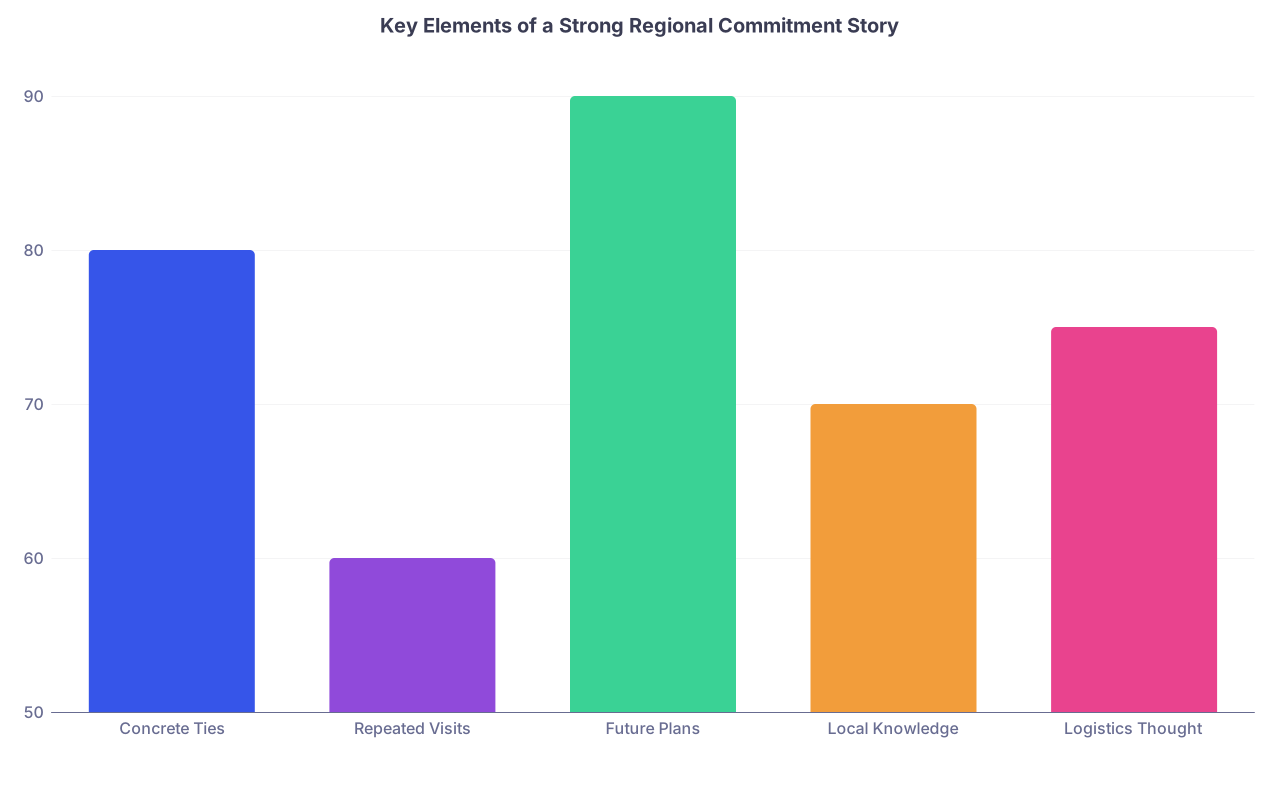
| Category | Value |
|---|---|
| Concrete Ties | 80 |
| Repeated Visits | 60 |
| Future Plans | 90 |
| Local Knowledge | 70 |
| Logistics Thought | 75 |
You should be able to answer “yes” to most of these:
- Can I clearly state my primary regional anchor in one sentence?
- Do I have at least 3 specific details (people, places, events) that show this region is already part of my life?
- Do I know 2–3 neighborhoods near the hospital and how housing roughly works there?
- Can I articulate why this region fits my long-term plan, not just my next three years?
- Do I have 2–3 thoughtful, region-specific questions ready for residents and faculty?
- Have I avoided any lines that sound like “backup region” or “I will go anywhere”?
If not, fix it before you show up on Zoom or in person.
10. Example Scripts You Can Adapt (Not Memorize)
Steal the structure. Replace the content with your reality.
Example 1: Strong family ties
“My strongest connection to this region is family. My parents moved to [Suburb] about ten years ago, and my younger brother is now in [Nearby City] for college. I have been visiting multiple times a year, so [City] is already familiar—everything from the winters to which neighborhoods feel like home. Long term, I see myself staying in this metro area, ideally in a community-based internal medicine practice similar to your graduates in [Clinic X / Hospital Y]. Training here would let me be close to my support system and build roots in the community I want to serve.”
Example 2: Partner-based commitment
“My spouse is a nurse at [Hospital/Health system] downtown and is very committed to this region. We have already settled in [Neighborhood], and our plan is to be here for the foreseeable future. That is why I focused my applications in this area. I want my residency training and my personal life in the same place, and I would like to stay in this region to practice after training.”
Example 3: No family ties, but strong lifestyle and practice fit
“I do not have family here yet, but I intentionally targeted [Pacific Northwest / New England / Midwest] programs because I know from living in [similar region] that this climate and scale of city work well for me. What stands out about [City] specifically is the combination of complex tertiary care at your hospital and the strong safety-net system in [Neighborhood/County]. I am interested in long-term outpatient general medicine with underserved communities, and I can absolutely see myself building that career here after residency.”

| Step | Description |
|---|---|
| Step 1 | Interview Day Signals |
| Step 2 | Low Confidence |
| Step 3 | High Regional Commitment |
| Step 4 | Moderate Regional Commitment |
| Step 5 | Regional Story Coherent |
| Step 6 | Specific Evidence Present |
| Step 7 | Future Plans Align Here |

11. Put It All Together: The On-the-Day Protocol
You want something simple you can execute even when you are tired and over-interviewed.
Morning of the interview
- Re-read:
- Your 1-sentence regional anchor
- Your 3–4 specific receipts
- Your 2–3 region-specific questions
- Open a map of the area for 5 minutes:
- Find hospital
- Find 2–3 realistic neighborhoods
- Note any transit options
During faculty interviews
- When asked “Why here?” or “Why this region?”:
- Use the anchor → evidence → future structure
- Sprinkle in:
- One specific neighborhood or city reference
- One future-oriented statement about practicing there
During resident Q&A
- Ask at least one practical life question:
- Housing
- Commute
- Schools/partners/activities
- If appropriate, mention:
- “My family is in [X] so I’m especially curious about…”
After the interview
- In any follow-up communication (if permitted by specialty/NRMP rules in your context):
- Reaffirm both:
- Program fit
- Regional commitment
- One sentence is enough:
“Given my family in [Suburb] and my goal to practice in this metro area, your program remains one of the places I can clearly see myself for residency and beyond.”
- Reaffirm both:
Do not overdo it. Subtle, consistent signals are more believable than desperation.
The Bottom Line
Three things matter if you want programs to believe your “regional commitment” on interview day:
- Have a real, specific story – One clear anchor, backed by concrete details and a credible future plan in that region.
- Act like you are already half-moved in – Know neighborhoods, commutes, cost-of-living basics, and ask questions that prove you have done the homework.
- Keep your message consistent – Across faculty, residents, and any follow-up, your regional narrative should line up and support your long-term practice goals.
Do that, and you stop sounding like every other applicant parroting “I really like this area,” and start looking like what programs actually want: someone who will show up, settle in, and stay.