The way most applicants compare call schedules across regions is dangerously superficial.
“q4 vs night float vs home call” is not enough. You are trying to compare completely different ecosystems using a single number. It is like comparing restaurants only by the calorie count.
If you want to compare call schedules across regions with different cultures in a way that actually predicts your quality of life, you need a system. Not vibes. Not a Reddit thread. A system.
This is that system.
Step 1: Stop Comparing Raw Call Numbers
The biggest mistake I see: people fixate on “q4 vs q5”, “5–6 calls a month vs 8–9,” without context.
Call does not exist in a vacuum. You must evaluate call in four dimensions:
- Type of call
- Intensity of call
- Support and culture during call
- Recovery after call
If you ignore any one of these, you will misjudge a program.
Let’s define a basic comparison framework that works across regions and cultures.
| Dimension | What You Ask About |
|---|---|
| Type | In-house, night float, home call |
| Intensity | Workload, pages, admissions, acuity |
| Support | Seniors, attendings, ancillary staff |
| Recovery | Post-call rules, days off patterns |
You will use these four dimensions as a “universal translator” for call schedules, regardless of whether you are looking at:
- A Midwest community program with heavy in-house call
- A West Coast academic center with “chill” culture but high expectations
- A Southern program with strong hierarchy and old-school overnight call
- A large coastal program with aggressive night float and high volume
Numbers without these dimensions mean nothing.
Step 2: Build a Standardized Call Profile Sheet
You cannot keep this in your head. Too many variables, too many biases.
You need a simple one-page “Call Profile” for each program you are comparing. Use the same structure for all of them, no matter the region.
Here is the minimum data you should capture per program:
Call Type by Year
- How many months of:
- Traditional 24+4 in-house call
- Night float
- Home call
- Shift-based (e.g., 12-hour shifts)
- How this changes PGY1 → PGY3/4+
- How many months of:
Average Frequency
- Typical “qX” pattern or shifts per week
- Any peak months (e.g., ICU, wards July–September)
Daytime Load + Call
- Average census on day teams
- How many admissions during call
- Average number of pages per night (ballpark)
Support Structure
- Number of residents on-call with you
- Senior coverage (in-house vs home backup)
- Attending availability (in-house, home, cross-covering multiple services)
Recovery
- Guaranteed post-call days?
- Post-call actually protected or do people stay late?
- Typical day off distribution per month
Cultural Notes
- How residents describe the feel of call
- Any red-flag phrases (“you get used to being exhausted,” “it’s a rite of passage,” “we just push through”)
Make a template in a spreadsheet or note app. Every time you talk to a resident, fill it out in real time. Do not trust your memory.
Step 3: Adjust for Regional Culture and Work Norms
Here is where people get lost. The exact same written call schedule can feel completely different in different regions because the surrounding culture changes how it plays out.
You must “culture-adjust” the schedule.
A. Understand Regional Work Culture Archetypes
I am generalizing, obviously. There are exceptions. But these patterns come up over and over:
Northeast large academic centers
- High volume, high acuity, fast-paged nights
- Culture: “Work hard, prove yourself, be efficient”
- Call may be tightly structured, but intensity is high
West Coast academic + lifestyle-focused programs
- Strong language around wellness, often more progressive schedules
- Culture: more pushback on staying late / extra work, but sometimes high expectations masked by soft language
- Support staff often better; social pressure to “have a life”
Midwest programs (academic and community)
- Often very collegial, “family” environment
- Volume can quietly be heavy, but people are nicer while you drown
- Nurses and ancillary often stable and experienced, which can soften call
South and some older-school regions
- More hierarchy, more deference to “this is how we’ve always done it”
- Residents sometimes accept brutal call as normal and underreport how rough it is
- On the flip side, strong team loyalty and seniors who truly protect juniors
None of these are automatically good or bad. They just change how the same call schedule feels.
B. How to Adjust for Culture
When a program says “q4 24+4 call” on paper, you translate it through this filter:
- Region / culture
- Support staff quality (nurses, phlebotomy, RT, transport)
- Resident attitudes toward pushing back
- Program leadership responsiveness
You literally assign each program a 1–5 rating for:
- “How safe do I feel asking for help on call?”
- “How likely is it that I will be shamed for being behind at 3 a.m.?”
- “How much does this region’s culture tolerate saying ‘no’?”
Those numbers matter as much as “q4 vs q5”.
Step 4: Ask Better, Sharper Questions on Interviews
Most applicants ask useless questions like, “How bad is call?” That gets you canned answers.
You need specific, behavior-based questions that reveal culture and workload without putting the resident on the spot.
Use these.
A. For Call Intensity
- “On a typical in-house call night for an intern, how many admissions would I get, and what is the max you have seen?”
- “If I am on night float, how many active patients am I cross-covering, and what is a rough number of pages per night?”
- “Which months are the hardest call months? What makes them hard—volume, acuity, poor support?”
B. For Support and Safety
- “At 2 a.m., who is physically in the building with me? Senior? Fellow? Attending?”
- “If I feel overwhelmed at 3 a.m., what does asking for help actually look like here?”
- “Tell me about the last time an intern was really struggling on call. How did the team handle it?”
You will learn faster from that last question than from any official description.
C. For Culture and Honesty
- “If a classmate at another program asked you to be brutally honest, how would you describe your call schedule and nights here?”
- “Does the written call schedule match real life, or are there unspoken expectations like ‘staying two hours post-call’ that do not show up on paper?”
Watch their body language. Hesitation, nervous laughter, “it depends” answers—those are data.

Step 5: Normalize Schedules Using a “Call Burden Score”
You want a single composite number to compare programs across regions. Not perfect, but better than “feels okay.”
Build a simple “Call Burden Score” out of 100. You are not publishing this. It is for you.
Step 5A: Define the Components (0–20 each)
Night frequency and duration (0–20)
- 0 = extremely light nights (e.g., rare, mostly home call)
- 20 = frequent q3 24+ call or intense night float blocks
Workload per call (0–20)
- 0 = few admissions, low cross-cover, mostly stable patients
- 20 = constant admits, high cross-cover, frequent rapid responses/codes
Support and supervision (0–20)
- 0 = strong, easily available senior/attending support, great nursing
- 20 = you feel alone, hesitant to call for help, poor ancillary support
Recovery and schedule design (0–20)
- 0 = reliable post-call days, protected time off, minimal flip-flopping
- 20 = post-call routinely violated, frequent circadian whiplash
Culture and respect (0–20)
- 0 = psychologically safe, humane norms, leadership listens
- 20 = toxic, shaming, “suck it up” culture around fatigue
Total range: 0 (utopian) to 100 (punishing).
Step 5B: Apply It Across Regions
Let us compare three hypothetical programs:
- Program A: Northeast academic, q4 24+4, high volume, strong seniors, spotty wellness
- Program B: Midwest medium-sized, mix of night float and q5 call, moderate volume, very supportive
- Program C: West Coast, primarily night float, strong ancillary, but highly competitive culture
You would score each dimension honestly based on what you gathered from residents.
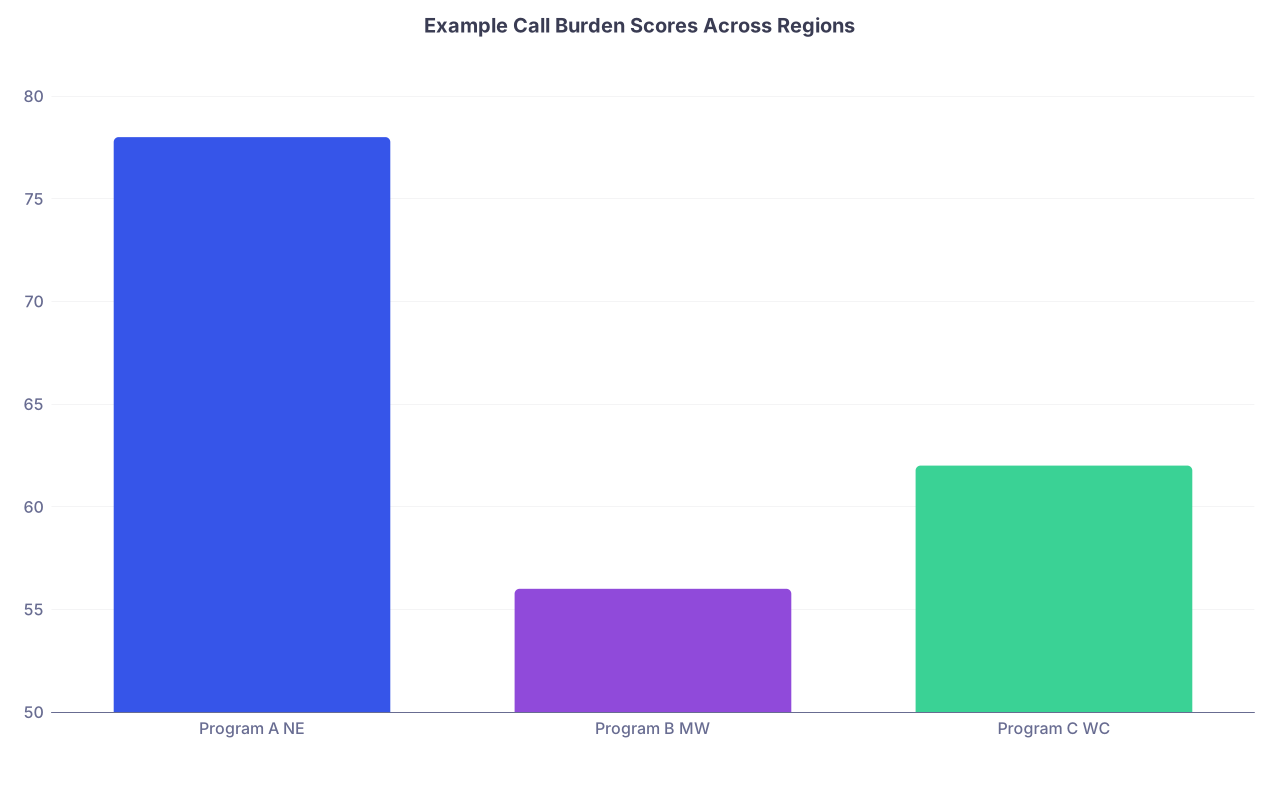
| Category | Value |
|---|---|
| Program A NE | 78 |
| Program B MW | 56 |
| Program C WC | 62 |
Now you have a structured way to say: “This Midwest program with more nights on paper may actually feel better than that big-name coastal center with fewer nights but a much colder culture.”
That is reality. I have watched people learn it the hard way.
Step 6: Factor In Lifestyle Outside the Hospital
This is where “different cultures” matters beyond medicine.
A tough call schedule in a city where:
- Your commute is 15 minutes
- Rent is affordable
- You have friends / family
- People actually go outside in daylight in winter
…may be more livable than a slightly lighter call schedule in a city where:
- You commute 60–90 minutes round trip
- Cost of living forces you into a noisy, stressful housing situation
- You are socially isolated
- The broader culture does not fit you
Call sits on top of your life. You cannot evaluate it in isolation.
Key Lifestyle Questions to Ask Yourself
- “How long will my door-to-door commute be leaving post-call at 10 a.m.?”
- “Will I realistically cook, sleep, and reset between calls, or will I be fighting logistics?”
- “How well do I fit the social and political culture of this region? Will I feel like I belong?”
Regions differ. A big-city East Coast program may have good public transport but brutal housing. A smaller Midwest town may lack nightlife but offer a five-minute drive home and a backyard.
You are not choosing a spreadsheet. You are choosing where you will drag yourself home at 9:30 a.m. post-call for three years.
Step 7: Decode Red-Flag and Green-Flag Phrases
Different regions use different language, but some patterns are universal.
Red-Flag Phrases Around Call
When you hear these, your alert level goes up:
- “You just learn to push through”
- “Everyone survives” (lowest bar imaginable)
- “Our call is intense, but it makes you strong”
- “We work hard and play hard” (translation: we overwork you and pretend social events fix it)
- “Well, officially the schedule says…, but unofficially…”
These often show up more in older-school or hierarchical cultures, but I have also heard them at fancy coastal programs trying to sound proud.
Green-Flag Phrases Around Call
- “If you are drowning at 2 a.m., here is exactly who you call and they will come in”
- “We used to do X, residents spoke up, and we changed it to Y”
- “We track call volume and adjust caps if it gets out of hand”
- “Post-call is sacred here. If someone tries to keep you late, seniors step in.”
These phrases tell you leadership is responsive and the culture is not gaslighting you about fatigue.

| Step | Description |
|---|---|
| Step 1 | Identify Region and Program |
| Step 2 | Gather Written Call Schedule |
| Step 3 | Interview Day Questions |
| Step 4 | Assess Support and Culture |
| Step 5 | Score Call Burden 0-100 |
| Step 6 | More Livable Option |
| Step 7 | Potential Red Flag |
| Step 8 | Factor in Lifestyle and Fit |
| Step 9 | Rank List Decision |
| Step 10 | Compare to Other Programs |
Step 8: Compare Across Specialties and Future Trends
You are not just comparing regions. You are also dealing with market realities:
- Some specialties are aggressively moving away from 24+ call to night float (IM, peds, FM in many places).
- Some will cling to traditional call longer due to OR requirements or old habits (surgery, OB in some regions).
Different regions adopt change at different speeds.
What To Look For About the Future
Ask explicitly:
- “Have your call schedules changed in the last 5 years? How?”
- “Are there any plans to shift away from 24+4 to more night float or shift-based systems?”
- “How does your program leadership think about resident fatigue and call design?”
Programs that say, “We restructured our ICU call three years ago based on resident feedback” are very different from, “It has always been like this.”
You want to be where the trajectory is improving, not where you are the next generation of sacrificial data.
Step 9: Create a Simple Visual Comparison
Humans make better decisions with visual data. Take your Call Profile Sheets and turn them into something you can scan in 30 seconds.
Here is one way:
For each program, assign 1–5 for:
- Night frequency
- Workload
- Support
- Recovery
- Culture
Plot them in a small table or even a quick hand-drawn radar chart (5 axes) if you like sketches.
| Program | Nights (1-5) | Workload (1-5) | Support (1-5) | Recovery (1-5) | Culture (1-5) |
|---|---|---|---|---|---|
| NE Academic | 5 | 5 | 3 | 2 | 3 |
| MW Community | 3 | 3 | 5 | 4 | 5 |
| WC Academic | 3 | 4 | 4 | 4 | 3 |
Then line these up against:
- Region
- Cost of living
- Personal ties
- Fellowship match outcomes (if that matters to you)
Call is one axis. An important one. Not the only one.
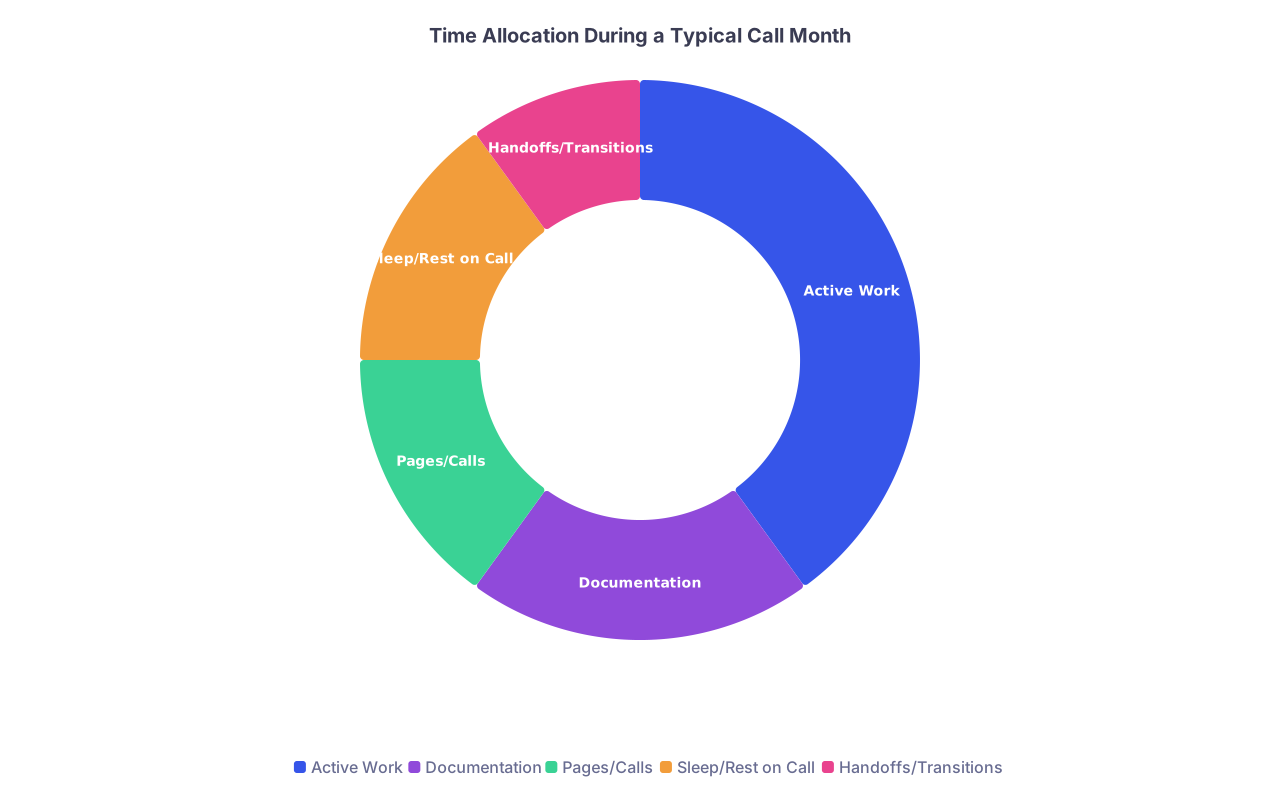
| Category | Value |
|---|---|
| Active Work | 40 |
| Documentation | 20 |
| Pages/Calls | 15 |
| Sleep/Rest on Call | 15 |
| Handoffs/Transitions | 10 |
Step 10: Reality-Check With People You Trust
You can do everything above and still be misled if you only talk to one or two very biased residents.
So before you finalize your rank list:
Reach out to alumni from your med school who matched in different regions and programs.
- Ask them: “If you had to give your program’s call a 0–100 Call Burden Score, what would you give it and why?”
Ask people who switched regions.
- Someone who did med school on the West Coast and residency in the South will have a much clearer sense of how regional culture shapes call than someone who never left one area.
Cross-check against what residents are not saying.
- If every program in one region volunteers stories about support on call, and one program never mentions it until you ask, that silence is loud.

A Quick Concrete Example
Let me walk you through how this plays out, because abstract advice is useless without a real scenario.
You are choosing between:
Program X – East Coast, big-name academic
- PGY1: 4 months wards q4 24+4, 1 month ICU q3, 1 month night float
- Residents say: “Brutal but you learn a ton.” “We definitely stay post-call until 1–2 p.m. sometimes.”
Program Y – Midwest, mid-tier but solid
- PGY1: 3 months wards with night float system, 1 month ICU with 12-hour shifts, 1 month home call
- Residents say: “Busy but doable.” “Post-call is pretty protected, seniors kick you out.”
Program Z – West Coast, lifestyle reputation
- PGY1: 2 months wards, 2 months night float, lots of cross-cover at night, huge hospital system
- Residents say: “Nights can be insane, but during the day it is lighter.” “Wellness is a big topic here.”
Your initial impression:
- X has prestige, but call sounds rough.
- Y sounds boring but humane.
- Z sounds cool-city, modern.
You run them through the Call Burden Score:
- X: Nights 18, Workload 19, Support 14, Recovery 16, Culture 13 → 80
- Y: Nights 12, Workload 12, Support 18, Recovery 17, Culture 17 → 66
- Z: Nights 15, Workload 17, Support 16, Recovery 15, Culture 14 → 77
Now you lay this next to your priorities:
- You care about learning and fellowship, but you are not 23 and immune to fatigue.
- You have a partner who will live with you and needs you semi-functional.
- You can be happy in either Midwest or coastal.
Suddenly, Program Y—the one you nearly dismissed as “less prestigious”—looks a lot more rational if you value not being destroyed by call.
That is how you should be thinking. Structured, not seduced.

Your Move: One Concrete Action Today
Open a fresh document or spreadsheet and build your Call Profile Template with these sections:
- Call type by year
- Frequency
- Workload
- Support
- Recovery
- Culture notes
- Call Burden Score (0–100)
Then take one program you are interested in—just one—and fill it out using what you already know and what you can infer from their website and any resident conversations you have had.
You will immediately see the gaps in your understanding.
That is your to-do list for the next interview or email to the chief resident.