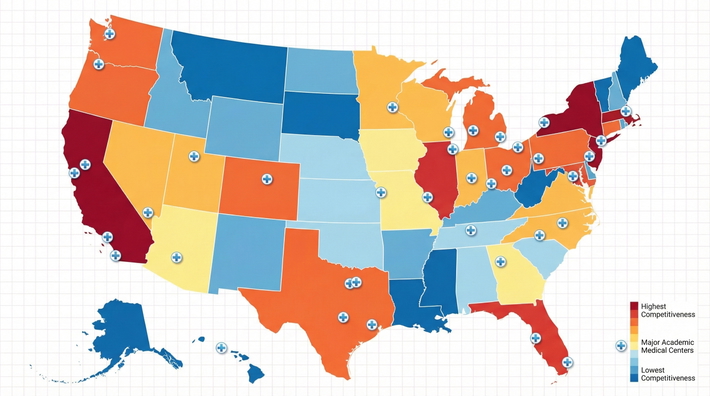
The worst couples match mistake is assuming geography is a preference instead of a negotiation variable.
If you and your partner are trying to Couples Match across two distant regions, you are not just “hoping it works out.” You are running a multi-stage, high-stakes logistics and strategy project. If you treat it like vibes and wishful thinking, you will get steamrolled by reality.
Here is how to fix it.
Step 1: Get Ruthlessly Clear On Your Real Priorities
Most couples do this part badly. They say things like “We’d love the Northeast, but West Coast would also be great, and we’re open to the South if the program is strong.” That is not a plan. That is how you end up with a rank list that looks nice but fails to maximize the chance you live in the same time zone.
You need to turn vague preferences into concrete rules.
A. Decide your non‑negotiables separately from your ideals
Each of you should answer these individually first, then compare:
Absolute deal‑breakers
- Minimum program quality: community vs academic vs “must be university”
- Minimum reputation / board pass rate / fellowship pipeline
- Must‑have features: visa support, specific fellowship at the same institution, strong OB training, etc.
- Life constraints: must be within X hours of aging parents or joint custody arrangements; no locations with certain state laws; need strong LGBTQ+ protections.
Geography tiers For each region you are considering (for example: “Boston/NY/Northeast corridor” vs “California/PNW”), rate:
- 5 = Would be thrilled to be here
- 3 = Comfortable / fine
- 1 = Only if this avoids long‑distance or going unmatched
Distance tolerance Be honest:
- Category A: “Same city or same metro area only”
- Category B: “Same region, ≤2–3 hours commute by car or train”
- Category C: “We will accept long‑distance for 1–2 years if careers demand it”
Then sit down and compare. Where people usually screw up is pretending they are both Category A (same city or bust) but then applying like they are Category C (scattered everywhere with no structure).
You must explicitly decide:
Are we optimizing for:
- Same city > everything
- Same region > specialty prestige
- Career optimal + willing to do temporary long‑distance
Pick a hierarchy and commit.
Step 2: Map the Two-Region Strategy Like a Game Board
If you are targeting two distant regions (say, Midwest vs West Coast, or NYC/Boston vs Texas), you have to stop thinking “random list of programs” and start thinking clusters.
You are not applying to programs. You are applying to geographic pairs.
A. Build regional clusters
Create a simple spreadsheet (or whiteboard) with clusters:
- Region 1 cluster: e.g., “Northeast – Boston / Providence / Worcester / Southern NH”
- Region 2 cluster: e.g., “Pacific Northwest – Seattle / Portland / Tacoma”
- Optional third cluster (safety): e.g., “Mid‑Atlantic – Philly / Baltimore / DC area”
- All programs in your specialties in that area
- For each program, label:
- Program tier (reach / realistic / safety)
- Lifestyle score (1–5)
- Family/life pros/cons
Now find cross‑matches:
- “If Partner A is at Program X, what are the realistic Programs Y and Z nearby for Partner B?”
Your unit of planning is now:
- “Boston pairings”
- “Seattle pairings”
- “Philly pairings” Not “MGH” or “UW” in isolation.
You want multiple viable pair combos per region, not one magical unicorn program.
Step 3: Understand How the Algorithm Treats Your Two-Region Plan
The Couples Match algorithm is not romantic. It is math. And it rewards structure.
Quick reality check:
- You submit a paired rank list of combinations:
(Partner A Program 1, Partner B Program 1),
(A1, B2),
(A2, B1), etc. - The algorithm tries to match you to the highest pair on your list where both can be placed.
- If one of you cannot match at that combination, it tries the next combination.
That means:
- If you mix your regions randomly (Seattle + Boston combos scattered everywhere), your effective willingness to move is incoherent and you will get random results.
- You must chunk your list by region, in the order you truly prioritize them.
B. Chunking the rank list by region
Decide your regional priority explicitly, for example:
- Region 1 (Boston cluster)
- Region 2 (Seattle cluster)
- Region 3 (Philly/Baltimore cluster)
- Worst‑case: One matched, one unmatched vs long‑distance vs SOAP plans
Your actual couples rank list might look like:
- All Boston‑Boston pairings (A at BI, B at MGH; A at Tufts, B at MGH; etc.)
- Then all Seattle‑Seattle pairings
- Then all Philly‑Baltimore pairings
- Then any “one matched, one unmatched” safety strategies if you are willing to go there
The point is: if Boston is region #1, every Boston‑based pairing must be ranked above every Seattle‑based pairing, even if the Seattle program is technically more prestigious for one of you. Otherwise you are lying to the algorithm about your priorities.
If you do not do this, your list will look logical to you but will behave chaotically when run.
Step 4: Design the Application Strategy — Not Just “Apply Broadly”
You have three levers here:
- Breadth (how many total programs)
- Depth per region (how many per cluster)
- Balance between partners (if one specialty is more competitive)
Let’s be blunt: Couples Match across distant regions is expensive. Attempts to be “cost‑efficient” by over‑trimming often backfire.
A. Assess each partner’s market reality
Here is where people need to be a bit colder and more objective.
| Specialty Type | Typical Step 2+ | Competitiveness Level | Couples Match Risk |
|---|---|---|---|
| Family Med / Psych | 220–230 | Lower | Lower |
| Internal Med (Univ) | 230–240 | Moderate | Moderate |
| EM / Anesthesiology | 235–245 | High | High |
| Ortho / Derm / Plastics | 245+ | Extreme | Very High |
| Peds / FM (Community) | 215–225 | Lower | Lower |
Questions you need to answer:
- Who is more constrained by specialty competitiveness?
- Who has geographic flexibility vs “needs academic pipeline”?
- Does one of you need higher‑tier name recognition more than the other?
Then decide:
- Which partner is the anchor (the one whose training needs are more constrained)
- Which partner is the flex (the one who will apply more broadly within each region)
Example:
- Ortho partner is anchor; they must target 2–3 regions with enough slots.
- FM partner is flex; they apply to basically everywhere in and around those regions.
B. How many programs per region?
Rough rule of thumb when targeting two distant regions:
- Competitive specialty (ortho, derm, ENT, plastics, urology):
- Aim for 40–60 programs total, distributed across at least 2–3 clusters
- Moderately competitive (IM academic, EM, anesthesia, OB/GYN, gen surg):
- 30–40 programs total
- Less competitive (FM, peds, psych, community IM):
- 20–30 programs total but denser coverage in your key clusters
Since you have two regions, you want at least 2 strong clusters with enough overlap:
Example:
- Region 1 cluster: 10–15 programs each partner can reasonably match at
- Region 2 cluster: 10–15 programs each
- Optional Region 3: 5–8 programs each, as backup
Do not make the classic mistake of:
- One region getting 80% of your applications
- The second region getting 3–4 scattered reaches and no depth
That second region is then fantasy, not a plan.
Step 5: Interview Season – How To Steer Programs Without Being Annoying
You cannot “negotiate” a move if no one knows you are a couple.
But you also cannot bulldoze PDs and coordinators with entitled demands. The middle ground is precise, respectful, and surprisingly effective.
A. When and how to disclose you are couples matching
The smart play:
- On ERAS: Clearly mark that you are in the Couples Match and list your partner and specialty.
- In your personal statement or secondary questions (if appropriate): One or two sentences about having a partner in X specialty and an interest in training in X/Y regions together.
- At interviews: When they ask, “Do you have any geographic preferences?” you say something like:
“Yes, my partner is applying in psychiatry and we are couples matching, primarily targeting the Northeast and Pacific Northwest. We have both applied broadly in this region and very much hope to be here together.”
That signals:
- You are serious about the region
- You have a partner in a plausible specialty
- Programs can factor that into their own ranking if they wish
B. Coordinating interviews across distant regions
Here is where couples either tighten things up or fall apart.
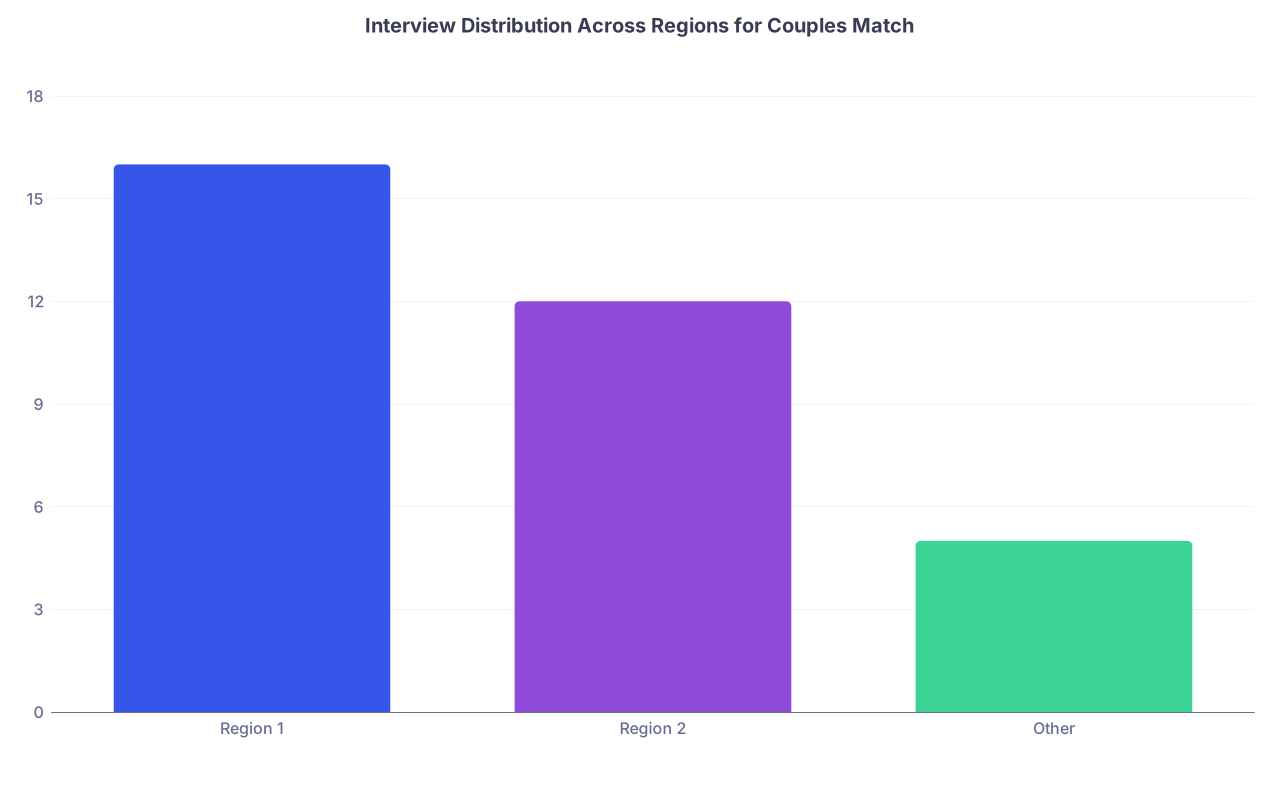
| Category | Value |
|---|---|
| Region 1 | 16 |
| Region 2 | 12 |
| Other | 5 |
Three concrete rules:
Front‑load communication, not last‑minute begging Once you or your partner has multiple interviews in one region (say, 3–4 in Seattle), and the other partner has zero or only one, send polite, focused update emails:
Example email:
Subject: Application Update – Couples Match (EM & IM)
Dear Dr. [PD Name],
I wanted to briefly update you on my application. My partner and I are participating in the Couples Match (my partner is applying in Internal Medicine). We are prioritizing the Pacific Northwest as a region where we hope to train together.
I have been fortunate to receive several interviews in the Seattle and Portland areas, and your program remains one of my top choices in this region given [1 specific, real reason]. If there is any opportunity to be considered for an interview, it would significantly support our ability to match together.
Thank you very much for your time and consideration.
Sincerely,
[Name, AAMC ID]This is not begging. It is giving programs actionable information.
Stack interview weeks by region If you get 3 interviews in Boston and 2 in NYC, take them in batches so that:
- Both of you can be physically in the same time zone
- You can share lodging, travel, and do rapid‑fire program comparisons
Be honest with each other when a region is clearly dying If by mid‑interview season:
- You have 6 interviews in Region 1
- Your partner has 5 in Region 1
- You have 1 in Region 2
- Partner has 0 in Region 2
Then Region 2 is probably dead as a primary cluster. Stop pretending. Build rank lists accordingly. Do not waste your top 10 ranks on low‑probability fantasies.
Step 6: Building the Actual Couples Rank List Across Two Regions
This is the part where people get overwhelmed and just throw things together. You cannot do that.
You need a working session with:
- Printed lists of programs for each partner, by region
- A whiteboard or big spreadsheet
- A clear hierarchy of:
- Same city, preferred region
- Same city, secondary region
- Same region, different cities (2–3 hours apart)
- One matched, one in nearby region
- One matched, one unmatched (if you are willing to rank this at all)
A. Use a structured pairing process
Here is a simple, reliable way to do it:
Rank individually first Each of you builds a solo rank list ignoring couples status. Just: “Where would I train if I were single?” Top to bottom.
Overlay by region For each region:
- Identify “top 3–5” programs for each of you.
- Identify “acceptable backup” programs for each of you.
Build pairs in tiers
Start with your top region (say, Northeast):
- Tier 1: Both top programs in same city
Example combos:- (A: MGH, B: MGH)
- (A: BWH, B: MGH)
- (A: BI, B: MGH)
- Tier 2: One top program + one mid‑tier but still strong program in same area
- (A: BWH, B: BIDMC)
- (A: Tufts, B: MGH)
- Tier 3: Both at mid‑tier but acceptable programs in same metro
Then repeat for Region 2 (e.g., Seattle/Portland cluster) after you finish all meaningful Region 1 pairings.
- Same region, different city If you have decided you could tolerate being 2–3 hours apart:
- Add pairings like:
- (A: Boston program, B: Providence program)
- (A: Seattle, B: Tacoma)
- But make sure these are still above any pairings that move you to a second‑choice region if your priority is “stay in Region 1 together or near‑together”
B. Only then consider “mismatched” or asymmetric scenarios
You need to talk about this like adults, not romantics.
Real questions:
- Will we rank scenarios where:
- One of us matches, the other is unmatched (and will SOAP or reapply)?
- One of us matches in our top region, the other in a different region (true long‑distance)?
- If yes, which is better for the relationship and careers:
- One solid match + one SOAP (but potentially same region)
- Two matches but in far‑flung regions?
If you are absolutely against being in different regions, do not include those combinations just to “have more pairs.” Every combination on your list is something you are saying “yes” to if the algorithm offers it.
Step 7: Logistics If You Actually Match Across Two Distant Regions
Sometimes you try everything, you plan well, you still end up in two different regions. It happens. It is survivable if you plan.
Here is the mistake: acting surprised and then improvising.
You should build a contingency plan before Match Day for:
- “We match together in Region 1.”
- “We match together in Region 2.”
- “We match in the same region but different cities.”
- “We match in different regions.”
A. Housing and moving protocol
If you end up in:
Same city / same metro
- Choose:
- One central apartment close to transit, or
- Two micro‑commutable options if both have brutal call and you value sleep.
- Plan your move as one combined operation with:
- One shared moving truck
- Both start dates and orientations mapped on a single calendar
- Choose:
Same region, 2–3 hours apart
- Decide if you will:
- Have one primary home and a crash pad for the person with worse commute
- Or two full apartments and designated “together weekends”
- Typical workable pattern:
- One partner lives where real estate is cheaper.
- The other keeps a small studio near hospital and travels on off weekends.
- Decide if you will:
Different regions Unpleasant but manageable if temporary. Your plan must include:
- Fixed visit schedule (every X weeks, not just “when possible”)
- Shared calendar with:
- Golden weekends
- Vacation weeks (coordinated early with chiefs/PDs)
- Pre‑decided timeline:
- Will one try to transfer after intern year?
- Will the other apply for fellowship in the partner’s region?
You do not wait until November of PGY‑1 to start thinking about transfers and fellowships. You start thinking in March of MS4.
B. Career repair moves if the match outcome is lopsided
One of you got a “dream” program; the other got a barely tolerable community slot in the other region. What now?
Blunt options:
- Transfer after PGY‑1:
- Hard but not impossible if you:
- Perform strongly
- Get PD support
- Target open PGY‑2 spots in your partner’s region
- Hard but not impossible if you:
- Changing specialties:
- Rare but sometimes strategically correct (for example, EM to IM or prelim to categorical) if the relationship and long‑term life goals trump the original plan.
- Fellowship alignment:
- Aim to:
- Do residency where you must for training
- Then converge for fellowship in one shared region
- Aim to:
Do not assume “it will just work out later.” It will not. Transfers and fellowships go to people who plan early and show programs a clear, consistent story.
Step 8: Common Pitfalls And How To Avoid Them
I have seen couples blow up their chances over the same avoidable mistakes.
Here is the short list of what not to do:
Vague region talk, no hard choices
- Saying “We love either coast” but building a rank list that mixes both randomly.
- Fix: force‑rank regions. 1, 2, 3. No ties.
Too few applications in the second region
- Applying to 25 programs in Region 1 and 3 programs in Region 2.
- Fix: if you name a region, you must build enough density there (10+ programs each partner) for it to be real.
Not aligning on distance tolerance
- One partner secretly okay with long‑distance for prestige; the other is not.
- Fix: explicit conversation, written down. Decide path before ERAS submission.
Using the “we are a couple” card sloppily
- Mass‑emailing programs with guilt‑trip or desperate messaging.
- Fix: strategic, concise emails only where there is already partial traction (one partner has interviews there or at nearby institutions).
Treating SOAP as a black box safety net
- Counting on SOAP to magically fix a bad strategy.
- Fix: design your rank list so SOAP is backup, not Plan A+. And if SOAP happens, you already know your priority: same region > prestige, or vice versa.
Visualizing The Process: From Planning To Match
Here is what a clean, well‑run couples two‑region strategy actually looks like.

| Step | Description |
|---|---|
| Step 1 | Define Priorities |
| Step 2 | Pick Regions and Clusters |
| Step 3 | Assess Competitiveness |
| Step 4 | Plan Applications per Region |
| Step 5 | Submit ERAS |
| Step 6 | Coordinate Interviews by Region |
| Step 7 | Reassess Region Strength |
| Step 8 | Build Paired Rank List by Region Priority |
| Step 9 | Match Outcome |
| Step 10 | Implement Local Housing Plan |
| Step 11 | Implement Distance Plan and Transfer/Fellowship Strategy |
| Step 12 | Same Region? |
That is it. That is the game board.
Quick Recap – How To Actually Win This
Three key points to leave with:
Regions are not vibes; they are tiers.
Force‑rank your target regions and build your entire application and rank strategy around that order. Every pair combination either reinforces that priority or undermines it.Depth in clusters beats scattered prestige.
A handful of shiny programs per coast is not a plan. You need multiple realistic pairings within each cluster so the algorithm has room to “catch” you together.Talk like planners, not romantics.
Decide your tolerance for distance, your willingness for asymmetric outcomes, and your backup transfer/fellowship moves before you click “Certify.” The couples who handle this like a joint logistics operation are the ones who actually end up in the same place long term.