
Most residents screw up their rank list by pretending their life is simpler than it is.
They pretend: “I just want the best training.” Or “I’ll go wherever they take me.”
Reality: you care about training, yes, but also your partner’s job, your aging parent two states away, whether you can afford rent, and if you will be miserable buried in snow or stuck in 110-degree heat for 3 years.
You are not choosing a program. You are choosing a life you will live, exhausted, for the next 3–7 years.
So let’s stop the hand‑waving and build a protocol that actually handles competing priorities: family, cost, and region. I will walk you through a concrete system I have used with applicants who were juggling:
- Partners in different fields in different cities
- Sick or elderly parents
- Massive debt and high‑COL (cost of living) cities
- Strong geographic biases (“If I leave the West Coast, I will never come back”)
This is not about “follow your heart.” This is about designing a rank list that will not blow up your life six months into intern year.
Step 1: Stop Lying to Yourself About Priorities
You cannot optimize for everything. So you need to decide what you are willing to trade.
There are four big buckets to rank first, before you even touch individual programs:
- Training quality / career outcomes
- Family and support system
- Cost of living and financial reality
- Geographic region and lifestyle
You probably think you know your priorities already. You are probably wrong. Because under pressure, people suddenly change their story. I have watched applicants swear they “do not care about location” and then melt down when they match far from family.
So you are going to force clarity. On paper.
Exercise: Forced‑Choice Priority Ranking
Take a piece of paper and assign a rank from 1 to 4 for each domain:
1 = absolute top priority
4 = lowest of the four (still matters, but you will trade it off first)
- Training quality / reputation / fellowship placement
- Family proximity / partner considerations / kids’ needs
- Cost of living / debt / financial stress
- Region and lifestyle (weather, culture, political climate, urban vs rural, etc.)
Then do this: imagine a program that is a 10/10 in your #1 priority, and a 3/10 in your #2 and #3. Would you still go? If that scenario makes you feel physically uneasy, your ranking is wrong. Switch them and re‑do it. Keep adjusting until the trade‑off feels honest.
This matters because everything else we are about to do depends on one clear decision:
What are you willing to suffer for?
If it is living near your parents because they are sick, admit that. If it is avoiding financial disaster, admit that.
Step 2: Build a Structured Scorecard (Not a Vibe List)
Most people’s rank list process:
- “We liked the PD.”
- “The residents seemed happy.”
- “The city was cool.”
So they end up with a vibe‑based mess that collapses the moment emotion hits.
You are going to build a weighted scorecard that bakes in family, cost, and region explicitly.
2.1 Define Your Core Factors
Use this starting template and customize:
- Training / Program Factors
- Board pass rates
- Fellowship placement (if relevant)
- Resident autonomy / case volume
- Reputation in your desired job market
- Family / Support Factors
- Driving time or direct flight frequency to key family
- Partner job prospects in that city
- Childcare / school situation (if relevant)
- Local support (friends, extended family)
- Cost / Financial Factors
- Cost of living index vs national average
- Average resident salary and benefits
- Housing costs (rent for a reasonable apartment)
- State income tax, commuting costs, parking
- Region / Lifestyle Factors
- Climate you tolerate vs hate
- Urban/suburban/rural preference
- Culture / values fit (this matters more than people admit)
- Access to your hobbies or non‑negotiables (mountains, coast, religious community, etc.)
Pick 3–4 factors under each domain that truly move the needle for you. Not 20. If everything matters, nothing does.
2.2 Weight What Actually Matters
Now you assign weights (how much each domain counts).
Example for someone with big loans and an ill parent 3 hours away:
- Training / Program: 30%
- Family / Support: 35%
- Cost / Financial: 25%
- Region / Lifestyle: 10%
Another applicant dead set on competitive fellowship and indifferent to location might be:
- Training / Program: 45%
- Family / Support: 20%
- Cost / Financial: 10%
- Region / Lifestyle: 25%
Be ruthless. If you find yourself putting 25% for everything, start over. You are just avoiding decisions.
2.3 Score Each Program: 1–10 Scale
For each program, score every chosen factor from 1–10. For example, for Program A:
- Training / Program (30%)
- Board pass rates: 9
- Fellowship placement: 8
- Autonomy/case volume: 7
- Reputation in target region: 9
- Family / Support (35%)
- Distance to parents: 6
- Partner job market: 4
- Local friends/support: 3
- Cost / Financial (25%)
- Cost of living: 3
- Salary/benefits: 7
- Housing cost: 3
- Region / Lifestyle (10%)
- Climate: 5
- City size: 6
- Culture fit: 7
Normalize within each domain (average them) then multiply by the domain weight. Add up to get a Composite Score.
You will end with a number like “Program A: 6.8, Program B: 7.4, Program C: 5.9” etc.
| Domain | Weight (%) | Example Factors Count |
|---|---|---|
| Training/Program | 30 | 4 |
| Family/Support | 35 | 3 |
| Cost/Financial | 25 | 3 |
| Region/Lifestyle | 10 | 3 |
Is this precise science? No. Is it better than “we liked the vibe”? Absolutely.
Step 3: Make Family Reality‑Based, Not Guilt‑Based
“Family” is vague. You need to break it down.
There are three very different family scenarios that change how you rank:
- You rely on them for survival
- They help with childcare daily
- You are a caregiver for a parent
- You have no other support system
- You want to see them often, but you are functionally independent
- You feel guilty about leaving, but they will be fine
You need to be brutally honest about which bucket you are in.
3.1 Quantify Family Distance and Access
Distance is not just “miles away.” It is:
- Door‑to‑door travel time
- Typical flight cost and frequency
- Ability to get home last‑minute (emergencies, holidays)
Use a simple scoring rule for Family Proximity (1–10):
- 9–10: Same city or <1 hr drive
- 7–8: 1–3 hr drive or cheap direct flight (<$250 roundtrip regularly)
- 4–6: 1 flight away, but more expensive or awkwardly timed
- 1–3: 2+ flights, or very expensive, or unreliable connections
Then add any caregiving or dependence needs as a multiplier. If your parent has advanced CHF and you are the only child nearby, being 2 flights away is not the same as “I just like Sunday dinners with family.”
3.2 Handle Pressure and Guilt
If your family is emotionally pressuring you to stay, you need a rule:
“I will factor family into my rankings proportionally to functional dependence and my real mental health needs, not guilt or nostalgia.”
So if you know being a 5‑hour flight away will wreck you emotionally during residency, say that. Weight it heavily. If you just like being close but can handle distance with FaceTime and occasional visits, drop the weight.
One tactic: write a short paragraph for yourself:
- “What will my daily life look like if I am far from family?”
- “How will this realistically affect my mental health?”
- “What logistical responsibilities (caregiving, financial help, etc.) get harder with distance?”
Answer those honestly. Adjust your Family/Support weight accordingly.
Step 4: Put Real Numbers on Cost and Debt
Most applicants under‑estimate how miserable financial stress feels during 80‑hour weeks. You cannot buy your way out of burnout, but you can absolutely worsen it with a $2,300 rent bill and daycare that costs more than your take‑home pay.
Let us be concrete.
4.1 Build a Quick Residency Budget per Program
For every city on your list, estimate:
- Typical PGY‑1 salary (from program website)
- Federal + state tax (roughly 25–30% for most residents)
- Monthly net pay
- Average 1–bed or 2–bed rent where residents actually live
- Estimated:
- Utilities + internet
- Car payment/insurance or transit
- Groceries
- Loan payments (use IDR estimates)
- Childcare if applicable
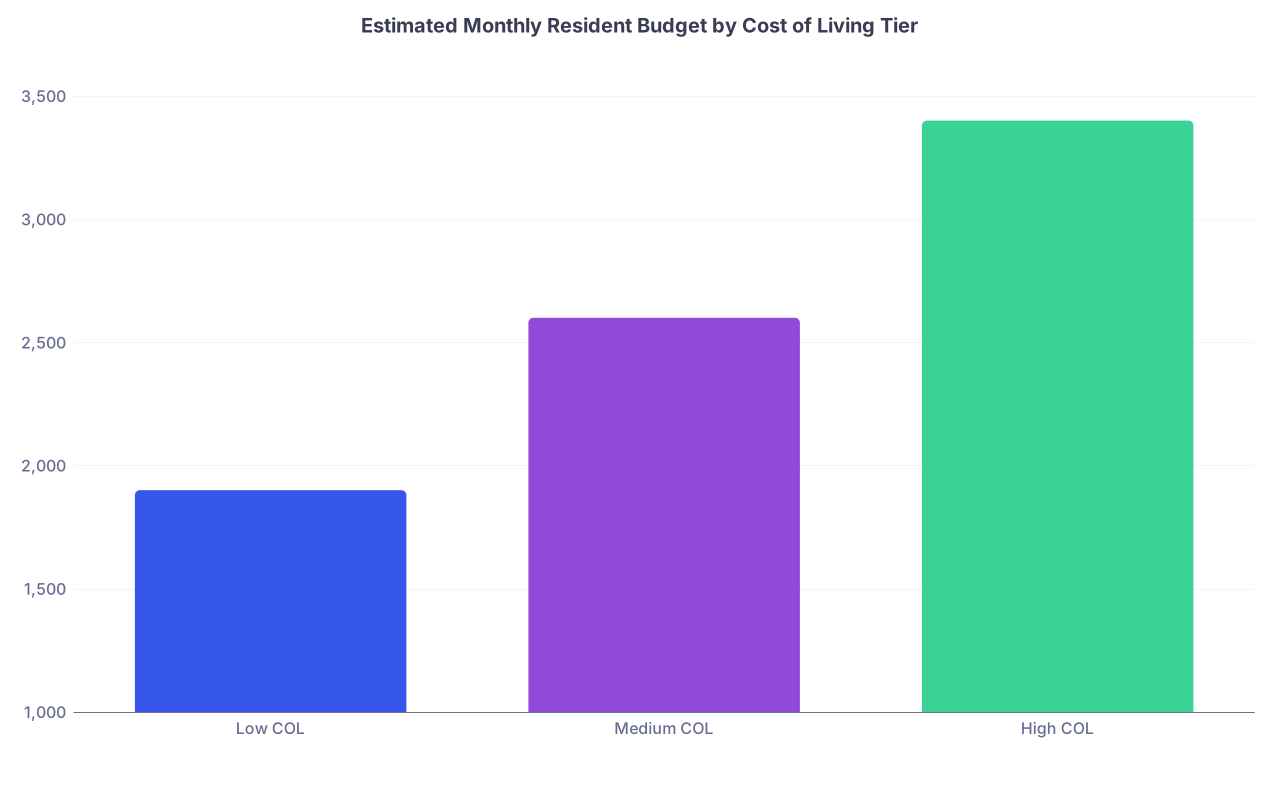
| Category | Value |
|---|---|
| Low COL | 1900 |
| Medium COL | 2600 |
| High COL | 3400 |
You do not need perfect numbers. You just need order‑of‑magnitude.
If the math says:
- City A: You will have ~$300/month left after essentials
- City B: You will have ~$1,000/month left
- City C: You are in the red unless you get help or take on credit card debt
That should materially move programs up or down.
4.2 Create a Deal‑Breaker Threshold
Decide on your non‑negotiable minimum financial safety:
For example:
- “I will not rank a program where, after realistic expenses, I am negative monthly without outside support.”
- Or “I must have at least $500/month flexibility after essentials.”
If a program fails that threshold, you have two choices:
- Drop it lower on your list, beneath any program that meets threshold.
- Remove it entirely from your rank list.
Yes, even if it is “prestigious.” Prestige does not cover overdraft fees.
Step 5: Be Honest About Region and Lifestyle
Region is not fluff. It is your day‑to‑day life, filtered through chronic fatigue.
Ask yourself three simple questions:
- What climates do I genuinely not function well in?
- Do I need urban density, or will that destroy me?
- Can I live in a place where my core values are in the minority?
You are going to be vulnerable, sleep‑deprived, and under stress. Everything irritating about a city is magnified. If you get seasonal depression every winter in the Midwest, do not convince yourself that “this time it will be different.”
5.1 Region Deal‑Breakers vs Preferences
Create two lists:
- Deal‑breakers
- “I will not live in a city with winter temps below X for 4+ months.”
- “I need to be within 30 minutes of an airport.”
- “I will not live in a state with law/policy X that directly contradicts my safety or values.”
- Preferences
- “I like big cities.”
- “Coastal is nice.”
- “I enjoy hiking/mountains.”
Deal‑breakers means: if a program violates this, you drop it below all non‑violating programs you would actually attend. Or you delete it from your list.
Preferences get handled via scoring, not elimination.
Step 6: Build the First Draft of Your Rank List
Now you have:
- A weighted scorecard
- Program scores
- Clear deal‑breakers around family, cost, and region
Time to sort.
6.1 Sort by Composite Score First
Order programs by your composite score (highest to lowest). That is your starting structure.
Then modify with your absolute rules:
- Any program that violates a deal‑breaker (financially, regionally, or family‑wise): drop below all programs that do not violate. Or remove it.
The output will look something like this:
- Program X – 8.2
- Program Y – 7.9
- Program Z – 7.5
- Program A – 7.3 (but high COL, near family)
- Program B – 7.1 (lower training reputation but best cost + partner job)
Now we fine‑tune.
Step 7: Use Scenario Testing to Break Ties
You will end up with clusters of programs that feel similar. This is where people stall and start guessing.
Instead, do scenario tests.
Take two close programs and ask:
“If I matched at Program A tomorrow, how would I feel? Now how about Program B?”
If you feel a sense of relief about one and tightness in your chest about the other, that matters. Your subconscious has already decided what it values.
You can also structure scenario tests by type:
7.1 Family vs Training Scenario
Program 1:
- Excellent training, far from family, high COL
Program 2:
- Solid but not elite training, driveable to family, moderate COL
Ask yourself:
- “I am 11 months into intern year, it has been brutal, and my parent is hospitalized. Which program choice do I regret less?”
If you already know which one you would resent, that is your answer.
7.2 Cost vs Region Scenario
Program 3:
- Dream city, awful rent, constant money stress
Program 4:
- Boring city, cheap, you can actually save
Picture your life each month:
- Can you tolerate having no margin for error financially for 3–5 years?
- Or will that constant stress crush you harder than a boring location?
Write down your gut choice. Use it to nudge the order.
Step 8: Special Cases – Couples Match, Kids, Elderly Parents
Things get hairier when more people are involved. You need extra structure.
8.1 Couples Match: Shared Scorecard
Stop pretending this is two separate rank lists.
You need:
- A shared set of priorities (you both sign off)
- A combined scorecard where:
- Training domains are listed for both of you
- Family/Support, Cost, Region are joint
For each city pair (Program A for you, Program B for them), score:
- Your training fit
- Their training fit
- Combined family situation
- Combined cost (two salaries, housing for two, etc.)
- Combined region fit
Then assign weights agreed upon together (you both compromise). Only then build your couples rank pairs.
One more brutal truth: sometimes one partner refuses to be honest about their flexibility. Force the conversation now, not when you are stuck in a city one of you secretly hates.
8.2 Kids: Childcare Is Not Optional Noise
If you have children, “family, cost, and region” become a very concrete set of constraints:
- Is there reliable childcare that opens early enough for morning rounds?
- Are there backup options when your kid is sick and you are on call?
- Does your partner have bandwidth to handle most kid logistics?
Programs with on‑site daycare or generous parental leave jump significantly. When scoring Cost/Financial and Family/Support, bump up childcare and backup support as heavy factors.
8.3 Elderly or Ill Parents
If you are actively involved in care, your decision changes.
Set specific rules like:
- “Maximum acceptable distance in hours by car/plane.”
- “I must be in a city with at least X flights per day to their city.”
- “I will not choose a place where last‑minute flights routinely cost more than [$X].”
Score programs accordingly. If necessary, adjust your weights so Family/Support is your top domain. That is not weakness; that is a clear life choice.
Step 9: Gut Check Against Fear and Ego
Once your list is structured, you have to filter out two toxic forces:
- Fear
- Ego
Ask explicitly:
- “Am I ranking this prestigious, distant, expensive program higher because of ego or because it genuinely serves my life and goals better?”
- “Am I ranking this close‑to‑home program higher out of fear of change, or because it truly supports me?”
Run each program through this filter:
- Would I still be proud of this choice 5 years from now when no one cares where I did residency, only what kind of doctor I am and whether I am burned out or not?
- Does this program support the version of my life I actually want, not the one other people expect?
Make adjustments where you catch yourself chasing status or hiding from discomfort.
Step 10: Final Pass – The “I Can Live With Any Match” Test
Before you certify your list, do one final exercise.
Look at your rank list from top to bottom and for each entry say:
“If I matched here, I could build a life I can live with.”
If you hit a program where the honest reaction is:
- “If I match here I will be absolutely miserable”
- “I would seriously consider not going”
That program should not be ranked. The algorithm might match you there. If you would not go, do not rank it. Full stop.
Do not keep a program on the list because “I might as well” or “maybe it will be fine.” This is not a lottery ticket. It is your life.
Visual: A Simple Decision Flow
Use this to sanity‑check your thinking:

| Step | Description |
|---|---|
| Step 1 | List all interviewed programs |
| Step 2 | Apply deal breakers |
| Step 3 | Move to bottom or remove |
| Step 4 | Score with weighted factors |
| Step 5 | Sort by composite score |
| Step 6 | Run scenario and gut tests |
| Step 7 | Adjust for fear or ego |
| Step 8 | Final I can live with any match test |
| Step 9 | Any program violates deal breaker |
If a program fails any major stage, it drops. No exceptions because the residents were funny on Zoom.
Quick Example: Putting It All Together
Let me walk through a realistic mini‑scenario.
You are an IM applicant with:
- $280k debt
- Divorced parents; one parent in moderate health issues whom you see monthly
- Strong preference for the West Coast, but not a deal‑breaker
- Long‑term goal: Cardiology fellowship, but you are flexible
You decide:
- Training/Program: 35%
- Family/Support: 25%
- Cost/Financial: 25%
- Region/Lifestyle: 15%
You have three programs:
- Program A – Big‑name city, high COL, far from family
- Great fellowship placement, high COL, cross‑country flight to parent
- Program B – Solid regional academic center, driveable to parent
- Good but not elite fellowship, moderate COL, 3 hr drive
- Program C – Community program, same city as parent
- Decent training, unknown nationally, very low COL
You score them honestly. Final composites:
- Program A: 7.2
- Program B: 7.4
- Program C: 7.0
Your old self might have auto‑ranked A > B > C “for the name.” But your structured approach says B slightly wins.
You scenario‑test:
- Imagine you matched at A: proud of the name, anxious about seeing your parent rarely, worried about money.
- Imagine B: less flashy, but you can drive home, money is tight but reasonable.
- Imagine C: financial and family dream, slight anxiety about fellowship competitiveness.
You know you can still get Cardiology from B or C with work. You know constant money stress and distance from family will hit you hard. You end up with:
- Program B
- Program A
- Program C
You can defend this list to anyone. More importantly, you can defend it to yourself when intern year gets rough.
Final Thoughts
Designing a rank list when family, cost, and region all compete is not about finding the “right” answer. It is about not lying to yourself.
Remember these three things:
- Force your priorities onto paper. Use weights and actual numbers. If you say family or cost matters, prove it in your scoring and final order.
- Set real deal‑breakers. For finances, distance, and region. If a program violates those, it does not deserve a high rank, no matter how shiny it looks on paper.
- Stress‑test your choices. Imagine your exhausted future self. Which program choice will you resent less when life is hard?
Do this properly and your rank list stops being a gamble. It becomes a conscious decision about the life you are willing to live for the next several years—and the doctor you are trying to become.