The belief that you cannot break into a new region without “local ties” is exaggerated, outdated, and—if you are strategic—flat-out wrong.
Programs like their comfort zone: local med schools, local rotations, local letters. Fine. Your job is not to whine about that. Your job is to give them such a coherent, evidence-backed story for your move that “no local ties” stops being a red flag and starts looking like a deliberate, well-planned decision.
I am going to give you a step-by-step plan to pivot regions even if:
- You did not grow up there
- You did not go to school there
- You have zero family or friends there
- Your current mentors have no connections there
This is fixable. But not with vague “I just love the city” statements on ERAS.
Step 1: Define Your Target Region Like a Strategist, Not a Tourist
The first mistake I see: people “decide” they want to move to “the West Coast” or “the Northeast” because of vibes. Programs can smell that from a mile away. You need specificity and proof of thought.
1.1 Lock down the region with real constraints
Ask yourself:
- Visa or citizenship constraints?
- If you need visa support, your “region” might be: “East Coast, large academic centers with history of sponsoring visas.”
- Relationship constraints?
- Partner in tech in Austin? Great. Your region is realistically Texas and maybe nearby states with easy flights.
- Career constraints?
- Want academic cardiology? You are not moving to a tiny community-only program in the middle of nowhere.
Now convert that into something concrete like:
- “I am targeting the Mid-Atlantic (DC/MD/VA/PA) with a preference for programs that have established hospitalist or subspecialty tracks.”
- “I am targeting the Pacific Northwest, particularly programs with strong primary care and rural training tracks.”
That sounds serious. That sounds intentional. Programs like intentional.
1.2 Build a short list, not a fantasy map
You are not “open to anywhere.” That reads as desperate and unfocused.
Do this:
- Pick 1–2 primary regions (where you truly want to land).
- Pick 1–2 backup regions (where you would be willing to go if needed).
- Build an actual list of programs in each.
Use:
- FREIDA (filter by region, program type, visa, etc.)
- Program websites (look at resident lists—where do they usually recruit from?)
- Doximity (ignore rank obsession; use for filters and basic info)
Now classify each program by realism:
| Tier | Description | How many to target |
|---|---|---|
| A | Reach programs | 5–10 |
| B | Realistic programs | 15–25 |
| C | Safety programs | 10–20 |
If you are pivoting regions, you cannot only apply to the glamorous city programs in that region. You need the Cs too—smaller, community, less well-known programs in the same geographic footprint.
Step 2: Manufacture “Ties” Before the Application Opens
You do not have natural ties. Fine. So you create professional and experiential ties.
There are five high-yield ways to do this. Ordered by power (and difficulty).
2.1 Away rotations / acting internships (gold standard)
If you are still in med school and have flexibility, this is your single best lever.
Priorities:
- Do at least one away in your target region.
- Better: two aways in the same metro or state (even if not your dream program).
Select sites strategically:
- Programs that routinely take their rotators as residents.
- Places where students actually get facetime with faculty, not just buried on ward teams.
On the rotation:
- Learn their EMR and workflows quickly.
- Be early, be prepared, and be visibly teachable.
- Ask for a letter explicitly framed toward your interest in that region/program type.
Then you can say:
- “After completing a sub-internship at XYZ in Baltimore, I confirmed my interest in training in the Mid-Atlantic region.”
- That is a tie. A real one.
If you are past the point of doing aways (or an IMG without that option), skip to the rest.
2.2 Remote research or QI projects with regional institutions
You do not need to be physically present to build an institutional connection.
Target:
- Faculty at your desired region’s programs with interests that match yours.
- Hospitals in that region with ongoing QI or population health projects.
Process:
- Identify 10–20 faculty members in your target region whose work aligns with your interests.
- Read at least one of their recent papers. Actually read it.
- Send a focused, short email:
- 3–4 sentences
- One specific comment on their work
- One concrete way you could contribute (data collection, chart reviews, lit review)
Do not write, “Do you have any research?” That gets deleted.
If you land even one remote project that lists:
- Their institution
- Their city
- Their region
You gain a manufactured “tie” that is completely legitimate. Now your application shows:
- “Research fellow with XYZ Medical Center, Seattle, WA.”
Now your pivot to the Pacific Northwest makes sense.
2.3 Conferences and regional meetings
Programs notice who shows up on their turf.
High-yield opportunities:
- State-level ACP, AAFP, ACS, ACEP, etc.
- Regional subspecialty meetings (e.g., NE regional cardiology conferences).
Your goal:
- Get your name on a poster or abstract
- Show up physically in that region
- Network with residents and faculty from your target programs
On your CV:
- “Poster presented at Pacific Northwest ACP Meeting, Portland, OR”
- “Attended Midwest Internal Medicine Resident Research Day, Chicago, IL”
Again: manufactured ties. Now you do have a story for “Why this region?” beyond weather.
2.4 Strategic networking with residents and fellows in that region
Blind cold emails to PDs are usually a waste. Cold emails to residents and fellows are not.
Sources:
- Program websites (resident and fellow lists)
- Med Twitter (yes, it still works if you behave like an adult)
Your message:
- Short
- Genuine
- Respectful of time
Something like:
“I am a [MS4 / IMG / transitional year resident] strongly interested in training in [region]. I noticed you trained at [X] and now are at [Y in that region]. Could I ask 2–3 specific questions about your transition to that area and what programs there value in applicants without local roots?”
You are not asking for a letter. You are not asking them to “put in a word.” You are building familiarity and intel.
Sometimes, this leads to:
- Insider advice about which programs truly take out-of-region applicants
- “Feel free to mention we spoke if you interview here”
- Occasional direct advocacy
Even when it does not, you now understand what those programs emphasize. That will shape your application.
2.5 Personal life anchors (use them, but do not overplay them)
If you have any of the following:
- Long-term partner or spouse in that region
- Match for your partner’s job/law/grad school
- Military commitment
- Aging parents you are relocating closer to
You must mention it. Once. Clearly. Professionally.
Do not write an entire personal statement about your boyfriend. But one crisp line in your regional paragraph is high-yield.
Step 3: Rewrite Your Story for One Region at a Time
Your personal statement and application language must be region-specific. Not generic.
If you fire the same boilerplate essay to all 80 programs, do not complain when they assume you have no real interest in them.
3.1 Build a “core narrative” and then regional modules
Do this:
- Write a core personal statement (why this specialty, who you are, what kind of physician you want to become). This stays 70–80% identical for all applications.
- Create regional paragraphs customized to:
- Region A primary
- Region B primary
- Maybe Region C backup
This regional paragraph should answer:
- Why this region specifically?
- What exposure do you already have to it?
- How does this region align with your long-term plans?
Bad version:
“I want to move to the West Coast because I enjoy the outdoors and diverse patient populations.”
Strong version:
“Over the last two years, my academic and professional collaborations have gradually centered on the Pacific Northwest. I worked with faculty at [Seattle institution] on a QI project improving diabetes care in community clinics, and I presented our early results at the Washington ACP meeting. This work exposed me to the region’s unique urban–rural interface and solidified my interest in training within the Pacific Northwest, where I plan to build a career in community-focused internal medicine with strong ties to academic centers.”
See the difference? There is an actual trail.
3.2 Use ERAS signaling and geographic preferences intelligently (when available)
If your specialty uses:
- Geographic preferences
- Preference signals
- Program signals
You need to rank regions and programs honestly but strategically.
For region pivoters, the rule:
- Over-invest your strongest signals into the new region you want to break into.
- Keep a safety net in your current region only through number of applications, not signals.
Do not spread your signals evenly across four different time zones “just in case.” That makes you look indecisive everywhere.
Step 4: Rebuild Your Application Details Around the Target Region
Everything in your application that can point to a region, should point to your chosen one. Or at least not contradict it.
4.1 Adapt your experiences section
Anywhere you can mention:
- Collaborative work with institutions in that region
- Projects serving patient populations similar to that region
- Skills that match that region’s needs (rural health, border medicine, immigrant health, etc.)
Do it.
For example, if you want the Midwest:
- Emphasize continuity clinic in a rural site.
- Highlight any experience with agricultural communities, opioid-affected regions, or underserved rust-belt cities.
If you want the Southwest:
- Emphasize Spanish language use.
- Border health, migrant populations, Native American health systems.
This is not random. You are showing that you are already aligned with that region’s patient realities.
4.2 Fix your letters of recommendation requests
You cannot control what your letter writers say, but you can guide them.
When you ask for a letter, say:
- “I am applying broadly but focusing particularly on [X region]. If you feel comfortable, it would help if you could speak to my readiness to train in a new environment and my adaptability to different health systems.”
Some faculty will ignore this. The good ones will not.
Bonus: if any of your letter writers have even the faintest prior link to your target region (trained there, grew up there, collaborated there), mention that in your ERAS or in interviews. Another subtle tie.
Step 5: Use Pre-Interview Communication Carefully and Sparingly
You can hurt yourself by over-emailing. But done well, a small number of targeted contacts can help.
5.1 When to email a program director or coordinator
Reasonable pre-interview emails:
- Clarify visa policies if you are an IMG.
- Explain a true, strong regional anchor (e.g., spouse job, dual-career situation).
- Alert them to a major, recent CV update (accepted publication, major award) particularly relevant to them.
Template for a regional pivot:
Subject: Applicant with strong commitment to [Region] – [Your Name, Specialty]
Body (short):
- 2 lines: who you are (school, year, specialty)
- 2 lines: why this region and their program specifically
- 1 line: concrete tie or anchor (project, partner, long-term plan)
- 1 line: polite close, no ask for “guaranteed interview”
If you ask, “Can I please get an interview?” it reads as desperation. Do not.
Step 6: Interview Day – Prove You Belong There Long-Term
Programs are wary of people who will train, then disappear back “home” immediately. Your job in the interview is to calmly destroy that fear.
6.1 Prepare specific, region-aware answers
You will be asked:
- “Why this region?”
- “What brought you here?”
- “Do you see yourself staying here after residency?”
If you stumble or give vague travel-guide answers, you are done.
Structure your answer into three parts:
- Professional logic
- Training style, case mix, academic vs community balance specific to that region.
- Existing ties or experiences
- The aways, research, conferences, contacts you built.
- Forward-looking plan
- A plausible, grounded idea of how you see your career unfolding there (even if you are not 100% certain).
Example:
“I am specifically seeking training in the Midwest because I want robust exposure to both tertiary referral centers and community hospitals. Through my work with a rural outreach clinic during medical school, I became very interested in how smaller communities interface with larger academic centers, which is a pattern that is very visible here. I have already begun collaborating with a faculty mentor at [Midwest institution] on a QI project around heart failure readmissions in rural patients. Long term, I see myself as a hospitalist or general internist in this region, ideally splitting time between a mid-sized city and outreach work to smaller surrounding communities. The infrastructure for that sort of career path seems very strong here.”
No fluff. Concrete, believable.
6.2 Ask questions that show you understand the region, not just the program
Bad questions:
- “What is there to do around here?”
- “How cold is the winter really?”
Good questions:
- “How does your program interface with the surrounding rural hospitals?”
- “What proportion of your graduates stay in this region, and what kind of jobs do they get?”
- “How do residents get exposed to the specific health challenges in [city/region]—for example, [diabetes burden, opioid crisis, immigrant populations, etc.]?”
You sound like someone already thinking as a future physician in that area, not a temporary visitor.
Step 7: If You Do Not Match in the New Region – Pivot Intelligently, Not Emotionally
Sometimes, even if you do everything right, you do not land in the new region on the first try. You scramble, SOAP, or match where you are now.
That is not the end of the story. It just changes the timeline.
7.1 If you SOAP or take a prelim / transitional year
Your goal that year:
- Align your projects, electives, and mentors with the region you still want.
You can:
- Do electives in your target region once you are in PGY1 (if your program allows outside rotations).
- Join remote research with faculty from your target region (see Step 2.2).
- Attend regional meetings there and get your new program’s support.
You will reapply with:
- One year of US residency training
- A much stronger, targeted regional story
- Program directors who can vouch for your professionalism and reliability
That is a massive upgrade from your first attempt.
7.2 If you match in your current region but want to move for fellowship or job
Same logic, different time horizon.
For fellowship:
- Present at national and regional meetings located in your desired region.
- Seek away electives / visiting rotations in that region if your residency allows.
- Target faculty mentors who are known and respected by programs in that region.
For jobs:
- Apply early.
- Use every fellowship or residency connection who trained there or has alumni there.
- Make one or two targeted trips to that region to meet groups and hospitals in person.
You can still move. It might just happen at the fellowship or attending level.
Step 8: Track and Adjust – This Is Not One Big Guess
Treat your regional pivot like a QI project, not a shot in the dark.
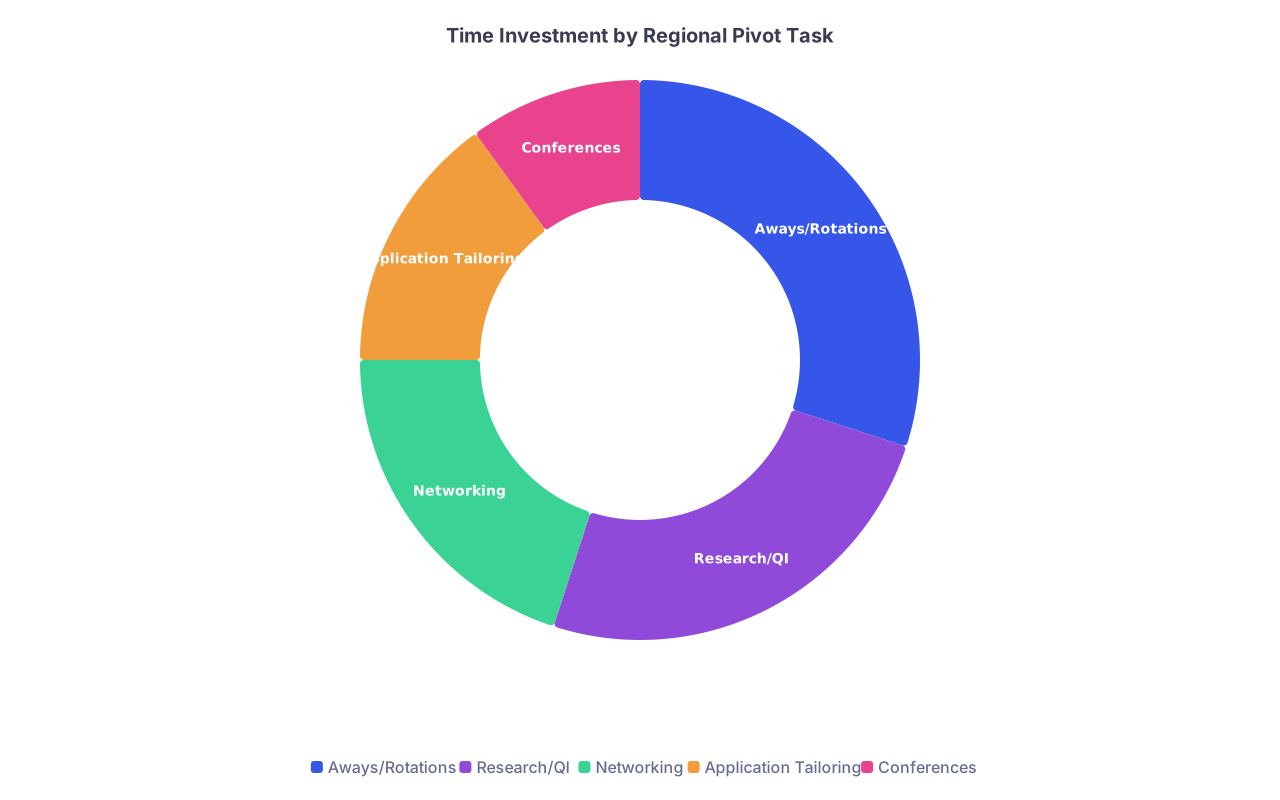
| Category | Value |
|---|---|
| Aways/Rotations | 30 |
| Research/QI | 25 |
| Networking | 20 |
| Application Tailoring | 15 |
| Conferences | 10 |
You have finite time and energy. You must see what is actually working.
8.1 Simple tracking system
Make one sheet with columns:
- Program name
- Region
- Type (academic/community/hybrid)
- Any existing tie (rotation, research, contact, conference)
- Application status (applied, interview, no response, rejection)
- Interview impression (if interviewed)
| Program | Region | Tie Type | Status |
|---|---|---|---|
| Univ A | Midwest | Remote research | Interview |
| Comm B | Midwest | Resident contact | No response |
| Univ C | Pacific NW | Conference contact | Rejection |
| Comm D | Current region | None | Interview |
Patterns you might see:
- Region A giving you interviews, Region B ignoring you.
- Programs where you have real ties responding at higher rates.
- Certain program types (academic vs community) being more open to outsiders.
Adjust the next year’s strategy based on data, not vibes.
Step 9: Emotional Reality Check – Stop Acting Like You Are Trapped
I have watched:
- Caribbean grads move from small IM residencies to faculty jobs in Boston.
- IMGs with zero US contacts match into California after two years of intentional networking and research.
- Residents from tiny Southern programs match cardiology fellowship in big coastal centers because they aligned their work and story.
The common denominator was not luck. It was deliberate, region-focused work over 12–24 months.
What does not work:
- Complaining that programs only like locals.
- Writing one generic personal statement and expecting the map to bend around you.
- “Manifesting” a move without building any visible commitment on paper.
You are not trapped by where you started. But you are constrained by how seriously you are willing to treat this as a project.
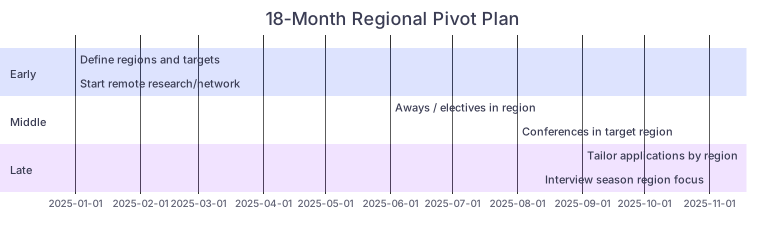
| Task | Details |
|---|---|
| Early: Define regions and targets | a1, 2025-01, 1m |
| Early: Start remote research/network | a2, after a1, 5m |
| Middle: Aways / electives in region | b1, 2025-06, 3m |
| Middle: Conferences in target region | b2, 2025-08, 2m |
| Late: Tailor applications by region | c1, 2025-09, 2m |
| Late: Interview season region focus | c2, 2025-11, 4m |


The Three Things That Actually Move the Needle
Keep this simple. The noise around regional bias is loud, but the levers are straightforward.
Concrete regional proof, not vague preference.
Aways, research, conferences, mentors, and experiences that tie you to your target region on paper and in conversation.A coherent, region-specific narrative.
Your story about why you are moving there must be believable, professionally logical, and consistent across your personal statement, ERAS, and interviews.Time and repetition, not magical thinking.
Some people pivot regions in one application cycle. Others need a prelim year, a research year, or fellowship. If you keep aligning your work and contacts with the region you want, you will stop looking like an outsider and start looking like someone who obviously belongs there.