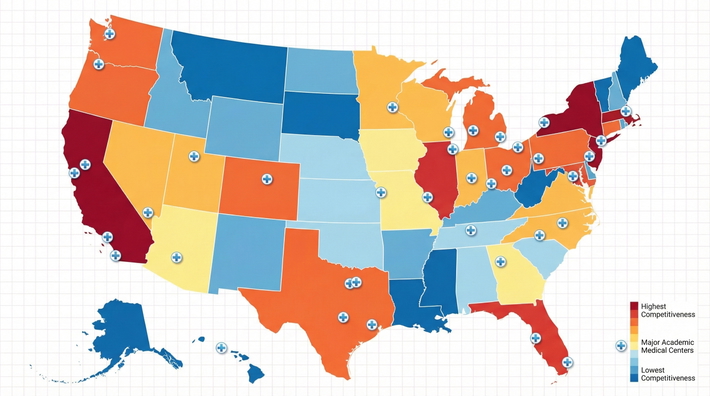
34% of fellows in some of the most “elite” subspecialty programs trained in what applicants casually call flyover states.
Not 3%. Not 5%. Over a third. I started noticing this reading fellowship rosters at places like Mayo, Cleveland Clinic, Michigan, Utah, and even coastal “brand name” places. The narrative on Reddit and in resident lounges—“If you don’t match big coastal academic, you’re dead for competitive fellowship”—does not match reality.
Let’s dismantle this properly.
The Myth: Coastal Zip Code = Fellowship Golden Ticket
The common script goes like this:
- Big-name coastal academic residency → doors fly open
- Midwest/South “regional” program → you are stuck regionally forever
- Community or state flagship in a non-coastal city → maybe generalist, but forget cards/GI/onc
This story persists because it feels intuitive and it flatters people chasing prestige. It’s also lazy, and the data do not support it.
Programs do not read your address and assign prestige by longitude. They care about:
- Who is vouching for you (letters and reputation of your mentors, not your ZIP code)
- What you’ve actually done (research, performance, board scores, clinical strength)
- How you show up on interview day
That is the hierarchy. Location is downstream of those things, not a magic spell.
What the Data and Rosters Actually Show
You will not find a randomized trial of “residency in Iowa vs Boston” for GI fellowship match. But you can do what fellowship PDs and serious applicants do: read rosters and patterns.
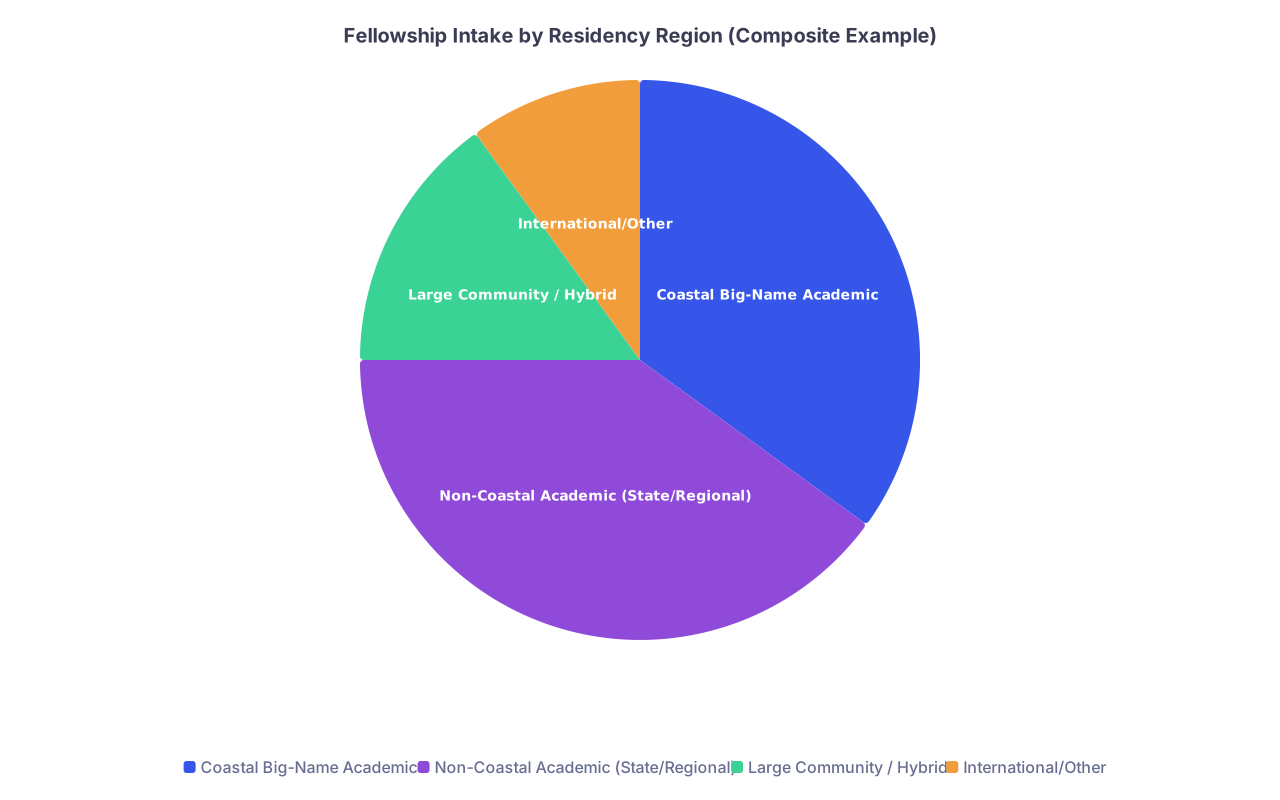
Here’s the kind of distribution you routinely see when you look at real rosters for high‑end fellowships (cards, GI, heme/onc) at academic heavyweights:
| Category | Value |
|---|---|
| Coastal Big-Name Academic | 35 |
| Non-Coastal Academic (State/Regional) | 40 |
| Large Community / Hybrid | 15 |
| International/Other | 10 |
Notice what that actually says:
- Around one third from “brand name” coastal places
- A bigger chunk from state flagships / non-coastal academic centers
- A meaningful slice from big community programs
If you’re in, say, a strong university hospital in Nebraska, Wisconsin, Tennessee, or Kansas, you’re in that middle 40%. That’s not “you’ll never leave.” That’s a primary pipeline.
Are coastal programs overrepresented? Yes. Are non-coastal programs locked out? Absolutely not. The idea that geography alone is determinative is fiction.
What Really Matters More Than Your State
Let me walk through the actual levers that move your fellowship application. These are the things PDs talk about in closed rooms, not the stuff in anonymous forums.
1. Who writes your letters (and who reads them)
I’ve watched PDs skim an application for 30 seconds, then flip straight to the letters and the letter writers. The thought process is blunt:
- “Is this writer someone I know, or someone whose judgment I trust by reputation?”
- “Does this letter sound generic or does it describe real, specific excellence?”
You can get letters like that in Minnesota, Indiana, Utah, Arkansas—anywhere that has legit subspecialty faculty.
Where you lose in a truly tiny, no-faculty community program is access to recognizable names in that subspecialty. But that’s not “flyover vs coast,” that’s “do you have subspecialists who are known in the field at all?”
Here’s the real hierarchy:
| Factor | Relative Impact |
|---|---|
| Strength/credibility of letters | Very High |
| Subspecialty research output | High |
| Program type (academic vs tiny) | Moderate |
| Geographic location alone | Low |
Notice: program type matters; geographic stereotype does not.
2. Subspecialty exposure and research
You do cards fellowship from a place where:
- There are actual cardiologists doing research
- You can show up to cath conference and heart failure rounds
- Someone is excited enough about you to put your name on a project
Plenty of “flyover” university programs check all of those boxes. In fact, some have more protected time and better‑organized resident research infrastructure than oversubscribed coastal giants.
I have seen residents at big-name coastal hospitals struggle to get any first‑author work because they are one of 40 residents trying to latch onto 6 overworked attendings. Contrast that with a smaller but academic midwestern program where a motivated resident becomes the go‑to person for GI QI projects or cards registries.
3. Your performance, not your address
Again, this sounds obvious, but applicants conveniently forget it because “I’m at Big Name” is easier than “I did the work.”
Program directors will look at:
- In‑training exam scores / board performance
- Your clinical reputation: “hard-working, independent, excellent with sick patients” vs “needs hand-holding”
- Concrete achievements: chief resident, teaching awards, significant QI projects
You can be the mediocre resident coasting in a shiny coastal hospital, or the star at a midwestern university. Guess which one consistently gets interviews.
Where Training Location Does Matter (But Not How You Think)
I’m not saying location is irrelevant. I’m saying it matters in more nuanced, less Reddit‑friendly ways.
Regional pipelines are real
Programs are biased toward what (and who) they know. Not because they hate the Midwest, but because:
- They’ve repeatedly interviewed residents from certain programs
- They know the grading culture, the leadership, and the style of letters
- They have alumni networks that funnel recommendations
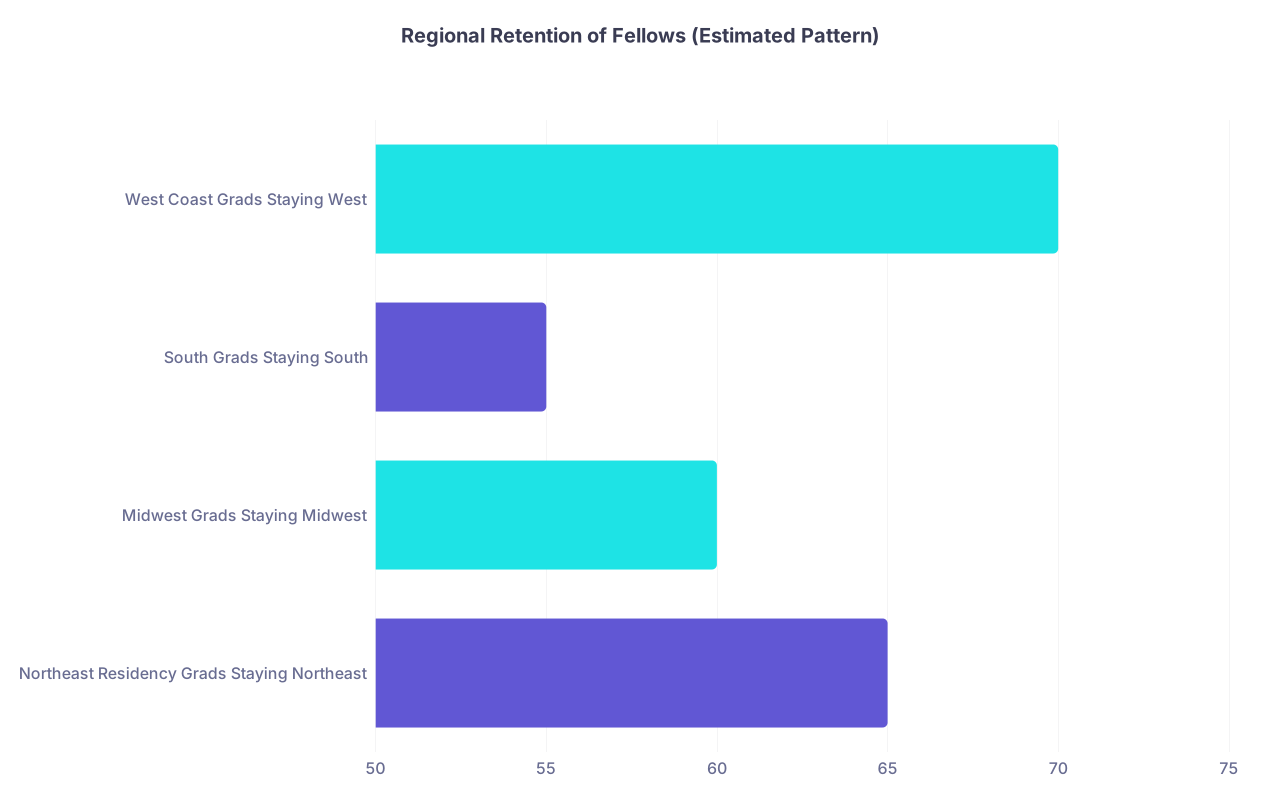
This creates regional clusters.
| Category | Value |
|---|---|
| Northeast Residency Grads Staying Northeast | 65 |
| Midwest Grads Staying Midwest | 60 |
| South Grads Staying South | 55 |
| West Coast Grads Staying West | 70 |
The healthy interpretation:
- Training in the Midwest makes it easier to stay in the Midwest
- Training on the coasts makes it easier to stay coastal
It does not mean training in the Midwest stops you from ever leaving. It just means the default path of least resistance is often regional.
If you’re at, say, University of Iowa and your dream is GI in Seattle or Boston, you don’t “need” a coastal residency. You need:
- A mentor willing to pick up the phone for those programs
- A record that looks clearly top‑tier compared to your peers
- A coherent story why you’re moving regions that makes sense
Name recognition vs actual training quality
Another subtle effect: some lesser-known programs in smaller states are an unknown quantity for coastal PDs. They might not know:
- How hard the rotations actually are
- Whether the top 10% there is equal to their average or better
This does not kill your chances. It just means:
- Your letters have to be explicit and specific: “top 1–2 residents I’ve ever worked with,” “functions at fellow level already”
- Your objective track record (scores, publications, presentations) has to back that up
If you’re at a mid‑tier, less-known program in a “flyover” region and your letters are lukewarm, yes, that’s a problem. But again, the culprit is performance and advocacy, not your area code.
The Real Risk: Tiny, Isolated Programs, Not “Flyover”
Let me draw a clean line between two very different things that often get lumped together.
Non-coastal but strong academic
- Examples: University of Wisconsin, Iowa, Nebraska, Kansas, Arkansas, Utah, Colorado, Kentucky, Alabama, Oklahoma, etc.
- Have fellowships, research, national presentations, subspecialty faculty.
- Graduates go to top fellowships every year.
Truly tiny, mostly community, little subspecialty footprint
- Minimal or no home fellowships
- One or two subspecialists in your desired field, no real research infrastructure
- Rarely send residents to competitive national fellowships
People call both of these “flyover.” That’s intellectually lazy.
If you want a competitive fellowship, it’s the second category that’s risky. But that second category exists in coastal cities too. A small community IM program in suburban New Jersey with no home GI fellowship is not automatically better for fellowship chances than a well‑respected academic IM program in Kansas.
Here’s how the risk actually stratifies:
| Residency Type | Fellowship Prospects If You Perform Well |
|---|---|
| Big coastal academic center | Excellent |
| Non-coastal academic with home fellows | Excellent |
| Large hybrid academic–community | Good to very good |
| Small community, no subspecialty base | Limited for most competitive fellowships |
Geography shifts the flavor, not the tier.
Three Common Misconceptions About “Flyover” Training
Let’s hit the greatest hits I hear from students and interns.
Myth 1: “No one on the coasts has heard of my program, so I’m doomed.”
Reality: PDs might not know your program intimately, but they absolutely know your faculty if they’re involved nationally.
You fix “unknown program” by:
- Working with attendings who are active in national societies
- Presenting at national meetings (ACC, DDW, ASH, ATS, etc.)
- Getting letters from people who are visible beyond your hospital
I’ve seen residents from what Reddit would call “no‑name Midwest IM program” land at MD Anderson for heme/onc and at top‑10 GI programs, because their mentors were nationally active and they had real CVs.
Myth 2: “If I don’t go to coastal residency right away, the door closes forever.”
Reality: Lateral moves exist. And fellowships absolutely recruit nationally.
You can:
- Do IM in Missouri, crush it, build a research track record, then match cards in California
- Train in Arkansas, then do heme/onc in Boston
- Start in a good regional program, then use away rotations, research years, or chief year to widen your network
There is no “one shot or die” mechanism. Medicine is full of late bloomers and circuitous paths.
Myth 3: “Fellowship PDs think less of Midwest/South training.”
Reality: Some of the hardest clinical environments and sickest patients are in exactly those places. PDs know that.
I’ve heard more than once on selection calls:
- “Residents from X midwestern program can manage volume. They’re ready.”
- “These guys see real pathology and less hand‑holding.”
If anything, there’s a subtle respect for people who trained outside the bubble and still built a strong academic profile.
How to Actually Evaluate a “Flyover” Program for Future Fellowship
If you care about fellowship, these are the questions that matter much more than the skyline outside the call room.

| Step | Description |
|---|---|
| Step 1 | Interested in Fellowship |
| Step 2 | Check Subspecialty Faculty |
| Step 3 | High Risk for Competitive Fields |
| Step 4 | Ask Where Fellows Come From |
| Step 5 | Ask Where Residents Match Out |
| Step 6 | Evaluate Research & Mentorship |
| Step 7 | Program Academic or Tiny |
| Step 8 | Home Fellowship? |
Concrete things to look at:
- Do they have home fellowships in your field of interest?
- In the last 5 years, where have residents matched for that fellowship? Names. Not vibes.
- How many subspecialists are there in your field, and are any of them actively publishing, presenting, or involved in national organizations?
- Is there structured research time, or is it all “do it at home after your 16‑hour shift”?
- Do they send residents to national meetings and help with abstracts?
You can be in a city most Americans couldn’t locate on a map and still check every one of those boxes.
So… Does a “Flyover State” Hurt Your Fellowship Chances?
If you’ve read this far, you already know the answer.
No, training in a flyover state does not inherently hurt your fellowship chances. What hurts you is:
- Training in a place—coastal or not—that has no subspecialty depth or academic culture in your area of interest
- Being anonymous at your program, with generic letters and no one willing to go to bat for you
- Assuming “I’m in the Midwest, so I’m stuck” and using that as an excuse to not build a serious CV
And what helps you is exactly the opposite:
- Strong, specific letters from respected subspecialists
- Tangible research or scholarly work in your target field
- Solid clinical performance and exam scores
- Strategic networking beyond your regional bubble
The state on your driver’s license is not your destiny. The content of your training—and what you do with it—is.
Key takeaways:
- Geographic region alone is a weak predictor of fellowship outcomes; program type, mentorship, and your performance matter far more.
- Strong academic programs in “flyover” states routinely place residents into top fellowships; tiny, isolated community programs are the real risk, regardless of coast vs Midwest.
- If you want competitive fellowship, prioritize subspecialty faculty, research opportunity, and match track record over city brand name.