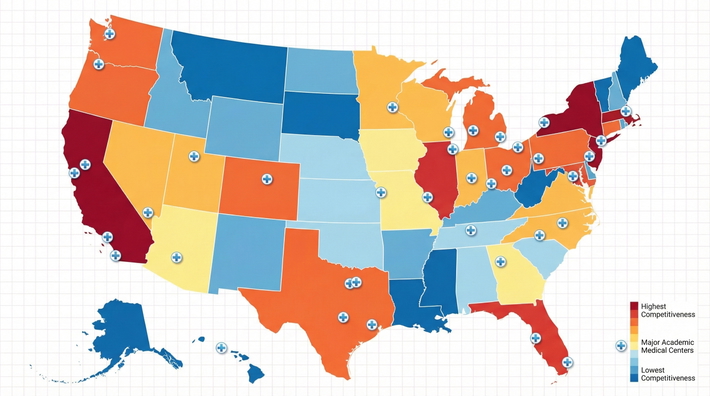
The obsession with coastal residencies is lazy thinking disguised as strategy.
You’ve heard the script: “If you want a top career, you have to be on the coasts—Boston, NYC, San Francisco, LA, maybe Seattle.” Anything inland is supposedly second tier. That’s not strategy. That’s herd behavior.
Let’s dismantle the “coastal = better” myth with what actually holds up: match data, fellowship outcomes, case mix, and real-world career trajectories—not Instagram shots of a hospital with an ocean view.
The Geography Prestige Trap
I keep hearing versions of the same line on rotations:
“If I don’t match on the coast, I’m screwed for academics.”
Wrong. Flat-out wrong.
What’s really going on is this:
Coastal cities tend to stack three things that people conflate with “better training”:
- Name-brand institutions (Mass General, UCSF, UCLA, Columbia, etc.)
- Dense populations with complex pathology
- Social signaling—“I live in NYC/SF/LA” sounds impressive at Thanksgiving
But geography is just the wrapper. The actual content—the training—depends on program quality, not longitude.
Look at it this way: if I move Mayo Clinic to Nebraska, does it suddenly become “mid-tier” because it’s not near salt water? Of course not. Yet this is exactly how a lot of applicants mentally rank programs.
The prestige geography myth survives because it’s simple. And applicants are stressed, overwhelmed, and time-poor. “Coasts good, middle bad” is an appealing shortcut. It’s also a terrible one.
What the Data Actually Shows (Not Your Group Chat)
Match and fellowship outcomes tell a different story than the Twitter narrative.
Is there clustering of top-ranked programs on the coasts? Yes. But clustering doesn’t equal monopoly. High-power, career-launching residencies exist all over the map.
| Program | Location | Notable Strength |
|---|---|---|
| Mayo Clinic | Rochester, MN | Elite subspecialty placement, research |
| Cleveland Clinic | Cleveland, OH | Tertiary/quaternary care volume |
| University of Michigan | Ann Arbor, MI | Research and fellowship pipelines |
| UT Southwestern | Dallas, TX | Ridiculous pathology and volume |
| Washington University | St. Louis, MO | Strong academic and fellowship outcomes |
Now, look at where leaders in various fields actually trained. Academic chiefs of medicine, chairs of surgery, program directors. Yes, you’ll see Mass General, Brigham, UCSF, Hopkins, Penn. But you’ll also see:
- Colorado
- Michigan
- Iowa
- Wisconsin
- Utah
- Nebraska
- UTSW
- Baylor
- UNC
- Emory
In other words: Plenty of “flyover” training backgrounds at the top of the food chain.
Programs care exponentially more about where you did your residency and what you did there than whether you could see the ocean from your apartment.
Pathology, Volume, and the “Boring Midwest” Lie
The idea that non-coastal programs have “weak pathology” is one of the dumbest persistent myths in medicine.
Coastal elites like to pretend that all the “real medicine” happens in Manhattan and the Bay Area. Anyone who’s worked in a major safety-net or referral center in the middle of the country knows how laughable that is.
Consider this: many landlocked academic centers are the only tertiary or quaternary referral hub for a massive multi-state region. Translation: the sickest of the sick go there. Not to the private coastal boutique hospital with valet parking.
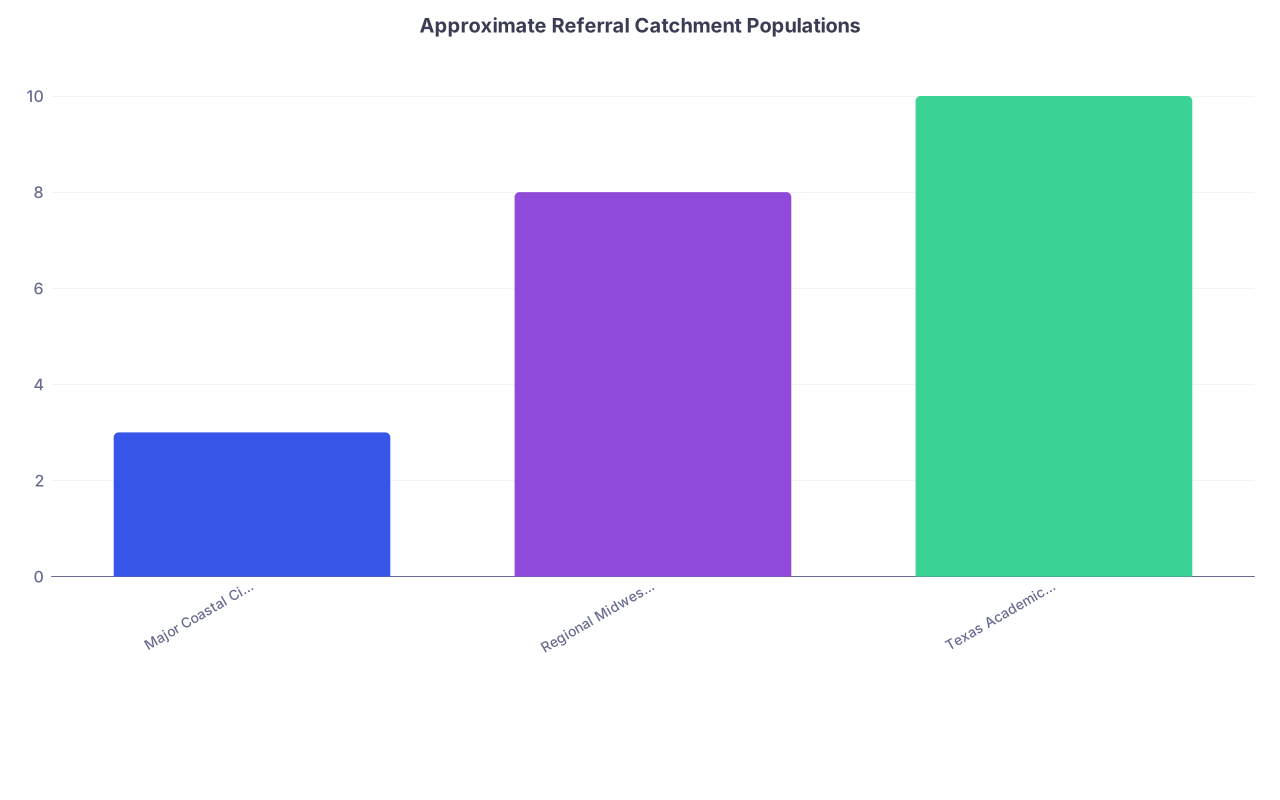
| Category | Value |
|---|---|
| Major Coastal City Hospital | 3 |
| Regional Midwestern Center | 8 |
| Texas Academic Center | 10 |
Think of it as millions of people, not exact numbers. The point: a lot of inland centers draw from huge geographic regions.
The reality in many non-coastal programs:
You see:
- Late-presenting disease because of poor access to care
- Severe, uncontrolled chronic conditions
- Multi-organ failure by the time they reach your ICU
- Trauma from farming, industrial, and highway accidents you almost never see in a dense coastal urban core
I’ve watched residents at landlocked programs manage jaw-dropping cases that rival anything on the coasts—often with less hand-holding, more autonomy, and fewer subspecialist safety nets at 2 am.
If your goal is to be clinically lethal—in the good way—non-coastal programs can absolutely be equal or better training grounds. Because you don’t just “consult out” everything mildly complex.
Fellowship and Career: Does Coast Matter?
This is where students usually get nervous: “But will I kill my chances at a competitive fellowship if I don’t match on a coast?”
The honest, slightly uncomfortable answer: your fellowship prospects depend far more on program culture, mentorship, and your own output than geography.
Fellowship selection committees look at:
- Strength and reputation of your specific program
- Letters from recognized mentors
- Your research productivity (if academic)
- How your PD and faculty advocate for you
- Your interview and professionalism
Geography is a weak proxy for all of this. Strong non-coastal programs place people into hyper-competitive fellowships every single year.
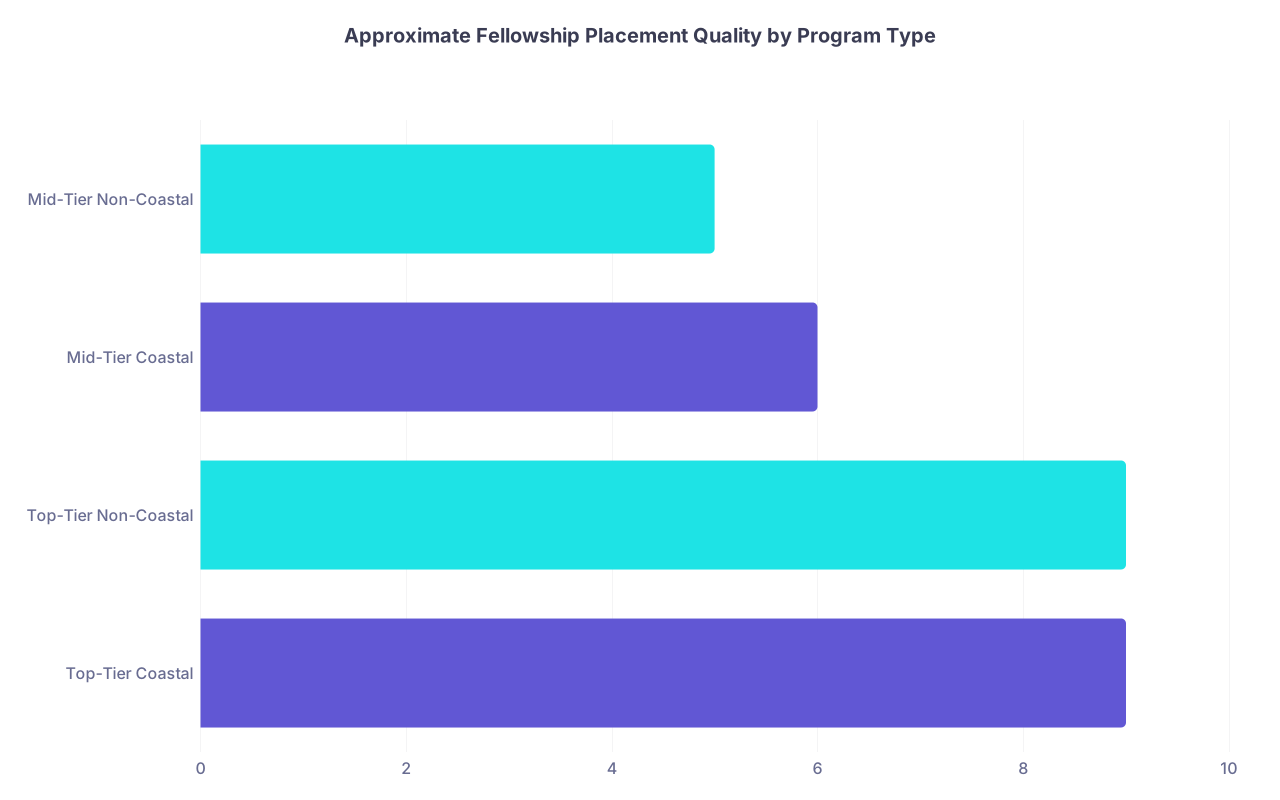
| Category | Value |
|---|---|
| Top-Tier Coastal | 9 |
| Top-Tier Non-Coastal | 9 |
| Mid-Tier Coastal | 6 |
| Mid-Tier Non-Coastal | 5 |
Treat those scores as “relative opportunity” on a 1–10 scale. Notice something? Top-tier is top-tier, coasts or not. Where you get into trouble is thinking “coastal” automatically equals “top-tier.”
A mid-tier coastal program with mediocre mentorship, minimal research infrastructure, and burned-out faculty can easily underperform a non-coastal powerhouse with strong support and clear pipelines into subspecialty training.
Fellowship directors know the difference. They know which programs—coastal or not—produce residents they trust.
Lifestyle, Money, and the Part Nobody Talks About
This is where coastal residencies get exposed.
Residents rarely run the math honestly. They just see “NYC! SF!” and stop thinking. So let’s put some numbers around the trade-off.
| City | PGY-1 Salary (Approx) | Typical 1BR Rent |
|---|---|---|
| San Francisco, CA | $78k | $3,300+ |
| New York City, NY | $76k | $3,000+ |
| Boston, MA | $76k | $2,700+ |
| Midwest City (e.g., St. Louis) | $65k | $1,100–1,400 |
| Southern City (e.g., Dallas) | $63k | $1,200–1,600 |
Yes, salaries can be a bit higher on the coasts. No, they don’t come remotely close to offsetting housing, taxes, and cost of living.
Residents at many inland programs:
- Rent a full apartment solo, not share a 700-square-foot shoebox with two co-residents
- Can own a car without handing over a kidney for parking
- Are not burning half their post-call day on transit
- Actually save money, pay down loans, or support a family
If you think wellness and burnout are purely about whether your hospital has a meditation pod and free coffee, you’re missing the bigger picture. Financial stress + brutal hours + no space + commute misery will crush you faster than not being walking distance from a Michelin-star restaurant.
There are absolutely residents who thrive in coastal megacities. But there are also a ton who quietly wish they’d matched somewhere sane, with sunlight, parking, and a cost of living that doesn’t feel like a hostage situation.
Coastal Halo Effect: Why Your Brain Keeps Getting Tricked
There’s a psychological bias at work here: halo effect. Because some of the top programs in the country are coastal, your brain subconsciously extends that glow to “coasts in general.”
You see:
- MGH, Brigham, UCSF, UCLA, Stanford, Columbia, Cornell, Penn
- Constant online chatter about NYC/SF/LA experiences
- Glam shots of scrub selfies with ocean sunsets
So you generalize: “Coastal = elite. Middle = backup.” This is sloppy thinking. You’re blending:
- Institution reputation
- Location desirability
- Social media noise
Into one mushy category called “better.” Reality check: there are excellent, average, and mediocre programs in every region. Coasts included.
I’ve seen it in real life:
An applicant ranks a mid-tier coastal medicine program above a top-tier non-coastal one purely because they “want to live in a big city” and are convinced fellowship doors will magically open just because a program is in LA. Then they discover their “big name city” program:
- Has minimal protected time for research
- Treats residents as warm bodies for service coverage
- Sends only a trickle of graduates to the fellowships they want
While their friend in a supposedly “less desirable” city has active mentorship, built-in scholarly time, and a PD who calls fellowship directors directly for their best residents.
The halo effect is powerful. And it’s costly.
Where Geography Actually Does Matter (A Little)
Not everything about geography is fake or overblown. There are legitimate ways location can influence your training and career.
First: regional networking. If you’re dead set on spending your life in the Northeast, training in that region can help with connections, letters, and comfort with the local system. Same for West Coast, South, Midwest, etc.
Second: patient demographics and exposure. Certain coastal cities give you extreme diversity in terms of languages, immigrant health, and rare pathologies tied to specific communities. Some inland programs give you depth in rural medicine, critical access transfers, and health system resource constraints.
Third: dual-career or family realities. If your partner has a very location-bound career, or your support system is in a specific area, location jumps from “nice to think about” to “non-negotiable.”
The mistake is turning these real considerations into a ranking system where “coastal = globally superior.” Region can and should be a factor. But it’s not the factor.
How to Judge a Program Without Falling for Zip Code Hype
If you strip away geography, what actually matters?
Ask yourself:
- Who are the people training me? Look at faculty, department culture, and evidence of resident support.
- What do graduates do? Programs that consistently place residents in the fellowships or jobs you want are gold, whatever the map says.
- How much real responsibility will I have? Excessive hand-holding or excessive scut can both be problems. You want graduated autonomy, not endless note-typing.
- How does the program talk about residents? As colleagues? As service coverage? You can hear it in how PDs and chiefs present their program.
- What’s the actual vibe from current residents? Not the staged interview-day smiles—the offhand comments, the way they talk about nights, consults, and administration.
Then—and only then—layer geography on top. As a modifier. Not a proxy for quality.
If you swap the name of the city in your mind and suddenly the program feels less impressive, that’s a red flag that you’re chasing status, not substance.
The Future: Less Geography, More Outcomes
Here’s the longer-term trend: medicine is moving, slowly, toward being more outcomes- and reputation-driven than place-driven.
Telemedicine, virtual conferences, national research collaborations—these are eroding the “you must be physically on the coast to be plugged in” argument. Program reputation today spreads through:
- Research output and presence at national meetings
- Word of mouth among fellows and attendings
- Resident performance on boards and in fellowships
- Shared multi-center projects and consortia
And lots of that is happening at landlocked powerhouses.
If you’re thinking 10–20 years out, prestige geography will likely matter even less. What will matter is: did your program set you up to practice excellent medicine, contribute to your field if you want to, and sustain a life you don’t hate?
That’s not a coastal vs non-coastal question. That’s a program vs program question.
The Bottom Line
Three things to walk away with:
- “Coastal” isn’t a qualification. It’s a coordinate. Top-tier and mediocre programs exist in every region; don’t confuse skyline with substance.
- Clinical depth, fellowship outcomes, and your own effort dictate your career far more than proximity to an ocean. Landlocked programs routinely produce national leaders.
- Use geography as a secondary filter—lifestyle, family, regional ties—not as a lazy shortcut for quality. Rank programs by training and outcomes first, zip code second.