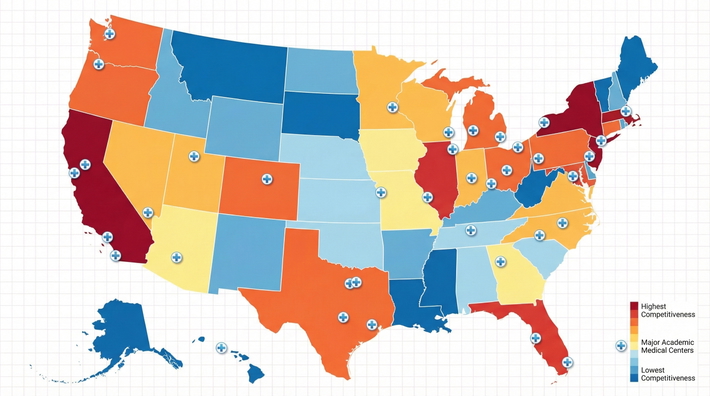
The belief that “big city = better procedural volume” is wrong. Not just oversimplified—wrong in a way that can poison your rank list and your training.
You’re not competing for a skyline. You’re competing for reps. And the things that actually determine your hands-on procedural experience are a lot more specific—and a lot more boring—than whether the hospital sits in Manhattan or a cornfield.
Let’s dissect the myth and get to what actually predicts procedural volume.
The Data: Big City ≠ Automatically High Volume
Program brochures love the word “high volume.” It’s as abused as “innovative” on tech websites.
Here’s the uncomfortable truth: the relationship between city size and procedural exposure is weak and extremely noisy. There is no consistent, national-level data set that says “residents in big metros get more procedures than residents in small towns.” What we do have are:
- ACGME case logs by program
- Specialty board case requirements
- Hospital-level procedural volume (CMS, state databases, published literature)
- Published surveys of resident operative experience
When you actually look, you see:
- Some of the highest procedural volume per resident is in mid-size cities or even places most applicants can’t find on a map.
- Some major, big-name city programs have residents quietly scrambling at the end to meet minimums.
- Procedural “volume” can be heavily concentrated in fellow or attending hands at prestige urban centers.
A famous example in surgery and OB/GYN: Several community-heavy programs in the Midwest and South routinely graduate residents with far above average case numbers, while some big urban flagships graduate residents just meeting ACGME minimums. Residents know this. Applicants don’t—because they’re dazzled by zip codes.
So no, you can’t use “population > 1 million” as a surrogate for “I’ll get a ton of airway, central lines, scopes, or operative cases.” That’s fantasy thinking.
What Actually Drives Procedural Volume
Let’s talk about the boring but real determinants of procedural exposure. These are the things that matter, and they cut right through the “big city vs small city” nonsense.
1. Case Mix and Hospital Type
There’s a big difference between:
- A quaternary referral center doing rare, complex pathology, and
- A high-throughput community hospital doing bread-and-butter cases all day
In many procedural specialties, bread-and-butter = your reps.
Urban academic megacenters often:
- Take the weirdest, sickest patients
- Have tons of subspecialists and fellows
- Structure rotations so residents see complexity and “manage” rather than do every step
Community-heavy or hybrid programs—often not in the biggest metros—frequently:
- See huge volumes of common procedures
- Have fewer learners fighting for each case
- Hand more of the case to residents because there’s no fellow hovering
If you want to be technically solid in routine lap chole, C-section, colonoscopy, central lines, chest tubes—high-volume community service can beat ivory-tower prestige every time.
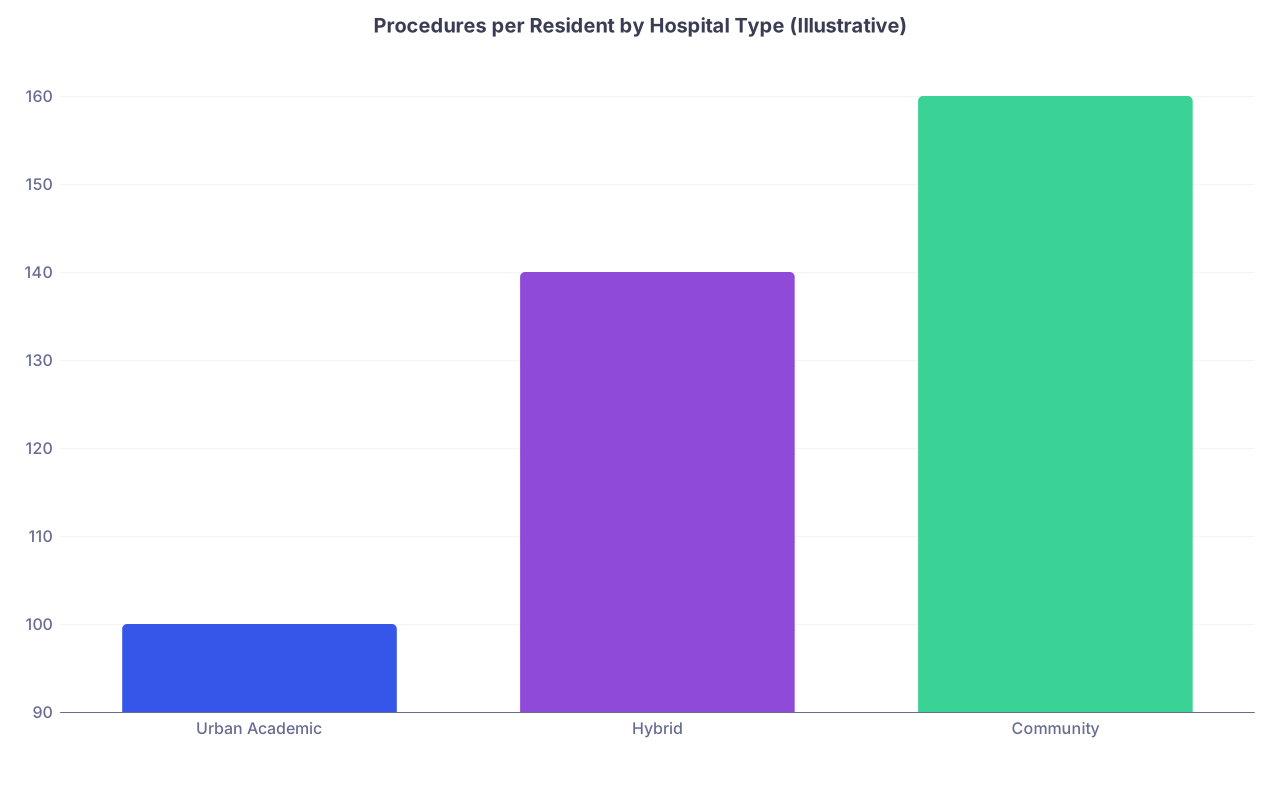
| Category | Value |
|---|---|
| Urban Academic | 100 |
| Hybrid | 140 |
| Community | 160 |
Is that chart exact national data? No. But it’s directionally consistent with what many specialty surveys show: community exposure often boosts per-resident numbers.
2. Number of Learners Per Case
You want a depressing equation?
Procedures per resident ≈ (Total cases × % resident-appropriate) ÷ (Residents + Fellows + Advanced practice learners)
A big-city program might have:
- Multiple residency programs pulling from the same procedural pool
- Several fellows in each subspecialty
- Nurse practitioners/PA fellows learning procedures
- Medical students lined up to “practice” suturing at closure
So your big tertiary-care downtown hospital with “huge volume” might deliver less per capita volume than a smaller program with fewer learners.
I’ve seen this play out in anesthesia and surgery repeatedly. The “huge volume” city program where CA-3s are still fighting with fellows for certain blocks or peds cases. Meanwhile, the no-name city program where CA-2s basically own key procedures.
The Hidden Killers of Resident Volume in Big Cities
Let’s get more specific about why big urban environments often undercut resident procedural volume, despite high patient numbers.
1. Fellow Creep
Fellows don’t show up on the glossy recruitment brochure where they say “you’ll get tons of experience in complex X.” But in the OR board room, they’re real, and they go first.
- Interventional cardiology fellows doing most caths
- GI fellows snatching every ERCP and many colonoscopies
- Surgical oncology fellows driving the cool liver and pancreas cases
- MFM fellows taking the tricky or high-profile deliveries
In a lot of big-city institutions, complex = fellow case unless the attending makes a deliberate choice to favor residents. Some do. Many don’t.
You need to explicitly ask:
- How many fellows are there in each procedural/service line?
- Who typically does what part of the case?
- Can senior residents still book and run their own room/clinic lists?
If a program dodges those questions during interviews, that’s your answer.
2. Subspecialization and Fragmentation
The more specialized an institution, the more fragmented the procedures.
Think about:
- Trauma split between multiple teams
- OB, Gyn, Gyn Onc, REI all owning different procedures
- Neurointerventional, stroke teams, neurosurgery all touching similar patient populations
In a smaller or less fragmented hospital, the same team might control a broader range of procedures. That’s often better for your education—more variety in your hands.
In giant metros, it’s common to hear residents say:
“I’ve seen a ton of X, but I haven’t done much of it”
because every step is carved out along service lines and fellowships.
When Big Cities Do Help Your Procedural Life
It isn’t all downside. There are situations where a big metro genuinely boosts your procedural training—but they’re conditional.
1. Multiple Affiliated Sites
The strong big-city residencies quietly solve the volume problem by sending you to:
- A massive academic center for complexity and weird pathology
- A community affiliate for repetitious bread-and-butter procedures
- Sometimes a county or VA for trauma, underserved populations, and autonomy
If the program has:
- Balanced time across these sites
- Clear case ownership for residents at each
- No fellow interference at the community or VA sites
Then yes, you can get the “best of both worlds”—complex cases downtown, volume and autonomy off-site.

| Step | Description |
|---|---|
| Step 1 | Main Academic Center |
| Step 2 | Complex Cases |
| Step 3 | Fellows Present |
| Step 4 | Community Hospital |
| Step 5 | Bread and Butter |
| Step 6 | Fewer Learners |
| Step 7 | VA or County Hospital |
| Step 8 | Autonomy |
| Step 9 | Resident Rotations |
The problem is applicants lump all big-city programs together instead of asking: “Do you actually have this multi-site structure with protected resident ownership?”
2. Specific High-Volume Services
Some big-city hospitals really are uniquely high volume for specific things:
- Trauma centers with absurd numbers of penetrating injuries
- OB units with >10,000 annual deliveries
- Cath labs running interventions 24/7 at scale
- Transplant centers doing liver/heart/transplant at a pace nobody else touches
If your career path is dead-set toward one of those niches, that may justify picking a big-city center that dominates that particular procedural area. But again: you still have to ask whether residents actually do the procedures or just hold retractors while fellows work.
The Rural and Mid-Size Advantage Nobody Markets
You know what smaller programs and mid-size city residencies are usually bad at? Branding. They don’t brag well. Meanwhile, their residents are swimming in cases.
Typical pattern in rural or mid-size settings:
- Fewer fellows, often none outside maybe critical care
- Wide procedural ownership by residents
- High per-resident volume in core, day-to-day procedures
- Attendings who trained at big-name places but came back home to actually operate and teach
Family medicine residents placing tons of lines and doing scopes at a regional hospital. EM residents in a college town intubating constantly because they staff almost everything. General surgery in a midwestern city where PGY-2s are main surgeon on basic cases.
These are real scenarios. But they don’t have the skyline or the famous name, so applicants underestimate them.
| Factor | Big City Academic | Mid-Size Hybrid | Rural/Community-Heavy |
|---|---|---|---|
| Total Hospital Volume | Very High | High | Moderate–High |
| Learners per Case | High (many fellows) | Moderate | Low |
| Resident Case Ownership | Variable, often limited | Strong | Very strong |
| Bread-and-Butter Exposure | Sometimes constrained | Strong | Strong |
| Complex Pathology | Excellent | Good–Very good | Variable |
That table is generalized, of course. But it tracks with what you’ll hear if you talk to current seniors at a lot of programs, not just the PD.
How to Actually Evaluate Procedural Volume (Without Getting Catfished)
If you care about procedures—and you should—stop asking “Is this program in a big city?” and start asking questions that correlate with reality.
Step 1: Look at Actual Case Logs and Graduates
You want:
- ACGME or internal reports on median and range of cases per graduating resident
- For your specific procedural categories (not just total cases)
- Comparison to national averages, if they have it
Programs that are proud of their numbers will show you this. Programs that are weak will change the subject.
Step 2: Drill Down on Fellows and Ownership
Ask on interview day or during second looks:
- Where do fellows exist? Which services?
- When there is a fellow, what cases do they get vs senior residents?
- At community or VA sites, are there any fellows? Who does the majority of the procedures there?
You will get very different answers between programs that look identical on paper.
Step 3: Ask Residents About Senior Autonomy
Not interns. Not PGY-2s who are still optimistic. Senior residents and chiefs.
Questions that actually reveal reality:
- “If something needs to be done urgently at 2 a.m., who actually does it?”
- “Do you ever feel like you’re scrambling to meet case minimums?”
- “On a typical day in [core rotation], how many procedures do you personally do?”
- “Do seniors have their own OR days/rooms/clinic lists they run?”
Listen for hesitation. Vague “oh yeah, volume is good” is less convincing than someone who can rattle off an average list from yesterday.
Step 4: Map Out Rotations by Site
If a program is big-city based but claims strong volume, the blueprint usually looks like:
- Time at main academic hospital (more complex, more learners)
- Time at community affiliates (higher bread-and-butter volume, fewer learners)
- Sometimes time at a VA or county facility (autonomy, underserved)
You should literally sketch out their rotations by location and ask:
- “Where did you log most of your [key procedure] numbers?”
- “Which site would you say made you technically comfortable?”
When residents say “honestly, the community site is where I learned to operate,” you’ve just identified the secret workhorse of the program.
The Future: Volume Alone Won’t Save You
One last uncomfortable point: even high procedure counts don’t automatically equal competence. And this is where the future of residency is headed.
We’re moving toward:
- Competency-based education
- Objective assessments of technique and decision-making
- Simulation-based training augmenting live procedures
- More scrutiny from boards and hospitals on whether “numbers” reflect real skill
A program with mindless volume but poor teaching, rushed attendings, or chaotic workflow can still graduate weak proceduralists. Conversely, a program with moderate volume but outstanding teaching and structured feedback can turn out very strong graduates.
Big cities aren’t leading or lagging here by default. Some urban academic centers are innovating in simulation and competency tracking. Some are still coasting on name alone. The same variability exists in mid-size and rural programs.
So your questions should evolve from only “How many?” to also “How well is this taught?”
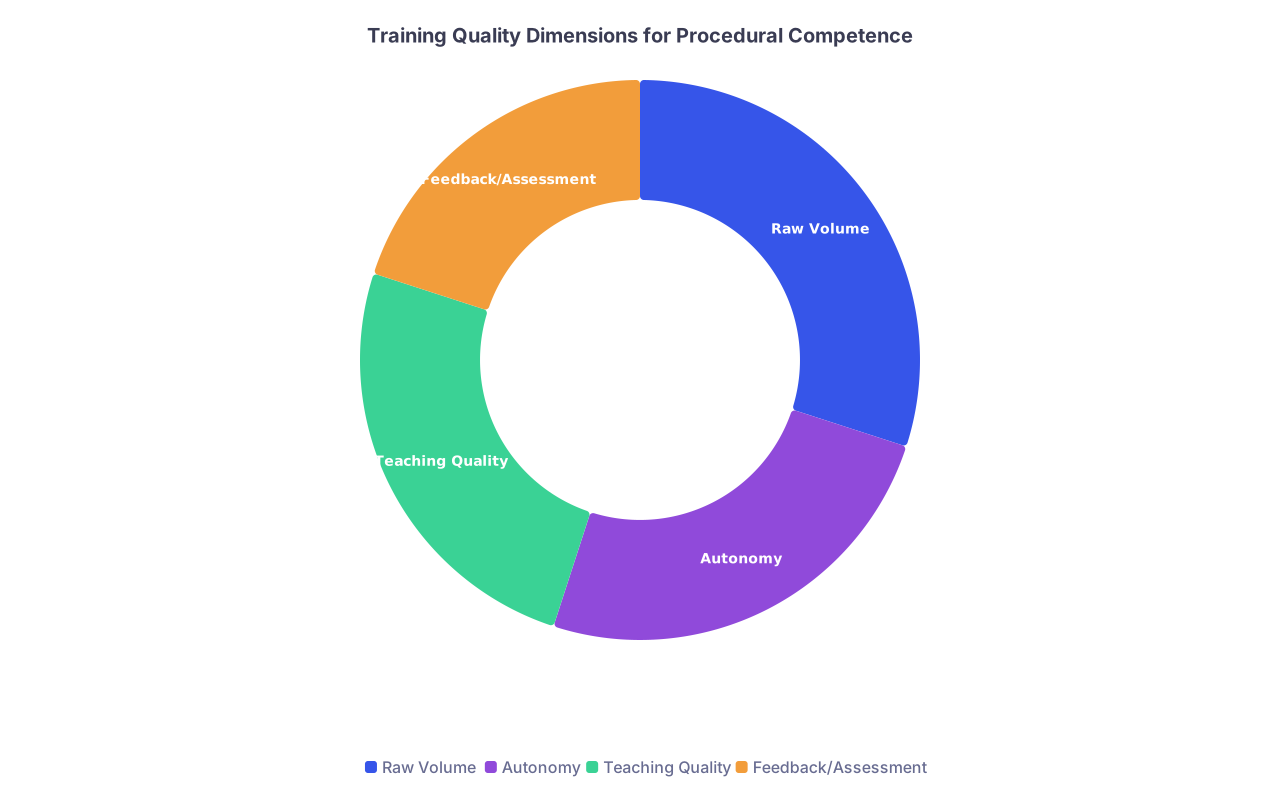
| Category | Value |
|---|---|
| Raw Volume | 30 |
| Autonomy | 25 |
| Teaching Quality | 25 |
| Feedback/Assessment | 20 |
The big myth is that city size proxies all of those through “reputation.” It doesn’t.
How to Use This When Building Your Rank List
You’re reading a “regional residency guide,” so let’s make this concrete.
Let’s say you’re comparing:
- Big coastal metro, flashy brand-name academic center
- Mid-size city hybrid program with strong community partners
- Smaller city or rural-leaning program with massive service need
If you care about procedural skill, list them based on:
- Documented per-resident case logs in your target procedures
- Clear senior autonomy and case ownership
- Strong community/VA partners where residents—not fellows—run the show
- Teaching culture that actually trains your hands, not just your notes
That ranking may or may not put the big city on top. Often, it does not.

The Bottom Line
Three things you should walk away with:
- Matching in a big city does not guarantee better procedural volume. City size is a terrible proxy for per-resident experience.
- Actual procedural exposure depends on case mix, fellows, number of learners, affiliated community/VA sites, and culture of resident ownership—not the skyline.
- If you want real procedural training, ignore the zip code and chase programs that can prove their residents get numbers, autonomy, and teaching where it counts.