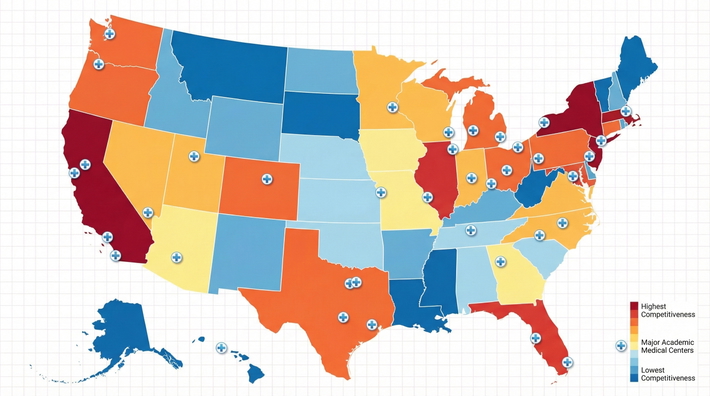
The fear that “if you leave your region, you can’t ever come back” is wildly overstated. The data simply does not support the idea that training out of region permanently poisons your chances of matching back home.
Does it make things different? Yes. Harder in some specific ways, easier in others. But the blanket warning you hear from classmates and Reddit threads—“never leave your region or you’re screwed”—is lazy advice.
Let’s walk through what actually happens when you try to match back home after training elsewhere, and who really gets burned.
The Myth vs. Reality: Does Region Lock Exist?
The “region lock” narrative usually sounds like this:
“If you go to medical school or residency outside your home region (Northeast, West Coast, Midwest, etc.), programs back home will assume you’re not serious and will rank local applicants ahead of you.”
There’s a tiny grain of truth under a pile of exaggeration.
Program directors do care about geography. The NRMP’s Program Director Survey (for multiple specialties) shows a consistent pattern: “ties to the area” is a positive factor, but it’s rarely a top-3 factor. Step scores, clerkship grades, letters, and perceived fit still dominate.
You know what that means? Being out of region doesn’t inherently hurt you as long as you can demonstrate ties and intent. And plenty of applicants do that successfully.
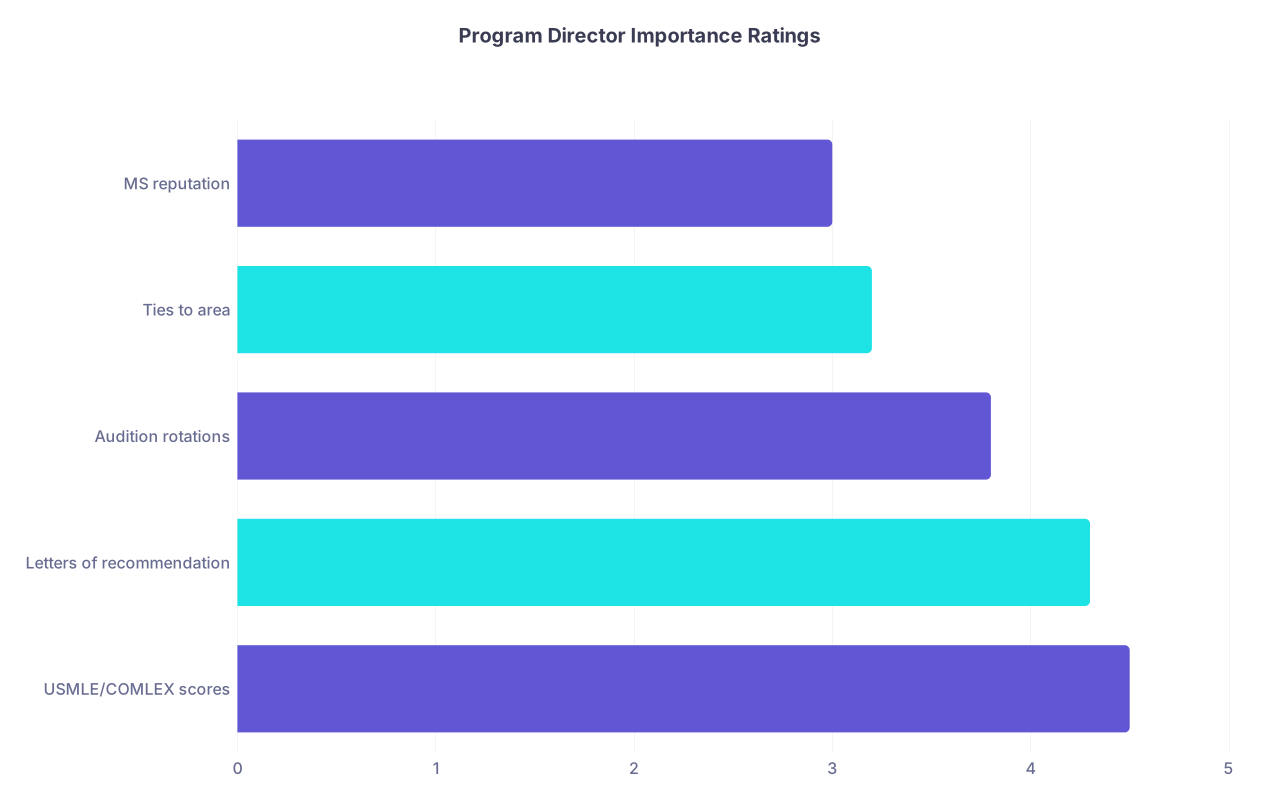
| Category | Value |
|---|---|
| USMLE/COMLEX scores | 4.5 |
| Letters of recommendation | 4.3 |
| Audition rotations | 3.8 |
| Ties to area | 3.2 |
| MS reputation | 3 |
You’ll notice “ties to area” isn’t trivial, but it’s not controlling the game either.
The real problem isn’t that you left your region. It’s that many people leave, then do nothing meaningful to maintain or re-establish a connection, and then act surprised when programs are skeptical.
Programs aren’t asking: “Where did you train?”
They’re asking: “Will this person actually come here and stay?”
Who Actually Struggles to Match Back Home?
I’ve seen the same archetypes get burned over and over.
The ghost applicant
Grew up in Chicago, went to med school in Texas, never rotated in Chicago, no Chicago letters, no mention of Chicago in the personal statement, then applies to every program in Chicago and says in the interview: “I just really like your city.” That applicant looks like a tourist, not a returner.The prestige gambler
From the Southeast. Goes to a mid-tier East Coast school. Aims only at the biggest, shiniest academic programs near home that are flooded with local students from their own pipeline schools. Ignores solid community and hybrid programs back home. When they don’t match “back home,” they blame geography instead of their top-heavy list.The last-second switcher
Does all rotations, letters, networking, and electives where they currently train; decides in November of M4 or late in residency that they “actually really want to go home.” At that point, they’ve built zero relationships or local credibility. Programs see them as a flight risk—because they are.
None of those are inherently about being out of region. They’re about being out of region and not acting like someone who truly intends to return.
What the Data and Patterns Actually Show
You’re not going to find a clean PDF that says “X% of people who leave never return.” NRMP doesn’t slice it that neatly. But there are consistent patterns from tracking match lists and institutional data over the years.
Here’s the rough reality you see if you look at multiple graduating classes from a few med schools and residencies:
| Scenario | Likelihood of Matching Back Home (rough pattern) |
|---|---|
| Strong ties + away rotation + local letters | Very high |
| Strong ties, no away, clear narrative | High |
| Weak ties, no away, generic story | Moderate to low |
| No ties, no narrative, no contact | Very low |
Note what’s missing: “Out of region = doomed.”
The people who reliably get back home did at least one of three things:
- Completed an away/audition rotation in the target region
- Got letters from faculty connected to that region
- Explicitly built and articulated a coherent narrative about returning (family, spouse, long-term plan, prior life there)
If you’re out of region and do none of those, yes, your odds drop. But that’s fixable with planning.
Specialty Matters Far More Than Region
Another inconvenient truth: in many specialties, regional issues are noise compared to specialty competitiveness.
Trying to go back to California for dermatology, ortho, ENT, plastics, or integrated vascular after training out of region? That’s not a “region” problem. That’s a “you chose one of the most constrained markets in the country” problem.
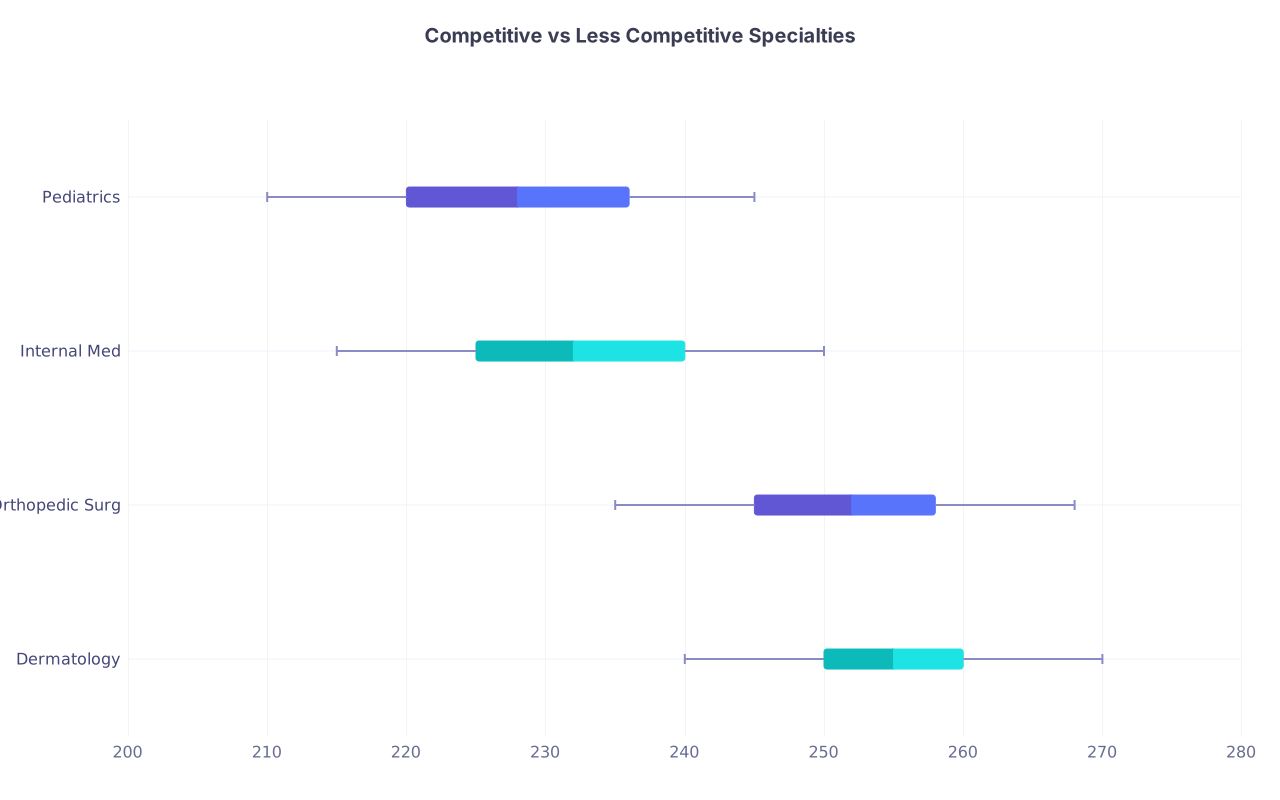
| Category | Min | Q1 | Median | Q3 | Max |
|---|---|---|---|---|---|
| Dermatology | 240 | 250 | 255 | 260 | 270 |
| Orthopedic Surg | 235 | 245 | 252 | 258 | 268 |
| Internal Med | 215 | 225 | 232 | 240 | 250 |
| Pediatrics | 210 | 220 | 228 | 236 | 245 |
Highly competitive specialties + hyper-desirable regions (SoCal, NYC, Bay Area, Seattle) form a bloodbath regardless of where you trained. Programs there are flooded with:
- Home students who rotated with them for 4+ weeks
- Regional pipelines they’ve trusted for decades
- Ultrastrong applicants from every elite institution
If you’re coming from out of region and from a less famous institution and targeting these hubs—you’re playing on hard mode. But you’d be playing on hard mode even if you never left home.
Flip it around:
Trying to return to the Midwest or South for internal medicine, pediatrics, family medicine, psych, or even many surgery programs? If your application is solid, your “out of region” status is a manageable problem, not a death sentence.
The spectrum is simple:
- Competitive specialty + popular metro = region hurts more, especially without ties
- Less competitive specialty OR less oversubscribed metro = region matters a little, but not decisively
Program Incentives: Why They Hesitate (And How You Fix It)
You need to think like a program director, not a nervous M3.
Their nightmare isn’t “someone from out of region.” Their nightmare is “someone from anywhere who leaves after training, badmouths the program, or bolts mid-career after they invested in them.”
Geography is just a crude proxy for retention risk.
They ask themselves:
- Does this person actually want to live here?
- Do they have real reasons to be here long-term (family, partner career, previous life here)?
- Are they just collecting interviews in every time zone and will choose whichever is shiniest?
That’s why someone from your state school with mediocre board scores might still beat you for a spot back home: the PD is 90% sure they’ll stay. You, out of region with no explanation, look like an unknown variable.
But you can change that perception:
Build an explicit narrative
Not “I like your city.”
More like: “I grew up here, my parents are still here, my spouse works for [company] in this city, we want our kids to be near their grandparents, and we plan to stay.” That is concrete, believable, and comforting for a PD.Put skin in the game
Away rotation. Second look. Reaching out to faculty with clear interest. Ranking multiple programs in that area, not just one elite place.Signal consistently
Mention your return-home intent in your personal statement, supplemental ERAS information, and interviews. Have your letter writers reinforce your plans to return if appropriate.
Programs are playing risk management. Make yourself the low-risk option, regardless of current geography.
The Med School vs Residency Difference
There’s another nuance people blur: matching back home after med school versus after residency.
From out-of-region med school back home for residency
This is the most common scenario students worry about.
Your main levers:
- Doing an away rotation in your target city/region
- Getting letters from regional faculty or alumni
- Using your personal statement and interviews to clearly explain your ties and long-term plan
Plenty of students born in California who go to med school in the Midwest match back to California for primary care, EM, psych, and even some surgical subs every single year. They are not unicorns. They just did the work to show programs they’re serious.
From out-of-region residency back home for fellowship or attending jobs
Here’s the twist: moving regions after residency is, in many cases, easier than moving regions for residency.
Why? Because now programs and employers care more about:
- Your operative/procedural volume
- Your reputation as a worker and colleague
- Your letters from attendings in the field
- Your board pass rates and clinical skills
Fellowship directors and hospital employers do not have the same “home-institution pipeline” bias that residencies often do. They want someone competent who will not be a disaster. If you’re good and you want to go home? They’re often delighted.
You know where people get into trouble? When their training is weak, their reputation is mixed, and then they expect geography to save them. It won’t.
The Away Rotation: Overrated, But Very Useful
People talk like a single away rotation guarantees you a spot back home. It doesn’t. But if you’re out of region and trying to return, it’s probably the highest-yield move you can make.

| Step | Description |
|---|---|
| Step 1 | Out of region trainee |
| Step 2 | Apply broadly elsewhere |
| Step 3 | Schedule away rotation |
| Step 4 | Get strong local letter |
| Step 5 | State clear ties in PS |
| Step 6 | Apply to multiple local programs |
| Step 7 | Higher chance to match home |
| Step 8 | Want to go home? |
You’re doing three things at once:
- Demonstrating you actually want to live and work there
- Giving faculty a chance to advocate for you as “one of ours”
- Getting an inside look at the program to make sure you’d actually be happy there
Is it mandatory? No. If you have very strong ties and a compelling story, you can still match back without it. But if you’re relatively anonymous in that region, skipping an away and then complaining about “region lock” is self-inflicted.
When Leaving Your Region Actually Helps You
One more unpopular point: staying in your region is not always the best career move.
Sometimes, leaving is an upgrade:
- Your home region is oversaturated with med schools and residents (think NYC, Boston, SoCal) and you’ll be competing with ten times as many people for the same jobs later.
- Another region has better training volume, more autonomy, or a stronger reputation in your specialty.
- You want broader perspectives, different patient populations, and different practice styles.
I’ve seen multiple residents go to the Midwest or South for training, get phenomenal procedural experience, then stroll back into coastal markets as appealing hires because they can do more, independently, from day one.
They “left” their region and actually improved their long-term odds there.
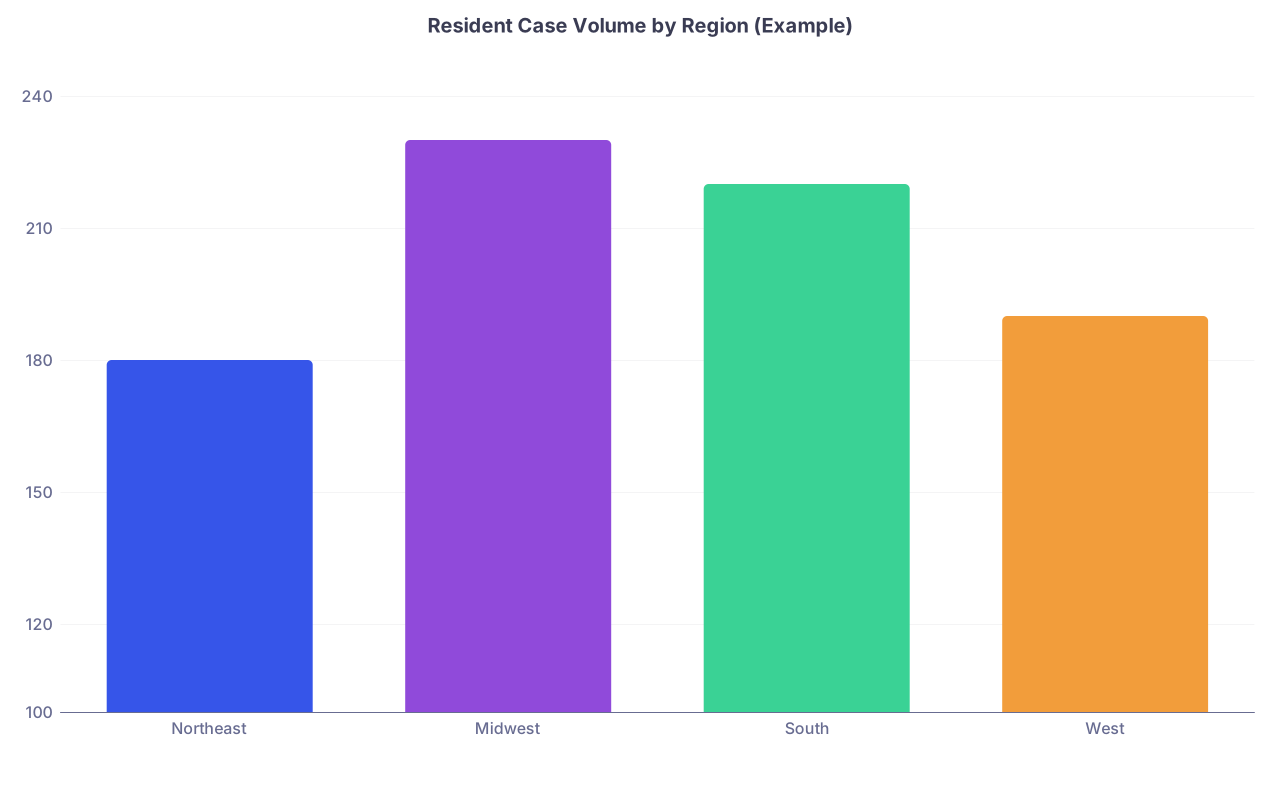
| Category | Value |
|---|---|
| Northeast | 180 |
| Midwest | 230 |
| South | 220 |
| West | 190 |
That’s a fictionalized dataset, but the pattern is real: some regions simply run busier, higher-volume programs. Employers know that.
Concrete Moves If You’re Out of Region and Want to Go Home
Let’s boil this into actions instead of vibes.
If you’re in med school out of region and planning residency back home:
- From M3 onward, deliberately plan 1–2 rotations (core or elective) in your target region if possible.
- Identify faculty or alumni with ties to your home region and tell them, explicitly, that’s your goal.
- Use your personal statement to make your “why home” story specific, not generic. Names, relationships, long-term plan.
- Apply to a range of programs back home, not just the most competitive academic names you recognize. Mix academic, community, and hybrids.
If you’re in residency out of region and planning fellowship or jobs back home:
- Go to conferences and introduce yourself to people from your target region. Ask about their programs.
- Present posters or talks with your home region programs on your radar; meet them in person.
- Use your mentors to open doors—most departments have someone who “knows a guy” in your region.
- When interviewing, be blunt about your plan to return and stay. Employers appreciate clarity.
None of that is magical. It’s just work. The people who do it stop blaming “region” for outcomes that were mostly about planning and positioning.
The Bottom Line
Three things to keep in your head:
Training out of region does not automatically make it harder to match back home. It makes it harder only if you’re lazy about maintaining ties and building a clear, believable story about returning.
Specialty competitiveness and city desirability matter more than geography. Trying to go back to a hyper-competitive coastal metro in a top-5 specialty will be brutal no matter where you trained.
Program directors care about retention and fit, not your zip code history. If you can convince them you’ll actually come, contribute, and stay, your “out of region” status becomes a footnote, not a deal-breaker.