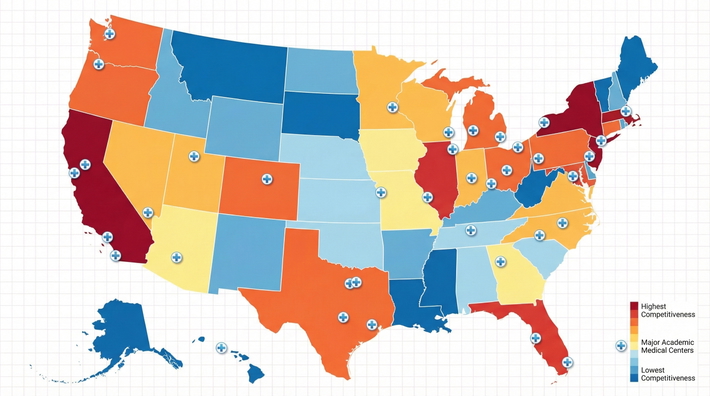
The narrative about “underserved” programs in the Midwest and Deep South is badly broken. A lot of what students repeat on Reddit or in group chats is flat-out wrong, outdated, or based on three anecdotes from people who never set foot in those regions.
You’re being sold a cartoon: coastal = prestige and opportunity; Midwest/Deep South = “backup,” low acuity, poor training, and miserable lifestyle. The data — match stats, procedure logs, fellowship placements, cost-of-living numbers — tell a very different story.
Let’s dismantle the common myths one by one.
Myth #1: “Underserved” = Low-Quality Training
This is the laziest assumption I hear: if a program calls itself “underserved,” especially in the Midwest or Deep South, people translate that as “couldn’t match anywhere else” and “bad hospital.”
Reality: a huge chunk of the country’s clinical volume and bread‑and‑butter pathology runs through exactly these places.
Look at where big trauma, high-risk OB, and true safety-net medicine actually happens. It’s not just the shiny coastal brand names. It’s county hospitals, regional referral centers, and state safety-net systems in places like:
- University of Alabama at Birmingham
- University of Mississippi Medical Center
- University of Louisville
- UT Memphis (Methodist/Regional One)
- Henry Ford (Detroit), University of Kansas, Nebraska, etc.
These are not “low quality.” They are the main referral hubs for entire states. That means high acuity, complex pathology, and volume that coastal boutique hospitals might not see.
To make it more concrete:
| Region | Example Type | Role in System |
|---|---|---|
| Deep South | State academic center | Only Level I trauma in state |
| Midwest | County safety-net hospital | Main indigent care provider |
| Deep South | Children’s hospital | Statewide pediatric referral |
| Midwest | VA + academic affiliate | Tertiary/quaternary mix |
Do some community-based Midwest or Southern programs struggle with resources, faculty recruitment, or subspecialty depth? Yes. So do community programs on Long Island, in New Jersey, or in inland California. Geography doesn’t cause mediocrity; leadership and funding do.
What “underserved” actually predicts:
- Higher uninsured/Medicaid mix
- More social complexity, barriers to care
- Less “screened” patient population (they show up later, sicker)
That combination usually increases your clinical exposure and independence, not the opposite.
If your career requires procedural competence, diagnostic confidence, and comfort with sick patients, an underserved-focused program in these regions can be an advantage, not a handicap.
Myth #2: You Won’t Match Competitive Fellowships from These Programs
This one refuses to die: “If you go to a Midwest or Deep South underserved program, you’re stuck in primary care or local practice forever.”
This is simply false. Program websites and NRMP data keep outing this myth every year.
Look at fellowship match lists from “non-coastal” academic centers. You routinely see people going into:
- Cards, GI, Heme/Onc, Pulm/CC from Louisville, Kentucky, Arkansas, Missouri, Kansas
- Ortho, ENT, Urology, Derm from places like UAB, Iowa, and Cincinnati
- EM grads from Midwestern county programs landing tox, ultrasound, critical care fellowships
Where people really get blocked is not “wrong region.” It’s:
- Weak letters (no one knows who you are, you never stood out)
- Thin CV with no scholarly output
- Poor Step 2/3 or in-training exams
- Mediocre program reputation within that field (some IM programs are weak for cards, some are strong — regardless of geography)
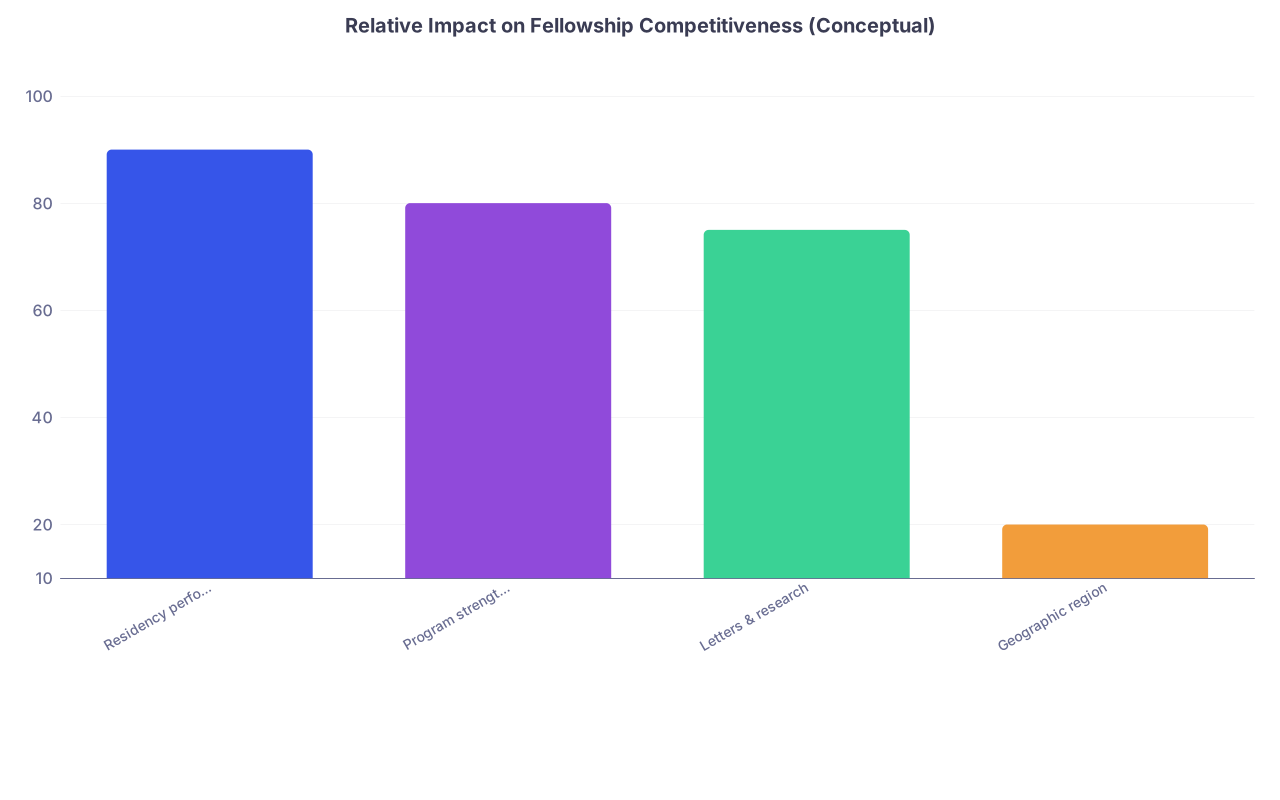
The effect size of “Midwest or Deep South vs coastal city” is tiny compared to “strong vs weak program in your specific specialty” and “top vs middle vs bottom of your class.”
Here’s how it tends to actually play out:
| Category | Value |
|---|---|
| Residency performance | 90 |
| Program strength in specialty | 80 |
| Letters & research | 75 |
| Geographic region | 20 |
The region is the least important variable by a mile.
There is one real pattern: some hyper-elite coastal fellowships tend to favor people from their usual “feeder” programs. But those feeders include powerful Midwestern and Southern institutions as well. If you think “prestige” equals only the coasts, you’re already operating with a broken map.
Myth #3: The Pathology is “Less Interesting” Outside the Coasts
I’ve heard this exact line: “If I go to [Midwest/Deep South city], I’ll only see diabetes and hypertension.”
Sure, if you did an entire month in a suburban primary care clinic, maybe. But step into any large safety‑net or tertiary center in these regions and you’ll quickly realize something: late‑presenting disease is everywhere, and it’s not boring.
You get:
- End-stage complications of common diseases: heart failure, advanced cirrhosis, awful diabetic foot infections
- Trauma from agriculture, industry, and motor vehicle accidents that city folks simply do not see
- Toxicology from regional exposures, snake bites, pesticides
- OB with minimal prenatal care
- Oncology caught much later due to access and trust issues
A lot of “underserved” programs are exactly where the “we never see this anymore” pathology still walks in every day.
What’s actually different from coastal academic centers?
- Less of the super-rare zebras sent for niche clinical trials
- More of the “this is what kills most Americans” pathology, but in its more advanced forms
If your goal is to become a clinician who can handle real-world medicine outside a glossy bubble, that second category matters more.
Myth #4: Training in the Midwest or Deep South Locks You Into Staying There
Another favorite: “If I match in the Deep South, I’ll never get a job back in California/New York.”
Again, no. Attending jobs are not residency applications. Employers care primarily about:
- Board certification and clean record
- Skillset and subspecialty
- Fit (do your references vouch for you, are you a sane human)
- Sometimes visa issues
Region of training? Way down the list.
The correlation people experience is different: many residents stay in the region where they trained because:
- They put down roots (partner, kids, house)
- They like the lifestyle and cost of living
- Local hospitals already know them and recruit aggressively
That’s preference, not captivity.
Yes, if you train at a tiny community program, anywhere in the country, and know nobody outside that region, your first job is likely to be local. But that’s a function of networking and visibility, not some invisible “Deep South stigma.”
If your plan is to leave:
- Go to national conferences
- Present, even small projects
- Build connections with faculty from other regions
- Choose electives away rotations in your target area if possible
People move all the time: Midwest-trained surgeons to the Pacific Northwest; Deep South-trained hospitalists to Boston; EM grads from Missouri to San Diego. It happens every single cycle.
Myth #5: These Programs Are Under-Resourced to the Point of Unsafe
This one has a kernel of truth that gets distorted.
Yes, genuine underserved safety‑net systems — in the Midwest, the Deep South, or anywhere — are financially stretched. You’ll see:
- Older equipment
- Nursing shortages
- Underfunded ancillary services
- Less “concierge” feel
But people then jump straight to “unsafe” or “substandard medicine.” That’s not usually true.
Residency programs are regulated by the ACGME. They don’t get a pass because they’re in Mississippi or Indiana. If they fail on supervision, procedure exposure, or didactics, citations land. In serious cases, accreditation goes on probation or is withdrawn.
The real differences you’ll feel:
- You work more with limited resources and must improvise within reason
- Social work, case management, follow‑up can be harder
- You learn to prioritize and advocate harder for your patients
That may be uncomfortable. It’s also exactly the skill set demanded in community practice pretty much anywhere.
The irony: many residents from “underserved” labeled programs end up more comfortable practicing in a wide range of settings because they trained in an environment that wasn’t padded and overstaffed.
Myth #6: Underserved Midwest/Deep South = Career Death for Highly Academic Types
There’s a belief that if you’re “a research person,” going to an underserved‑focused program in these regions will kill your academic career.
Sometimes that’s true — but only if you choose a place that genuinely doesn’t care about scholarship, not because of its address.
Look at NIH funding and publication output. The Midwest and Deep South have:
- Heavy‑hitting academic centers (UAB, Vanderbilt, WashU, Iowa, Emory, Cincinnati, etc.)
- Mid‑tier programs with pockets of strong research (a particular cardiology division, a cancer center, a pediatric subspecialty)
- Purely clinical workhorses with almost zero research infrastructure
Exactly like the Northeast and West Coast.
The key questions are:
- Does the department have funded investigators in your interest area?
- Are there ongoing clinical or translational projects you can join?
- Do residents consistently produce abstracts/papers, or is it a ghost town?
If those boxes are checked, the latitude/longitude of the institution is irrelevant. The main practical differences:
- You might get more individual attention in a smaller or mid‑tier program hungry to grow its research footprint
- You may have fewer built-in “brand name” mentors, but if someone publishes and sits on national committees, their letter still counts
You can absolutely go Midwest/Deep South, train in an underserved setting, and build a competitive academic CV. I’ve seen residents at “non-famous” programs match cards at places like Cleveland Clinic, onc at MD Anderson, and pulm/CC at top coastal centers. The common thread was productivity and strong letters, not a zip code.
Myth #7: Lifestyle in These Regions Is Automatically Worse
People assume “rural, boring, isolated, regressive” whenever they hear Midwest or Deep South. That’s lazy stereotyping.
Let’s separate three variables:
- Call schedule and hours – Program-specific, not regional. There are malignant programs in Manhattan and chill ones in Alabama.
- Cost of living – This is where the Midwest and Deep South quietly demolish the coasts.
- Cultural fit – Highly individual.
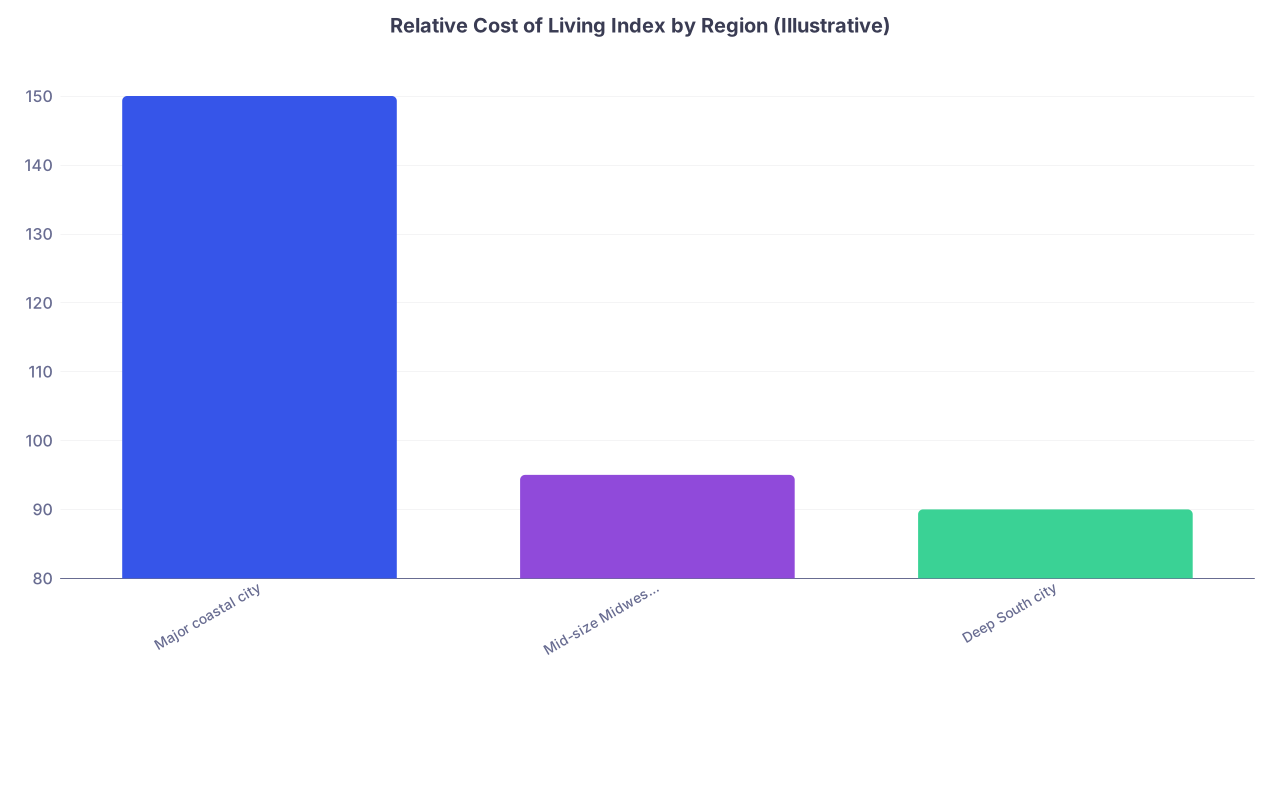
On cost of living, the numbers are brutal:
| Category | Value |
|---|---|
| Major coastal city | 150 |
| Mid-size Midwest city | 95 |
| Deep South city | 90 |
If the index for a mid-sized Midwest or Deep South city is ~90–100, and the coastal city is 150–180, your PGY‑2 salary stretches dramatically more. That’s not abstract. That’s:
- Owning a decent house vs cramming into a tiny, overpriced apartment
- Paying off credit cards vs endlessly carrying balances
- Actually having savings by the end of residency
Cultural fit is trickier and very real. You do need to be honest with yourself:
- Can you handle being in a more religious or conservative environment, if that’s the local vibe?
- Does the city have communities you identify with (LGBTQ+, specific ethnic communities, etc.)?
- Is there enough to do on your rare days off that you won’t lose your mind?
But again, blanket statements like “the South is unsafe for X identity” or “the Midwest is culturally dead” ignore that cities like Atlanta, Nashville, Louisville, Kansas City, Birmingham, New Orleans, and Minneapolis exist — each with rich subcultures and plenty of residents from all over the country.
How to Actually Evaluate an “Underserved” Program in These Regions
Forget the message-board caricatures. If you’re assessing a Midwest or Deep South program that serves an underserved population, judge it on the right axes:

Ask:
- What is the procedure and case volume like for my specialty?
- How do recent grads perform: boards, jobs, fellowships?
- Do residents seem burned out and bitter, or tired but proud of their training?
- Is there consistent supervision, or are interns abandoned at night?
- Does the “underserved” mission feel real (clinics, community partnerships) or just brochure copy?
If you want something visual, think of your evaluation like this:

| Step | Description |
|---|---|
| Step 1 | Start |
| Step 2 | Check training quality |
| Step 3 | Reassess priorities |
| Step 4 | Review graduate outcomes |
| Step 5 | Assess culture and support |
| Step 6 | Program is a strong option |
| Step 7 | Program serves underserved? |
| Step 8 | Strong clinical volume? |
| Step 9 | Fellowship/jobs align with goals? |
| Step 10 | You can live in region 3-5 years? |
That’s a better framework than “is it coastal” or “is it in a big name city.”
The Bottom Line
Let me condense this without sugar-coating anything:
- “Underserved” programs in the Midwest and Deep South are not automatically low quality; many deliver tougher, richer clinical training than some shiny coastal names.
- Your fellowship and career options depend far more on your performance, letters, and program strength within your specialty than on the region of the country.
- Cost of living and real-world pathology are often better in these regions; the main variable that matters is whether you personally can handle (or enjoy) living there for a few years.
Do not let Reddit geography myths dictate a 3–7 year decision. Look at real data, talk to current residents, and judge programs on how well they’ll turn you into the physician you actually want to be.