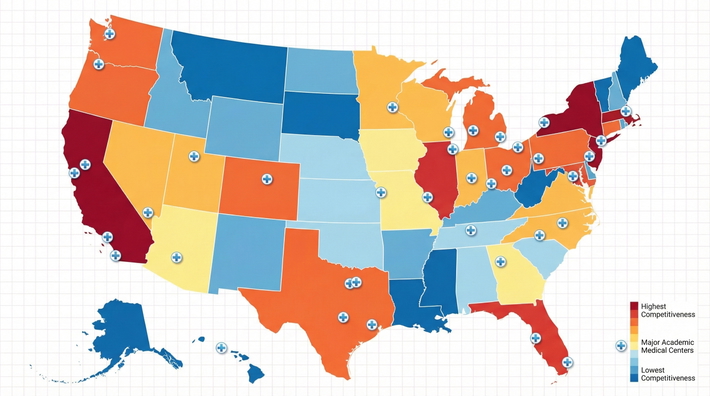
The idea that “training in the South kills your academic career” is lazy, outdated, and flat‑out wrong.
I hear this line constantly from students at mid-tier Northeastern schools who think moving below the Mason‑Dixon line will exile them from the ivory tower forever. Then I watch graduates from Alabama, UTSW, Emory, Vanderbilt, UNC, and UAB walk into Harvard, UCSF, Penn, and NIH fellowships every single year.
So let’s be clear: the South is not your academic barrier. Your strategy, mentorship, and output are far more decisive than your ZIP code.
The Myth: Southern Training = Community Track Only
Here’s the caricature floating around Reddit threads and hallway gossip:
- “If you train in the South, you’re signaling you’re not serious about academic medicine.”
- “Southern programs are more ‘service heavy’ and not research focused.”
- “Top coastal fellowships don’t respect Southern residencies.”
- “Everyone there just wants to be a private hospitalist back home.”
I’ve heard attendings in big coastal centers quietly push this narrative too. Usually the ones who haven't looked at a rank list since 2005.
The real story is more inconvenient: there’s enormous variation within every region, and a strong Southern academic program will beat a weak coastal program every single time when it comes to research exposure, mentorship, and fellowship placement.
Let’s get specific.
What the Data and Match Lists Actually Show
Look at where top academic fellowships pull from, not where people complain from.
If you skim actual recent fellowship match lists for competitive subspecialties—cards, GI, heme/onc, PCCM—patterns emerge. You routinely see residents from:
- University of Texas Southwestern
- Baylor (Houston)
- Emory
- Vanderbilt
- UNC Chapel Hill
- Duke (yes, still technically the South)
- UAB
- UT Houston / McGovern
- UT San Antonio
- Medical University of South Carolina
- Tulane (for some fields)
- UTMB, etc.
In heme/onc and cardiology especially, those names are regulars at top national programs. Not occasional flukes.
To make the point clearer, compare the “brand” of some Southern programs to known coastal benchmarks.
| Region | Example Programs |
|---|---|
| South | UTSW, Emory, Vanderbilt, UAB, UNC |
| South | Baylor Houston, UT Houston, Duke |
| Non-South | UCSF, Penn, Michigan, Northwestern |
| Non-South | Mount Sinai, Brown, Beth Israel Deaconess |
Residents from all of these programs show up together on the same fellowship rosters.
So no, there is no invisible blacklist for “trained in the South.”
Are there smaller or more community-focused Southern programs that rarely place into R01-heavy fellowships? Absolutely. But that’s also true for plenty of community or low-research‑volume programs in the Midwest, Northeast, and West Coast. Geography is not the defining feature. Institutional research culture is.
Where the Bias Actually Comes From
Now, there is bias in academic medicine—but people mislabel it as “regional.”
Program leadership tends to weight:
- Institutional prestige / name recognition
- Research track record (of the residency and the applicant)
- Known faculty connections and letters
- USMLE performance and transcripts
- Conference presence (who they see presenting year after year)
“South vs North” is lazy shorthand for “places I do or do not pay attention to.” Big mistake.
Here’s what I’ve actually seen evaluating applications:
- A resident from UAB with 4–5 first/second‑author publications and a strong letter from a nationally known PI is taken far more seriously than a community Northeast resident with no research. Instantly.
- A UTSW or Emory trainee who has presented at national conferences multiple times fits right into the interview pile next to UCSF, Michigan, and Penn.
- What hurts you is not “Texas” or “Georgia.” It’s “no track record, no mentor, vague career goals.”
If you want to be research‑heavy academic faculty and you pick a program that has essentially zero research infrastructure, then yes—you have put a barrier in front of yourself. But that barrier isn’t “the South.” It’s “you chose a service-only program.”
Let me underline this: serious academic programs in the South are not seen as second‑class by people who actually read CVs.
The people who sneer at “training in Alabama” usually can’t name a single grant that institution holds. The folks sitting on fellowship selection committees usually can.
Academic Firepower in the South: Hard Reality, Not Marketing
You want actual academic medicine, not slogans. So look at the ingredients that matter:
- NIH funding
- Number of R01-funded faculty
- T32 training grants
- Number of ongoing clinical trials
- Specialty‑specific research reputation
Many Southern institutions are quietly stacked on these metrics.
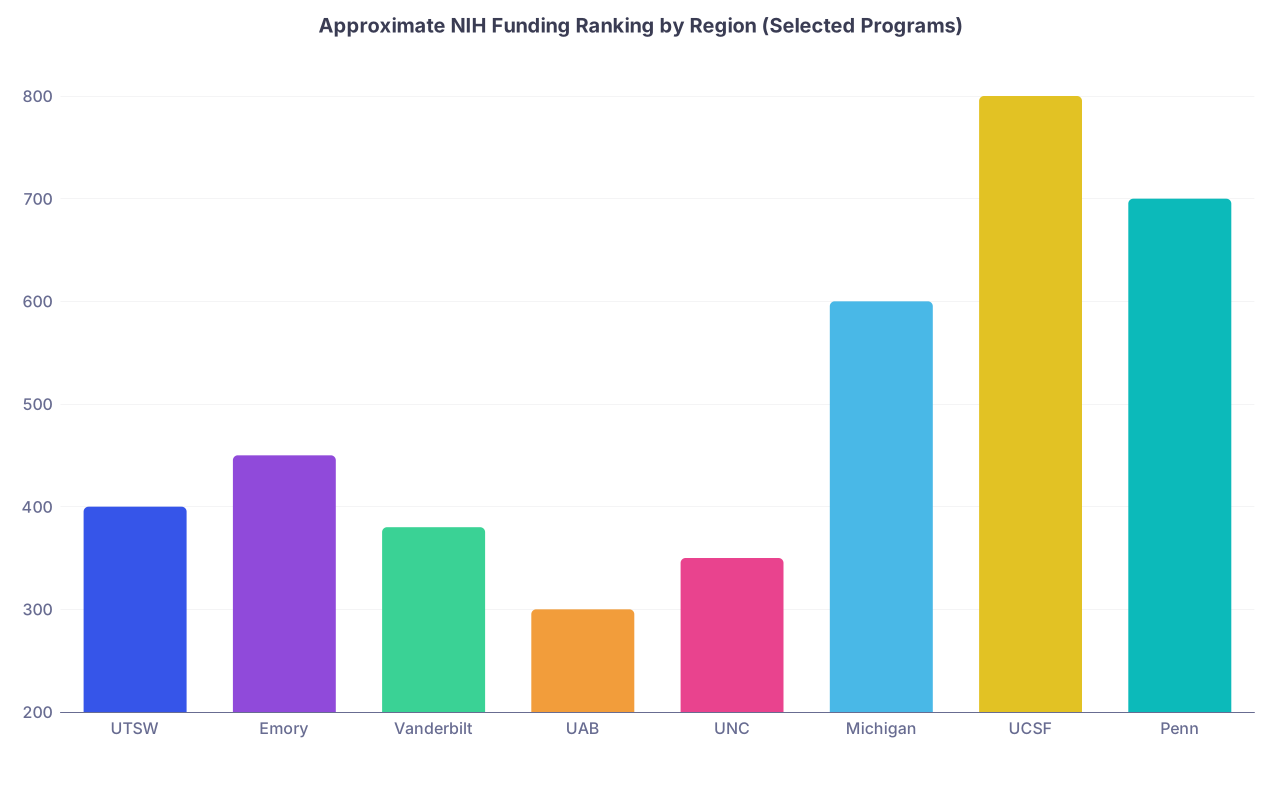
| Category | Value |
|---|---|
| UTSW | 400 |
| Emory | 450 |
| Vanderbilt | 380 |
| UAB | 300 |
| UNC | 350 |
| Michigan | 600 |
| UCSF | 800 |
| Penn | 700 |
Numbers above are rough-scale, not penny-accurate. The point is simple: some Southern institutions are in the same ballpark as “name brand” coastal powerhouses.
Take just a few examples:
- UTSW: Known nationally for cardiology, GI, and basic science. Heavy NIH footprint, huge research infrastructure.
- Emory: Powerhouse in ID, global health, cardiology, neuro. CDC is literally next door.
- Vanderbilt: Big in genetics, pharmacology, cardiology, pulmonary, and informatics.
- UAB: Monster in transplant, pulmonary, rheumatology, infectious diseases.
- UNC: Strong in GI, heme/onc, pulm/crit, health services research.
If your goal is to build an academic CV, the question is not “South vs Not South.” It’s “does this program have the research ecosystem in my field?”
The Real Trade-offs: What Actually Changes When You Train in the South
Let’s talk about the things that do reliably differ by region, because pretending everything is identical is also nonsense.
1. Culture and Lifestyle
Southern programs often have:
- Lower cost of living (Atlanta and Nashville are drifting upward, but still below NYC/Boston/SF madness).
- Typically more driving, less public transit.
- Different patient demographics (more rural, higher uninsured rates, different disease burdens—tons of diabetes, CHF, end-stage everything).
- Stronger local cultural expectations (faith communities, family ties, etc.) that shape patient interactions.
This doesn’t block academic careers. It just changes the kind of medicine and social context you see. Frankly, a lot of academics benefit from seeing real-world American pathology instead of pure tertiary‑referral zebras.
2. Brand Recognition Abroad vs Domestically
Outside the US, plenty of people have heard of “Harvard, Johns Hopkins, Stanford.” Fewer have heard of “UT Southwestern” or “UAB.” Domestically, though, fellowship directors know exactly which Southern programs are academically serious.
If you dream of a future heavily tied to global prestige branding, some Southern names won’t travel as far. But for US academic careers, the right Southern program is absolutely competitive.
3. Network Density
Coastal hubs like Boston, NYC, SF have absurd densities of academic centers packed together. That means more:
- Cross‑institution collaborations
- Joint conferences
- Informal networking
The South is catching up in some areas but doesn’t match that density. You can compensate, but you have to be proactive:
- Go to national meetings every year.
- Join multi-center research collaborations.
- Cold-email PIs at other institutions.
If you sit quietly and never leave your local bubble, yes, it’s easier to be isolated in a city with fewer big neighbors. But that’s about your behavior, not your longitude.
What Actually Predicts an Academic Career (Regardless of Region)
Strip away the noise and you see the same variables over and over in people who land real academic jobs:
Meaningful scholarly output
Not just your name buried as the 9th author on a retrospective chart review. I mean:- 1–2 first‑author papers
- Multiple co‑authorships
- Conference abstracts/posters/oral presentations
- Some coherent theme (not 9 unrelated projects you touched for two weeks each)
Strong, specific letters from known or respected faculty
Letters saying you’re “hard-working and pleasant” are worthless. Letters saying you independently designed part of a project, rescued a failing trial, or wrote a paper from scratch—gold. This is available at many Southern institutions if you seek it out.Fit with fellowship / department needs
You want heme/onc and have done 3 solid oncology projects with presentations and you can talk actual content? You’re competitive—South or North. You want to “maybe do GI or maybe cards or maybe hospitalist, I haven’t really decided” with no real focus? Geography won’t save you.Mentors who will pick up the phone for you
This is underrated. The right mentor at UAB or Emory can make a phone call to a colleague at MD Anderson or Penn and your application immediately gets a serious look. That phone call matters far more than where your driver’s license says you live.

If you’re obsessing over “South vs Northeast” and not asking “who are the mentors here in my field and what are they working on?” you’re looking at the wrong problem.
The Places Where Training in the South Can Hurt You
So where can Southern training legitimately be a disadvantage? There are a few narrow but real scenarios.
1. You Choose a Purely Service Program with No Research
There are Southern residencies where:
- Nobody expects residents to publish.
- There’s no protected research time.
- There’s no one in your subspecialty doing active scholarship.
- Nobody in your department has an R01 or runs clinical trials.
If you want a serious academic career and you sign up for that environment, you have handicapped yourself. Full stop.
But that scenario exists in every region. Call it what it is: “low-research program,” not “Southern program.”
2. You Underestimate How Much You Have to Self-Advocate
In some Southern settings (and some Midwestern ones, and honestly everywhere outside a few hyper-academic bubbles), the default culture is:
- Do your clinical work well.
- Be humble.
- Don’t self-promote.
Great values for being a decent human, bad values for a cutthroat academic market.
You may have to:
- Push harder for research opportunities.
- Ask directly for protected time.
- Request to be first author explicitly.
- Tell your PD and mentors, repeatedly, “I want an R01-track academic career in [field].”
That can feel uncomfortable if everyone around you is quietly sliding into community jobs. But again, not uniquely Southern. Just more common in certain institutional cultures.
3. You Never Leave Your Geographic Comfort Zone
If you train, rotate, present, and network only within a single Southern metro, you may be less visible nationally. That’s fixable:
- Always submit your work to national meetings (ASH, ACC, ATS, ACG, etc.).
- Do away electives at big-name programs, especially if your home institution is less known.
- Attend at least one major meeting a year and actually meet people instead of hiding with your co-residents.

| Step | Description |
|---|---|
| Step 1 | Southern Residency |
| Step 2 | Find Research Mentor |
| Step 3 | Community Career |
| Step 4 | Produce Abstracts and Papers |
| Step 5 | Present at National Meetings |
| Step 6 | Strong Letters and Network |
| Step 7 | Competitive Fellowship |
| Step 8 | Academic Faculty Position |
| Step 9 | Academic Interest? |
That pathway is used every single year by residents in the South who end up faculty at “elite” places.
A Blunt Framework for Choosing a Southern Program (If You Want Academics)
If you’re actually serious about an academic career and considering Southern training, stop asking “Will the South hurt me?” and ask these instead:
- In my intended specialty, which Southern programs are nationally recognized?
- How many residents from this program match into academic fellowships? Look at actual lists.
- Who are the top 3‑5 research faculty in my field at this program? What are they funded to do?
- Do residents at this program routinely publish, not just “have opportunities”?
- Is there structured research time? A research track? T32 spots?
If a Southern program checks those boxes, the “barrier” narrative collapses. Your odds of an academic career from there are very solid if you do the work.
If it doesn’t check those boxes, you’re looking at a community‑leaning program—whether in Atlanta or Albany.
The Bottom Line: Stop Blaming Latitude for Lack of Strategy
Let me cut through the noise.
Training in the South is not inherently a barrier to an academic career. The barrier is choosing a weak research environment, failing to build a scholarly record, and not securing strong mentors—problems that exist in every region.
Strong Southern academic centers (UTSW, Emory, Vanderbilt, UAB, UNC, Baylor Houston, Duke, etc.) place residents into top fellowships and academic jobs every year. Fellowship directors know this, even if anxious MS3s online don’t.
If you want an academic career, choose a program—Southern or not—where your intended field has active research, real mentorship, and a track record of sending people into academic fellowships. Then use it aggressively. Output, not geography, is what gets you hired.