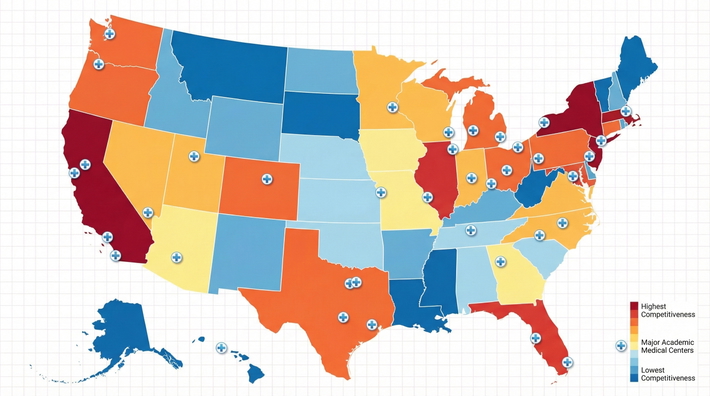
The belief that you’re trapped within your residency state for fellowship and jobs is exaggerated, outdated, and often flat-out wrong.
State lines matter far less than people think. Regions and reputation matter. Networks matter. Visa status and licensing logistics matter. But that imaginary electrified fence at the state border? Not really.
Let’s tear this apart properly.
The Big Picture: Programs Don’t Care About Your State. They Care About Your Ecosystem.
Fellowship program directors are not sitting there saying, “We only rank people from our state.” That’s not how this works.
What they actually care about (based on NRMP Program Director Surveys, match data, and what PDs say when the mics are off) is:
- Reputation of your residency program
- Letters of recommendation from known faculty
- Research output and subspecialty interest
- Perceived fit and professionalism
- Board scores only in a few competitive subspecialties
- Visa / legal / licensing logistics (this one is real)
Notice what’s not on that list: “Lived in Ohio for three years.”
Where state does sneak in is through proxies:
- State-based networks (your attendings know the local PDs more than far-away ones)
- Regional training cultures (Midwest vs Northeast vs West Coast norms)
- Patient populations and case mix (rural vs urban, academic vs community)
That’s regional gravity, not state prison.
What the Data Actually Shows: People Move. A Lot.
Let me put some structure around this.
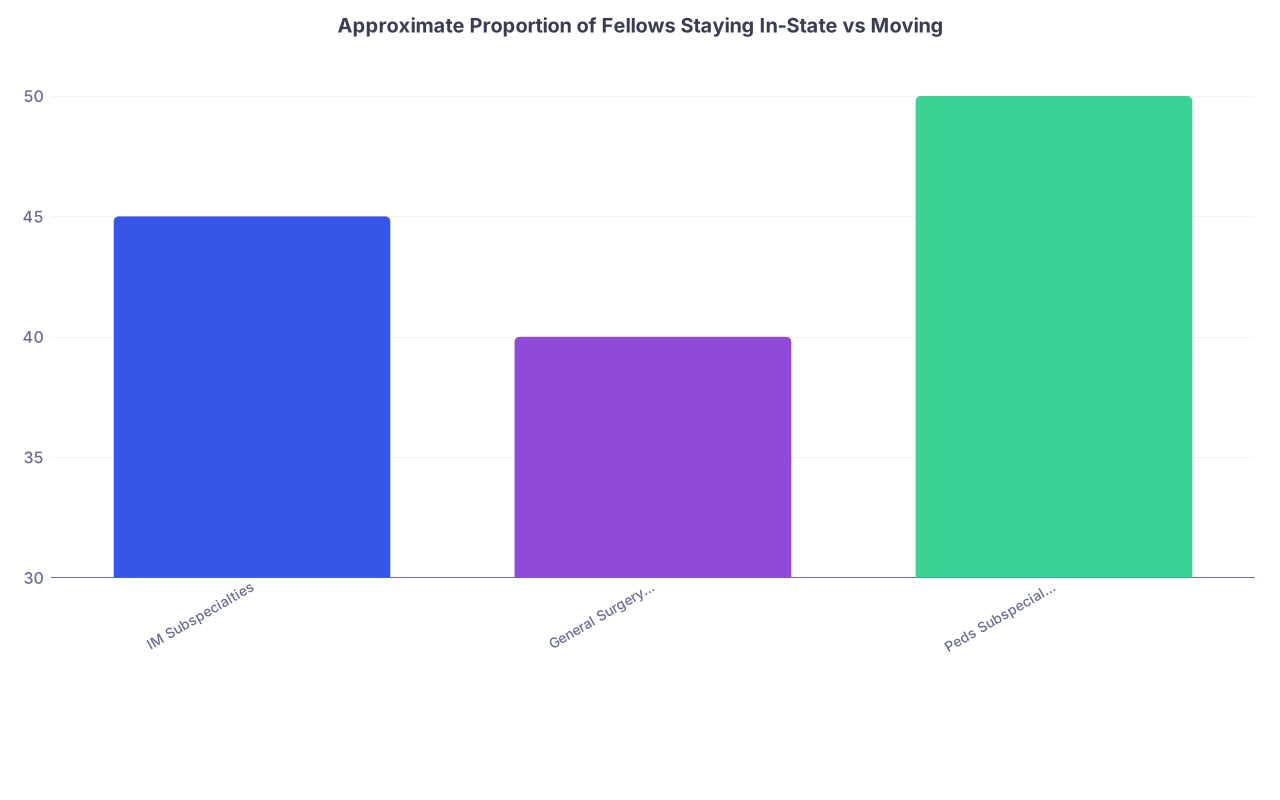
| Category | Value |
|---|---|
| IM Subspecialties | 45 |
| General Surgery Fellowships | 40 |
| Peds Subspecialties | 50 |
Roughly (and this varies by specialty and program):
- 40–50% of fellows stay in the same state as their residency
- The other 50–60% cross state lines, often across regions
- Some go from community programs in modest cities to brand-name academic centers in totally different regions
If state borders were as rigid as people claim, those numbers would be more like 80–90% staying put. They’re not.
Example patterns I’ve actually seen:
- IM resident at a midwestern university → GI fellowship in Boston
- Texas community resident → Cardiology fellowship in the Pacific Northwest
- New York academic resident → Hem-Onc fellowship in Atlanta, then job back in New York
The more competitive the subspecialty, the more national the game becomes. Advanced Heart Failure, Transplant Hepatology, Interventional Pulmonology—they’re not recruiting only in-state. They’d be dead in a week.
The Real Unit of Geography: Region, Not State
Stop thinking “Can I cross from Pennsylvania to New Jersey?” Start thinking in terms of regions and their patterns:
| Residency Region | Common Fellowship Destinations | Comments |
|---|---|---|
| Northeast | Northeast, Mid-Atlantic, Midwest | Dense academic hubs, strong inter-institution ties |
| Midwest | Midwest, South, occasional coasts | Seen as solid training, easier to move outward than you think |
| South | South, Midwest, selectively coasts | Growing academic centers, strong local job markets |
| West Coast | West Coast, Mountain, selective national | Limited fellowship spots, high competition |
What actually happens:
- Regional clustering is strong because faculty know each other’s programs and pick up the phone.
- Same-state staying is often just a byproduct of that: if you train in Boston, there are 10+ fellowships within 30 miles. Of course a chunk of residents stay “in-state.” That doesn’t mean Massachusetts matters. The academic cluster does.
A resident in rural Arkansas going to fellowship in Tennessee is technically crossing state lines, but that’s a tiny regional hop. Meanwhile, going from a Florida program to a major center in Seattle is a true regional jump, and it happens every year.
So if you’re stressing about “I did residency in Ohio, can I ever leave Ohio?”—you’re asking the wrong question. Ask: “Is my program regionally or nationally known, and can my faculty connect me to where I want to go?”
Where State Really Does Matter (A Little)
Let’s talk about the few domains where state isn’t completely meaningless.
1. Licensing and “Easy Hire” Bias for Jobs
For jobs, not fellowship, state lines come back into the conversation because of licensure and risk-aversion.
- Employers like candidates who already have (or can quickly get) a state license.
- If you did residency and fellowship in State X, your initial job offers are more likely to be in State X or nearby, just because you’re a known quantity and the licensing path is clear.
But that’s convenience, not destiny. Physicians move states all the time for their first or second job. It just takes a few extra months and some paperwork.
2. State-Specific Training Pipelines
Some states and systems are explicit about building local pipelines. A few examples:
- Big public systems (UT, UC, SUNY, etc.) sometimes lean toward keeping “their own” for jobs, less so for fellowship.
- Rural states with physician shortages may offer loan repayment or bonuses for people who trained in-state.
That can give you an edge staying put, especially for community or hospital-employed jobs. It doesn’t lock you in, but it tilts the table.
3. Visa and Sponsorship Realities
For IMGs on visas, state and institution can matter a lot more for jobs and occasionally for fellowship:
- J-1 waiver jobs are state-specific, and some states are more IMG-friendly than others.
- Some state health departments run very structured waiver programs that heavily favor in-state trainees.
But again—that’s law and policy, not some magical preference for your ZIP code.
The Biggest Distortion: People Confuse Comfort With Constraint
There’s another dirty little secret: many residents choose to stay in-state and then retroactively interpret that as “I had no choice.”
Why do people stay?
- Spouse / partner / kids are settled
- Already bought a house
- Family support system is local
- Familiar with the hospital system and faculty
- Afraid of starting over socially
None of that is bad. It’s just not the same as “the system wouldn’t let me leave.”
If you look only at match outcomes, you see, “Wow, 50% stayed in-state.” If you actually talk to the residents, you hear, “Yeah, I could have gone elsewhere, but my partner’s job is here and we like it.”
So be honest with yourself: are you asking “Can I leave this state?” or “Am I willing to disrupt my life to leave this state?” Those are very different questions.
Reputation > State: A Hard Truth Some Don’t Want to Hear
Here’s the part that stings a little.
A strong program in a “less sexy” state will give you more mobility than a weak program in a desirable coastal city.
Give me:
- University of Iowa IM resident
Over: - Tiny, unknown community program in suburban California
If both want a Cardiology fellowship at a mid-tier academic center in another region, the Iowa resident probably has the cleaner path. Better-known faculty. Stronger letters. More research infrastructure.
The state is irrelevant. The signal is the institution.
That’s why people from “flyover” states routinely match into fellowships on the coasts and in major cities. Their program’s reputation crosses state lines just fine.
Concrete Examples of Crossing State Lines
This isn’t theoretical. Here are patterns I see repeatedly:
- Midwest IM residency → West Coast GI fellowship → job in the South
- Texas general surgery residency → Northeast surgical oncology fellowship → job back in Texas
- New York pediatrics residency → Midwest NICU fellowship → job in the Pacific Northwest
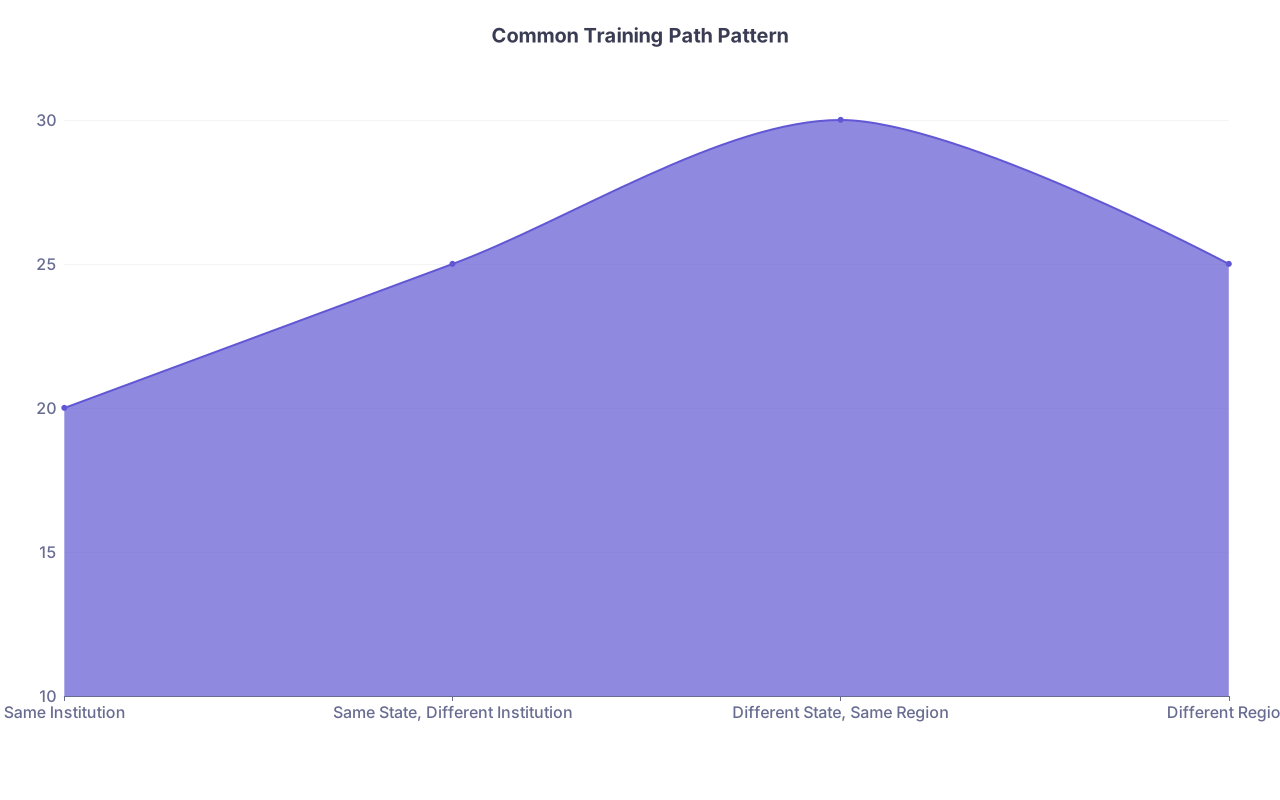
| Category | Value |
|---|---|
| Same Institution | 20 |
| Same State, Different Institution | 25 |
| Different State, Same Region | 30 |
| Different Region | 25 |
If state borders had real power, those “Different Region” transitions would be rare. They’re not. They’re routine.
Networking: The Real Geography Engine
If there’s a “border,” it’s not between states—it’s between networks.
Fellowship PDs are more comfortable:
- Ranking someone whose letter writer they’ve collaborated with on a trial
- Taking a chance on a resident from a program where their former co-fellow is now faculty
- Interviewing people recommended through a quick email or phone call from someone they trust
That’s why:
- A resident at a small program with one well-connected subspecialist can suddenly have national options.
- A resident at a big-name program with disengaged mentors can still hit a ceiling.
Your job is not to obsess over whether you’re on the “right side” of a state line. Your job is to plug into networks that are bigger than your city.
Conferences. Collaborative projects. Multi-center trials. Virtual grand rounds. This is how geography bends.
Jobs: Where Geography Bites Harder—but Still Not at the State Border
Fellowships are relatively portable. Jobs tighten things up a bit.
Employers care about:
- Will you stay at least a few years?
- Do you understand our patient population and payer mix?
- Do you fit our clinical volume and culture?
- Is the licensure / visa / credentialing process straightforward?
Again, that’s more regional than state-specific. A hospital in North Carolina will usually be fine hiring someone from South Carolina or Tennessee or Virginia. The culture overlap is pretty big. The same is true for Illinois ↔ Wisconsin ↔ Indiana, etc.
Where you see real friction is:
- Physician used to a very cushy, resource-heavy academic environment trying to move to a lean community shop in a completely different region.
- Physician trained in a region with one demographic/payer mix trying to adapt to a totally different one without acknowledging the learning curve.
That’s about practice style. Not the name on your driver’s license.
When Should You Actually Care About State?
A few specific scenarios where state is not imaginary:
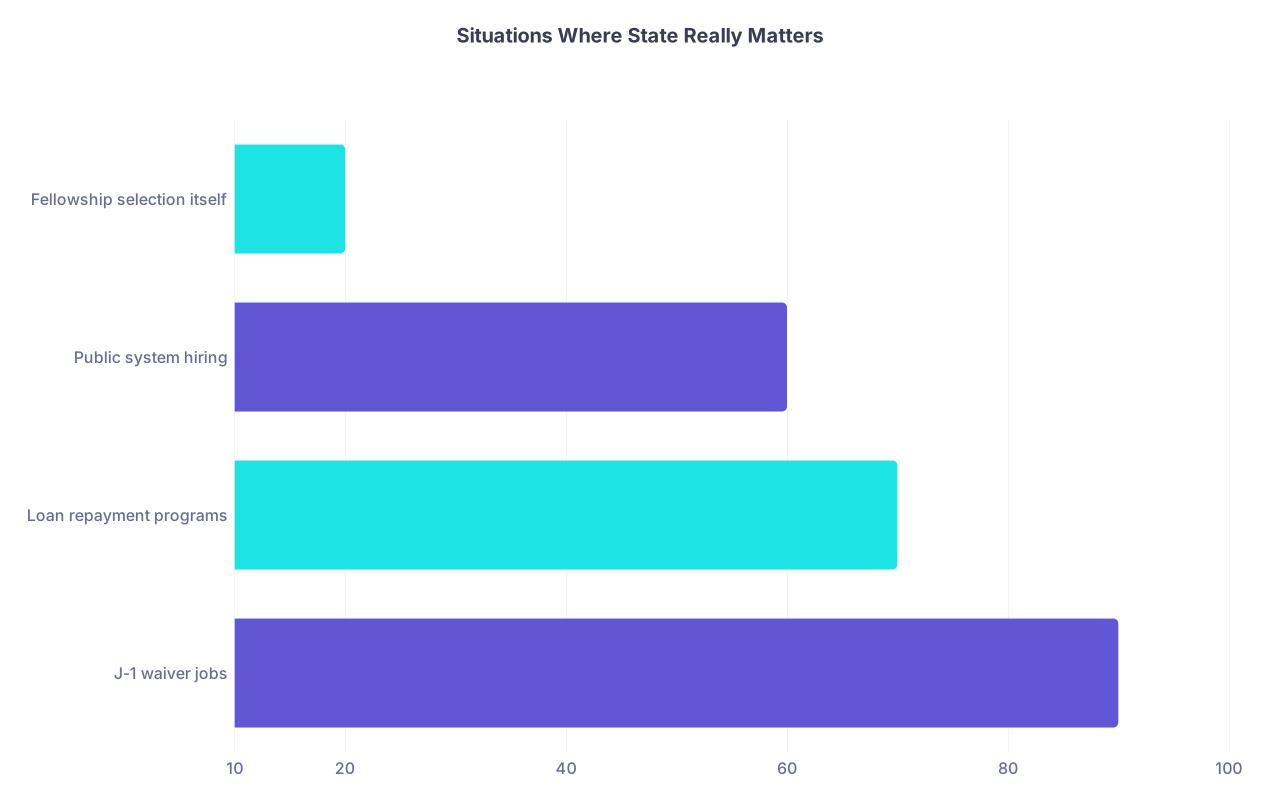
| Category | Value |
|---|---|
| J-1 waiver jobs | 90 |
| Loan repayment programs | 70 |
| Public system hiring | 60 |
| Fellowship selection itself | 20 |
Think roughly like this:
- J-1 waiver and immigration-driven jobs: state = very important
- State / federal loan repayment programs: state = often important
- Public university / VA / state health systems hiring: state = moderately important
- Fellowship selection itself: state = minimally important, if at all
So if you’re an IMG planning a J-1 waiver, or you know you want a specific state loan repayment program, then yes—where you end up training and working initially can be strategically tied to that state.
But if your concern is, “Will doing residency in Arizona doom my chances of getting a Critical Care fellowship in Chicago?” No. It will not.
The Real Takeaways (Without the Fairy Tales)
Let me strip this down to the non-delusional version:
- State borders are mostly noise for fellowship selection.
- Regional ecosystems, institutional reputation, and faculty networks are the real drivers.
- Many people choose to stay in-state for personal reasons and then mythologize it as systemic constraint.
- Jobs are more geographically sticky than fellowships, but still not dictated by state lines—except for visas and specific public/loan programs.
- A strong program in a “boring” state is a better launchpad than a weak program in a “cool” state.
So if you’re a med student choosing residency or a resident thinking ahead to fellowship and jobs, stop obsessing over whether you’re training five miles on the wrong side of a state border.
Think bigger than that. Think:
- Whose name will be on your letters?
- What kind of research and clinical exposure will you actually get?
- Which region’s culture and patient population do you want to understand deeply?
- How willing are you, really, to move for training and then maybe move again for a job?
Years from now, you won’t remember whether your badge said Ohio or Indiana. You’ll remember who picked up the phone for you—and where you decided you were willing to go.