The idea that weather is a “soft” factor in residency burnout is wrong. Geography and climate quietly change your sleep, mood, social life, and even your call recovery—then show up in your burnout scores and depression screens.
Not theory. Data.
Let’s pull apart the myth that “you should never rank programs based on weather” and look at what regional outcomes actually tell us.
The Myth: Weather Is Just a Lifestyle Extra
You’ve heard this line on the trail:
- “Choose training, not sunshine.”
- “You can’t pick a program like you’re picking a vacation.”
- “If you care about weather, you’re not serious.”
I have heard PDs say, almost proudly, “We tell applicants: don’t come here for the weather.” Translation: we know it’s miserable for 5–6 months, we just pretend it doesn’t matter.
That’s cute. It’s also out of step with what we know about:
- Seasonal affective disorder (SAD)
- Sleep regulation and circadian rhythm
- Depression and anxiety in residents
- Burnout trajectories across training
Does climate override leadership quality, workload, and toxicity? No. But “trivial”? That’s fantasy.
What the Data Actually Shows About Mood, Climate, and Training
We do not have a perfect “burnout by ZIP code” dataset for all US residencies. Anyone who pretends we do is lying. What we do have are several converging lines of evidence.
1. Residents are already a high-risk mental health group
Multiple multi-center studies have shown:
- Around 45–60% of residents meet criteria for burnout at some point in training.
- 20–30% screen positive for depressive symptoms.
- Sleep deprivation and schedule chaos are baked into most programs.
Now layer on a regional factor that:
- Reduces daylight exposure
- Increases indoor confinement
- Disrupts physical activity
- Increases commute difficulty and fatigue
You really think that’s trivial?
2. Latitude and daylight are not just vibes
There’s long-standing epidemiology on:
- Higher rates of seasonal depression at higher latitudes
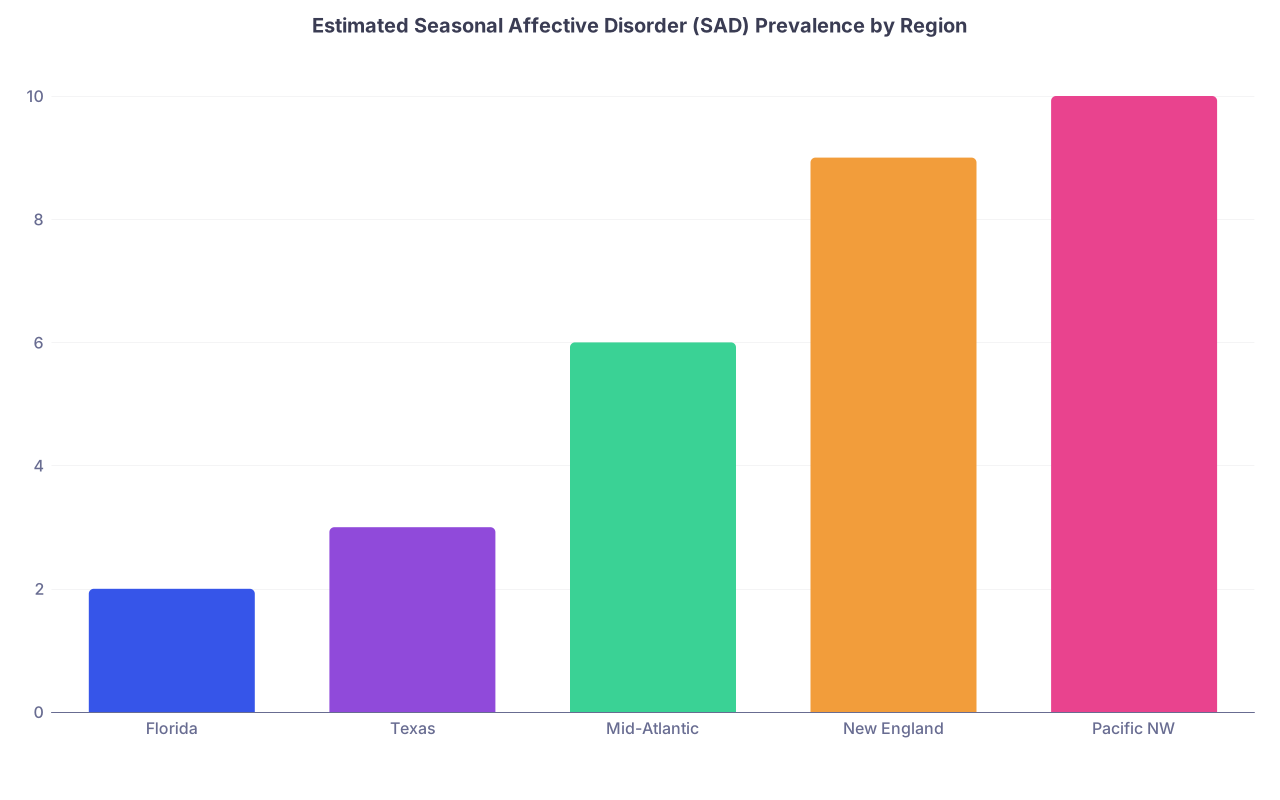
- SAD prevalence estimates:
- Around 1–2% in Florida–Texas range
- 9–10% in New England and parts of the Pacific Northwest
Residents are not magically immune to the same biology.
Here’s the basic biology compressed:
- Light hits retinal cells → signals suprachiasmatic nucleus (SCN) → regulates melatonin and circadian rhythm.
- Low daylight + erratic shifts = circadian chaos.
- Circadian chaos worsens:
- Sleep quality
- Cognitive performance
- Mood stability
Put a night-float-heavy schedule in a place with a 4pm sunset and 6 days of sun per month. It will not feel the same as doing that in Phoenix or San Diego.
| Category | Value |
|---|---|
| Florida | 2 |
| Texas | 3 |
| Mid-Atlantic | 6 |
| New England | 9 |
| Pacific NW | 10 |
These aren’t residency-specific numbers, but when your baseline risk is already high, stacking an extra 5–7% population-level seasonal mood burden on top is not negligible.
3. Weather, exercise, and burnout
There’s decent evidence that consistent physical activity reduces burnout and depressive symptoms in trainees.
Now look at your realistic weekly life:
- 60–80 hours of work
- Variable, often terrible call
- One or two nights where you could exercise if you’re not completely destroyed
If you live somewhere with:
- Icy sidewalks 4 months a year
- Windchill that makes 15 minutes outside feel like punishment
- Darkness before you even leave sign-out
You don’t “just go for a jog.” You skip it. Over and over.
Compare that to a warm, dry climate where a quick run, walk, or bike ride is always available. Same workload. Different recovery options.
Exercise is not a bonus. It’s one of the few high-yield, low-time interventions that reliably improves mood and resilience. Climate changes the friction cost of doing it.
Regional Patterns: What We Can Actually See
Again, no one has the perfect national map of “IM residents’ burnout by region, adjusted for toxicity and EMR clicks per hour.” But we have clues.
1. Some regional wellness surveys quietly admit it
Institutional wellness assessments in northern and overcast regions repeatedly show:
- Spikes in depression and burnout markers in late fall and winter
- Increased use of counseling, wellness services, or crisis lines in darker months
- Self-report comments like:
- “The winters here are brutal on morale.”
- “I did not realize how much the lack of sun would hit me on nights.”
I’ve seen resident feedback where the “most helpful wellness intervention” was literally: free or subsidized light therapy lamps and discounted gym access. That’s not just a cute perk. That’s compensating for weather.
2. East Coast vs Sun Belt attitudes
Programs in the Northeast and upper Midwest often lean on this macho narrative: We’re serious. We work hard. The weather is bad; deal with it. And their recruitment pitch is prestige, pathology, fellowship placement.
Programs in California, Arizona, parts of Texas and the Southeast often don’t even stress weather—they treat it as a background asset. Yet casually, residents say things like:
- “Honestly, having sunlight after call saves me.”
- “Our wellness is not perfect, but being able to sit outside in January helps a lot.”
Is that selection bias? Partly. People who self-select to those regions may value outdoors and lifestyle more. But that’s the point: people who know they’re vulnerable to seasonal depression or who rely heavily on outdoor time should not pretend climate is neutral.
3. Weather and commute fatigue
This one’s underrated. Driving home after a 28-hour call:
- In dry, clear conditions, worst risk is you drift a little.
- In blowing snow or freezing rain with black ice, your commute is a second stress test.
Every extra cognitive load when you’re already sleep-deprived chips away at safety and stress. Residents describe winter commutes with words like “terrifying,” “white-knuckle,” “I honestly should not have been driving.”
That ongoing stress feeds the chronic exhaustion that shows up in burnout scales.
When Weather Really Matters (And When It Doesn’t)
Let’s be precise. Weather is not the strongest predictor of burnout—that’s still workload, control, support, and culture. But climate acts as a multiplier.
Here’s when it changes the equation.
Weather is a big deal if:
- You have a history of:
- Seasonal affective disorder
- Major depression with seasonal worsening
- Strong sensitivity to gray, cold stretches
- You rely heavily on:
- Outdoor running / biking / walking
- Social life that happens outside
- Nature exposure as your main decompression
- You’re entering:
- A high-intensity specialty (surgery, EM, ICU-heavy IM, OB/GYN)
- A program with heavy nights and 24–28 hour calls
- A city where you won’t have a car and will walk/metro in all weather
For these people, pretending Minnesota vs San Diego or Boston vs Houston is “trivial” is dishonest.
Weather is less critical if:
- You:
- Tolerate winter well
- Do most of your hobbies indoors
- Have no clear seasonal mood swings
- You’re going to:
- A small, tight-knit program with real support
- A city with strong indoor amenities (gyms, indoor tracks, social hubs)
- The program difference is massive:
- One program is a clear clinical/educational fit and the other is just sunnier but weaker across the board
If Mayo is your dream program and you do fine in snow, choosing it over a random community program in Florida makes sense. Prestige and training quality can absolutely justify rougher weather—if you’re honest about your own risk profile.
Weather vs. The Usual Big Factors: How Much Weight?
Let’s stack weather against the usual variables.
| Factor | Typical Impact on Burnout Risk |
|---|---|
| Toxic culture/abuse | Very high |
| Chronic understaffing | Very high |
| Excessive work hours | High |
| Poor leadership | High |
| Weak mentorship/support | Moderate–high |
| Geographic isolation | Moderate |
| Weather/climate | Low–moderate alone, higher as multiplier |
Weather alone rarely breaks you. But if you stack it:
- High workload
- Weak leadership
- Poor social support
- Dark, cold, gray climate
You’ve just built a burnout machine.
Flip it:
- Strong leadership
- Reasonable call and staffing
- Supportive co-residents
- Mild, sunny climate
You’ve tilted the board a bit back in your favor.
Concrete Regional Patterns You Actually See On the Ground
This is what residents actually say across regions—things you won’t see in glossy recruitment videos.
Northeast / Upper Midwest (Boston, Chicago, Minneapolis, Detroit, Rochester)
Common themes:
- “Morale tanks in February.”
- “Intern year plus this weather was rougher than I expected.”
- “I wish I had taken my history of seasonal depression more seriously.”
Upsides: elite training, pathology volume, strong academics.
Downsides: long winters, early darkness, icy commutes, cabin fever.
Pacific Northwest (Seattle, Portland)
Not that cold, but:
- Long stretches of gray
- Persistent drizzle
- Limited bright sun in winter
This absolutely nails some people’s mood. Others love it. But if you already know gray skies drag you down, do not ignore that.
Sun Belt / Southwest (Phoenix, Tucson, San Diego, parts of Texas)
Themes:
- “Being able to sit outside on call days off changes everything.”
- “I don’t have to think about the weather to work out.”
Downsides:
- Summers can be brutally hot, which flips the problem: outdoor activity limited midday.
- Heat + walking commutes can also exhaust you.
But for most residents, “too much sun and heat” is easier psychologically than “cold, wet darkness for months.”
Southeast / Gulf Coast
Mix of:
- More sunlight
- Very humid summers
- Hurricane season anxiety in some areas
Still, seasonal depression tends to be lower due to more consistent daylight and milder winters.
| Category | Value |
|---|---|
| Pacific NW | 2000 |
| New England | 2100 |
| Midwest | 2300 |
| Mid-Atlantic | 2400 |
| Southeast | 2600 |
| Southwest | 3200 |
| California Coast | 2900 |
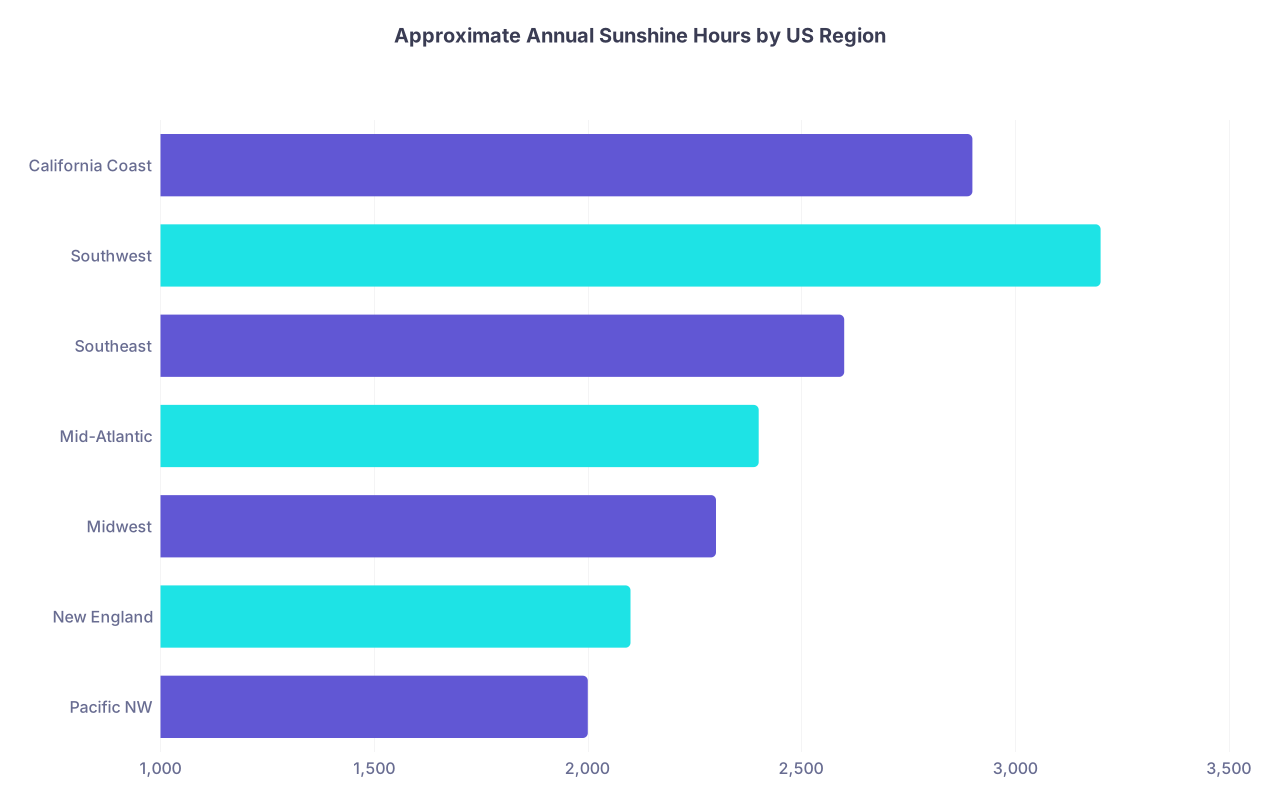
More sun hours ≠ automatically less burnout. But it does change your baseline.
How to Actually Use Weather in Your Rank List (Without Being Dumb)
The advice “ignore weather” is lazy. So is “always choose the sunniest place.” Do this instead:
Step 1: Audit your own history honestly
Have you ever:
- Felt clearly worse in winter for more than one year?
- Needed light therapy, meds, or therapy for seasonal mood?
- Lost all motivation for months when it’s gray?
If yes, weather moves up your rank list. Full stop.
Step 2: Stratify your options
Divide your top programs into three buckets in your head:
- Strong fit + decent climate
- Strong fit + harsh climate
- Mediocre fit + good climate
You want as many in the first group as possible. Between the latter two, it becomes a judgment call:
- If your mental health is fragile, a “good enough” program in a supportive climate may beat a slightly stronger program that will crush you mentally.
- If your resilience and history are strong, the harsh-climate powerhouse may be worth it.
Step 3: Ask residents the real questions
Not “Do you like living here?” That’s useless. Ask:
- “How does winter affect morale on the service?”
- “Do people feel more burned out in certain months?”
- “What do you actually do for fun November–March?”
- “Do many residents use light therapy or mental health services more in winter?”
Their tone will tell you more than the words.
Step 4: Look at program-level weather mitigation
Smart programs in rough climates don’t hand-wave this. They:
- Provide or recommend light therapy lamps
- Negotiate gym discounts or on-site fitness
- Organize indoor social events in winter
- Normalize talking about seasonal mood changes
If leadership shrugs and says “We work hard, it’s fine,” they’re telling you how they’ll treat your mental health generally.

| Step | Description |
|---|---|
| Step 1 | Baseline Resident Stress |
| Step 2 | High Workload |
| Step 3 | Sleep Disruption |
| Step 4 | Limited Autonomy |
| Step 5 | Burnout Risk |
| Step 6 | Harsh Climate |
| Step 7 | Less Sunlight |
| Step 8 | Reduced Exercise |
| Step 9 | Worse Mood |
| Step 10 | Mild Climate |
| Step 11 | More Outdoor Time |
| Step 12 | Better Mood |
| Step 13 | Lower Burnout Risk |
This is not “weather = destiny.” It’s weather as an amplifier.
The “Trivial Factor” Myth Needs to Die
Calling weather “trivial” in residency planning ignores everything we know about:
- Circadian biology
- Seasonal mood patterns
- The role of physical activity in mental health
- The reality that residents have almost no control over anything except where they match
So here’s the straight version:
- Weather is not the main driver of burnout, but it is a real, biologically grounded contributor, especially as a multiplier of existing stressors.
- For people with any history of seasonal or climate-sensitive mood issues, regional climate should be a meaningful factor in where they train—not an afterthought or something to be ashamed of.
- Programs that pretend climate “doesn’t matter” are signaling that they’re not thinking deeply about resident well-being. The smart ones quietly design around it.
You’re not soft for caring about sunlight, temperature, or the ability to safely get outside on your one day off. You’re just being honest about the physiology you’re stuck with.