

What happens when the interview invites finally start landing, and your first feeling isn't excitement, but a quick, sick calculation of what each one costs?
If that's you right now, this article is your playbook. If you're a fourth-year staring at six invites and a bank account that can handle two, here's what to do. Interview season has a price tag most applicants never planned for, and the worst response is pretending it'll somehow work out. It won't. But with some strategy, you can cut your costs in half, sometimes more, without sacrificing the programs that matter.
Let's get into it.
This article is for educational purposes only. It is not financial advice, not legal advice, and not tax advice. Figures vary by individual circumstances, so consult a qualified professional before acting.
The Real Cost of Interview Season (And Why You're Not Alone)
Eight to twelve interviews is the standard advice for a solid match probability. At $300 to $700 per trip once you add everything up, you're looking at $3,000 to $8,000. For a demographic that often has negative net worth, that's not a line item. It's a crisis.
And the advertised cost is never the real cost. The flight is $220. Then comes the checked bag ($35 each way because your suit doesn't fit in a personal item), the Uber from the airport to a hospital nowhere near public transit ($48), the hotel the program "recommends" at $189 a night, and the airport sandwich you didn't want but bought anyway. I've watched applicants budget $250 for a trip and land back home $460 lighter. Every single time.
Here's what makes this worse: nobody talks about it. Medical school culture runs on a quiet pretense that everyone's fine. Your classmates are posting airport selfies, not GoFundMe links. So you assume you're the only one rationing interviews, and that isolation compounds the stress.
That stress isn't just unpleasant, it's expensive in a different way. You cannot walk into an interview room and sell yourself as a confident future colleague while mentally calculating whether your debit card will clear the hotel hold. Financial anxiety follows you into the room. Programs can see it.
So let's name it plainly: this is a structural problem in medical education, it hits first-gen and low-income applicants hardest, and you have nothing to be ashamed of. Now let's solve your version of it.
Free and Low-Cost Travel Hacks That Actually Work
If flying is your default, stop. Here's the hierarchy of options, cheapest first:
- Greyhound and intercity buses. Often under $50 between major cities, and the network is far bigger than people assume. Yes, it's slower. Yes, the stations can be grim. Bring headphones, treat it as study time, and pocket the $250 difference.
- Amtrak with a student discount. Around 15% off with a valid student ID, and overnight routes can double as your accommodation. A $95 train that replaces a $320 flight plus a $189 hotel is a triple win.
- Budget airlines, with eyes open. Frontier, Spirit, and Allegiant advertise $39 base fares and then charge you for everything including a carry-on. Fly them anyway, but do the math on the full price with bags before celebrating. Sometimes the "expensive" carrier is cheaper all-in.
- Red-eyes. Cheaper fare, and you skip a hotel night. Rough, but effective.
- Driving. Run the break-even before you commit. Gas plus tolls plus parking for a 500-mile round trip usually lands near $180, worth it if you can split costs with a classmate interviewing in the same city, questionable solo.
Three more moves worth making. First, sign up for fare alerts through Going (formerly Scott's Cheap Flights) or Airfarewatchdog, error fares and flash sales genuinely happen, and a $120 mistake fare to Chicago is real money saved. Second, pack light enough to skip checked bags entirely. A garment folder in a carry-on keeps a suit interview-ready; paying $70 round-trip to check one is just lighting money on fire. Third, if you must fly one airline repeatedly, join their free loyalty program on day one. Even without status, points from six round-trips can fund trip seven.
None of this is glamorous. Neither is declining a top-ten program because you spent your budget on convenience.
Strategic Interview Planning: When You Can't Attend Everything
If you've got ten invites and the budget for five, here's how you choose, and the answer isn't "the five cheapest."
Start by ranking programs on genuine interest, not geography. Then look at the map. Three interviews in the same metro area within the same week isn't three trips, it's one trip with two extra hotel nights. Cost-per-interview collapses when you cluster. I've seen applicants cut their travel spending by 60% doing nothing more exotic than calling programs and asking to shift dates so two cities aligned. Programs get this request constantly. They accommodate it.
Then run the hard calculus: is this program worth $500 or more for what is often a 15-minute conversation? For your top tier, yes, find the money. For a program you'd rank eleventh out of twelve, in a city you'd never live in? That invite is not an obligation. It's an option.
Before you decline anything, though, check whether a virtual option exists. Plenty of programs kept hybrid formats after COVID, and some will offer one if you ask directly (more on that next). Declining should be the last move, not the first.
Reaching Out to Programs: How and When to Ask for Help
This is where applicants leave the most money on the table, because embarrassment keeps them quiet. Listen carefully: many programs have interview assistance funds, hotel partnerships, and travel vouchers, and most applicants never find out because they never ask.
Programs want their top candidates in the room. If you're holding an invite, they've already decided you're worth meeting. A program coordinator would rather approve a hotel voucher than lose a strong applicant to a bus ticket they couldn't afford. That's not charity. That's recruitment.
Timing matters. Ask when you accept the invitation, not the week before the interview, and definitely not after the slot has expired. Be direct, specific, and brief. Don't grovel. Something like:
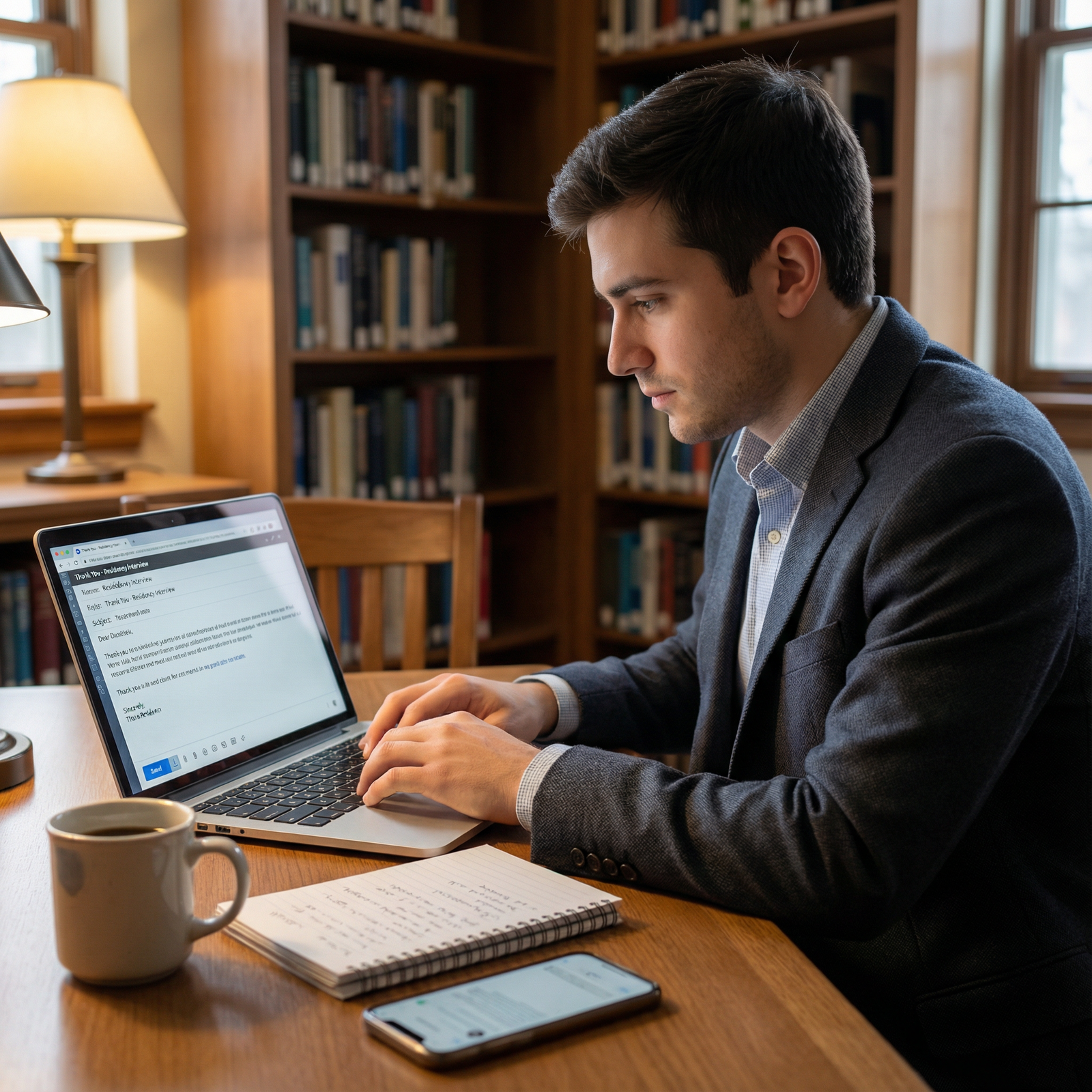
Dear Dr. [Name],
Thank you for the invitation to interview on [date], I'm genuinely excited about the program. I'm writing to ask whether the program offers any travel assistance, discounted hotel rates, or partnerships with nearby lodging for interviewees. I'd also like to know whether a virtual interview format is available should travel present a barrier.
Thank you for your time, and I look forward to meeting the team.
Three sentences of ask. Zero apologies. Notice the framing on the virtual option: it's an accessibility question, not a favor. Programs respond to that framing because it's accurate.
What can you realistically get? Hotel points bookings, discounted block rates, flight vouchers, parking validation, and occasionally a stipend. You won't receive most of these unless the words leave your mouth, or your keyboard.
Emergency Resources and Support Networks
If the hacks and the emails still leave you short, this is your fallback ladder. Climb it in order.
Your own medical school, first. Deans' offices and financial aid departments often hold emergency funds earmarked for exactly this, interview travel, suit purchases, unexpected application costs. It is the most underused money in medical education, partly because students assume the answer is no. Book a meeting this week. Bring your invite list and your budget. Ask plainly.
Crowdfunding, second. GoFundMe and Givebutter campaigns for interview travel are common now, and they work. I know the pride swallow involved. Do it anyway. Your family, your college friends, your mentors, people want to contribute to something concrete, and "help me get to my residency interviews" is about as concrete as it gets.
Community knowledge, third. Student Doctor Network and similar forums run threads where applicants share hotel rooms, split rental cars, and flag which programs offered them assistance. Splitting a hotel room with another interviewee halves your biggest cost instantly.
Credit, last. A 0% intro APR card can bridge short-term cash flow if, and only if, you have a realistic plan to pay it down with your first residency paychecks. Treat it as a bridge, not a solution. Carrying high-interest interview debt into intern year is a bad trade.
Two special cases: if you're an HPSP military scholarship recipient, interview travel benefits may already be built into your program, ask your branch. And if you're in the National Health Service Corps pipeline, check what your award covers before assuming you're on your own.
Your Action Plan: Starting Today
Enough reading. Here's the sequence, starting tonight:
- Calculate your real budget. Not a guess, a number. Savings, available aid, family help. Then list your invites with an honest per-trip cost estimate.
- Map three geographic clusters. Find the interviews you can combine into single trips. This alone is usually the biggest savings.
- Set fare alerts and join loyalty programs for any airline you'll realistically fly twice.
- Draft your outreach email using the template above, and send it to every program where cost will be a factor. Send it when you accept the invite.
- Book a meeting with your financial aid office or dean this week, not next month. Emergency funds get requested early and run out.
- Open a dedicated interview fund account so spending is visible and separate from rent money.
Key Takeaways
- Interview costs are a real barrier for thousands of qualified applicants every cycle. You're not alone, and programs know this better than you think.
- Cluster interviews geographically and use buses, trains, student discounts, and red-eyes, strategy routinely cuts costs by 50-70% without touching your top programs.
- Always ask about travel assistance before you decline anything. The funds exist. The only requirement is asking.
- Your school's financial aid office is the most underused resource in this entire process. Go first, go early.
- Financial constraint is a logistics problem, not a verdict on your worth as an applicant. Programs rank candidates, not bank balances.
So here's your next move: open a spreadsheet tonight. List every invite, every estimated cost, and every cluster opportunity. Then send one email, to a program coordinator or your financial aid office, before you go to bed. Momentum beats anxiety, and it starts with a single sent message.


