Preparing for the USMLE Step 1 while in a preliminary medicine year (prelim IM) is uniquely challenging. You’re learning to function as a physician, adjusting to call schedules and new responsibilities—often with less protected study time than you had in medical school. Yet Step 1 performance still matters for fellowship aspirations, future specialty transitions, and, for some international graduates, licensing and visa processes.
This guide walks you through how to integrate USMLE Step 1 preparation into your preliminary medicine year, with practical strategies, schedules, and resource recommendations that recognize your time and energy realities as an intern.
Understanding Step 1 in the Context of a Preliminary Medicine Year
Why Step 1 Still Matters in 2025 and Beyond
With Step 1 now Pass/Fail, the exam’s nature has changed, but its importance has not disappeared:
Licensure and institutional requirements
- Many states and institutions (especially for IMGs) still require a passing Step 1 for credentialing and visa processing.
- Failing Step 1 can delay progression or complicate contract renewals in some systems.
Foundation for Step 2 CK and clinical performance
- Strong Step 1 “systems thinking” makes Step 2 CK and in-training exam prep much easier.
- Your daily work on the floors (electrolytes, acid–base, sepsis, renal dosing) is grounded in Step 1 physiology and pharmacology.
Competitiveness for future specialty training
- While Step 2 CK now plays a bigger role in fellowship/specialty applications, PDs still care whether Step 1 was:
- Passed on the first attempt
- Completed on time (no unexplained long delays)
- A delayed or failed Step 1 can prompt questions about readiness or reliability.
- While Step 2 CK now plays a bigger role in fellowship/specialty applications, PDs still care whether Step 1 was:
For preliminary medicine residents, especially those planning to transition to advanced specialties (neurology, radiology, anesthesiology, dermatology, etc.), a clean Step 1 record simplifies future applications.
Unique Challenges of Studying During Prelim IM
Your prelim IM year is not designed with exam prep in mind:
Unpredictable schedule
- Rotations with call, night float, and ICU can crush your energy.
- Days off may be irregular and sometimes consumed by life tasks and recovery.
Cognitive load
- You’re learning EMR systems, hospital protocols, and how to manage acutely ill patients.
- Your “decision-making bandwidth” may feel spent by the end of the day.
Mental and physical fatigue
- Long shifts, disrupted sleep, and emotional stress (codes, difficult family discussions) reduce your ability to do sustained study.
You cannot simply replicate your fourth-year med student Step 1 study plan. Instead, you need a resident-specific, lower-friction approach that respects your limited time and energy.
Strategic Planning: When and How to Prepare During Your Prelim Year
Clarify Your Timeline Early
First, determine where Step 1 fits in relation to your prelim medicine year and career plans:
You have not taken Step 1 yet and must pass during or shortly after prelim year
- Common for some international graduates or those from schools with delayed Step 1.
- Objective: Pass on the first attempt and meet licensing or program requirements.
- Strategy: Integrate structured USMLE Step 1 study into your prelim year with a focused exam window (e.g., post-ward month, between rotations, or at the end of prelim year).
You passed Step 1 before residency but feel weak in Step 1 content
- Objective: Strengthen core basic science to support Step 2 CK/boards and clinical reasoning.
- Strategy: Lighter, integrated review: 30–60 minutes/day tied to real cases.
You failed Step 1 previously and are retaking during prelim year
- Objective: Achieve a clear, confident pass and address prior weaknesses.
- Strategy:
- Secure as much schedule flexibility as possible with your program.
- Build a more intensive and structured plan with frequent self-assessment.
Discuss Your Plan with Your Program Leadership
This is essential. Your residency program wants you to succeed and stay in good standing. Have an early, honest conversation with:
- Program Director (PD)
- Associate Program Director (APD)
- Possibly your chief residents
Discuss:
- Your Step 1 status (not taken, failed attempt, need for visa, etc.).
- Required deadline for passing based on licensing or program policies.
- Options for:
- A lighter rotation month (e.g., ambulatory block) around your exam date.
- Use of vacation time for an intensive study block (e.g., 1–2 weeks before the exam).
- Minimizing overlapping major responsibilities (e.g., no ICU or night float immediately before test day).
Document the plan in an email so expectations and support are clear.
Building a Realistic Study Plan Around a Resident Schedule
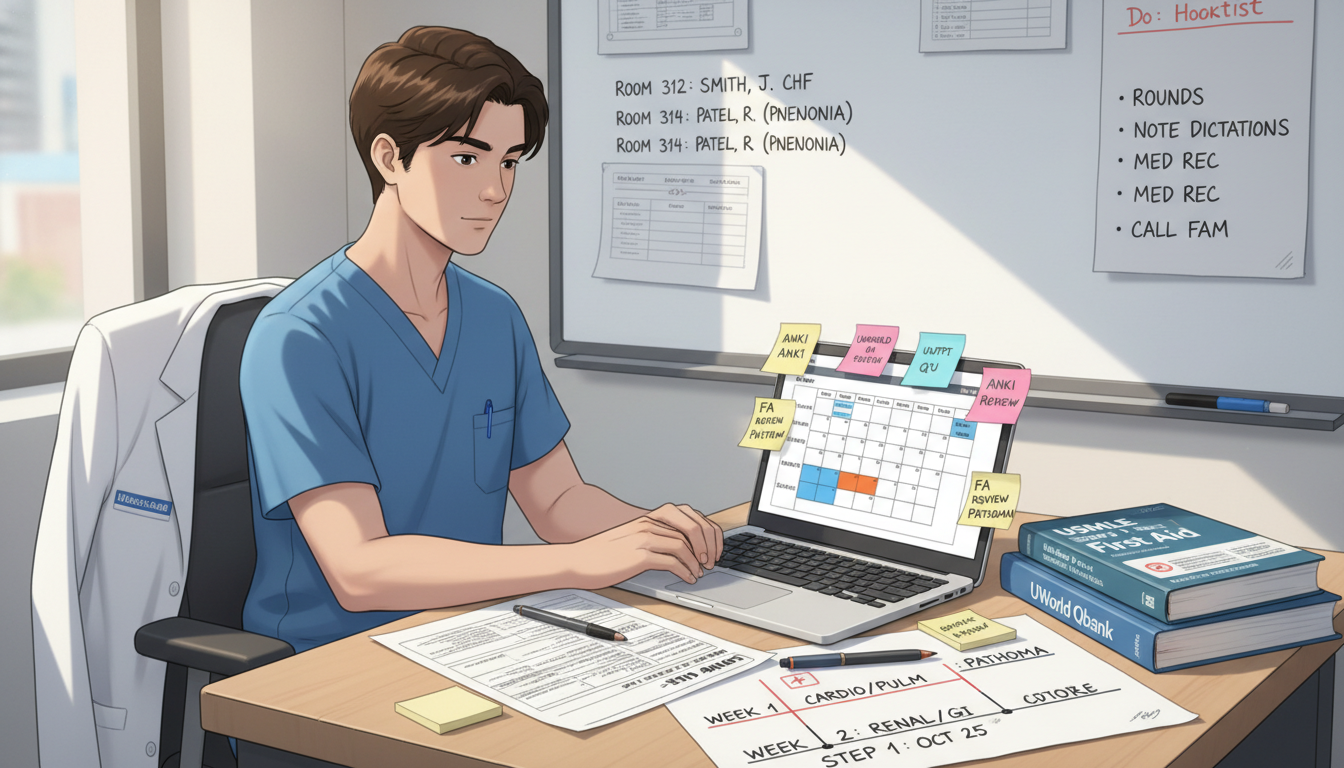
Principles for USMLE Step 1 Study During Prelim IM
Sustainability over intensity
A plan you can follow for months at 60–90 minutes/day is better than a 4-hour/day fantasy you abandon after a week.Anchoring study to fixed habits
Attach study sessions to routine points in your day:- After morning sign-out and breakfast
- After pre-call dinner
- During predictable quiet times on some rotations (clinic days, late afternoons on electives)
Blend clinical work with Step 1 content
Turn daily patient encounters into triggers for micro-review:- New DKA patient → 10–15 minute review of insulin mechanism and ketoacidosis pathophysiology.
- Hyponatremia consult → brief nephron physiology refresh.
Use short, targeted study blocks
- 15–25 minutes of focused work + 5-minute breaks.
- Several short blocks spread across your day often work better than one long block in an exhausted state.
Example Study Templates by Rotation Type
1. Busy Inpatient Wards / ICU
Weekly realistic target: 4–8 hours total
Daily framework (call-dependent):
Non-call days:
- 20–30 UWorld-style Step 1 questions in the evening.
- Quick 10–15 minute review in the morning (flashcards or key tables).
Call days:
- Very light: maybe 5–10 flashcards while waiting for labs or during breaks.
- No guilt days are okay; focus on survival and patient care.
Post-call days:
- Prioritize sleep. If anything, do 15–20 minutes of low-effort review in the evening.
2. Night Float Blocks
These have variable intensity. For many, post-shift is too cognitively drained for deep USMLE Step 1 study.
- Before shift (if you can wake up a bit early):
- 10–15 UWorld questions or a short systems-based review.
- On quiet nights (variable; never compromise patient care):
- “On-deck” flashcards or skim of a short topic if appropriate.
The priority during night float is circadian stability and safety. It’s better to maintain a minimum maintenance dose of USMLE Step 1 content than attempt aggressive studying.
3. Ambulatory / Elective Months
These are your most valuable Step 1 preparation windows.
Goal: 1.5–3 hours of study per day on most days, especially in the weeks leading up to your exam.
Possible structure:
- Morning (before clinic):
- 20–30 practice questions (mixed or system-based).
- Afternoon:
- Content review on key weak areas (e.g., immunology, biochemistry).
- Evening:
- Flashcards / spaced repetition (Anki or similar).
If you can align your designated exam month with an ambulatory rotation and partial vacation, you can transition into a near full-time USMLE Step 1 study mode.
Sample 12-Week Step 1 Study Framework During Prelim Year
Assumes: exam scheduled for the end of Week 12, with Week 11–12 being a lighter rotation or partial vacation.
Weeks 1–4: Foundation & Diagnostic Phase (Light Clinical Months Recommended)
- Complete a diagnostic NBME early (to identify baseline).
- Study focus:
- Rebuild fundamentals: physiology, pathology, and high-yield pharmacology.
- 20–30 questions/day on most days (4–5 days/week).
- Weekly target: 120–150 UWorld questions + 4–6 hours of content review.
Weeks 5–8: Consolidation & Systems Integration
- Increase question volume if possible: 30–40/day (5–6 days/week).
- Focus on:
- Integration across systems (e.g., cardiology path + pharm + physiology).
- Regular self-assessment every 2–3 weeks using NBME or UWorld self-assessments.
- Begin “error log”:
- Track recurring themes (e.g., lysosomal storage diseases, immunodeficiencies, renal tubular acidosis).
Weeks 9–10: Targeted Weakness Repair
- Based on self-assessment data, choose 3–5 weakest domains (e.g., biochemistry, neuroanatomy, endocrine).
- Heavy emphasis on:
- Reviewing all missed and marked questions.
- Condensing notes into rapid-review sheets.
- Continue 20–30 Qs/day, emphasizing weak topics.
Weeks 11–12: Final Review & Exam Readiness (Preferably with Vacation Time)
- Focus on:
- High-yield Step 1 resources: First Aid, Pathoma summaries, high-yield tables.
- Timed blocks of exam-like questions.
- At least one more full-length practice test 5–7 days before the real exam.
- Final days:
- Light review, flashcards, formulas, and pictures.
- Early sleep, nutrition, and logistical prep for test day.
Choosing and Using Step 1 Resources Efficiently
You have much less free time than in medical school, so resource discipline is critical. Focus on a core set of high-yield, proven Step 1 resources, rather than dabbling in many.
Core Step 1 Resources for Prelim IM Residents
Question Bank (QBank): UWorld (Primary)
- Still the gold standard for USMLE Step 1 study and clinical linkage.
- Use tutor or timed-random modes depending on your level and goals.
- Strategy:
- Initially: Tutor mode, system-based (align with rotation if helpful).
- Later: Timed random blocks to simulate the real exam.
- Focus on reading explanations deeply, not just answering.
First Aid for the USMLE Step 1 (FA)
- Best used as:
- A mapping tool: making sure you’ve seen every high-yield topic.
- A spine to which you connect QBank insights and notes.
- Mark or annotate with your personal mnemonics and QBank pearls.
- Best used as:
Pathoma / Boards & Beyond / Sketchy (Choose selectively, not all)
- Pathoma: Excellent for pathology fundamentals; efficient videos that fit into short resident-time windows.
- Boards & Beyond: Great for conceptual clarity in physiology and mechanisms; use for your weakest systems.
- Sketchy (Micro/Pharm): Efficient memory aid for micro and some pharm, especially if you already used it in med school.
Anki or Spaced-Repetition Decks
- Very powerful as maintenance during heavy rotations.
- Use:
- Pre-made decks (e.g., popular Step 1 decks) filtered to your weak areas.
- Custom cards only for high-yield misses from QBank and self-assessments.
- Goal: 20–60 minutes daily, split into small bursts.
How to Integrate Resources With Your Clinical Work
Your prelim medicine year gives you a living context for Step 1 material. Use that:
New consult for acute kidney injury (AKI)
→ Review: renal blood flow, GFR regulation, prerenal vs intrinsic vs postrenal patterns.Patient with sepsis and vasopressors
→ Microbiology of common pathogens + adrenergic receptor pharmacology.Hypertensive emergency on the floor
→ Mechanism of action and side effects of IV antihypertensives.
This approach improves retention because your brain sees material in action, not just in abstract.

Advanced Tactics: Time Management, Burnout Prevention, and Exam-Day Readiness
Time Management Strategies for Residents
Micro-blocking your day
- Identify 3–5 daily “micro-blocks” of 10–20 minutes:
- Pre-round coffee time
- Lunch break (if predictable)
- Pre-bed quiet time
- Assign each block a type:
- Morning: Review flashcards (low friction).
- Afternoon: A few QBank questions (if time).
- Evening: Short video or content summary.
- Identify 3–5 daily “micro-blocks” of 10–20 minutes:
Use “frictionless” study modes when you’re tired
- Too exhausted for full UWorld blocks? Switch to:
- Flashcards
- Audio summaries (if available)
- Quick review of your error log
- Too exhausted for full UWorld blocks? Switch to:
Weekend strategy on wards
- Protect half-days:
- One half-day for life tasks and sleep.
- One half-day for a longer study session (e.g., 1.5–3 hours).
- Protect half-days:
Batch low-value tasks to free mental space
- Combine:
- Laundry, groceries, and meal prep on a designated day or use delivery services if financially feasible.
- Small lifestyle tweaks can indirectly increase your cognitive capacity for USMLE Step 1 study.
- Combine:
Protecting Your Mental Health and Preventing Burnout
Burnout risk is significant during prelim IM—adding Step 1 can increase it. Intentionally protect yourself:
Set realistic expectations
- Your goal is to pass Step 1 and build a solid foundation, not aim for a 270-level performance during intern year.
- Accept that some days and even weeks will be “low-yield” academically—especially on ICU or heavy call rotations.
Create non-negotiable self-care anchors
- Minimum sleep target most nights (even if not perfect).
- At least 1–2 non-medical activities per week (exercise, hobbies, social contact).
Monitor for warning signs
- Persistent insomnia, irritability, detachment, or loss of motivation.
- If present, talk early with:
- A trusted faculty mentor
- Program leadership
- Institutional wellness or counseling services
Healthy resident → more efficient learning → better Step 1 performance.
Exam-Day Logistics for the Working Resident
As you approach your exam date:
Ensure administrative readiness
- Confirm:
- Test center location and timing.
- Required ID and documents.
- Arrange:
- A post-call or day-off before the exam if at all possible.
- Coverage if you are on a service that might otherwise conflict.
- Confirm:
Simulate exam conditions beforehand
- At least one full-length, timed self-assessment:
- Start at the same time as the real exam.
- Follow break structure similar to Prometric rules.
- Practice:
- Nutrition and hydration strategy.
- Caffeine amount that leaves you alert but not jittery.
- At least one full-length, timed self-assessment:
The 48 hours before Step 1
- Light review only: formulas, key images, high-yield lists.
- No new major topics.
- Focus on:
- Sleep
- A regular sleep–wake cycle
- Low-stress activities in the evening (short walk, light reading)
After the exam
- Plan a brief recovery window if possible.
- Return to residency with a mindset of:
- Integrating your strengthened basic science knowledge into patient care.
- Focusing on Step 2 CK and specialty-specific development when appropriate.
Putting It All Together: A Case Example
Case: Dr. K, a Preliminary Medicine Intern Planning to Transition to Neurology
Background:
- IMG, completed basic sciences 2+ years ago.
- Program requires a passing Step 1 by March for contract continuation.
- Match already secured for a PGY-2 neurology position, contingent on Step 1 completion.
Schedule Highlights:
- July–September: Heavy wards and ICU.
- October: Ambulatory block.
- November–December: Combination of wards and consults.
- January: Elective with more flexible hours.
- February: Night float.
Plan:
- July–September:
- Light USMLE Step 1 study: 10–20 UWorld questions/day 4 days/week.
- General path/phys review with short Pathoma videos on off days.
- Begin light Anki review for high-yield topics.
- October (Ambulatory):
- Ramp up: 30–40 questions/day, 5 days/week.
- Start First Aid read-through, integrated with QBank.
- NBME self-assessment near the end of the month.
- November–December:
- Maintain: 20–30 Qs/day (ward-dependent).
- Target weak areas identified by NBME with Boards & Beyond.
- Continue spaced repetition.
- January (Elective):
- Block out part of vacation and lighter days for intense review.
- 50–60 Qs/day 5 days/week.
- Second NBME mid-January; adjust final plan based on results.
- February:
- Schedule Step 1 for early March.
- Use night float to keep at least minimal flashcard or error-log review without compromising sleep.
- Week Before Exam:
- Partial vacation days, final NBME (if needed) and high-yield consolidation.
- Light review last 2 days, focus on rest.
- July–September:
Outcome:
- Dr. K passes Step 1 comfortably.
- Feels more confident with neuroanatomy and neuropharmacology during subsequent neurology training.
- Uses the same structured approach for Step 2 CK and RITE exams later in residency.
FAQs: USMLE Step 1 Preparation During a Preliminary Medicine Year
1. Is it realistic to prepare for Step 1 during a prelim IM year, or should I delay until after?
It is realistic to prepare and pass during a prelim year, especially if:
- Your program is aware and supportive.
- You leverage lighter rotations (ambulatory/electives) for heavier study.
- You keep a consistent low-to-moderate baseline of study even during busy months.
Delaying past prelim year can create licensing and credentialing complications, particularly for IMGs and those entering advanced specialties.
2. How many hours per day should I study for Step 1 as a resident?
There is no universal number, but common effective ranges:
- Busy inpatient months: 30–60 minutes/day on average, with some off days.
- Lighter/elective months: 1.5–3 hours/day on most days.
- Final 1–2 weeks pre-exam (with vacation or lighter service): 4–6 hours/day, structured and focused.
Focus more on consistency and quality than sheer hours.
3. Which Step 1 resources are essential if my time is very limited?
If you must keep it minimal, prioritize:
- UWorld Step 1 QBank – cornerstone of learning and assessment.
- First Aid Step 1 – to ensure you’ve covered all high-yield topics.
- One conceptual/visual aid (e.g., Pathoma or Boards & Beyond for your trickiest systems).
Add Anki or flashcards only if you can realistically maintain daily reviews.
4. I already passed Step 1 in medical school. Do I still need to think about Step 1 during prelim?
You don’t need dedicated Step 1 preparation, but:
- A light USMLE Step 1 style review can significantly boost your Step 2 CK readiness.
- Integrating basic science reasoning with your daily cases will improve your performance on in-training exams, boards, and future fellowship applications.
Think of it less as “Step 1 studying” and more as clinical reinforcement of foundational science.
By aligning your USMLE Step 1 preparation with the realities of a preliminary medicine year—variable schedules, high clinical load, and limited energy—you can still build a strong, sustainable plan. Focus on core Step 1 resources, consistent question practice, and smart scheduling around your rotations, and you will not only pass the exam but also enhance the quality of your clinical reasoning for the rest of your training.