For a US citizen IMG interested in Emergency Medicine-Internal Medicine (EM IM combined), Step 2 CK is arguably the most important standardized metric on your application. As an American studying abroad, you may not have a home EM or IM program or a school that is deeply familiar with the US residency system—so your Step 2 CK score becomes a powerful way to prove you can handle fast-paced, high-acuity clinical work.
This guide is tailored specifically to you: a US citizen IMG aiming for emergency medicine internal medicine training, looking to plan, execute, and optimize USMLE Step 2 study so that your score strengthens your match chances.
Why Step 2 CK Matters So Much for US Citizen IMGs Targeting EM-IM
1. The post-Step 1-pass landscape
With Step 1 now pass/fail, Step 2 CK is the primary numerical marker of your test-taking and clinical reasoning abilities. For a US citizen IMG, program directors will:
- Look at Step 2 CK to compare you with US MD/DO seniors
- Use your score to gauge your clinical readiness for internship
- Often filter applicants by score cutoffs during the initial screen
In EM and IM—and especially for EM IM combined programs, which are small and competitive—your Step 2 CK score can influence whether your application is reviewed at all.
2. Why EM-IM programs care about Step 2 CK
EM-IM combined programs need residents who can:
- Manage acute, undifferentiated emergencies
- Handle complex, chronic multi-morbidity on inpatient and outpatient IM services
- Learn rapidly and adapt across settings
Step 2 CK directly tests:
- Clinical reasoning
- Prioritization and triage
- Safe management decisions
- Evidence-based medicine and guidelines
These are the exact skills EM-IM programs need. For a US citizen IMG, a strong score shows you’re well prepared for:
- Busy ED shifts with rapid decision-making
- IM wards with high patient volumes and complex patients
- Board pass expectations in both EM and IM
3. Score expectations for EM-IM and categorical EM/IM
Programs rarely publish exact cutoffs, but in recent cycles:
- Competitive EM and IM programs often expect above-average scores
- EM-IM combined programs typically review applicants with solid to strong Step 2 CK scores, often above their general pool
You don’t need a “perfect” Step 2 CK score, but as a US citizen IMG, your goal should be to outperform average matched IMG data in EM and IM. A strong Step 2 can partially offset:
- Non-US school
- Limited US clinical experience
- Fewer home rotations in EM or IM
Building a Strategic Step 2 CK Study Plan as an American Studying Abroad
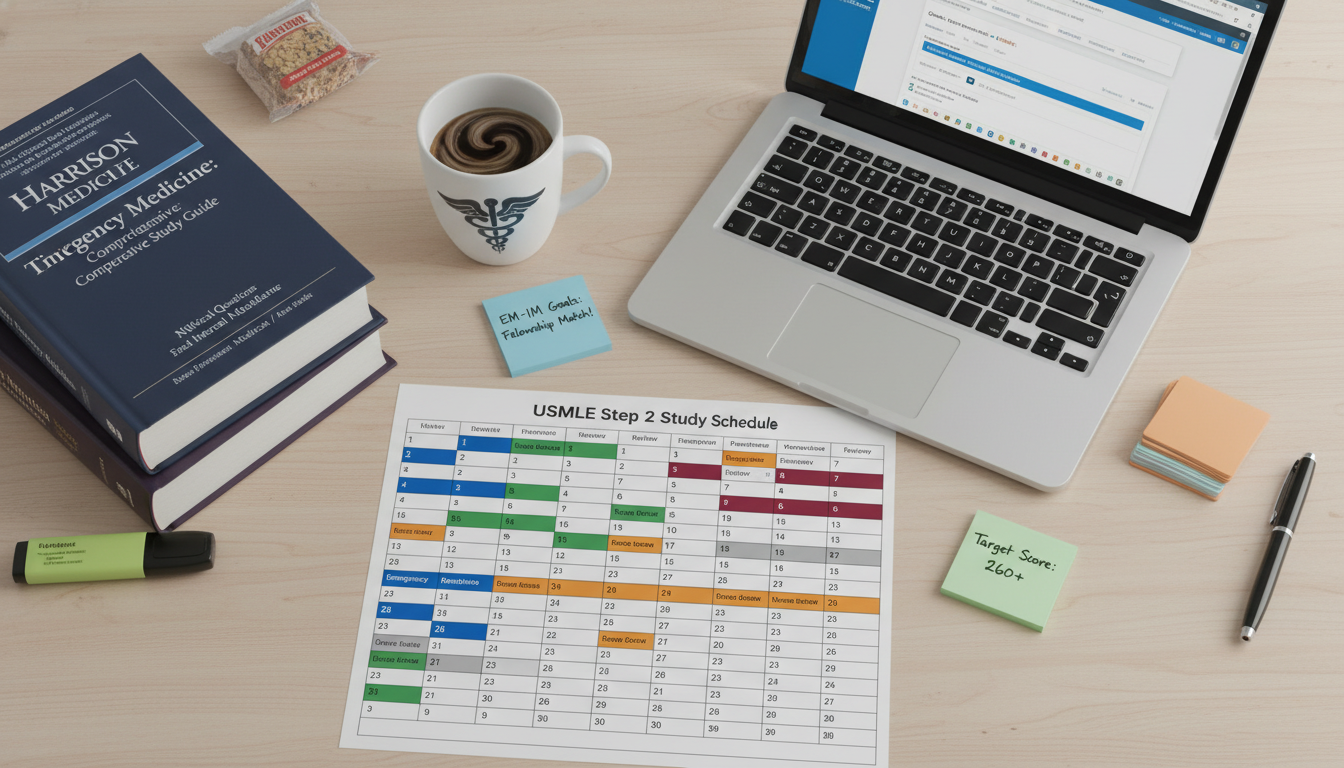
A strong Step 2 CK preparation plan needs to account for your IMG curriculum, clinical exposure, and timeline for EM-IM applications.
1. Start with your application timeline
Work backward from your target match cycle:
- Aim to take Step 2 CK by July–August of the year before you start residency (i.e., before ERAS opens in September).
- This ensures:
- Your Step 2 CK score is available for initial screening
- You have time for a retake if something unexpected happens (ideally not needed, but important as a safety buffer)
- Your EM and IM letters of recommendation can mention your strong Step 2 performance
For many US citizen IMGs, the ideal timing:
- Complete core rotations (IM, surgery, peds, OB/GYN, psych, family)
- Take Step 2 CK shortly after your most clinically intense rotations, particularly internal medicine
2. Assess your baseline and constraints
Before diving into intense USMLE Step 2 study, list:
- Your Step 1 background
- Strong Step 1? You may need less time for foundational review.
- Pass with difficulty? Build in extra time and more structured support.
- Your clinical exposure
- Have you already done US rotations (clerkships, electives, or observerships) in EM or IM?
- Do you mostly have non-US clinical experience that may not mirror US practice patterns?
- Your weekly schedule
- Are you on full-time clinical rotations, or do you have a dedicated study block?
- Do you have call, night shifts, or intense rotation demands?
3. Decide on your prep length
Typical time frames for US citizen IMGs:
- Dedicated prep (no rotations): 8–12 weeks
- Common for students taking Step 2 between 4th and 5th year or right after core rotations.
- Integrated prep (during rotations): 4–6 months
- Doing QBank questions nightly and on weekends while on the wards.
If you’re targeting EM-IM and want a standout Step 2 CK score:
- Aim for 2–3 months of high-intensity prep, whether dedicated or semi-dedicated.
- If your Step 1 was marginal or your school’s clinical training is weaker:
- Plan toward the longer end (10–12 weeks of dedicated).
4. Create a high-yield weekly structure
A simple but effective weekly Step 2 CK preparation framework:
Daily (5–6 days/week)
- 40–60 timed, random QBank questions (split into 2–3 blocks)
- Thorough review of all explanations
- 1–2 hours of targeted review (videos, notes) of weak areas
Weekly
- 1 full-length practice block (40 questions) under test-like conditions
- 1–2 hours of systems/discipline consolidation (e.g., review all EM-relevant cardiology topics)
- 1 day light or off to avoid burnout
Monthly
- One NBME or UWorld Self-Assessment (UW SA) to:
- Track progression
- Recalibrate your study priorities
- Predict your Step 2 CK score range
Core Step 2 CK Resources and How to Use Them for EM-IM
Step 2 CK resources are overwhelming if you try to use everything. The key is to use a limited, high-yield set deeply and systematically.
1. Question banks: your primary resource
For a US citizen IMG, QBank performance and learning from explanations is where you gain the most.
Essential QBanks:
UWorld Step 2 CK
- Non-negotiable. Make this the centerpiece of your prep.
- Strategy:
- Complete 100% of questions, ideally with a mix of timed and random blocks once you’re comfortable.
- Treat it like a learning tool, not just an assessment.
- For EM-IM:
- Pay special attention to:
- Cardiology, pulmonology, neurology
- Infectious diseases, sepsis, shock
- Endocrine emergencies, electrolyte disorders
- Trauma, toxicology, environmental exposures
- Pay special attention to:
NBME Self-Assessments for Step 2 CK
- These give the most accurate predictive score estimates.
- Take at least 2–3 NBMEs, spaced ~2–3 weeks apart in the second half of your prep.
Optional QBank (if time permits):
- AMBOSS
- Useful if you finish UWorld early or want more EU-style clinical reasoning cases (which may parallel some IMG schools).
- Great for quick reference during rotations too.
2. Video and teaching platforms
Choose one main video resource and don’t over-commit.
Common options:
OnlineMedEd (OME)
- Structure: Well organized by clerkship and organ system.
- Best for: Building a clinical framework if your rotations were weaker or non-US-focused.
Boards & Beyond (Step 2 CK)
- Strong on pathophysiology and bridging Step 1→Step 2.
- Good if your Step 1 foundations need reinforcement while you build clinical skills.
Divine Intervention podcasts
- High-yield rapid review, especially late in preparation.
3. Written references and notes
You don’t need multiple textbooks. For a US citizen IMG in EM-IM, focus on:
- UWorld notes or Anki decks derived from UWorld
- One set of comprehensive notes (e.g., OME notes or your own summary PDF)
- High-yield EM/IM references for tricky areas:
- ACLS algorithms (cardiac arrest, bradycardia, tachycardia)
- Trauma protocols (ATLS-style priorities)
- Sepsis and shock management bundles
EM-IM Specific Content Strategy: What to Emphasize on Step 2 CK

Even though Step 2 CK is general clinical medicine, certain domains overlap heavily with what EM-IM programs care about.
1. Acute care and resuscitation
High-yield for Step 2 CK and EM-IM:
Initial stabilization:
- Airway: indications for intubation
- Breathing: oxygen delivery, NIV vs. intubation
- Circulation: fluids vs. vasopressors, shock types
Shock and sepsis:
- Distinguish hypovolemic, cardiogenic, distributive, obstructive
- Know initial fluid resuscitation and when to add vasopressors
- Empiric antibiotic choices for common sources (pneumonia, UTI, intra-abdominal, skin/soft tissue)
Chest pain and ACS:
- STEMI vs. NSTEMI vs. unstable angina
- Immediate management: MONA (modified), antiplatelets, anticoagulants, cath lab timing
- Contraindications to thrombolytics
Stroke and neurologic emergencies:
- Time windows for tPA and thrombectomy
- Hypertensive emergencies vs. urgency
- Status epilepticus management
Actionable tip:
Create one-page algorithms for:
- Sepsis management
- Chest pain/ACS
- Stroke code
- Major trauma assessment (primary and secondary survey)
Use them for rapid weekly refreshers.
2. Chronic disease management (IM-heavy content)
EM-IM programs need residents who can manage long-term conditions too. On Step 2 CK, this appears as:
- Heart failure (acute exacerbation vs. chronic management)
- COPD (acute exacerbation, oxygen targets, steroids, antibiotics)
- Diabetes mellitus (DKA vs. HHS, outpatient regimens, hypoglycemia)
- Chronic kidney disease (indications for dialysis, medication adjustments)
- Hypertension, hyperlipidemia, and ASCVD prevention
As you study, always ask:
- “What is the next best step in managing this chronic disease?”
- “When does this chronic issue become an acute emergency?”
This dual lens (acute vs. chronic) is exactly what EM-IM intern years will demand.
3. Infectious disease and antibiotics
Across EM and IM:
- Know empiric antibiotic choices based on:
- Site of infection
- Community vs hospital-acquired
- Severity of illness
- Recognize opportunistic infections in immunocompromised patients
- Distinguish when to treat vs observe (e.g., asymptomatic bacteriuria)
For a US citizen IMG whose home country may have different antibiotic patterns, Step 2 CK is your chance to show you understand US-based guidelines.
4. Ethics, communication, and systems-based practice
EM-IM physicians frequently handle:
- Capacity assessments
- DNR/DNI decisions, code-status discussions
- AMA discharges
- Emergency consent
Step 2 CK has a significant number of questions on:
- Informed consent
- Confidentiality (e.g., adolescents, STIs, pregnancy)
- End-of-life care
- Reporting requirements and public health
These questions can be easy points if you study them intentionally. Use ethics-specific QBank blocks and summary tables.
Practical Study Tactics for US Citizen IMGs: Common Challenges and Solutions
As an American studying abroad, you may face distinct obstacles that US MD/DO students don’t. Here’s how to overcome them.
1. Limited exposure to US-style clinical reasoning
Challenge: Your school may emphasize theory over US guideline-based practice.
Solutions:
- During UWorld review:
- Pay attention to why wrong answers are wrong in the context of US guidelines.
- Note US-specific thresholds (e.g., when to start statins, BP treatment thresholds, cancer screening ages).
- If you’ve done US rotations:
- Connect your question-based learning to your real patient experiences.
- Consider short, targeted use of:
- OnlineMedEd or AMBOSS articles to understand standard US approaches to common conditions.
2. Time zone and scheduling constraints
Some USMLE-specific webinars and review courses are US-based.
Solutions:
- Rely primarily on asynchronous resources (Qbanks, recorded lectures).
- Build a fixed daily routine anchored to your local time that feels “USMLE-first,” even if you’re not in the US physically.
- Join online study communities for US citizen IMGs:
- Discord groups, WhatsApp groups, or online forums where timing is flexible.
3. Balancing rotations with Step 2 CK prep
Many US citizen IMGs cannot take long dedicated periods.
Tactics:
Micro-study blocks:
- 10–15 questions in the morning
- 10–15 questions at lunch
- 20–30 questions in the evening
Prioritize quality of review over total question volume:
- Even 20–30 questions thoroughly reviewed daily is powerful.
Use rotations strategically:
- On IM rotations: Focus extra on IM-related Step 2 topics that week.
- On EM/elective rotations: Pay special attention to acute care and triage-style questions.
Test-Taking Strategy to Maximize Your Step 2 CK Score
Your content knowledge is only part of your Step 2 CK performance. Test strategy can raise your effective score by several points.
1. Approaching questions like an EM-IM physician
Think in structured steps, similar to how EM and IM attendings think:
Stabilize first
- If the patient is unstable, the correct answer is often an immediate intervention, not more tests.
Define the problem clearly
- What is the key clinical syndrome? (e.g., sepsis, ACS, PE, stroke)
Use probabilities and pre-test risk
- Step 2 CK heavily rewards understanding when to test and when to treat.
Select the next best step
- Even if multiple steps will eventually be done, the exam asks: What is the optimal next action right now?
2. Timing and stamina
The exam is long, similar to a heavy ED call shift.
Practice:
- Timed blocks only in the final 4–6 weeks.
- At least 2–3 full-length, exam-style days using multiple NBME/UW blocks back-to-back.
On exam day:
- Plan structured breaks (e.g., after every 2 blocks).
- Bring simple snacks and hydration similar to a long call shift.
3. Handling uncertainty and avoiding last-minute changes
Use a consistent approach:
- Eliminate obviously wrong options first.
- Look for extreme or unsafe options.
- Choose the safest, most guideline-concordant answer.
Avoid over-editing:
- Only change answers if you realize you misread the question or recall new, relevant information.
- Do not change answers due to vague “gut feelings” without evidence.
Putting It All Together: A Sample 10-Week Plan for a US Citizen IMG Targeting EM-IM
Here’s an example of how to structure your USMLE Step 2 study.
Weeks 1–2: Foundation and orientation
- UWorld:
- 30–40 questions/day, untimed, by system.
- Focus: Internal Medicine, Emergency Medicine, Cardiology, Pulmonology.
- Video:
- 1–2 OME or B&B videos/day on topics related to that day’s questions.
- Task:
- Build or refine your one-page EM-IM algorithms (sepsis, ACS, stroke).
Weeks 3–4: Building momentum
- UWorld:
- 40–60 questions/day, move toward timed blocks.
- Include random mixed blocks 1–2 times/week.
- Assessment:
- Take NBME #1 at the end of Week 4.
- Adjust:
- Identify bottom 3 systems and increase focus.
Weeks 5–6: Intensification
- UWorld:
- Aim to reach ~70–80% completion by end of Week 6.
- All blocks now timed, mostly random.
- Assessment:
- Take NBME #2 or a UWorld Self-Assessment.
- Weakness focus:
- If OB/GYN, Peds, or Psych are weak, add targeted sessions.
Weeks 7–8: High-yield refinement
- UWorld:
- Finish all remaining questions.
- Begin a second pass of incorrects or marked questions.
- Ethics and systems:
- Do dedicated ethics and biostatistics review.
- Assessment:
- Take NBME #3.
Weeks 9–10: Final polish
- Focus:
- Incorrects, weak areas, algorithms, rapid-review notes.
- Practice:
- 1–2 full-length practice days to simulate test day.
- Final assessment:
- Optional final UWorld SA if you want additional reassurance.
- Week before test:
- Decrease volume slightly; focus on sleep, consolidation, and maintaining confidence.
FAQs: US Citizen IMGs, EM-IM, and Step 2 CK
1. What Step 2 CK score should a US citizen IMG aim for if applying to EM-IM combined programs?
There is no official cutoff, but because EM-IM programs are small and selective, aim to be at least above the national average and ideally above average for matched IMGs in EM/IM. A stronger score helps compensate for:
- Non-US medical school
- Less exposure to US-style clinical training
- Limited home EM/IM programs
Your personal goal should be:
- High enough to avoid automatic screens, and
- Solid enough that program directors see you as ready for high-acuity training.
2. Do EM-IM programs care more about Step 2 than categorical EM or IM programs?
For combined EM-IM, your Step 2 CK score matters to both EM and IM sides. They want residents who can handle:
- ED resuscitations
- Complex inpatient and outpatient IM cases
That makes Step 2 CK—focused on real-world clinical decisions—especially important. Categorical EM and IM care deeply about Step 2 as well, so a good score keeps multiple pathways open (EM-IM, EM only, IM only, EM with IM prelim, etc.).
3. How can I tailor my Step 2 CK preparation specifically toward emergency medicine internal medicine?
You don’t need separate EM-IM resources, but you should:
- Emphasize:
- Acute care (shock, sepsis, trauma, airway)
- Cardiopulmonary emergencies
- Chronic disease management (HF, COPD, diabetes, CKD)
- Practice thinking in terms of:
- Immediate stabilization vs. diagnostic workup vs. long-term management
- Use an EM-IM lens during QBanks:
- Always ask: “What would I do next if I were the ED doc?” and “How would I manage this as the IM physician on the ward or in clinic?”
4. Is it risky to delay Step 2 CK to try for a higher score as a US citizen IMG?
Delaying Step 2 CK can be beneficial if:
- You genuinely need more time for solid preparation, and
- You still plan to take the exam before ERAS submission, ideally by July–August.
It’s risky if:
- You push the exam so late that:
- Scores are not ready for initial review, or
- You leave no safety margin in case of illness, scheduling issues, or a poor performance requiring a retake.
For EM-IM applicants, having a good score available early often helps more than chasing tiny improvements with a very late test date.
A focused, disciplined USMLE Step 2 study plan can significantly elevate your residency application as a US citizen IMG targeting emergency medicine internal medicine. Treat Step 2 CK as both an exam and a rehearsal for your future EM-IM practice—the way you learn to think for this test is the way you’ll think on shift and on the wards.