Hook: The retake isn’t the scandal — the story around it is
Here’s the myth: a late USMLE retake is career poison for a DO applicant, and somehow a COMLEX stumble is gentler, softer, easier to forgive.
That’s lazy thinking.
A late USMLE retake does not automatically hurt a DO applicant more than a COMLEX retake. What matters is the pattern. The timing. The specialty. And whether your file tells a coherent story or looks like a pile of bad decisions taped together the week before ERAS.
I’ve seen applicants catastrophize a single retake like it’s a felony. It isn’t. Program directors are not sitting around waiting to execute anyone who needed one reset. They read it in context. Was it one miss followed by a meaningful jump? Was there a rational delay because you actually rebuilt your prep? Or does the application scream instability, denial, and magical thinking?
That’s the real issue.
The question isn’t, “Is a late retake bad?” Too simplistic. The real question is whether you look stable, honest, and ready for the specialty you’re applying into. A retake can fit inside that story. Repeated chaos usually can’t.
What program directors actually care about: retake timing, trend, and context
A late USMLE retake can be more visible than a late COMLEX retake. That part is true. Especially at programs that use USMLE as a convenient comparison tool or at places where faculty barely know how to interpret COMLEX beyond “higher seems better.” Visibility, though, is not the same thing as damage. Applicants confuse those two constantly.
Here’s what program directors actually react to:
- Was it a single retake or part of a pattern?
- Did the score improve enough to show real readiness?
- Did the timing make sense, or did you clearly rush it?
- Did the applicant learn from the first attempt, or just repeat the same mistake with different flashcards?
A single delayed retake after a clear reset in preparation is usually manageable. Multiple retakes? Different story. That starts to signal chronic test-taking instability, poor self-assessment, or both. None of those are attractive traits in a residency applicant.
And let’s kill another bad assumption: COMLEX is not automatically “safer.” If your COMLEX pattern is weak, especially at osteopathic-friendly programs that actually understand those scores, they will notice. A low COMLEX Level 2 after a prior issue is not magically harmless because it’s more familiar to DO-heavy programs. Sometimes it’s worse because they know exactly what they’re looking at.
The retake becomes a problem when it implies delayed readiness. If you retook late because your study plan collapsed, your clerkships were disorganized, and you kept moving the date because you weren’t close, that’s concerning. If you retook late because you failed narrowly, paused, got tutoring, changed how you studied, and came back with a substantial jump, that reads very differently.
That’s not spin. That’s how applications are actually read.
USMLE versus COMLEX: why the comparison is messier than applicants think
Applicants want a clean rule. They want someone to say, “USMLE retake bad, COMLEX retake less bad,” or the reverse. Sorry. Real life is uglier than that.
USMLE and COMLEX are not judged identically because programs don’t use them identically. That’s the whole game. Some MD-heavy programs treat USMLE as the common language and see COMLEX as a translation they don’t fully trust. That doesn’t make them right. It makes them common. So for a DO applicant, a USMLE retake may create a sharper optics issue in those settings because it’s the score they use to line you up next to everyone else.
Meanwhile, at osteopathic-friendly programs, a COMLEX weakness can carry just as much weight or more, because they’re comfortable with the exam and its score patterns. There’s no protective fog there. They understand exactly what a poor trajectory means.
This is where students get trapped by false equivalence. They think one exam should “count” less because it’s less emphasized in a certain environment. Maybe. But if the rest of the application is mediocre, any retake becomes louder. If the rest of the file is strong, one retake often becomes background noise.
And yes, the whole file matters. More than applicants like to admit. A DO student with one late Step 2 retake, strong clerkship evaluations, honors in medicine and surgery, excellent letters, no professionalism concerns, and a convincing specialty narrative is not viewed the same way as someone with the same retake plus average rotations, generic letters, and no clear reason for applying to the field.
Specialty matters too. Competitive fields scrutinize everything. Dermatology, orthopedic surgery, ENT, plastic surgery, radiology at selective academic programs—those places can afford to be picky, and they often are. A retake there hurts more because the margin for error is tiny. No mystery.
But in primary care, psychiatry, pediatrics, family medicine, many community internal medicine programs, and a lot of solid mid-tier training environments, upward trends and clinical fit often matter more than one late stumble. Not always. But often enough that the doom-posting online is nonsense.
If you want the blunt version, here it is:
- USMLE retakes are often more visible at MD-heavy programs.
- COMLEX weaknesses are not automatically forgiven anywhere that understands COMLEX.
- One retake rarely sinks a solid applicant by itself.
- A chaotic pattern absolutely can.
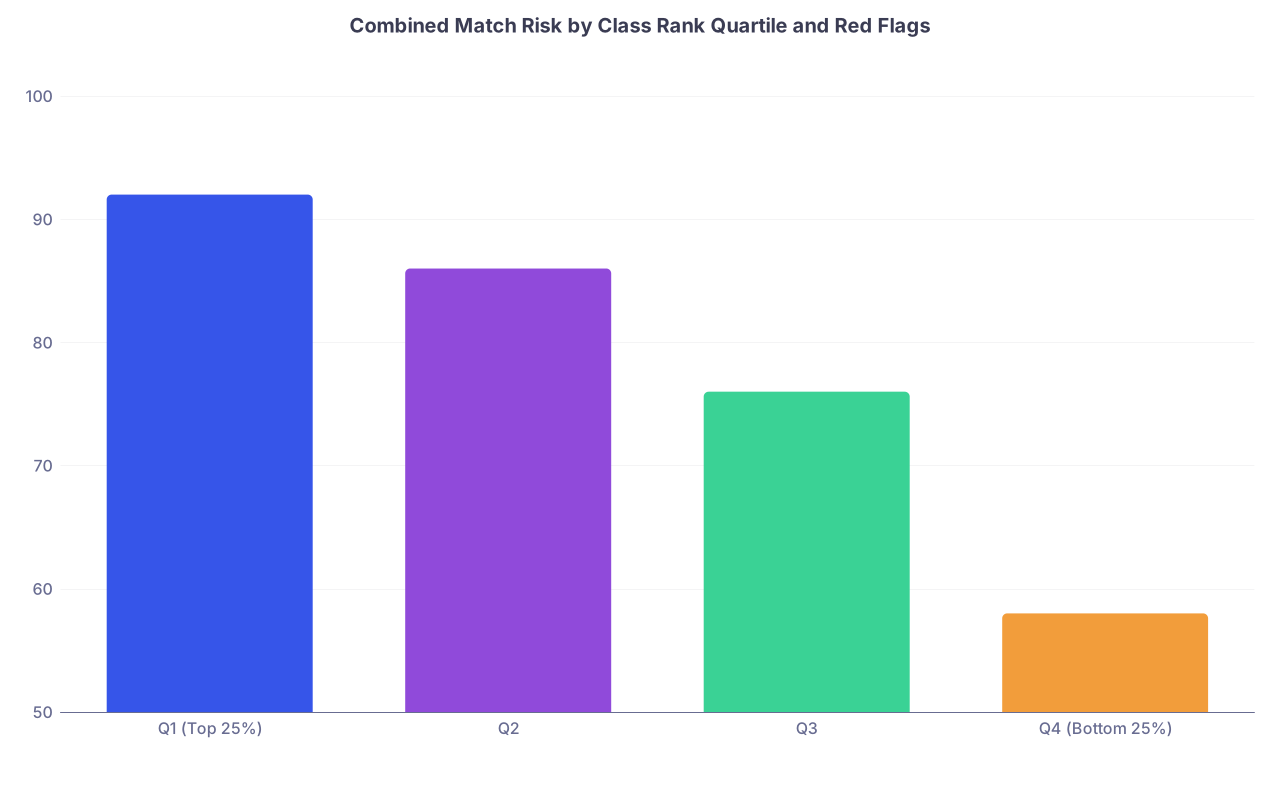
That’s the data-shaped reality, not the mythology students trade in group chats.
When a late USMLE retake becomes a real red flag — and when it doesn’t
Let’s separate drama from actual risk.
A late USMLE retake becomes a real red flag when it comes with one or more of the following:
- Repeated failures or multiple retakes
- No meaningful score improvement
- Retaking suspiciously close to application season with no clear reason
- Inconsistent explanations across ERAS, emails, and interviews
- Delayed disclosure or weird evasiveness
- Other professionalism issues in the file
That last one matters more than students realize. One exam issue plus professionalism trouble is not “two separate concerns.” To a program director, it becomes a pattern: poor judgment under pressure.
Now the lower-risk version. One delayed retake after a near-pass or modest miss. Time taken to reset. A clear change in strategy. Better performance afterward. Clean explanation. No other red flags. That scenario is often survivable, and sometimes barely memorable if the rest of the file is good.
The retake itself is not the poison. Ambiguity is.
I’ve watched applicants sabotage themselves in interviews by overexplaining. They turn a manageable issue into a ten-minute confession. Don’t do that. Program directors do not need your emotional autobiography about the exam. They need a brief, accountable explanation that answers three questions:
- What happened?
- What changed?
- Why should we trust that it won’t happen again?
That’s it.
A strong answer sounds like this: “My initial score didn’t reflect readiness for the specialty I’m pursuing. I paused, changed my preparation structure, worked with faculty support, and retested once I was consistently performing at a higher level. The later score better reflects where I am now.”
Short. Adult. Credible.

How to reduce damage before ERAS: a no-drama strategy for DO applicants
The smartest move is usually the least emotional one.
Don’t rush a marginal late retake just because panic on Reddit told you to. If the retake is unlikely to meaningfully improve competitiveness, you may be creating more concern, not less. A rushed late exam with a small score bump—or worse, another bad result—is how applicants manufacture red flags out of insecurity.
Use a simple framework:
- Will the retake materially improve your application for your target specialty?
- Can you prepare well enough to show a clear jump, not a cosmetic one?
- Will the timing still allow your application to look organized rather than chaotic?
- Would your energy be better spent strengthening the rest of the file?
Because yes, the rest of the file matters. A lot.
What helps offset one retake?
- Strong clinical performance
- Honors or standout sub-I evaluations
- Letters that sound specific and enthusiastic, not generic
- Audition rotations where you act like someone programs want around at 5:30 a.m.
- A consistent specialty story
- No professionalism nonsense
If you need to address the retake in a personal statement or interview, keep it lean. Own the timeline. Don’t whine. Don’t blame the exam, your school, the proctor, Mercury retrograde, or “test anxiety” with no evidence of growth. Show what changed. Then pivot to proof of readiness: later performance, clinical evaluations, stronger structure, better judgment.
That’s the whole reframing applicants need. The question is not whether a late USMLE retake is abstractly “worse” than COMLEX. That’s a student-forum question. The real question is whether your total file shows resilience, competence, and predictability.
Programs can work with a stumble. They hate uncertainty.
Summary
Here’s what the data actually shows: a late USMLE retake is not automatically more damaging than a COMLEX retake for a DO applicant. The effect depends on context—timing, score trend, specialty competitiveness, and the strength of the rest of the application.
The real red flags are repetitive failure, bad timing, poor judgment, and a messy explanation. Not one isolated retake by itself.
And if you remember one thing, make it this: program directors are not grading your shame. They’re assessing whether you look ready to train. A coherent file with one repaired mistake can match. A chaotic file with excuses usually won’t.