
The way program directors interpret dual USMLE–COMLEX scores from DO applicants is not what you’ve been told on forums. It’s messier, more political, and far more pattern-based than anyone wants to admit.
Let me walk you through what really happens behind that closed office door when your file comes up.
The First Pass: What Actually Gets Seen
Here’s the dirty little secret: on the first screen, you are not a nuanced human with parallel exam pathways. You are a line in a spreadsheet.
Most programs export applications from ERAS into some sort of sortable list. That list has columns: name, school, Step 1, Step 2 CK, COMLEX 1, COMLEX 2, maybe a filter flag like “DO.”
On that first pass, three things usually determine whether you live or die in the pile:
- Do you have USMLE scores or only COMLEX?
- Are any scores obviously disqualifying?
- Do your scores fit what the PD “expects” for a DO who took both exams?
The nuance comes later. But if you do not survive this brute-force first screen, no one is reading your personal statement about holistic care.
Here’s the practical breakdown of what PDs actually do with dual scores.
How PDs Really Rank USMLE vs COMLEX
Most MD-heavy programs, especially in competitive specialties, treat USMLE as the “currency” and COMLEX as supporting documentation. They won’t say that publicly. I’ve heard it stated verbatim in PD meetings.
In a typical academic IM, EM, anesthesia, or surgery program, the hierarchy goes like this:
- USMLE > COMLEX for comparison across all applicants
- COMLEX used to cross-check or make sense of inconsistencies
- If only COMLEX, they either convert (roughly, inconsistently) or quietly de-prioritize you
When you have both, they do not average them, they do not meticulously crosswalk them using NBOME’s conversion PDFs. Most PDs do a mental shortcut:
- “Step 1/2 is X. COMLEX is around Y. Do these look aligned or weird?”
- “Is there a glaring discrepancy that needs an explanation?”
- “Does this DO’s USMLE make them easy to rank against MDs?”
The key word there is easy. Anything that makes you “complicated” in a busy PD’s mind hurts you.
Common Score Patterns and How PDs Interpret Them
Let me go through the patterns I’ve seen debated in actual selection meetings.
Pattern 1: Strong on Both – The DO Who Becomes an “Honorary MD”
Example:
- COMLEX Level 1: 640
- COMLEX Level 2: 660
- Step 1: 238 (back in the numerical days) / P now
- Step 2 CK: 247
How PDs see this:
- “This DO can hang with our MD applicants.”
- COMLEX confirms: “They weren’t just gaming USMLE; they’re consistently strong.”
- You stop being a “risk.” You become straightforward. Easy to justify to faculty who only think in USMLE numbers.
This combination is gold at mid-to-high tier programs and absolutely expected in competitive specialties (EM at big urban places, anesthesia, rads, ortho, etc).
In actual rank meetings, people say things like:
“Yeah, they’re DO but Step 2 is 247 and COMLEX 2 is 660. They’ll be fine. Move them up.”
You want people to say that about you.
Pattern 2: Strong COMLEX, No USMLE – The “Great But Hard to Compare” Applicant
Example:
- COMLEX Level 1: 640
- COMLEX Level 2: 660
- No USMLE taken
How this plays:
At DO-friendly programs or former AOA programs, you’re totally fine. Some PDs even prefer this. They know the exam. Their faculty all took it. No problem.
At MD-majority academic programs? Very different:
- Some PDs will say, “We don’t need USMLE. COMLEX > 600 is good.”
- Many others quietly rank you lower because they can’t easily compare you to the MD stack.
Behind closed doors, I’ve heard:
“I like them, but we have no USMLE. Tough to know where they fall with the rest.”
Then they get bumped just a bit down. That “bit” is where people lose spots.
Pattern 3: Good COMLEX, Mediocre USMLE – The “Red Flag Question Mark”
Example:
- COMLEX Level 1: 620
- COMLEX Level 2: 640
- Step 1: Pass
- Step 2 CK: 224
This is the pattern that causes the most discussion and the most damage if no one coached you.
What PDs infer:
- “Why are USMLE scores underperforming relative to COMLEX?”
- “Did they just barely scrape by USMLE?”
- “Is their test-taking not as strong when removed from the osteopathic exam style?”
Fair or not, USMLE dominates the room. Many faculty simply don’t trust COMLEX scaling. So they default to what feels “objective” to them: the lower USMLE.
I’ve watched files like this get demoted with comments like:
“COMLEX looks strong but USMLE 224 is borderline for us. We have plenty of applicants at 240+.”
If you’re going to sit for USMLE, you cannot treat it like a side quest. A weak USMLE chained to a strong COMLEX hurts more than COMLEX-only in certain programs.
Pattern 4: Mediocre on Both – The “Depends on the Program” Applicant
Example:
- COMLEX Level 1: 520
- COMLEX Level 2: 540
- Step 1: Pass
- Step 2 CK: 228
This is the bulk of applicants. Not bad. Not stellar. Just… normal.
Interpretation depends entirely on:
- Specialty competitiveness
- Program tier
- How DO-friendly the institution is
- What else you bring (letters, home rotation, research, life story)
In a community IM program with DO faculty: “Looks fine, bring them in.”
In a mid-tier academic program for EM/anesthesia: “Maybe. Let’s see if they rotated here or have any connections.”
In derm, ortho, plastics? They’re done before anyone scrolls.
Pattern 5: High USMLE, Lower COMLEX – The “We Don’t Care” Scenario
Example:
- COMLEX Level 1: 530
- COMLEX Level 2: 560
- Step 1: Pass
- Step 2 CK: 245
Here’s what happens: most PDs ignore COMLEX once that Step 2 CK crosses their comfort threshold.
I’ve literally heard:
“USMLE is solid. COMLEX is fine whatever. Move on.”
You rarely get penalized for a slightly lower COMLEX if your USMLE is strong. You will get penalized for the reverse.
If you’re going dual, your priority exam—strategically—should be USMLE, because that’s the language of the room.
Pass/Fail Step 1 Changed the Game – But Not For You
Step 1 going pass/fail helped MDs a lot more than it helped DOs.
Here’s why:
- With MDs, PDs now lean heavily on Step 2 CK for differentiation.
- With DOs, PDs still scrutinize COMLEX 1 and 2 and Step 2 CK together to see if you “belong” in their usual range.
A common internal pattern:
- DO with P on Step 1 + 248 Step 2 CK + 650 COMLEX 2 → “Strong, no concerns.”
- DO with P Step 1 + 228 Step 2 CK + 580 COMLEX 2 → “On the margin; let’s see the rest.”
- DO with P Step 1 + no USMLE + 600 COMLEX 2 → “Depends if we’re comfortable with COMLEX-only.”
You are not being evaluated by the same unspoken rules as the MDs. The dual-exam reality makes it worse, not better, if you’re not strategic.
The Conversion Myth: What PDs Really Do With Score Equivalents
There’s this fantasy online that programs sit down with some official COMLEX–USMLE conversion chart and scientifically map your 620 to a “USMLE equivalent.”
No. They don’t.
What actually happens:
- A minority of data-minded PDs know rough correlations: “600+ is like low- to mid-230s ish,” etc.
- Most just have a gut feel:
“500s = average. 600+ = strong. 700 = beast.”
“Step 2 CK 250 is obviously strong. 220 is borderline for us.”
The comparison is not precise. It’s pattern-based.
| Category | USMLE Step 2 CK (rough) | COMLEX Level 2 (rough) |
|---|---|---|
| Weak | <220 | <500 |
| Borderline | 220–230 | 500–549 |
| Solid | 231–245 | 550–620 |
| Strong | 246–255 | 621–670 |
| Exceptional | >255 | >670 |
Are these official? No. But I’ve heard versions of these ranges repeated in different rooms for years.
When your USMLE and COMLEX fall in similar “bands,” faculty are reassured. When they misalign, you get talked about. And not always in a good way.
DO Applicant Archetypes and Behind-the-Scenes Reactions
Let’s put faces to this.
The “Why Did They Take Both?” Applicant
Profile:
- COMLEX 1: 590
- COMLEX 2: 615
- No USMLE until late, or Step 2 CK 224 taken “just in case”
Reaction in conference:
“COMLEX is solid, they probably would’ve been fine without USMLE. Now that 224 on Step 2 just makes them look weaker compared to the rest of the pool.”
This is the applicant who listened half-way to the advice: “Take USMLE to be more competitive.”
They didn’t ask the second question: “…only if you’re going to do well on it.”
If your COMLEX trajectory is good and you’re late in third year, shooting a rushed USMLE just to “check the box” can absolutely backfire.
The “Calculated Gambler” Applicant
Profile:
- Wants competitive specialty (EM, anesthesia, rads)
- Takes COMLEX and Step 1/2 CK with a dedicated plan to crush both
- Ends up: 640+ on COMLEX, 245+ on Step 2 CK
What happens:
- You get treated basically like a competitive MD applicant with a DO degree
- Programs that “prefer MDs” suddenly make room for you
- The DO label softens; your scores become your primary identity on the spreadsheet
This is the DO who understood the game and played to win. Everyone in the room knows what high dual scores cost you in time and energy. You get respect for that.
The “COMLEX-Only and Proud” Applicant
Profile:
- Very strong COMLEX (often 620–700)
- Never took USMLE, often on advice from DO mentors or school
- Applies broadly but intelligently: DO-heavy or historically DO-friendly programs
At DO-centric programs, conversations sound like:
“They didn’t take USMLE? Good. I actually like that. COMLEX 2 of 650, that’s excellent. They focused on doing one thing well.”
At some MD-heavy programs, though, the conversation is:
“COMLEX is strong, but it’s harder to compare. We’ll keep them in the middle group and see how many interview spots we have left.”
So the same profile that’s a top-tier candidate at one program is a “maybe” at another based solely on exam culture and comfort.
How Specialty Affects Dual Score Interpretation
I’ve sat in or heard detailed debriefs from multiple specialties. The behavior is not uniform.
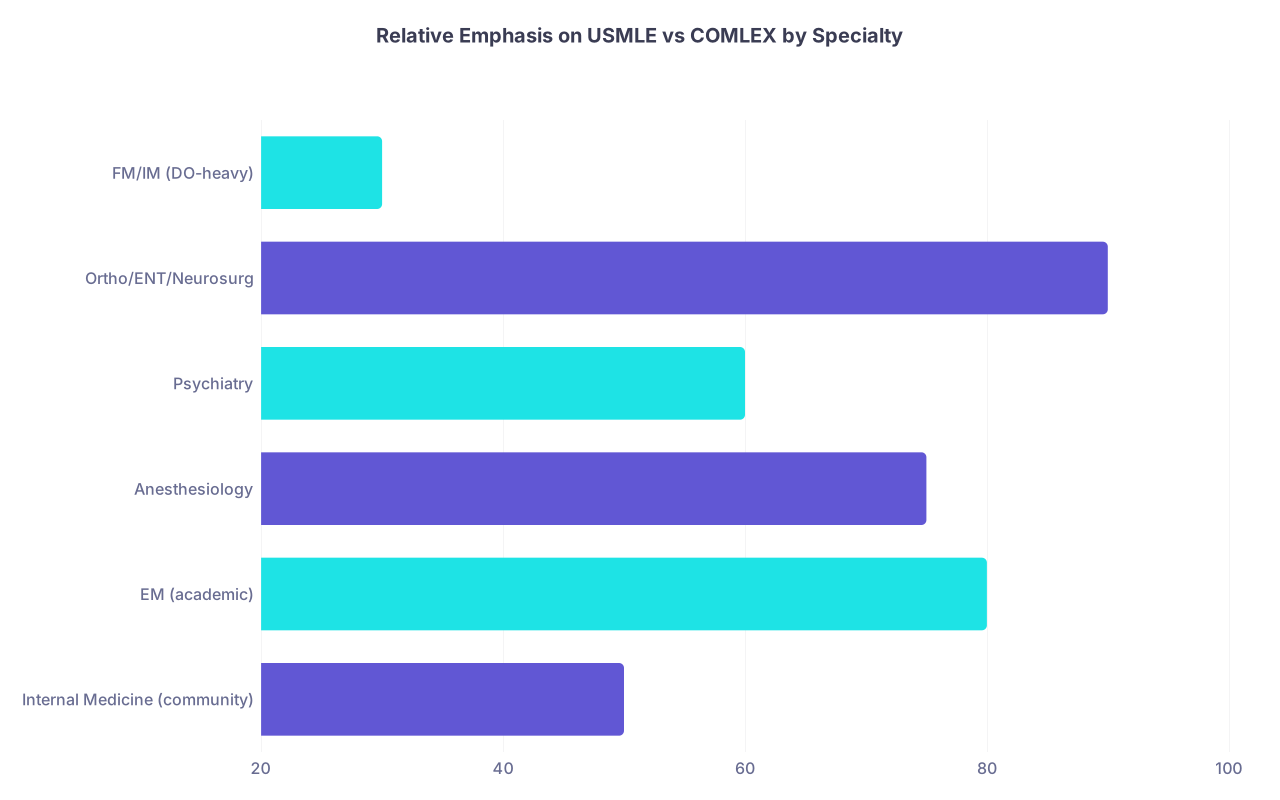
| Category | Value |
|---|---|
| Internal Medicine (community) | 50 |
| EM (academic) | 80 |
| Anesthesiology | 75 |
| Psychiatry | 60 |
| Ortho/ENT/Neurosurg | 90 |
| FM/IM (DO-heavy) | 30 |
(Values ~ “how strongly USMLE dominates decision-making” out of 100.)
Here’s how this plays out in the real world:
- Ortho/ENT/Neurosurgery: USMLE is king. If you have COMLEX-only, a handful of DO-friendly programs will seriously look at you. Everyone else quietly moves on.
- EM, Anesthesia, Rads: Increasingly comfortable with DOs, but dual scores are often expected at mid/high-tier academic places. Strong USMLE is heavily rewarded.
- Internal Medicine (academic): Many will say “we accept COMLEX,” but in their actual rank lists, dual high scorers cluster at the top.
- Psych, FM, community IM: Much more willing to use COMLEX as primary. COMLEX-only with strong numbers can absolutely thrive.
You are not applying to “residency” in the abstract. You’re applying to very specific microcultures with very different beliefs about what your scores mean.
Red Flags PDs Whisper About (But Don’t Publish)
Let me be uncomfortably honest about what gets said.
These are the patterns that get your file circled in red ink:
-
- COMLEX 2: 640, Step 2 CK: 220
- Whispered interpretation: “Something’s off. They may not handle our in-training exams well.”
Multiple USMLE attempts with better COMLEX
- Even if you passed on second try, repeated USMLE plus solid COMLEX screams inconsistency.
- Programs hate unpredictability in exam performance because of board pass rate metrics.
Late USMLE taken after application opens
- Looks reactionary.
- “They probably realized too late that they needed USMLE and rushed it.”
Long gap between COMLEX 2 and Step 2 CK with lower CK
- Seen as a sign of plateau or poor planning.
None of this is written in any official selection policy. Yet it governs how real PDs talk about you.
How You Should Strategically Decide on Dual Exams
Here’s the framework I’d give my own advisees, not the PR-safe version:
If you are targeting competitive or MD-dominant specialties or top-tier academic programs:
You should strongly consider USMLE, but only if you can commit to scoring competitively. Half-trying and landing in the low 220s while acing COMLEX is strategically worse than COMLEX-only at many places.If you are targeting primarily DO-heavy or community programs (FM, psych, IM, some EM):
COMLEX-only with strong scores is absolutely enough. High 500s–600+ COMLEX plus strong letters and clinical performance will carry you.If you already took USMLE and it’s weaker than your COMLEX:
- You cannot hide it. They will see it.
- Your job is to show an upward trend, nail Level 2 and Step 2 CK, and make the rest of your app scream “reliable, hardworking, coachable.”
- Rotations at target programs can soften the impact.
If you crushed COMLEX but haven’t taken USMLE yet:
- Ask where you realistically want to match.
- If your dream list is full of MD-dominant academic programs, taking USMLE with proper prep can unlock doors.
- If your list is mostly DO-friendly or community based, you may gain less than you risk.
How PDs Weigh “Improvement” Across Exams
One final nuance most students miss.
PDs don’t just look at isolated numbers. They look at trend:
- COMLEX 1: 510 → COMLEX 2: 590
- Step 1: Pass → Step 2 CK: 240
That trajectory—clear improvement—is reassuring. They say things like, “They figured it out. They’re on an upward curve.”
On the other hand:
- COMLEX 1: 580 → COMLEX 2: 570
- Step 1: Pass → Step 2 CK: 225
Technically nothing is a failure. But there is a subtle stink of “stagnant.” Not enough to sink you by itself, but combined with an average application, you quietly slide down the rank list.
Dual scores amplify this. You’re giving them more data points to interpret your trajectory. That can either protect you or expose you.

| Step | Description |
|---|---|
| Step 1 | See DO Applicant |
| Step 2 | Use COMLEX bands and move on |
| Step 3 | Applicant de-prioritized |
| Step 4 | Look at Step 2 CK |
| Step 5 | Borderline or reject |
| Step 6 | Check COMLEX for consistency |
| Step 7 | Green light, full consideration |
| Step 8 | Discuss discrepancy, may drop tier |
| Step 9 | USMLE Present? |
| Step 10 | Comfortable with COMLEX-only? |
| Step 11 | Step 2 in acceptable range? |
| Step 12 | Aligned with COMLEX? |
That’s the mental pathway more often than not, even if they’d never diagram it this explicitly.
Bottom Line: What You Control vs What You Don’t
You don’t control PD biases, faculty comfort levels with COMLEX, or the inertia of decades of USMLE dominance.
You do control:
- Whether you introduce USMLE into your story at all
- How prepared you are when you sit for either exam
- How coherent your score profile looks over time
- Where you apply and how realistic your list is given your score patterns
The harsh truth is this: dual scores don’t automatically make you more competitive. They magnify whatever you are. If you’re strong across the board, they make you undeniable. If you’re inconsistent, they highlight every wobble.
Your job is not to collect exams. Your job is to present a clean, internally consistent picture of someone who will pass boards on the first try, stay out of remediation, and not make the PD regret their choice.
Years from now, you won’t be thinking about COMLEX-to-USMLE conversions. You’ll be the senior resident rolling your eyes at how seriously everyone takes these numbers. But how you play this exam game now determines whether you get to sit in that chair.