

You’re a DO student who transferred schools. Maybe you started at one COM, switched after M1 or M2 for personal, academic, or accreditation reasons, and now you’re staring at your ERAS application and personal statement thinking:
“How do I explain this without sounding like a problem?”
“Are ACGME programs going to assume I couldn’t hack it?”
“Do I have to talk about BOTH schools in every interview?”
You are in that weird niche: osteopathic, transfer student, applying ACGME residencies. Not cookie-cutter. Which is exactly why you need a clean, controlled, non-defensive story.
Let’s build that.
1. What Program Directors Actually Worry About (When They See a Transfer)
Forget what your classmates speculate. Here’s what program directors, APDs, and interviewers actually think when they see two DO schools on your transcript.
They scan your ERAS and see:
- School A (OMS I–II)
- School B (OMS II–IV)
- Maybe a gap semester/year
Their internal checklist kicks in:
- Did this student get dismissed or almost fail out?
- Is there some professionalism or “problem learner” backstory?
- Did they leave a sinking ship (accreditation issues) or something dramatic?
- Is this person unstable or prone to drama and big life changes?
- Did their performance improve, tank, or stay steady after the transfer?
They are not mostly curious. They’re screening for risk.
Your job is to give them a short, coherent, low-drama explanation that answers those questions before they even ask. If you do that, the transfer becomes neutral or even slightly positive (“adaptable,” “resilient,” “handled a disruptive change well”).
If you don’t, they’ll fill the gaps with their own worst-case narrative.
2. Decide What Story You’re Actually Telling
There are only a handful of legitimate transfer narratives that play well with ACGME. Figure out which one is closest to your situation and lean into it—honestly.
| Narrative Type | Risk to PDs | Needs Deep Explanation? |
|---|---|---|
| Family/medical relocation | Low | Brief |
| School closure/accreditation | Low | Brief |
| Academic performance reset | Moderate | Careful |
| Clinical opportunities/location | Low–Mod | Moderate |
| Serious personal circumstances | Moderate | Careful |
1) Family / Partner / Medical Relocation
Example: “My partner’s job moved; I needed to be in X city.” Or “chronic illness in a parent; I moved closer to home.”
Programs see this constantly. It doesn’t scare them if:
- Your grades were fine
- COMLEX/USMLE timing looks normal
- Your performance after transfer is stable or better
This story should be short and factual. Do not write them a soap opera.
2) School Closure / Accreditation / Structural Issues
Example: “My original COM lost accreditation candidacy” or “major leadership turmoil, large proportion of class transferring out.”
This is almost always perceived as rational self-preservation. Programs have seen this happen with specific DO schools.
You must avoid sounding like you’re trashing your old school, but you can be honest:
“Evolving accreditation situation”
“Uncertainty about long-term clinical placements”
This is one of the easiest narratives to explain as long as you don’t sound vengeful.
3) Academic Performance Reset / Rough Start
This is the touchiest one.
If you transferred because you struggled academically early (borderline failing courses, remediation), programs will automatically wonder if you were pushed out.
Your strategy:
- Do not pretend it was all about “better research” if your transcript screams otherwise.
- Own the academic bump, focus hard on improvement, and show that the transfer was part of a mature course correction, not running from consequences.
You can make this work if:
- The rough patch was early (M1 mainly)
- You improved significantly at the new school
- Your board scores are solid and show the turnaround
4) Clinical Opportunities / Geographic Fit
Example: “I wanted a school with stronger clinical rotation network in the region I hoped to train/practice.”
This can sound like marketing fluff if you oversell it. But it’s fine if your actions back it up: rotations, letters, and applications all geographically aligned.
5) Serious Personal Circumstances
Serious mental health crisis, family abuse situation, legal issues, etc.
You do not owe every gory detail to every interviewer. But you also cannot be so vague that it looks like you’re hiding something.
The line: honest, non-graphic, and focused on recovery and stability.
3. How to Present It on ERAS Without Raising Extra Flags
ERAS doesn’t have a “Why did you transfer?” box. But your transfer shows up in three places:
- Education section (two schools, dates, degree-granting institution)
- Transcript upload (from both schools, usually)
- MSPE/Dean’s letter (often references the transfer)
The question for you: Do you address it directly in your personal statement or leave it for interviews?
General rule I’ve found works:
If your transfer is benign and obvious (e.g., school closed / family had to move) and your record is clean:
– Mention it very briefly or not at all in your PS
– Let it be a one-liner in interviewsIf your transfer coincides with academic trouble, a gap, or a major timeline shift:
– Give a controlled, 2–3 sentence explanation in your PS
– Be fully ready for follow-up in interviews
Here’s what not to do in ERAS:
- Long paragraphs in the “Education” area explaining why (that’s not what it’s for)
- Dramatic language: “to escape a toxic environment,” “due to irreconcilable issues with administration”
- Blaming language targeting faculty, classmates, or administration
You want this to read as: “This happened, I handled it, I succeeded afterward. Moving on.”
4. Templates: How to Explain Your Transfer (Without Sounding Defensive)
Let’s get specific. These are frameworks you can literally adapt.
A. Short, Low-Drama PS Mention (Relocation / School Situation)
“One transition that shaped my medical education was transferring after my second year from [School A] to [School B] due to a family relocation to [City/State]. Although changing institutions mid-training presented logistical and academic challenges, it also forced me to quickly adapt to a new curriculum, clinical sites, and expectations. That experience made me more intentional about communication, organization, and seeking feedback—skills that have served me well on my core rotations and will carry into residency.”
That’s it. Two sentences. Normal. Not begging for sympathy.
B. Accreditation / Institutional Instability
“I began medical school at [School A] and transferred to [School B] as our class faced evolving uncertainty around long-term accreditation and clinical placement stability. Transferring required me to adjust to a different curriculum and evaluation system, but it also gave me early exposure to working in new environments and aligning quickly with new expectations. At [School B], I have maintained [or improved] my academic performance and taken advantage of robust clinical experiences in [region].”
Key moves:
You signal the real reason (“accreditation,” “clinical placement uncertainty”) without setting yourself up as a whistleblower.
C. Academic Struggles → Transfer → Improvement
Here’s where tone matters most.
“In my first year at [School A], I struggled with the pace and volume of the pre-clinical curriculum and required remediation in [course, if it’s already in your record]. That experience was humbling and forced me to confront gaps in my learning strategies and time management. After working closely with academic support and reassessing my study approach, I transferred to [School B], where I continued to refine those strategies. Since that time, I have [passed all subsequent courses, performed strongly on COMLEX Level 1/2, and received positive evaluations on my clinical rotations], reflecting the more sustainable habits I developed.”
You admit the problem, you name the behavior change, you show results. No melodrama, no excuses.
D. Serious Personal Circumstance (Without Oversharing)
“Midway through my pre-clinical years, several significant family circumstances required me to relocate to [region] and ultimately transfer from [School A] to [School B]. That period was difficult, but it sharpened my sense of priorities and reinforced the importance of seeking support when needed. With my situation now stable, I have been able to fully re-focus on my training, as reflected in [board performance/clinical evaluations/leadership roles].”
If they want more detail, they’ll ask in the interview. And then you give just enough to be human and honest, not a therapy session.
5. How to Field Transfer Questions on Interview Day
You will get this question in some form:
- “Can you tell me about your transfer between schools?”
- “I see you started at [School A]. What prompted the move?”
- “Walk me through your path from M1 to now.”
Do not overcomplicate this. Use a three-part structure:
- Reason – one sentence
- Challenge – one to two sentences
- Outcome – one to two sentences, focused on growth and performance
Example (family relocation):
“I transferred after my second year because my partner’s job moved to [City], and we made a decision for me to train closer to where we’d be long-term. Logistically, it was an adjustment—new curriculum, new faculty, completely different rotation network. But it pushed me to get very comfortable with change and to be proactive about communication. Since the transfer I’ve [performed consistently well on my rotations and boards / taken on X responsibility], and I feel very settled in where I am now.”
Example (academic struggles):
“I had a rough first year at [School A] and ended up needing remediation in [course]. That was a wake-up call about the habits I’d carried from undergrad that simply did not work in medical school. I worked closely with academic support to overhaul how I studied and managed my time. The transfer to [School B] coincided with me applying those new strategies in a fresh environment. Since then, I’ve passed all coursework, scored [###] on COMLEX Level 1/2, and received strong feedback on rotations. It was a tough way to learn those lessons, but I’m better for it.”
Notice what’s not included:
- Bashing old faculty or administration
- Blaming “bad exams” or “unfair grading”
- Long, wandering family sagas
You aim for calm, matter-of-fact, and done. You’re not still in the drama.
6. Being a DO Transfer Specifically Applying ACGME: Extra Landmines
ACGME PDs will already be checking:
- How comfortable you are in ACGME environments
- Whether you’ve taken USMLE (depending on specialty and region)
- Whether your DO school prepared you well for evidence-based, guideline-driven care
Transfer adds one more layer. Here’s how you offset that.
Show Stability After the Transfer
If your record at School B is:
- Clean (no failures, no professionalism notes)
- Progressively better (pre-clinical → clinical → boards)
Say that out loud.
“Since transitioning to [School B], my training has been very stable. I’ve [list concrete outcomes].”
Programs care much more about your trend than about the fact you moved.
Anchor Yourself to a Region or Path
PDs hate risk. A wandering DO transfer student who appears to change their life story every year sets off alarms.
So connect the dots:
- Transfer location
- Rotations you chose
- ACGME residencies you’re applying to
- Where you say you want to practice
If they all sit in the same geographic or logical bucket, you look intentional, not chaotic.
Use Letters of Recommendation to Validate Your Story
Strong letters from School B faculty and attendings do a lot of heavy lifting.
You want at least one letter that subtly demonstrates:
- You integrated well into the new system
- You’re reliable, prepared, and good to work with
- Absolutely no hint of “concerns” or “ongoing adjustment”
You can nudge this by telling your letter writers:
“I transferred schools after M2, so some programs may wonder about that. Anything you can say that speaks to how I’ve performed and integrated here would really help.”
Reasonable attendings understand what that means and will often plug that exact gap.
7. A Quick Reality Check: When You Need to Own the Risk
I’m not going to sugarcoat this: some transfer situations will hurt more.
Red flags that raise the difficulty:
- Multiple leaves of absence
- Pattern of failures across both schools
- Vague professionalism issues that might be in your MSPE
- Big unexplained gaps in your timeline
If you’re in that territory, your strategy shifts:
- You do mention it in your PS, clearly
- You do prepare a very crisp, non-rambling explanation
- You aim to show insight: what you learned, changed, and how your current behavior is different
Programs will accept some risk if you show insight and there’s a convincing upward trajectory.
What they won’t accept is someone who acts like nothing happened and then gets defensive the second they’re asked.
8. Concrete Example: Assembling the Whole Package
Let me put this into a mini-case so you can see how it all fits.
You:
- Started at “Midwest COM A” (2020)
- Transferred to “East Coast COM B” after M2 (2022) for family relocation + mild academic struggles
- COMLEX 1: 515 (after transfer)
- COMLEX 2: 535
- Applying Internal Medicine ACGME programs in the Northeast
How you package it:
Personal Statement:
Two-sentence mention mid-PS.
“I completed my pre-clinical training at [COM A] and transferred to [COM B] after M2 due to a family relocation to [City]. Adjusting to a new institution and clinical system while solidifying my study strategies during board preparation pushed me to be more deliberate about how I learn and how I work within a team.”
MSPE:
Will already list transfer. You cannot control that. But you can ask your dean’s office that the description be neutral and factual.
Interview answer (when asked):
“I transferred after second year because my family relocated to [City], and it made the most sense for me to complete my training closer to where we’d be long term. I also used that transition as a reset point for how I approached studying. I’d passed everything at [COM A], but I knew I was working in a way that wouldn’t be sustainable for the boards and for residency. The move forced me to recalibrate, and I think the results show that—both in my board scores and the consistency of my clinical evaluations at [COM B].”
Your LORs:
Two strong IM letters from attendings at [COM B] sites who can speak to your reliability and clinical reasoning.
Your application as a whole now reads as: “Normal student with a transfer that actually improved their trajectory,” not “walking red flag.”
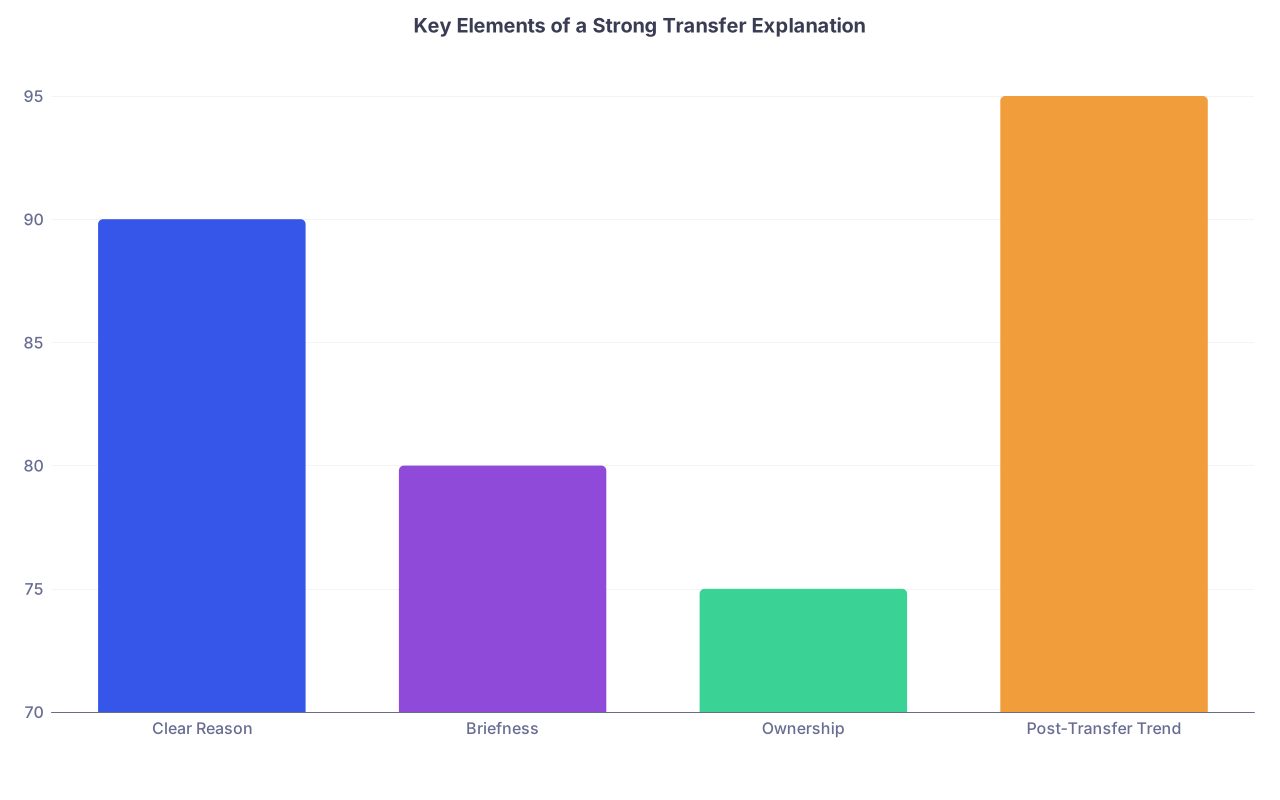
| Category | Value |
|---|---|
| Clear Reason | 90 |
| Briefness | 80 |
| Ownership | 75 |
| Post-Transfer Trend | 95 |
9. What To Do This Week If You’re a DO Transfer Applying ACGME
Here’s the short, brutal checklist.
Write your 3–4 sentence transfer narrative on a blank page.
If it’s more than 5 sentences, it’s too long. Tighten it.Decide where it lives:
- One or two sentences in your PS?
- Or PS stays clean and you keep this strictly for interviews?
Email your dean’s office and ask how your transfer is described in the MSPE.
If it’s overly dramatic or vague, ask (politely) if it can be made more objective and factual.Pick two people you trust (advisor, upper-level resident, faculty) and say:
“Read this 3–4 sentence explanation. Does it sound defensive, or does it sound straightforward?”Practice saying your explanation out loud 5–10 times.
You want to sound like you’re describing where you grew up. Calm, factual. Not like you’re on trial.
FAQ (Exactly 4 Questions)
1. Do I have to disclose the “real” reason I transferred if it was mostly academic trouble?
You do not need to self-incriminate beyond what’s already in your official record, but if courses were failed, remediated, or if you had a required leave, programs will see or infer it. Pretending it was “for more research opportunities” when your transcript suggests otherwise makes you look dishonest. You’re better off briefly acknowledging the struggle, showing what changed, and emphasizing your improvement. Honest, concise, and paired with an upward trend beats a polished but implausible story every time.
2. Will ACGME programs automatically judge me for transferring DO schools?
No. I’ve seen plenty of DO transfers match solid ACGME programs. What hurts is not the fact of transferring, but chaos without a clear narrative: multiple moves, unexplained gaps, or vague answers. If your record at the second school is strong, your boards are solid for the specialty, and your explanation is calm and coherent, most PDs will move on quickly and focus on your recent performance.
3. Should I ask a faculty member from my first DO school for a letter of recommendation?
Usually not, unless there’s a very strong reason (major research relationship, outstanding mentorship, or it’s a big name in your chosen specialty). Programs care far more about how you’ve performed recently, especially in clinical environments. Extra letters from the old school can sometimes re-focus attention on a chapter you’re trying to keep as background context, not the headline.
4. How much detail about family or personal issues should I give when explaining my transfer?
Less than you think. Your goal is to establish that (1) there was a legitimate reason, (2) the situation is now stable, and (3) you performed well afterward. You do not need to describe diagnoses, court cases, or intimate family dynamics. One sentence about the category of issue (“significant family health issues,” “urgent need to relocate to support a family member”) plus a focus on your stability and growth is usually enough. If an interviewer pushes for specifics you’re not comfortable sharing, it’s acceptable to say, “It was a difficult situation for my family that required me to be closer to home, but things are now stable and I’ve been able to devote my full focus to training.”
Open a new document right now and write your transfer explanation in 4 sentences or fewer. Out loud-test it. If you’d feel comfortable saying it to a PD in the first five minutes of an interview, you’re on the right track.


