The match is not as “objective” as everyone pretends. Backchannel calls and quiet advocacy move people up and down the rank list every single year—especially DO applicants.
I’ve watched it happen on rank night more times than I can count: the spreadsheet is “final,” everyone’s exhausted, and then one faculty member says, “By the way, I got a call about a DO student from XCOM… we should take another look.” That applicant jumps 10–15 spots. Someone else with slightly better metrics doesn’t move. That is how it really works.
You want the truth about backchannel calls and networking as a DO? Here it is.
What “Advocacy” Actually Means (Not the Fluffy Version)
Most students think advocacy means, “My attending really likes me.” That’s not advocacy. That’s sentiment.
Real advocacy is specific, active, and often off the record. It usually takes one of three forms:
- A direct call or text from someone the PD actually knows and respects.
- An internal champion speaking up in the rank meeting.
- A reputation-based nudge: “She’s from that osteopathic school that sends us solid residents; let’s trust that.”
Let me translate how PDs and faculty actually think.
When a PD hears, “I’d take this DO student in my own program if I had a spot,” from another PD they trust—that’s gold. That can erase a mediocre Step 2 score, limited research, or a non-home rotation. Not always. But more often than anyone admits.
What does not move the needle:
- A random email from your premed advisor
- A generic form letter from a dean who’s never worked on the wards with you
- Your mom’s cardiologist saying, “Nice kid, works hard”
If your advocate can’t credibly comment on (1) your clinical reliability, (2) your team functioning, or (3) your judgment under pressure, their “advocacy” is background noise.
Programs live in fear of one thing: a weak resident who makes more work for everyone else. That’s what advocacy actually addresses: “I have seen this person on the wards. They are not going to be that problem.”
How Backchannel Calls Really Happen
Let’s strip away the Instagram mythology. Backchannel calls are not some formal, tracked, equitable process. They’re messy, relational, and often spontaneous.
Typical scenario:
It’s late January. Rank list draft is done. The PD is skimming through the “maybe” tier. An email pings from a colleague:
“Hey, quick favor—this DO student rotated with us, applied to you. Very solid. Would you mind taking a serious look? I’d be happy to take this person myself.”
Two things determine what happens next:
- Who sent that email.
- Where the applicant currently sits on the rank spreadsheet.
If that email is from a close colleague—someone they’ve known from national conferences, committee work, or fellowship—they may:
- Pull your file again
- Re-watch your interview (yes, people do this)
- Ask their team, “Did anyone have a strong opinion about this applicant?”
- Bump you up a tier
If it’s from someone they barely know? They might add a small note. Or they might ignore it. Depends on how political the program culture is.
The brutal part: DO candidates get more dependent on these calls because the baseline bias is still there in many MD-heavy programs. Even the ones that swear they “value diversity of training backgrounds.” I’ve heard attendings say in closed meetings, “We love our DOs” and five minutes later argue against ranking a DO over an MD with essentially identical stats. The bias isn’t always conscious, but it’s real.
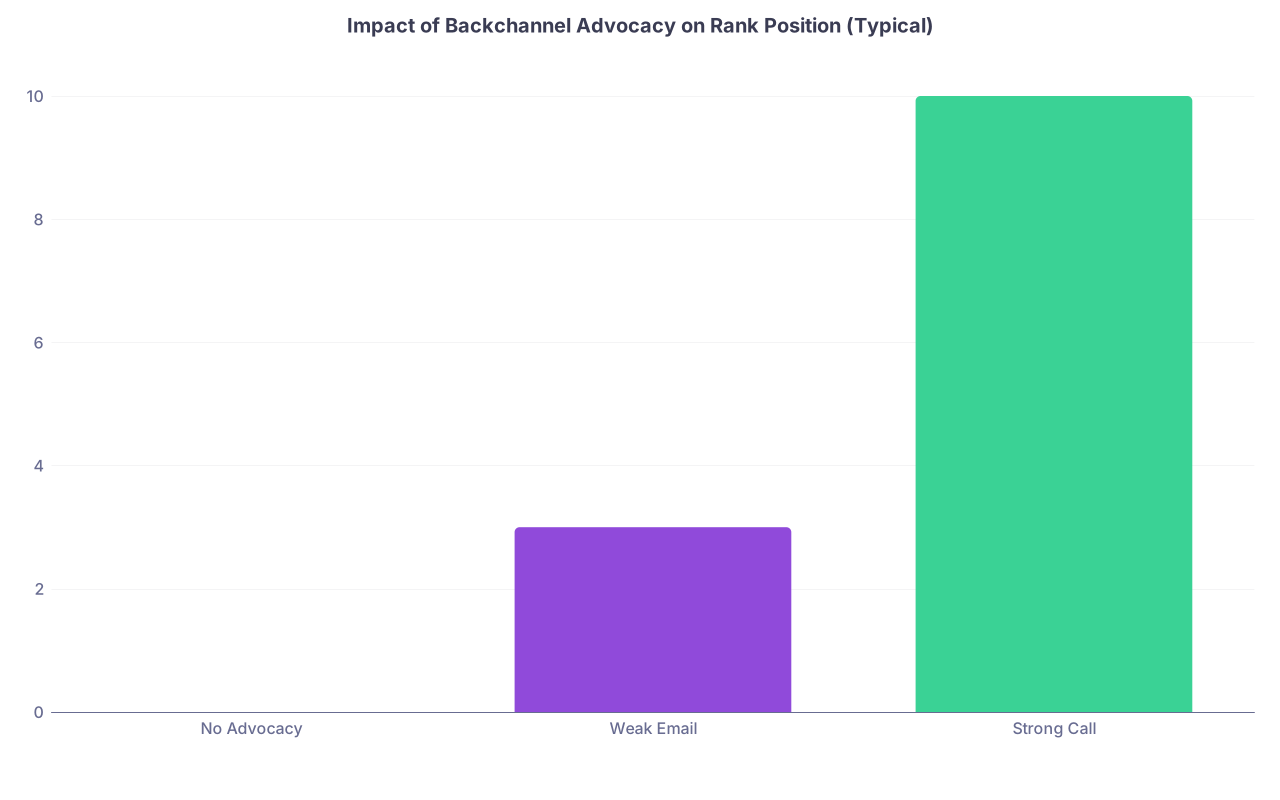
| Category | Value |
|---|---|
| No Advocacy | 0 |
| Weak Email | 3 |
| Strong Call | 10 |
Those numbers aren’t from a published paper. They’re pulled from years of watching rank lists move on actual screens. No advocacy? You stay roughly where your interview and metrics put you. Weak advocacy (generic emails)? Small nudge at best. Strong call from a trusted voice? You can jump half a tier or more.
Who Actually Has Power To Help You (And Who Doesn’t)
Students waste an absurd amount of time trying to get the wrong people to advocate for them.
Here’s the harsh breakdown.
Strong Advocates
These are the people whose calls or emails actually do something:
- Program Directors and APDs at your home or rotation sites
- Department chairs or well-known division chiefs (who know you personally)
- Fellowship directors in that specialty with national reputations
- Long-standing faculty who’ve trained many residents and are known at national meetings
Example: A DO student rotating at a community IM program. The APD there previously trained at the academic program you’re targeting. They pick up the phone and tell that PD, “We had this DO rotator. She functioned like a PGY-1. No drama, no handholding. I’d rank her high.” That’s the kind of advocacy that moves you out of the “safe mid-pack” and into “we’d be very happy to match her.”
Medium Advocates
These people can help, but it’s more limited:
- Clinical faculty who know you but aren’t deeply networked nationally
- DO school deans who have decent but not deep relationships with PDs
- Research mentors without major name recognition in that specialty
Their advocacy often becomes tiebreaker material: “I’ve heard she’s reliable and teachable, so let’s put her above these unknowns.” It won’t usually save you if your file is a complete mismatch.
Weak Advocates
And then you’ve got:
- Shadowing docs you followed around for 20 hours two years ago
- Primary care physicians writing “character” letters
- Family friends in medicine in totally unrelated fields
- People who barely remember you from a single shift
These folks may care about you as a person. But calling a PD with, “I don’t know them that well but they seem like a great kid” is background noise. PDs are brutal about this. They won’t say that to your face, but they say it in their heads.
The Timeline: When Backchanneling Actually Matters
Students try to trigger advocacy at the wrong times. Too late, too early, or in ways that annoy PDs.
Here’s how it tends to play out behind the curtain:
Before Applications Drop (Summer)
This is when your relationships are being formed, not formal advocacy. PDs and faculty are watching you during rotations or sub-Is, deciding whether you’re someone they’d stick their neck out for later.
What matters here for DO candidates:
- Showing you can function at the same level as MD students—and then some
- Making it clear you’re serious about that specialty, not “keeping options open”
- Being consistent; PDs are obsessed with reliability
No one’s calling anyone yet. They’re just mentally tagging you as: “I’d vouch for them,” “I’d keep an eye on them,” or “I’d stay neutral.”
After Interviews (Nov–Jan)
This is prime advocacy season.
PDs are finalizing impressions. Notes from interviewers, comments from residents, and yes—calls and texts from colleagues. This is when a strong advocate can take you from “We liked them” to “We should rank them in our top 10.”
A very real example I’ve seen:
- DO applicant, decent Step 2, excellent rotation performance at a different site
- Mixed interview feedback, sat in the “mid” tier
- Two weeks later, PD gets a text from a long-time colleague:
“We had this DO student for a month. I’d be comfortable with them here. Very mature. If you’re on the fence, I’d go for it.” - The PD pulled up the list during the rank meeting: “We got a strong recommendation from someone I trust; let’s move them above these unknowns.”
- They jumped a full tier.
Right Before Rank Submission (Late Jan–Feb)
Last-minute calls still happen. But they’re riskier. Some PDs find them annoying because it feels like trying to game the system after the fact.
Still, if:
- You’re a DO with a strong rotation at another program
- That PD or APD truly believes in you
- And they know the target PD personally
…a well-timed call can still move you a bit. Just do not spam PDs asking, “Did you get a call about me?” That’s the kind of thing that gets you quietly downgraded.
How DO Students Can Actually Get Advocated For (The Non-Delusional Playbook)
You’re not going to brute-force your way into strong backchannel support. You have to set it up months in advance.
Here’s what I’ve seen actually work for DOs.
1. Choose Rotations Strategically, Not Emotionally
Too many DO students chase geographic fantasy (“I love Boston!”) instead of strategic value (“Where does my school or my mentors actually have pull?”).
You want:
- Rotations where DOs before you have matched or been loved
- Programs where your school’s PD or chair knows their PD or chair
- Sites with a track record of giving DOs a fair shot
You don’t want:
- A hyper-elite MD-heavy academic shop that has never taken a DO in your specialty
- Places “just for the name” where you’ll be compared to homegrown MDs who know the system inside out
For osteopathic applicants, a B+ rotation at a DO-friendly program beats a miserable, ignored month at a brand-name MD program every single time.
| Rotation Type | Advocacy Potential | DO-Friendliness |
|---|---|---|
| DO-heavy community program | High | High |
| Mid-tier academic with prior DO matches | High | Medium-High |
| Elite academic, never taken DO | Low | Low |
| Random private hospital, no teaching culture | Very Low | Unknown |
2. Make It Easy For People To Go To Bat For You
Faculty do not advocate for you just because you “worked hard.” That’s the baseline. They advocate when you were memorable in the right ways.
Patterns I’ve seen in DOs who get calls made for them:
- They consistently volunteered for the unsexy work—admissions, follow-ups, calling consultants—without complaining
- Their notes were clean, accurate, and done on time, so residents trusted them
- When they did not know something, they admitted it, looked it up, and did not repeat the same mistake twice
- They were self-aware about being DOs in an MD-majority environment—confident but not defensive
These are the residents faculty want to work with. That’s what makes someone think, “I’d hire you here. So I’ll help you get there.”
3. The Ask: How To Actually Request Advocacy
This is where many students blow it with needy, tone-deaf emails.
Here’s the version that works:
“Dr. Smith,
I appreciated the opportunity to rotate with you last month. I learned a lot from how your team managed complex patients and the emphasis on ownership.
I’m very interested in [specialty] and have applied broadly, but [Program X] is a top choice for me because of [specific reason].
If you feel you can comfortably advocate for me, I’d be grateful if you’d be willing to reach out to them. If not, I completely understand and still wanted to thank you for the teaching and feedback this month.
Best,
[Name]”
That last line is key: “If you feel you can comfortably advocate for me.” You’re giving them an out. If they hesitate, trust me—you do not want them making a lukewarm call for you.

| Step | Description |
|---|---|
| Step 1 | Student finishes rotation |
| Step 2 | Thank them, do not ask for advocacy |
| Step 3 | Request letter + possible advocacy |
| Step 4 | Potential strong backchannel call |
| Step 5 | Solid letter, mild impact |
| Step 6 | Faculty impressed? |
| Step 7 | Faculty well-connected? |
What PDs Really Say When They Get These Calls About DOs
You want the internal monologue? Here it is.
Call from a trusted colleague about a DO student:
“Okay, I know this PD. They don’t over-sell. If they’re comfortable with this DO, then this isn’t going to be a high-maintenance resident. Let’s take another look.”
Call from a marginal contact about a DO student:
“I’ve met this person at conferences twice. They’re trying to help their student, but I really don’t know how much weight to put on this. I’ll glance at the file, but I’m not reshuffling my list for it.”
Vague, glowing advocacy:
“Look, everyone’s ‘hard-working, compassionate, team-oriented.’ This doesn’t tell me whether they can handle night float or a busy January census. Pass.”
Specific, grounded advocacy:
“They took ownership of complex patients, never disappeared, handled feedback well. If you need someone who’ll adjust quickly to your system, they’ll do it.”
That last type of description is what moves you.
The Ugly Truth: Advocacy Helps, But It’s Not Magic
Let me be blunt. If you’re a DO applying to an insanely competitive specialty with:
- A barely passing Step 2
- No meaningful clinical letters in that specialty
- Weak or generic comments from rotations
…no phone call is going to rewrite reality. A good PD will not risk their program to save a fundamentally weak file. They might nudge you from “do not rank” to “end of list.” That’s it.
Backchannel networking amplifies what’s already in your application. It rarely creates something out of nothing.
But if you’re already in the competitive range—and a DO who’s fighting subtle bias at every step—those calls matter more for you than they do for a similar MD. That’s the unfair piece. You have less margin, so advocacy becomes more valuable.
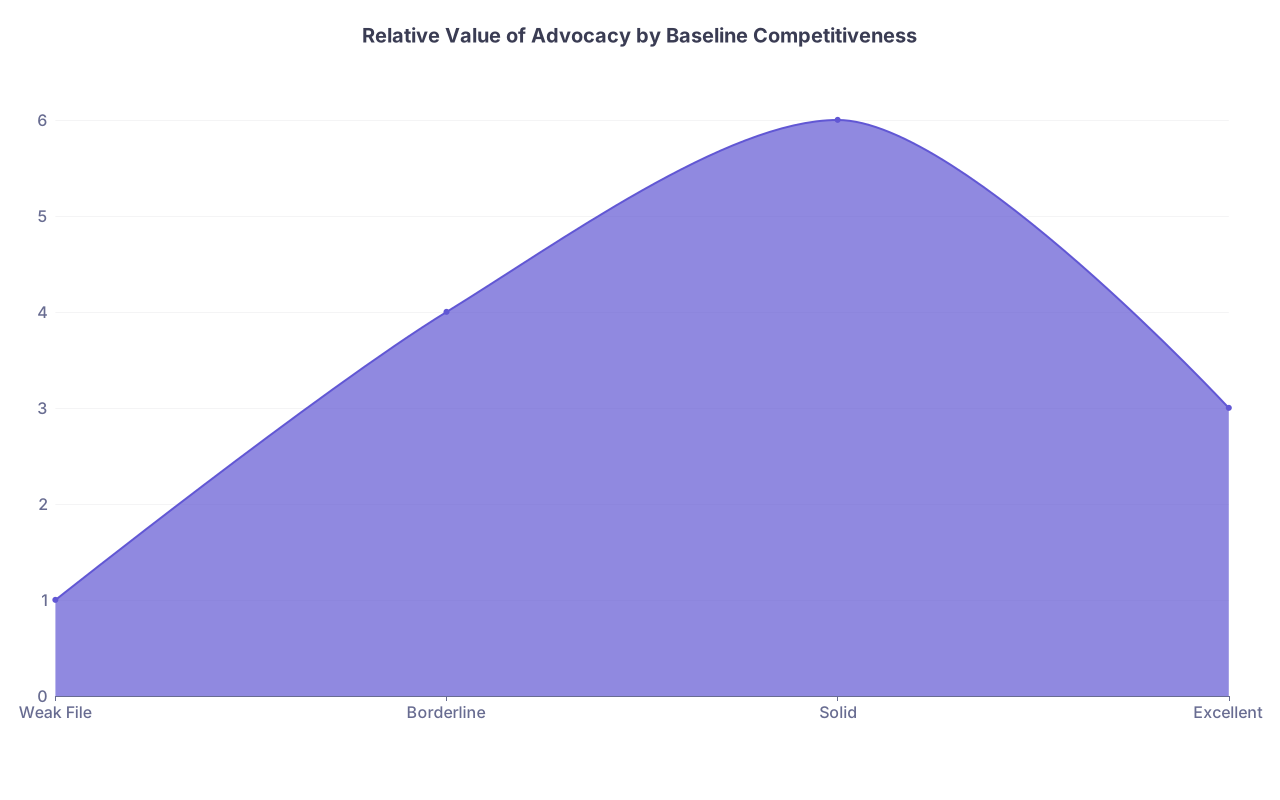
| Category | Value |
|---|---|
| Weak File | 1 |
| Borderline | 4 |
| Solid | 6 |
| Excellent | 3 |
Notice the dip at “Excellent.” If you’re already at the very top, you don’t need much advocacy. If you’re borderline, a strong advocate can change your outcome.
What Not To Do (That I See Every Year)
Let me save you from the mistakes that make faculty less inclined to help.
- Do not name-drop in your personal statement: “Dr. X said they would call Y PD for me.” That makes everyone uncomfortable.
- Do not email PDs asking, “Can you tell me where I am on your rank list?” or “Did you hear from Dr. X about me?” That’s a fast track to the “annoying” column.
- Do not pressure faculty: “I really need you to call them or I won’t match.” Guilt isn’t persuasive; it’s off-putting.
- Do not ask for advocacy from someone you barely worked with: a half-day clinic, a single weekend shift. They will either say no or make a weak, useless call.
And probably the worst:
Don’t flood one PD with “advocates” who barely know you. When a PD gets three bland emails about the same DO student, it smells orchestrated and desperate. One strong, credible voice beats three superficial ones every time.
How To Know If Someone Is Actually Advocating For You
Faculty will rarely copy you on emails or tell you verbatim what they said. But there are clues.
Signs it’s real:
- They’ve worked with you closely for at least a week or two
- They voluntarily brought up, “If you need help with programs, let me know”
- They’ve mentioned specific strengths in feedback, not just generic praise
- When you ask politely, they respond confidently: “Yes, I can reach out to them,” not “I’ll see what I can do” in a vague way
Signs it’s lip service:
- “Sure, I’ll put in a good word,” but they never ask which programs you’re targeting
- They mix up your name, school, or specialty interests
- They don’t know your basic stats or background (Step 2, DO vs MD, etc.)
You can’t control everything. But you can strategically choose who you invest your effort with.
FAQs
1. Is it appropriate for me, as a DO student, to ask my PD or attending directly to call another program for me?
Yes—if you have a real relationship and performed well. The key is how you ask. You’re not demanding a favor; you’re giving them the option. Phrase it as, “If you feel you can comfortably advocate for me, I’d really appreciate it,” and be specific about which program and why. If they hesitate or deflect, don’t push. A half-hearted call can hurt more than it helps.
2. Can DO school deans or advisors actually influence MD programs with backchannel calls?
Sometimes, but less than students assume. A DO dean who’s been in the game for years and regularly sends graduates into certain programs can absolutely have some sway, especially at mid-tier or DO-friendly places. But at highly competitive, MD-dominated academic centers, a random email from a DO dean they don’t know usually carries minimal weight. It’s the relationship, not the title, that matters.
3. If I don’t have any strong advocates, am I basically doomed as a DO applicant?
No. Advocacy is an amplifier, not a prerequisite. I’ve seen plenty of DOs match well with zero backchannel help—solid scores, strong letters, smart school/rotation choices, and a realistic list. What advocacy does is push borderline or mid-pack files into safer territory and occasionally rescue someone from being overlooked. If you don’t have it, you need to be extra strategic with where you apply and how well you perform on every rotation and interview. You’re not doomed, but you can’t afford sloppy decisions.
Key points to remember:
First, backchannel advocacy is real and it matters more for DOs than most people will admit, but only when it comes from the right people.
Second, your behavior on rotations and your choice of where to rotate determine whether anyone credible will want to advocate for you.
Third, advocacy amplifies a solid application; it rarely fixes a weak one. Build the strongest DO application you can, then let the right people—who’ve actually watched you work—do the quiet talking behind the scenes.