18% of ACGME residency programs still do not routinely interview DO applicants, even though osteopathic grads now match into those same specialties at record-high rates.
That gap between perception and data is where a lot of DO applicants get hurt.
Let me walk through what the numbers actually show for DO vs MD match rates by specialty, and what that means for your strategy as a DO applicant.
1. The Big Picture: DO vs MD in the ACGME Match
Step back first. The overall landscape.
Across recent NRMP Main Residency Matches (post–single accreditation), the broad pattern is consistent:
- MD seniors have a higher overall match rate than DO seniors.
- The gap shrinks substantially in primary care.
- The gap widens dramatically in the most competitive subspecialties.
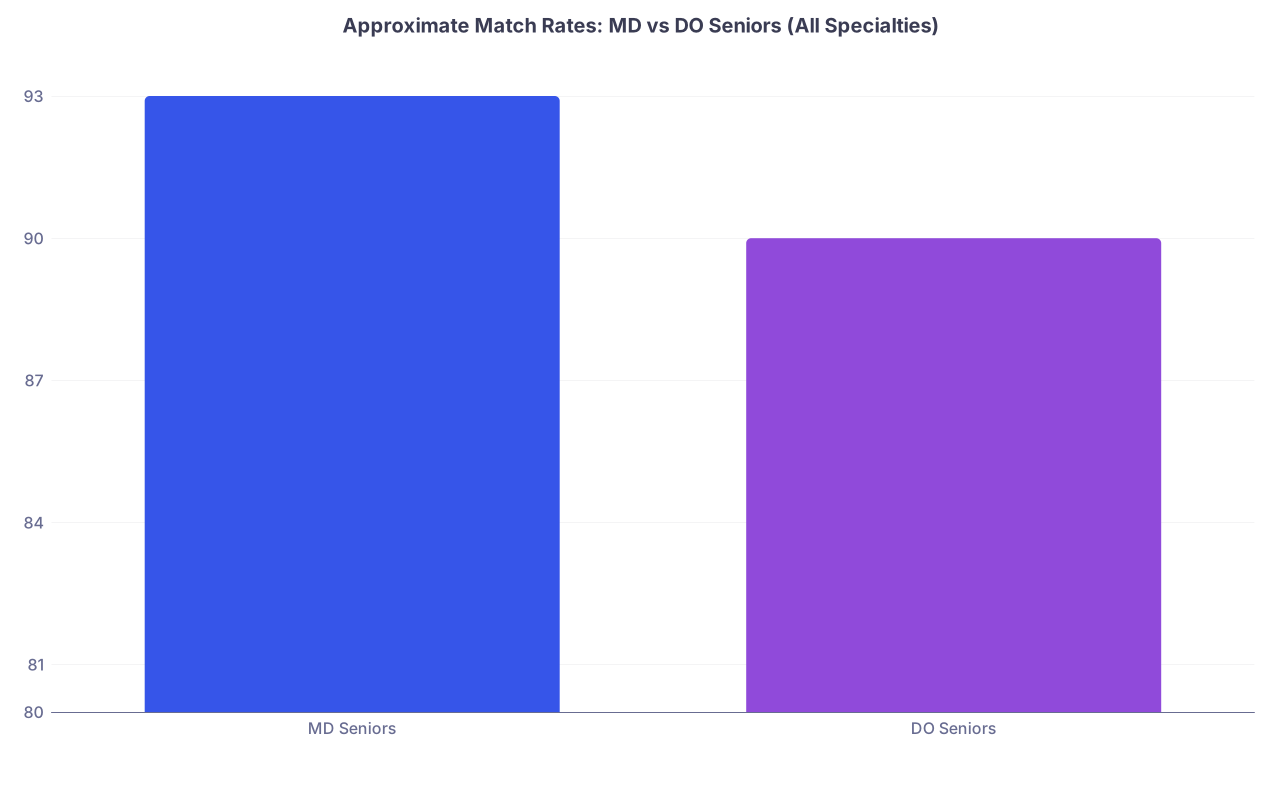
Aggregating recent cycles, you see approximate match rates along these lines (US seniors only):
- MD seniors overall: ~92–94%
- DO seniors overall: ~89–91%
So the “penalty” for being a DO in aggregate is about 2–4 percentage points. But that average is misleading. The real story appears when you slice by specialty.
| Category | Value |
|---|---|
| MD Seniors | 93 |
| DO Seniors | 90 |
Three drivers explain most of that gap:
- A disproportionate number of DO seniors aim for very competitive specialties with weaker Step/COMLEX scores.
- Some ACGME programs still screen out DOs on paper (especially in certain surgical and ROAD specialties).
- DO applicants, on average, apply to fewer “reach” academic programs and more community programs, which actually helps match rates but can limit ceiling.
So the right way to think about DO vs MD is not “Do DOs match worse?” but “In which specialties is the DO disadvantage large, small, or negligible, and what compensates for it?”
2. Primary Care: Where DOs Nearly Close the Gap
Primary care is where the data are most favorable for DO applicants. In several fields, the MD vs DO difference in match rate is small enough that other factors (Step score, research, geography) dominate.
2.1 Internal Medicine (Categorical)
Internal Medicine is the workhorse of the Match and the most common landing spot for DO applicants.
Recent patterns:
- MD seniors in IM (categorical): ~96–98% match
- DO seniors in IM (categorical): ~93–96% match
The gap here is roughly 2–4 percentage points. Modest.
| Applicant Type | Match Rate (%) |
|---|---|
| MD Seniors | 96–98 |
| DO Seniors | 93–96 |
What the data show on the ground:
- Community and mid-tier university IM programs routinely take DOs.
- Top-10 and some top-25 academic IM programs still heavily favor MDs, especially for physician-scientist tracks.
So for a DO with a strong numeric profile (Step 2 CK ≥ 245 or COMLEX 2 ≥ 620, solid letters), IM is very high yield. The bottleneck is not matching IM; it is matching at the very top academic centers.
2.2 Family Medicine
Family Medicine remains the least “DO-discriminatory” field statistically.
Typical patterns:
- MD seniors: ~94–96% match
- DO seniors: ~92–95% match
In some cycles, DO seniors in FM have essentially indistinguishable match rates to MDs, because the applicant pool is smaller than the number of available positions and many programs like DO training backgrounds.
Where DOs do especially well:
- Community FM programs
- Programs with strong OMM/osteopathic heritage or those in states with multiple DO schools (MI, PA, MO, TX)
Unless there are serious red flags, a DO applicant with realistic geographic flexibility can treat FM as a near-sure bet.
2.3 Pediatrics
Pediatrics sits between IM and FM in competitiveness.
Approximate ranges:
- MD seniors: ~95–97% match
- DO seniors: ~92–95% match
The main difference is distribution: MDs more frequently fill categorical slots at big-name children’s hospitals; DOs tend to cluster at community and regional academic programs.
As a DO, a 240+ Step 2 (or strong COMLEX-only profile with solid clinical comments) usually translates into a high-probability Peds match.
3. Middle-Tier Competitiveness: Where Strategy Starts to Matter
Now the specialties where the gap becomes meaningful but not insurmountable if you play the game well: Emergency Medicine, Psychiatry, OB/GYN, and Anesthesiology.
3.1 Emergency Medicine
Emergency Medicine has been in flux; applicant interest dropped, positions went unfilled, then started partially recovering. That volatility has actually helped DO applicants.
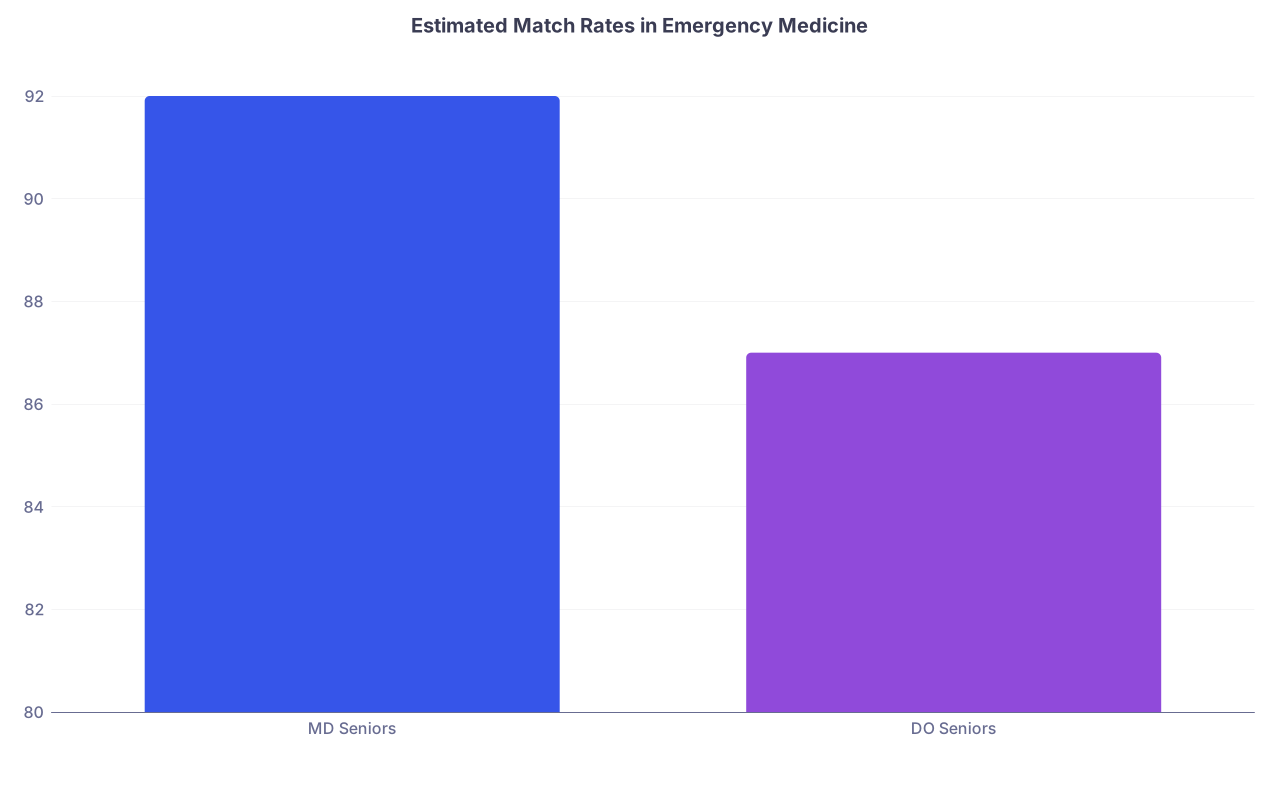
Recent cycles have seen:
- MD seniors in EM: ~90–94% match
- DO seniors in EM: ~84–89% match
So the gap can be 5–8 percentage points.
Why?
- Historically, some EM programs used Step 1 cutoffs that screened out more DOs.
- A few legacy EM programs still do not accept COMLEX alone, hurting DO applicants who skip Step 2 CK.
- SLOEs (EM-specific letters) are essential; DO students at schools with weaker EM home programs can struggle to secure high-yield away rotations.
If you are a DO aiming EM, the numbers strongly favor three moves:
- Take Step 2 CK, and score > 240 if possible.
- Get at least 2 strong SLOEs from known EM programs.
- Apply broadly, especially to community and smaller university programs.
| Category | Value |
|---|---|
| MD Seniors | 92 |
| DO Seniors | 87 |
3.2 Psychiatry
Psych has become more popular across the board but remains relatively DO-friendly.
Approximate pattern:
- MD seniors: ~94–96% match
- DO seniors: ~90–94% match
The gap is 2–4 points, driven less by DO bias and more by:
- A subset of DO applicants with lower Step/COMLEX scores targeting Psych as a “backup.”
- Geographic clustering; coastal academic programs remain more MD-heavy.
Solid clinical grades plus a Step 2 in the mid-230s or strong COMLEX-only performance usually put a DO in a very safe zone for Psych.
3.3 OB/GYN
OB/GYN is where I see a lot of DO applicants get surprised. They treat it like a mid-tier field; in reality, the data show a harder ceiling.
Typical pattern:
- MD seniors: ~87–91% match
- DO seniors: ~75–83% match
You are looking at a 8–12 point gap in some cycles.
Reasons:
- Long-standing program biases favoring MDs, especially at academic centers.
- High proportion of DOs applying with borderline scores or limited OB research.
- Fewer DO schools with strong OB home departments and name-recognition faculty.
For a DO, OB/GYN is absolutely realistic—but only with deliberate positioning:
- Step 2 CK preferably ≥ 240 (or COMLEX 2 ≥ ~620 equivalent).
- Strong performance on OB/GYN rotation, ideally at your home institution plus one away.
- Apply very broadly (often 60+ programs) unless your stats are clearly above national averages.
3.4 Anesthesiology
Anesthesia sits in that “upper-middle” tier.
Recent trends:
- MD seniors: ~93–96% match
- DO seniors: ~84–90% match
The DO disadvantage here is noticeable but less brutal than in derm/ortho/plastics.
Anesthesia has become more DO-friendly as the field expanded, but certain academic powerhouses still heavily favor MDs, especially for combined programs (e.g., Anesthesiology + Critical Care, advanced fellowships).
As a DO:
- Step 2 ≥ 240 or COMLEX 2 ≥ 620 is strongly recommended.
- Well-written personal statement tying in procedural interest/ICU exposure helps.
- Strong letters from anesthesia faculty—even from community hospitals—still matter more than most applicants think.
4. Highly Competitive Non-Surgical: The Steepest DO Penalties
Now the brutal section: three specialties where DO vs MD differences are huge—Dermatology, Radiology (especially Diagnostic), and Radiation Oncology.
4.1 Dermatology
Dermatology has one of the lowest DO match penetration rates in the ACGME system.
Typical pattern:
- MD seniors: ~70–75% match
- DO seniors: often in the 30–45% range
Derm has a smaller denominator of DO applicants, but the probabilities are stark. Many cycles see single-digit numbers of DOs matching derm nationwide into categorical programs.
What drives this:
- Extreme emphasis on research—especially first-author derm publications—where most DO schools lag in infrastructure.
- Program preference for US MDs with honors grades and gold-standard letters from known academic dermatologists.
- Historically low exposure to derm in many DO curricula, so fewer early pipeline opportunities.
If you are a DO chasing dermatology, the data say one thing clearly: you must behave like a research-track MD applicant, not a typical DO.
That usually means:
- An extra research year with 10+ publications/abstracts in dermatology or cutaneous oncology.
- Strategic networking at derm conferences and with program chairs.
- Applying to nearly every program in the country.
4.2 Diagnostic Radiology
Radiology historically waxed and waned in competitiveness. Post–COVID and AI hype, it has tightened again.
Match patterns approximate:
- MD seniors: ~85–90% match
- DO seniors: ~65–75% match
Again, a 10–20 point gap in some cycles.
Key factors:
- Heavy reliance on Step 2 scores and board pass rates.
- Preference for MDs at academic programs with strong neuroradiology/interventional reputations.
- Some programs still not completely comfortable weighing COMLEX-only applicants.
For a DO, diagnostic radiology is realistic if:
- Step 2 ≥ 245 (COMLEX 2 ≥ 630).
- Good performance in core clerkships, especially IM and surgery.
- Willingness to embrace community and hybrid academic-community programs, not just big-name university centers.
4.3 Radiation Oncology
Radiation Oncology is numerically unusual: low applicant numbers, high number of unfilled spots in some recent years. But that does not automatically help DOs.
What happens in practice:
- MD seniors: If they apply with reasonable stats and usable research, match rates are very high.
- DO seniors: The absolute number of DO applicants is tiny, and only a handful match each year.
The core barrier is not DO status per se; it is research capital. Rad Onc is dominated by academic centers and PhD-heavy departments. DO schools rarely have dedicated radiation oncology departments with NIH-level funding.
If you are DO + Rad Onc, the numbers essentially demand:
- Research year(s) at a major academic cancer center.
- Multiple Rad Onc publications.
- Faculty advocates who are known nationally.
Without that, the DO acceptance rate approaches zero in many cycles.
5. Highly Competitive Surgical: Ortho, ENT, Plastics, Neurosurgery
This is where the DO penalty is most obvious and brutally consistent.
To see it clearly, look at relative probabilities. Very roughly:
| Specialty | MD Senior Match Odds | DO Senior Match Odds |
|---|---|---|
| Internal Med | Very high | Very high |
| OB/GYN | High | Moderate |
| Ortho Surgery | Moderate | Low |
| Dermatology | Moderate | Very low |
| Neurosurgery | Moderate | Very low |
Numbers shift year to year, but patterns hold.
5.1 Orthopedic Surgery
Ortho is the classic “MD-dominated” surgical field, even post–single accreditation.
Approximate match rates:
- MD seniors: ~70–75% match
- DO seniors: often ~45–55% match range
Again, remember these are US seniors only. The actual DO “penalty” is heavily concentrated in top-tier academic ortho programs.
What drives the discrepancy:
- Many ortho PDs still default to MDs unless there are standout DOs with research and personal connections.
- Research expectations are now substantial; 10–20 publications/abstracts is common among matched applicants at top programs.
- Fellowship outcomes and board pass rates historically skew MD, reinforcing PD bias.
For a DO applicant:
- Above-average Step 2 (often ≥ 250), solid orthopaedic research, and early mentorship are non-negotiable if you want a realistic shot.
- Applying to both traditional MD programs and historically DO-heavy ortho programs is essential.
5.2 Otolaryngology (ENT)
ENT is small, competitive, and heavily academic.
Patterns:
- MD seniors: ~75–80% match
- DO seniors: low absolute numbers; many cycles see only a few DOs matching nationwide.
Like dermatology and rad onc, ENT is a specialty where program familiarity and research drive everything. A DO with multiple ENT rotations and high-impact research can absolutely match—but the base rate is low.
5.3 Plastic Surgery (Integrated)
Integrated Plastics is probably the toughest match in the entire system for a DO.
Realistically:
- MD seniors: majority of spots
- DO seniors: often 0–3 total integrated plastics matches in a given year; some years none
There are individual success stories—a DO with a 260+ Step, 30+ pubs, dual degrees, etc.—but they are outliers. Statistically, the field is almost closed to DOs without extraordinary credentials and heavy academic networking.
5.4 Neurosurgery
Neurosurgery keeps a similar pattern:
- MD seniors: ~75–80% match
- DO seniors: very small numbers, low single digits.
Again, not impossible; just extremely unlikely at baseline.
To beat the odds in these top surgical fields as a DO, you generally need to look like:
- Step 2 CK in the 250–260+ range.
- 1–2 dedicated research years with dozens of publications.
- Deep relationships with faculty at major academic centers.
- Willingness to apply incredibly broadly and accept that a prelim year or SOAP backup may be necessary.
6. How Program Type Changes the DO Equation
You cannot interpret DO vs MD match data without separating community vs academic programs.
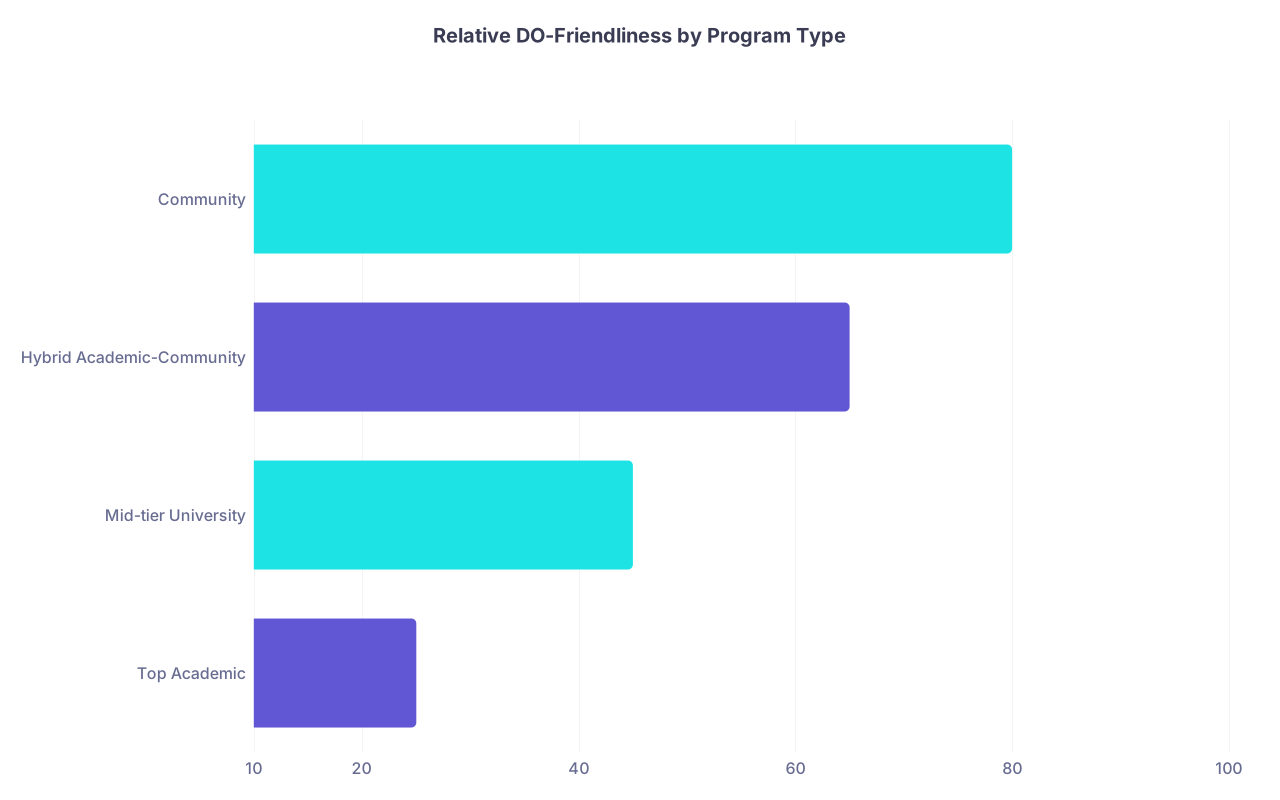
6.1 Community vs Academic
Broadly:
- Community programs tend to be more DO-friendly and more COMLEX-accepting.
- University and university-affiliated academic programs show higher DO penalties, especially in competitive fields.
For DO applicants, the data consistently show higher match rates when they:
- Apply heavily to community and hybrid programs.
- Target regions with strong DO presence (Midwest, South, certain parts of the Northeast).
- Include former AOA (osteopathic) programs that transitioned to ACGME.
| Category | Value |
|---|---|
| Top Academic | 25 |
| Mid-tier University | 45 |
| Hybrid Academic-Community | 65 |
| Community | 80 |
(Values represent approximate proportion of programs that regularly rank DOs highly.)
6.2 Former AOA Programs
An underused advantage for DOs: legacy osteopathic programs that moved under ACGME.
These programs:
- Often have long histories of training DO residents.
- Tend to be more comfortable evaluating COMLEX-only transcripts.
- Frequently sit in desirable but not “brand-name” cities.
I have seen plenty of DO applicants ignore these because the names are less flashy. Then regret it in SOAP.
If you are DO and in a competitive or mid-competitive specialty, identifying these programs and treating them as “core” targets often boosts your effective match probability by double digits.
7. Practical Takeaways: What the Numbers Mean for Your Strategy
Data without decisions is useless. So translate the stats into concrete actions.
7.1 If You Are a DO Aiming Primary Care (IM, FM, Peds)
- Your DO status is a relatively small factor.
- Focus on:
- Solid clinical performance.
- Pass both COMLEX levels on first attempt; Step 2 CK is helpful but not always mandatory if you are content with community programs.
- Applying broadly to match your geography desires.
Match probability for a reasonably strong DO in these fields is very high—similar to MDs.
7.2 If You Are a DO Aiming Mid-Competitive Fields (EM, Psych, OB/GYN, Anesthesia)
- DO penalty: moderate but manageable.
- Step 2 CK matters—a lot. A borderline score will hit harder for you than for an MD at the same percentile.
- You need:
- Clear specialty commitment on paper (rotations, letters).
- Strategic, broad applications including many DO-friendly programs.
- Realistic expectations on academic “tier.”
7.3 If You Are a DO Aiming Highly Competitive (Derm, Ortho, ENT, Plastics, Neurosurg, DR, Rad Onc)
The data are blunt:
- Baseline probabilities for DOs in these specialties are low, often dramatically lower than for MDs.
- To counteract that, you must overperform on:
- Scores (Step 2 in the top decile).
- Research output.
- Networking and away rotations at targeted programs.
And you need a robust backup plan. Not as an afterthought. As a parallel strategy.
8. Summary: What the Numbers Actually Say
Condense the whole thing:
- The DO vs MD match gap is small in primary care, moderate in mid-competitive fields, and very large in top surgical and ultra-competitive specialties.
- Program type matters as much as specialty: community and former AOA programs are far more DO-friendly than elite academic centers.
- For DOs, strong Step 2/COMLEX scores and deliberate program selection shift match probabilities more than almost any other variable—often more than “DO vs MD” itself in the non-elite ranges.