Most DO students are applying to the wrong number of ACGME programs—and they are guessing instead of using data.
The NRMP, AACOM, and program fill statistics give you enough signal to stop guessing. If you line up your profile honestly against those numbers, you can get to a rational application range instead of “spray and pray” or “I hope 20 is enough.”
I will walk through that logic.
1. The Core Reality: DOs Face Different Numbers
The data are clear: osteopathic applicants are held to different acceptance probabilities than MDs in many ACGME programs, especially in competitive specialties.
Let’s start with the big picture. These are representative, rounded numbers using recent NRMP and AACOM reports plus program fill data. Exact values shift year to year, but the pattern holds.
| Metric (approximate) | MD Seniors | DO Seniors |
|---|---|---|
| Overall Match Rate (all specialties) | 92% | 89% |
| Match Rate into Categorical IM | 96% | 93% |
| Match Rate into Categorical Surgery | 85% | 75% |
| Match Rate into EM | 93% | 84% |
| Match Rate into Ortho | 78% | 62% |
Now add program type behavior:
- Many university programs historically rank few or no DOs in certain specialties.
- Community programs are more DO-friendly but often receive hundreds of applications per spot.
- Step 1 being Pass/Fail did not magically level the field. Programs shifted harder to Step 2, school “brand,” and perceived training background.
So the application strategy for a DO is not “copy your MD classmate’s list.” The volume required to reach a similar match probability is usually higher.
To quantify what “higher” means, you need one more concept.
2. The Interview Curve: Where More Applications Stop Helping
Every NRMP “Charting Outcomes” edition shows the same shape: more contiguous ranks = higher match probability, but the curve flattens.
The data consistently show something like this:
- 1–3 ranks: volatile, low probability; small changes in list size matter a lot.
- ~6–10 ranks: large jump in match rate; most of the benefit is here.
- ~12–15 ranks: curve starts flattening; diminishing returns.
20 ranks: incremental benefits, but not proportional to extra effort or cost.
For primary care, DOs often need fewer programs than they think—if they are geographically flexible. For competitive fields, DOs often need more programs than MD peers to reach that same “10–12 reasonable interviews” threshold.
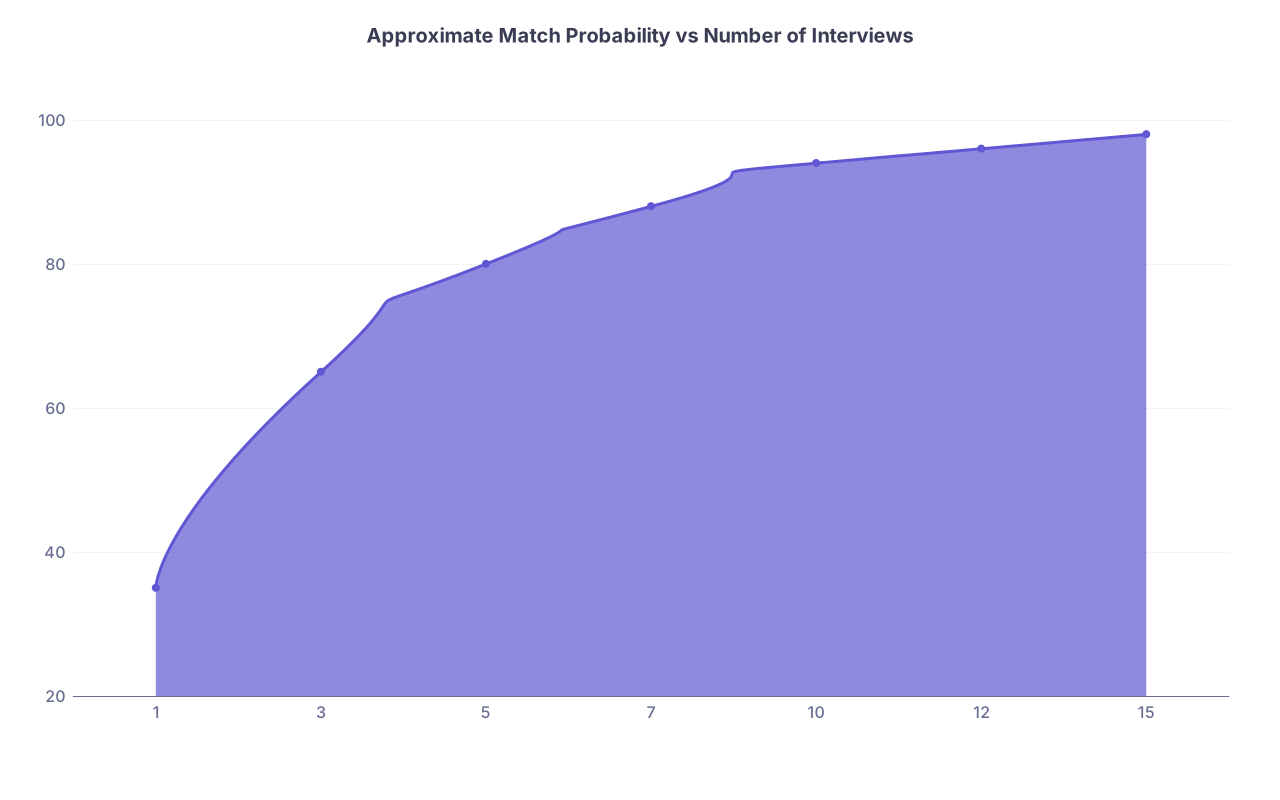
To make this concrete, let’s link number of applications → interviews → match probability.
| Category | Value |
|---|---|
| 1 | 35 |
| 3 | 65 |
| 5 | 80 |
| 7 | 88 |
| 10 | 94 |
| 12 | 96 |
| 15 | 98 |
The data (for categorical positions, U.S. seniors) consistently show:
- Around 5 interviews: ~80% chance to match.
- Around 10 interviews: ~94–95% chance.
- Beyond 12–15: you are buying marginal gains.
Everything in this article is aimed at backing you into a strategy that yields 8–12 interviews in realistic programs for your profile.
3. Four DO Applicant Profiles: Where You Fit
Let me be direct: your numbers and red flags determine your application volume more than your “passion for the specialty.”
We will group DO applicants into 4 practical tiers. These are not perfect, but they map reasonably well to how programs sort you.
Profile A – Strong DO Applicant
You look competitive anywhere except the hyper-elite university programs.
Typical characteristics:
- COMLEX 1/Level 1: Pass on first attempt
- COMLEX 2/Level 2: ≥ 620
- If USMLE taken: Step 2 ≥ 245
- No fails, no leaves of absence
- Top third of class, solid clinical evaluations
- Some research or meaningful scholarly work, especially if applying to competitive specialties
- No major professionalism issues
Profile B – Solid / Average DO Applicant
Competitive at most community and many mid-tier university programs.
- COMLEX 2: ~560–615
- Step 2 (if taken): ~230–244
- No exam failures
- Middle 50% of class
- Limited research (or none) but some leadership / volunteering
- Typical letters: good but not “glowing from a chair of XYZ”
Profile C – At-Risk DO Applicant
Will need volume and careful targeting, even in less competitive fields.
- COMLEX 2: ~510–555
- Step 2: ~220–229 (or not taken, which is a liability in many ACGME programs now)
- Maybe a marginal preclinical record, but no catastrophic issues
- Minimal research, average letters
- Possibly one mild concern: weak shelf scores, late Step 2, or limited geographic flexibility
Profile D – Red-Flag or Low-Score DO Applicant
You are not out of the game, but you are in a fight with the numbers.
Possible issues:
- COMLEX 2: < 510
- Step 2: < 220 or fail on any board (COMLEX or USMLE)
- Repeated course failures, leaves of absence without clear explanation
- Significant professionalism notes or later clinical turnaround after early trouble
- Late specialty switch with no clear track record
The ranges I give below are per specialty and assume you want to maximize match probability, not “see what happens with a conservative list.”
4. Data-Backed Application Ranges by Profile and Specialty Group
You are here for numbers, so let us put numbers on the table.
These are realistic ACGME application ranges for DOs, excluding AOA-only positions (since many of those are now folded into ACGME anyway). They assume you are aiming for a decent shot at 8–12 interviews.
Customize for your geography. If you are geographically very restricted, lean toward the upper end of each range.
| Specialty Group | Profile A | Profile B | Profile C | Profile D |
|---|---|---|---|---|
| Internal Medicine (categorical) | 25–40 | 35–55 | 50–70 | 70–90 |
| Family Medicine | 15–25 | 20–35 | 30–45 | 40–60 |
| Pediatrics (categorical) | 20–35 | 30–45 | 40–60 | 55–75 |
| Psychiatry | 25–40 | 35–55 | 50–70 | 65–85 |
| Emergency Medicine | 40–60 | 55–80 | 75–110 | 100–140 |
| Anesthesiology | 35–55 | 50–75 | 70–100 | 95–130 |
| General Surgery (categorical) | 45–65 | 65–95 | 90–130 | 120–160 |
| OB/GYN | 40–60 | 55–80 | 75–110 | 100–135 |
| Orthopedic Surgery | 60–90 | 80–120 | 110–160 | 150–200+ |
| Dermatology / Neurosurgery / ENT | 70–100 | 90–140 | 130–200+ | 180–220+ |
Interpretation:
- Those ranges look high for a reason. DOs often get fewer interview offers per 10 applications than MDs in the same score band, especially in competitive fields and at big universities.
- If you are aiming for a competitive specialty as a DO, and you are not in Profile A, you are playing a probability game that simply requires more “tickets.”
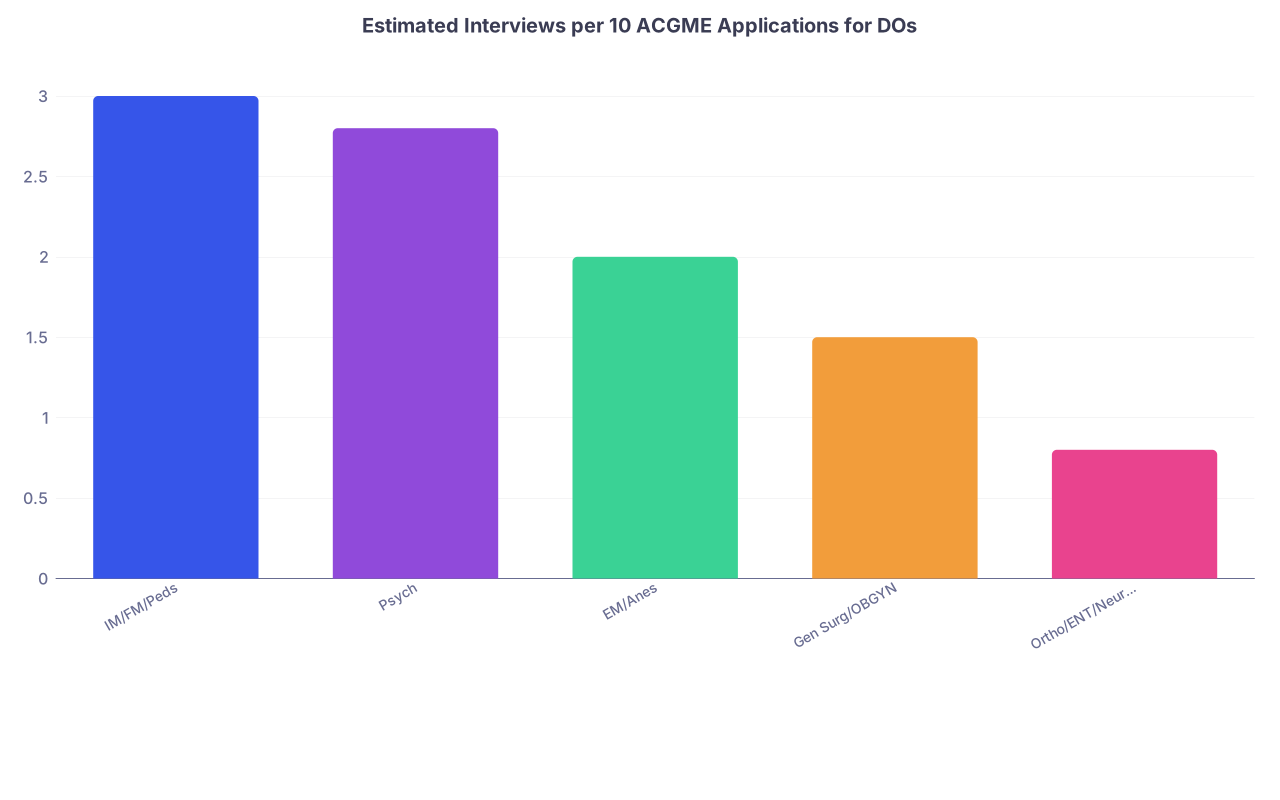
Expected Interviews per 10 Applications
These are rough, but they match what I see over and over in DO advising:
| Category | Value |
|---|---|
| IM/FM/Peds | 3 |
| Psych | 2.8 |
| EM/Anes | 2 |
| Gen Surg/OBGYN | 1.5 |
| Ortho/ENT/Neuro/Derm | 0.8 |
You can argue with the exact decimals, but the relative pattern is accurate:
- For primary care: 3–4 interviews per 10 applications is very achievable if you target DO-friendly programs.
- For surgery/OBGYN: closer to 1–2 interviews per 10.
- For ortho, ENT, neurosurgery, dermatology: often under 1 per 10 for non-elite DOs.
Multiply those crude yields by your application volume, and you see why some DOs need 80+ applications to sniff 10 interviews in competitive specialties.
5. Specialty-Specific Nuances for DO Applicants
You cannot apply with a single template in mind. The way ACGME programs treat DOs is not uniform.
Internal Medicine (Categorical)
Data pattern:
- Many IM programs are DO-friendly, especially community-based and university-affiliated community programs.
- NRMP data show DOs matching very well when they get 8–10 interviews.
Implication:
- If you are Profile A/B and broad geographically, you do not need to carpet bomb.
- The lower end of the ranges in the table are realistic with smart filters: DO current residents, mid-tier step cutoffs, non-elite research expectations.
For a Profile B applicant with COMLEX 2 ~585 and Step 2 ~236, I routinely see:
- ~35–45 IM applications → 10–15 interviews.
Family Medicine
FM is often where DOs overspend on applications relative to their actual risk.
- Many FM programs are actively DO-seeking.
- Interview yields often approach 4–5 per 10 applications for reasonably strong DOs.
If you are Profile A aiming only for FM, 15–20 ACGME programs plus a few osteopathic-leaning programs is usually entirely sufficient—unless you are rigid on location.
Pediatrics
Peds sits between FM and IM in competitiveness for DOs.
- University children’s hospitals may be cooler toward DOs; mid-tier and community programs are often very DO-friendly.
- Interview yield ~3 per 10 is common for Profile A/B.
For a Profile C DO with COMLEX 2 around 530 and no Step 2, 45–60 peds programs is a rational number if you want to feel safe.
Psychiatry
Psychiatry has become more competitive. The number of DOs matching into psych is still solid, but:
- Top academic centers and balanced rural-urban programs are more selective.
- Interview yield might be slightly under IM for DOs, especially at brand-name sites.
Profile B DO, COMLEX 2 ~580, Step 2 ~235:
- 40–50 psych applications → 8–12 interviews is realistic if you include community-heavy and DO-friendly lists.
Emergency Medicine
The recent EM “overcorrection” (class size vs job market panic) changed applicant behavior:
- Slight dip in competitiveness at some sites, but many EM programs still treat DOs as clearly second-tier compared with similar MDs.
- EM historically loved USMLE scores; Step 1 P/F pushed more emphasis to Step 2 and SLOEs.
For DOs:
- EM is not low-risk unless you are clearly Profile A with strong SLOEs.
- Profile B EM DO: 60–80 applications is not overkill. It is realistic math.
Anesthesiology
Anes has swung between less and more competitive over the past decade, but for DOs:
- Some university programs have essentially token or no DO presence.
- Community anes programs are more open, but many still rely heavily on Step 2 cutoffs.
Profile A DO with Step 2 ~245:
- 40–50 anes programs can be enough if targeted well. Profile B/C DO without Step 2 or borderline scores will often land in the 70–100 application range.
General Surgery (Categorical) and OB/GYN
These are classic “weed-out” specialties for DOs in ACGME programs.
- Many academic surgery and OB/GYN programs take very few DOs.
- Those that do are often deluged with DO applications.
The data you can actually see:
- Proportion of DOs among categorical residents often runs in the 0–15% range at many university programs.
- Community programs may be 30–60% DO, but still drown in applications.
This is why interview yields for an average DO applicant in surgery/OBGYN are low.
Orthopedic Surgery, Dermatology, Neurosurgery, ENT
Here the data are brutal:
- A small subset of DO schools and DO students dominate the DO match lists in these specialties.
- Many academic programs essentially do not consider DOs meaningfully unless they have top-tier Step 2 and strong research.
For most DOs in these specialties, especially Profile B/C:
- 120–200+ applications is not insane. It is what the numbers force you into.
- Dual applying (e.g., Ortho + categorical prelim surgery or IM) is not a “maybe.” It is statistical damage control.
6. How to Trim the List Without Killing Your Odds
You probably looked at some of those upper-end ranges and thought: “That is expensive and miserable.”
Correct. So the key is not blind volume. It is targeted volume.
Here is how I filter with students when we build lists:
Check DO representation.
Look up current residents. If a program has zero DO residents in a DO-heavy region, do not waste the application unless you are truly Profile A+ with research.Score cutoffs and language.
Many programs still list “USMLE Step 2 score > 230 preferred” or “USMLE required.” As a DO:- If they require USMLE and you did not take it, move on.
- If you took USMLE and are clearly below their stated preference, skip.
Geographic logic.
DOs usually do better in:- Regions with many DO schools (Midwest, some Northeast, parts of the South).
- Community and hybrid academic-community programs.
Program type.
Pure big-name university hospitals with minimal or no DOs: very low-yield for everyone except top-tier DOs. You can sprinkle a few as reach programs, not 40 of them.Osteopathic recognition / DO-friendly culture.
These programs often have:- Former DO PDs or APDs
- OMT clinics
- Explicit language welcoming DOs
Here is what that looks like practically:
For a Profile B DO applying to IM:
- Start with 120 “possible” programs.
- Remove all programs with 0 DO residents across all PGY levels unless they are strong personal geographic ties.
- Remove programs that explicitly state “USMLE required” if you did not take it.
- Remove programs in oversaturated markets where you have zero ties and they rarely take DOs (e.g., some big coastal metros).
You will often cut down to 50–70 realistically DO-friendly programs. Then you decide how aggressive you want to be (e.g., keep 40 vs 60).
7. Cost, Yield, and When to Stop Adding Programs
The math of cost vs benefit:
- ERAS base + per-program fees add up quickly; applying to 100+ programs can easily approach or exceed $2,000–$3,000 in fees alone.
- If adding 20 more applications only realistically buys you 1 more interview (e.g., in ortho as a Profile C DO), that is expensive—but may still be rational if:
- You have no backup specialty.
- You understand the probability curve and are trying to move from 5 → 6 interviews.
You can think of it as marginal cost per expected extra interview.
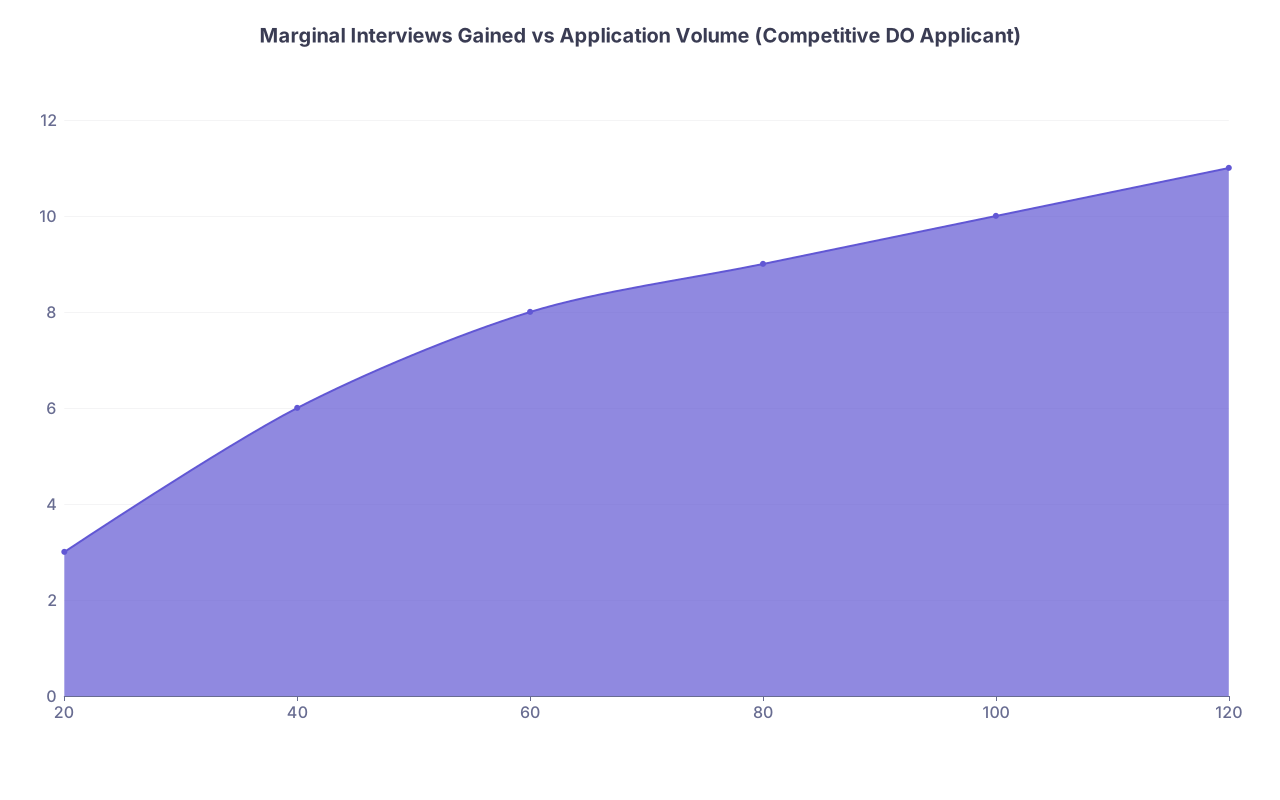
| Category | Value |
|---|---|
| 20 | 3 |
| 40 | 6 |
| 60 | 8 |
| 80 | 9 |
| 100 | 10 |
| 120 | 11 |
Pattern:
- 20 → 40 apps: each group of 20 may add ~3 interviews.
- 60 → 80: maybe ~1 additional interview.
- 100 → 120: again, maybe 1 more.
You stop adding when:
- The incremental expected interview yield is less valuable than either:
- Saving the money for a second application cycle if needed.
- Putting that energy into away rotations, better letters, or a stronger Step 2.
For primary care DOs (IM/FM/Peds), the diminishing returns hit earlier:
- Going from 40 → 80 IM applications as a Profile A/B DO rarely doubles your interviews. It just shifts your list from “good coverage” to “overkill.”
8. DO Reality Check: Step 2, COMLEX-Only, and Red Flags
Three final data levers that change your application counts.
1. USMLE Step 2 vs COMLEX-Only
The data show:
- Programs that historically did not understand COMLEX are still disproportionately skeptical of COMLEX-only applicants.
- DOs with both COMLEX and USMLE Step 2 in a competitive range directly increase their interview yield, especially at academic and some coastal programs.
If you are COMLEX-only:
- Expect your interview yield at university-heavy ACGME programs to drop.
- Compensate with:
- Higher application volume.
- More community and DO-heavy programs.
2. Board Failures
One fail is survivable, but it changes the math.
- The NRMP data: U.S. seniors with exam failures match at substantially lower rates, especially in competitive fields.
- Programs often screen out automatically on “any fail” unless there is a strong tie or advocacy.
For a DO with a fail:
- Shift upward in the ranges I gave by ~15–30% in competitive specialties.
- Strongly consider dual applying unless you are already Profile A in every other respect.
3. Geographic Inflexibility
If you are limited to:
- One city
- One state
- Or one small region where there are only a handful of DO-friendly programs in your specialty
…your risk shoots up. Because your “effective” list of realistic programs may be 5–10 even if you apply to 40 in the region.
In that case:
- Either broaden geography or escalate volume dramatically.
- And recognize that for a DO with constraints and average numbers, a backup specialty is statistical self-defense, not pessimism.
9. Bringing It Together
You do not control how many DOs a given PD will rank. You do control how rationally you treat the numbers.
Three key points:
Application volume is profile- and specialty-dependent.
A Profile A DO applying to IM might be fine with 30–40 programs. That same applicant aiming at ortho or dermatology needs 80–140+ to have a comparable shot.Your target is interviews, not applications.
Work backwards: you want ~8–12 realistic interviews. Estimate your interviews per 10 applications for your specialty and profile, then set your application count from there.Targeting beats blind volume.
DO representation, COMLEX/USMLE policies, and geography matter. Cut low-yield programs aggressively. Spend your money where the historical data show DOs actually match.
If you treat this like a probability problem instead of a wish list, you will make better, colder, and ultimately safer decisions.