
The biggest mistake military-bound DOs make is pretending they do not need a real civilian backup plan.
If you’re a DO aiming for the military match but also considering ACGME civilian residency as insurance, you are in a narrow, tricky lane. You do not have unlimited bandwidth. You do not have unlimited money. And the timelines between JSGME/MDSSP/HPSP/GMO and ERAS do not care about your stress level.
You need a clear structure, not vibes.
I’m going to walk you through exactly how to think about this if you’re a DO who is:
- Committed (or strongly leaning) to a military career
- Unsure about competitiveness in your chosen specialty
- Worried about going all‑in on military and getting burned
- Not sure how much to invest in ERAS, COMLEX vs USMLE, and letters
This is the “here’s the playbook if you’re in this specific situation” guide.
Step 1: Get Honest About Your Risk Profile
Start here. Not with personal statements. Not with ERAS tokens. With risk.
You’re in one of three buckets, whether you admit it or not:
| Profile | Military Competitiveness | Specialty Type | Backup Intensity Needed |
|---|---|---|---|
| Low Risk | Strong scores/records | Less competitive (FM, IM, Psych) | Light backup |
| Moderate Risk | Average record or minor red flags | Mid (EM, Anes, OB, Gen Surg) | Moderate backup |
| High Risk | Weak or mixed record | Competitive (Ortho, Derm, ENT, Urology) | Heavy backup |
Now I’ll translate that into real talk.
Low-risk: You’re likely to match military
You probably:
- Have COMLEX 1/Level 2 (and maybe USMLE) in the solid range for your branch
- Don’t have major professionalism issues
- Are targeting something like:
- Family Medicine
- Internal Medicine
- Pediatrics
- Psychiatry
- Possibly EM or General Surgery if your scores/letters are strong and the branch has decent spots
If you’re here, you still need a backup, but not a 60-program ERAS carpet-bomb.
Moderate-risk: You could match military… or not
Typical profile:
- Mid-range scores (e.g., COMLEX 1 in 480–520 range, Level 2 similar)
- Some decent clinical evals but not glowing
- Applying to:
- EM, Anesthesiology, OB/GYN, General Surgery
- Or a less competitive specialty in a branch with very few spots that year
This is the “I really might get squeezed” group. You can’t half‑ass ERAS and hope.
High-risk: You’re rolling the dice if you rely only on military
You might:
- Be going after a super competitive specialty:
- Orthopedic surgery
- Dermatology
- ENT
- Urology
- Neurosurgery
- Have:
- Below-average scores
- A failed exam attempt
- Limited or weak specialty letters
- No serious research in that field
If that’s you, pretending “I’ll probably match military because there’s less competition” is fantasy. The military is small. When they don’t think you fit, you don’t just slide into some backup program—they simply don’t take you.
Your civilian strategy here should be very robust.
Step 2: Understand the Timeline Collision (And Use It)
Military and civilian timelines are not aligned out of kindness. But you can use that.
For most branches (HPSP/USUHS/MDSSP), the pattern is roughly:
- Military match decisions come out before or early in the civilian season
- ERAS opens and programs start reviewing around September
- Civilian rank lists and Match Day happen later (Feb–March)
That means: you will often know your military fate before you’re locked into civilian rank lists. That’s good. The problem is you have to prepare for both long before you know.
Here’s the high-level flow:

| Step | Description |
|---|---|
| Step 1 | MS3 Spring |
| Step 2 | Decide Specialty + Risk Profile |
| Step 3 | Plan Military Auditions + Letters |
| Step 4 | Decide Civilian Backup Intensity |
| Step 5 | MS4 Early: Build ERAS, Personal Statement, CV |
| Step 6 | Submit ERAS to Backup Programs |
| Step 7 | Military Match Results |
| Step 8 | Withdraw from Civilian Interviews/Programs |
| Step 9 | Go Full-Throttle on Civilian Interviews + Rank List |
Your structure has to assume this: you prepare for civilian as if you will not match military, then scale back if you do. Not the other way around.
Step 3: Decide How Heavy Your Civilian ERAS Should Be
Here’s where most people get paralyzed. “How many programs do I apply to?” “Which specialties?” “Do I need a separate personal statement?”
I’ll break it into concrete tiers based on the risk buckets above.
Tier 1 Backup: Light Civilian Presence
Who this is for: low‑risk, primary care–bound, strong military candidate.
What this looks like:
- Programs: 10–20 civilian programs, primarily:
- Community-based
- DO-friendly
- In states you’d actually live in
- Strategy: You’re buying insurance against a rare military miss or a late GME restructuring, not planning a full second life.
You must:
- Have ERAS ready and submitted early (mid‑September).
- Have at least:
- 1–2 solid specialty letters
- 1 general “character/professionalism” letter
- Sit for COMLEX Level 2 on time; USMLE Step 2 is optional unless your specialty cares.
You can afford one personal statement that’s slightly tuned to “service, mission, and teaching” and use it both military and civilian.
Tier 2 Backup: Serious Civilian Parallel Plan
Who this is for: moderate‑risk applicants. Or those targeting moderate-competitive specialties.
What this looks like:
- Programs:
- 40–60+ for EM/Anes/OB/Gyn/Gen Surg
- 30–40 for IM/FM if your record is mixed
- Wider geographic net. You’re not just applying near home. You are applying where you are most likely to match.
You should:
- Take USMLE Step 2 if you can score in a reasonably competitive range. A strong Step 2 can help overshadow a weaker Step 1/Level 1.
- Have two versions of your personal statement:
- One slightly tailored to the military and service.
- One standard civilian version focused on patient care, teaching, and academic interests.
- Structure rotations so that:
- You do at least one civilian audition/sub-I at a program type you’d realistically rank.
This tier costs more money and time. But if you’re in the gray zone, it’s cheaper than scrambling later.
Tier 3 Backup: Full Civilian Priority With Military As Preferred Path
Who this is for: high‑risk candidates in competitive specialties.
Harsh truth: if you’re DO + competitive specialty + medium/weak metrics, you should not rely on the military to “save” your match. You should treat military as Plan A if it works, but your match security comes from civilian.
Concrete structure:
- Programs:
- 60–80+ for fields like ortho, ENT, derm, etc.
- Broad range of competitiveness: include lower-tier academic and solid community programs.
- You absolutely should:
- Take USMLE Step 2 if at all possible.
- Have specialty‑focused research, even if small projects.
- Do at least 2 civilian auditions in the specialty.
- Personal statements:
- One highly specialized for that field, civilian-focused.
- One version tailored if the military asks for anything different.
For you, the military match is like a bonus track. The civilian match is the album.
Step 4: Comlex vs USMLE, and What Civilians Actually Care About
You’re a DO. Civilian ACGME programs now live in the single accreditation world, but bias did not magically evaporate.
Here’s how to think about exams:
- If you already took USMLE Step 1 and it’s decent:
- Strong (e.g., > 230–235): leverage it. Take Step 2 and aim higher.
- Weak: you either:
- Take Step 2 to show improvement, or
- Skip Step 2 for civilian and lean on COMLEX (risky in competitive fields).
- If you did not take Step 1:
- For primary care and many IM/FM/Psych programs: COMLEX alone can be enough.
- For competitive fields: not having USMLE is still a handicap at some programs. Not fatal everywhere, but definitely a filter at many.
Do not invent some grand narrative about “I only took COMLEX as a DO identity choice” if the real reason is you were scared of USMLE. People can smell the spin. If asked, keep it short and practical: limited time, focused on COMLEX, then pivot to how you’ve performed clinically and on Level 2.
Step 5: How to Split Your Rotations Without Sabotaging Either Side
You get a finite number of fourth-year slots that actually matter. You can’t do six military auditions, three civilian ones, and still graduate on time with required rotations checked off.
You have to be intentional.
General rotation structure that works
MS4 early year, rough outline:
- 1–2 military auditions in your chosen specialty (if available)
- 1 civilian audition in your specialty
- 1 away or home sub-I where you can get a strong letter (civilian or military)
- Remaining blocks: required rotations + one “safety net” rotation (like IM/FM) where you could pivot if forced into a different field
If you’re heavy into Tier 2 or Tier 3 backup, that civilian audition is non-negotiable. You need at least one place that can say: “I’ve seen this person work in our system, they’re fine.”
And structure matters. You want:
- At least one letter writer who knows you from a civilian, ACGME-style environment. They tend to write differently, and civilian PDs read those letters slightly differently.
- Timing: do not stack all your key rotations at the very end of fall. ERAS opens early. Have at least one strong rotation wrapped up by August with an attending primed to write quickly.
Step 6: Letters, Personal Statements, and the “Double-Life” Problem
You’re living two parallel lives: future officer and potential civilian resident.
You can’t send the same exact messaging everywhere without sounding generic. But you also can’t write five personal statements and request 12 different flavors of letters. You’ll drown.
Here’s how to be smart about it.
Letters of Recommendation
You want three functional categories:
Specialty letter – military
- From an officer/attending in your branch if possible.
- Talks about your military bearing, teamwork, leadership, and fit for the specialty.
Specialty letter – civilian (or civilian-style)
- From an attending in the specialty at a civilian or civilian-affiliated site.
- Talks in ACGME language: milestones, patient care, systems-based practice, etc.
General “character/work ethic” letter
- Could be IM/FM or another core.
- This one can be used across civilian and military if written broadly.
You do not need 10 letters. You need 3–4 solid ones deployed strategically.
Be explicit with attendings when you ask:
- “I’m applying to both the military and civilian match as a backup. Would you be comfortable writing a strong letter that I can use for both?”
The word “strong” matters. If they hesitate, move on.
Personal Statements
Do not overcomplicate this. Aim for two versions:
Military-leaning version:
- Includes your reason for service, leadership experiences, and alignment with military values.
- Still shows you are a good physician first, soldier/officer second.
Civilian-leaning version:
- Minimal branch talk. If you mention service, frame it as part of your background, not the whole identity.
- Emphasizes clinical interest, teaching, academic or community engagement.
They can share 60–70% of the same spine. Just adjust the emphasis and opening/closing paragraphs.
Step 7: Picking Civilian Programs Strategically (Not Randomly)
Here’s where people either panic and overapply, or get lazy and underapply.
You’re not building a random list. You’re building a net that matches your risk tier.
Look at these factors:
| Filter Type | What to Look For |
|---|---|
| DO-Friendliness | Current DO residents, prior AOA heritage, explicit statements |
| Exam Policies | Accepts COMLEX-only vs requires USMLE |
| Program Type | Community vs academic vs hybrid |
| Geographic Flexibility | States where you'd actually go if it’s your only match |
| Specialty Competitiveness | Mix of safer and more competitive programs |
You can do this in one focused evening:
- Pull FREIDA / program websites for your specialty.
- Highlight:
- COMLEX-only friendly
- Has DOs in current residents
- Not top-10 academic powerhouses you have no shot at (unless you’re truly competitive)
For a Tier 2 or Tier 3 backup, you want a mix:
- 30–40 “safety/solid” programs where your stats are at or above their typical resident profile.
- 10–20 “reach” programs if you have something unique (research, military background, niche interest).
Do not waste half your list on purely prestige programs. You’re not doing a victory lap here. You’re building a parachute.
Step 8: Handling the Fork in the Road After Military Results
This is the part nobody prepares you for: what to actually do the week your military results come out while ERAS is live.
Two main scenarios.
Scenario A: You match military
You need to cleanly back out of civilian without seeming flaky or unprofessional.
Concrete steps:
Immediately (within 48–72 hours), email civilian programs where you’ve applied or been invited, saying:
- You have matched to a military residency and are respectfully withdrawing from consideration.
Keep it short. No drama. Something like:
“Dear Dr. X,
I’m writing to let you know that I’ve matched to a military residency position and will be fulfilling my service obligation through that route. I’m therefore withdrawing my application from your program. I appreciate your consideration and the time you and your team have given my application.
Sincerely,
[Name]”Decline any already-scheduled interviews, freeing those spots for others.
This protects your reputation and closes the loop. People remember students who vanish without explanation.
Scenario B: You do not match military
This is why you did the work up front.
Your response in the next 1–2 weeks:
- Immediately update your mindset: civilian is now Plan A, not “backup”.
- Make sure ERAS is fully polished:
- Experiences updated
- Personal statement tuned (you can remove heavy military phrasing if needed)
- If you hadn’t applied broadly enough, consider:
- A targeted additional wave of applications to DO-friendly or community programs.
- On interviews:
- Be honest if asked about military:
- “I applied to the military match as part of my service commitment, but I was not selected for a position this cycle. I’m very committed to completing high-quality training in [specialty], and I see civilian residency as an excellent path to that.”
- Be honest if asked about military:
You do not need a long sob story. Programs care more about who you are walking in the door than why the Pentagon didn’t pick you.
Step 9: Money and Time Management So You Don’t Burn Out or Go Broke
You’re essentially running two parallel processes. That costs.
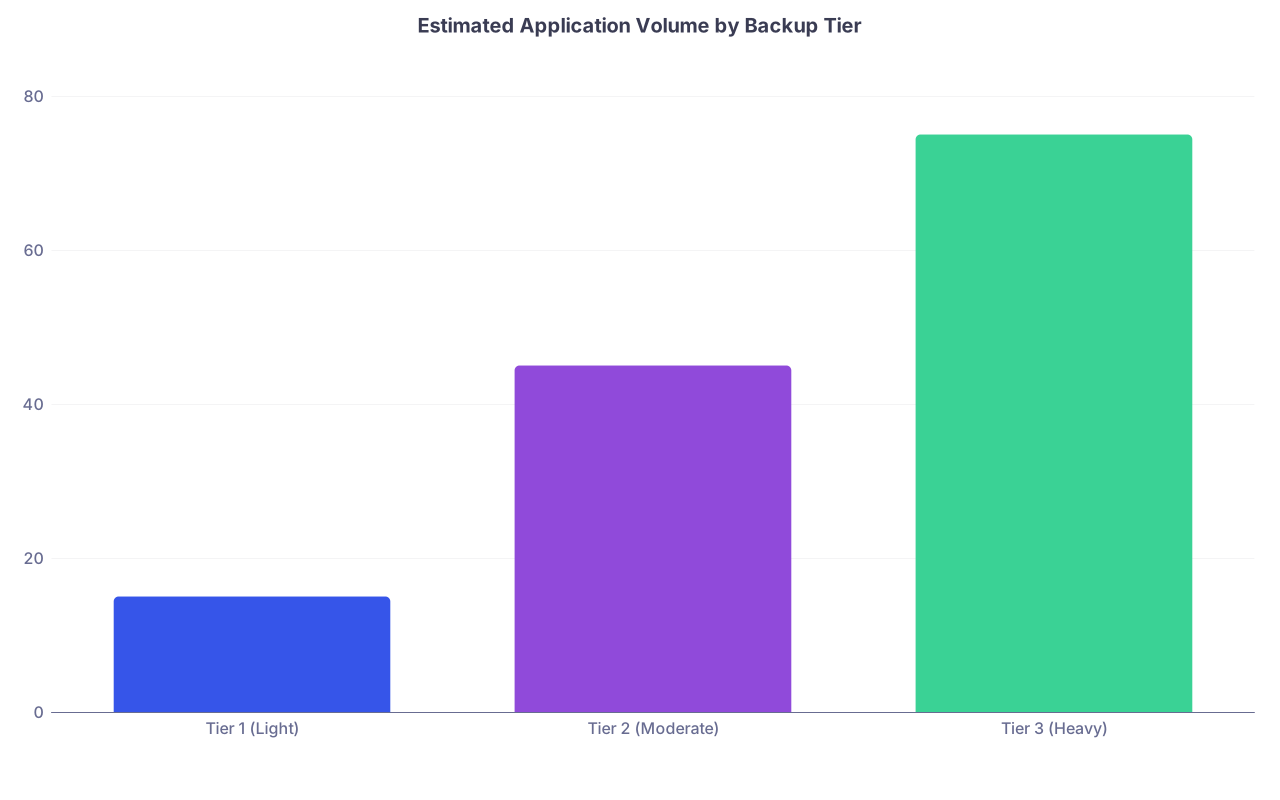
| Category | Value |
|---|---|
| Tier 1 (Light) | 15 |
| Tier 2 (Moderate) | 45 |
| Tier 3 (Heavy) | 75 |
Straight talk:
- Tier 1 backup: Your extra cost is manageable—maybe a few hundred dollars.
- Tier 2: You’re in the $1–2k+ range between ERAS fees and travel if in-person interviews exist.
- Tier 3: Could easily hit $3k+.
You can’t change ERAS fees. But you can:
- Limit unnecessary “vanity” applications.
- Make a realistic ceiling and work backwards. E.g., “I’m not spending more than $2000,” then size the list accordingly.
- Be strategic with interviews:
- You don’t need to attend 25 civilian interviews if you match military.
- If you don’t match military, prioritize programs where:
- You fit their typical resident profile.
- They’ve already shown interest (quick invites, personalized messages).
And protect your time. Two personal statements. One well-maintained CV. A sane interview schedule. You’re not a full-time applicant; you still have to finish school.
Step 10: Emotional Reality Check (Because This Messes With Your Head)
Juggling military + civilian can make you feel like you’re betraying one side every time you work on the other.
You’re not.
You’re doing professional risk management in an unstable system that doesn’t guarantee you a job despite years of work and debt. That’s not disloyal. That’s rational.
Three things I’ve seen help students in your exact shoes:
Pick a primary narrative for yourself.
“I want to serve, but I also want to be the best-trained physician I can be. That means having multiple pathways to residency.” You are not gaming the system; you’re protecting your ability to practice.Be honest but concise when people ask.
To military mentors:
“I’m committed to the military path, but I’m also preparing a civilian backup in case I don’t match. I respect the process too much to assume I’m guaranteed a spot.”
To civilian programs:
“I applied to the military match as part of my scholarship/obligation, but I’m fully committed to [specialty] and very interested in training here.”Don’t wait to build Plan B until Plan A explodes.
By then it’s too late.
Putting It All Together: A Simple Structural Template
If you want a quick template for how to actually structure your apps, here it is:
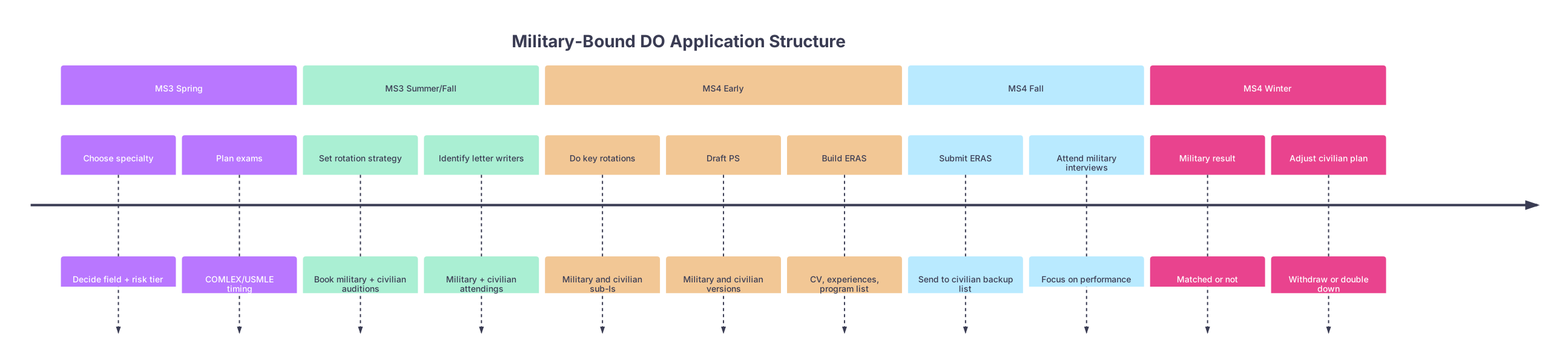
| Period | Event |
|---|---|
| MS3 Spring - Choose specialty | Decide field + risk tier |
| MS3 Spring - Plan exams | COMLEX/USMLE timing |
| MS3 Summer/Fall - Set rotation strategy | Book military + civilian auditions |
| MS3 Summer/Fall - Identify letter writers | Military + civilian attendings |
| MS4 Early - Do key rotations | Military and civilian sub-Is |
| MS4 Early - Draft PS | Military and civilian versions |
| MS4 Early - Build ERAS | CV, experiences, program list |
| MS4 Fall - Submit ERAS | Send to civilian backup list |
| MS4 Fall - Attend military interviews | Focus on performance |
| MS4 Winter - Military result | Matched or not |
| MS4 Winter - Adjust civilian plan | Withdraw or double down |
Use this as a mental checklist. If any box is blank right now, that’s where to focus this week.
Open a blank document today and write down, in order:
- Your specialty.
- Your honest risk tier (low, moderate, high).
- How many civilian programs you will apply to based on that tier.
- The one civilian audition/sub-I you absolutely need to schedule or confirm.
Do that, and you’ve started turning this from a vague anxiety into an actual strategy.


