Most DO applicants are underselling their osteopathic research and QI—and losing interviews they should be getting.
Let me be blunt. ACGME programs are not docking you for “osteopathic” research. They are docking you for presenting it poorly, labeling it vaguely, and failing to translate it into the language MD review committees understand: rigor, impact, and your specific role.
If you are a DO with OMM/OMT projects, osteopathic-focused QI, or COM-specific scholarly work, you are not the exception anymore. You are the norm. The differentiator is not what you did; it is how you package it in ERAS, your CV, and your interviews.
Let me break this down specifically.
Core Principle: Your Job Is Translation, Not Apology
Stop defending that your work is “just osteopathic research” or “only a school QI project.” Program directors care about:
- Can you ask a clinical or educational question?
- Can you design or contribute to a structured project answering it?
- Can you write, present, and talk about it clearly?
- Did it change anything—care, teaching, workflow, outcomes?
Osteopathic focus is a modifier, not a handicap.
The mindset shift you need:
- You are not “selling OMM.”
- You are selling:
- Research skills: study design, data collection, analysis.
- Systems thinking: how QI fits into real-world workflows.
- Professional behaviors: deadlines, IRB, collaboration, presenting to faculty.
You make that legible to an ACGME committee by standardizing your language and being surgically precise about your role and outcomes.
How to Enter Osteopathic Research and QI Correctly in ERAS
This is where most DO students quietly sabotage themselves: bad titles, vague descriptions, and dumping everything under “Volunteer” or “Other.”
Where things belong in ERAS
Use the standard ERAS buckets. That alone makes you look more “ACGME native.”
| Activity Type | ERAS Section |
|---|---|
| OMM/osteopathic research project | Research Experience |
| Osteopathic-focused QI (clinical) | Research or Work/Volunteering (case-dependent) |
| QI required by rotation/hospital | Work/Volunteering or Research (if rigorous) |
| Posters, oral presentations, abstracts | Publications/Presentations |
| OMM education curriculum project | Research or Teaching/Leadership |
Rule of thumb:
If there was IRB, data collection, analysis, or structured PDSA cycles → “Research Experience.”
If it was primarily implementing a change with minimal data work → “Work/Volunteering” or “Leadership and QI.”
Do not create a weird “Osteopathic” category. That just signals you are not comfortable aligning with ACGME norms.
Writing Strong ERAS Entries for Osteopathic Research
This is where you go from “DO doing OMT stuff” to “resident who understands clinical investigation.”
You need three things in every research entry:
- A standardized, clinically meaningful title
- Clear design/aim language
- Specific, role-focused bullet(s) describing what you did
1. Title: drop the school jargon
Bad ERAS entry title:
“OMM Independent Study for COM Research Track”
Better:
“Randomized Trial of OMT as Adjunctive Therapy for Chronic Low Back Pain in Primary Care”
Notice the difference. The second title tells an MD reviewer:
- What population (chronic low back pain)
- What intervention (OMT as adjunct)
- What context (primary care)
- That it is a trial, not a fluffy “project”
A few more examples:
Instead of “OMM in COPD Exacerbations” →
“Pilot Study of Osteopathic Manipulative Treatment in Hospitalized Patients with COPD Exacerbation”Instead of “OMM in Pregnancy Clinic” →
“Prospective Cohort Study of OMT for Low Back Pain in Pregnant Patients at an Academic Clinic”
If it was QI:
- “QI: Improving OMT Utilization in Hospital” →
“Quality Improvement: Increasing Timely OMT Consults for Inpatients with Musculoskeletal Pain”
You want any PD skimming your CV to understand the project in 2 seconds without knowing anything about osteopathy.
2. Design/Aim: speak research, not vibes
In the main description box, explicitly state:
- Type of project
- Aim
- Basic design
Example:
“Prospective randomized controlled trial evaluating the impact of adjunctive osteopathic manipulative treatment on pain scores and opioid use among adults with chronic low back pain in a primary care clinic.”
Or for QI:
“Resident-led quality improvement project using PDSA cycles to increase same-day OMT consults for inpatients with acute musculoskeletal pain on the internal medicine service.”
If you do not explicitly say “retrospective chart review,” “prospective cohort,” “RCT,” “PDSA-based QI,” reviewers will assume it was a loose case series you did for a grade.
3. Your role: no more “involved in” or “helped with”
Vague verbs kill you. “Assisted with,” “participated in,” “was involved in” tell me nothing. You need to itemize what you actually did, in language PDs respect.
Strong verbs:
Designed, performed, collected, analyzed, drafted, presented, implemented, audited, coordinated, led, supervised.
Example ERAS research entry (for an OMT RCT):
“Role: Co-investigator (Student)
- Screened and consented eligible patients in primary care clinic; performed baseline data collection and scheduled follow-ups.
- Performed standardized OMT protocol under faculty supervision; documented sessions in EHR.
- Entered and cleaned data in REDCap; collaborated with biostatistician on preliminary analysis.
- Co-authored abstract accepted for podium presentation at AAO Convocation 2024.”
That reads like any solid MD student research experience. The fact that the content is osteopathic is secondary.
Presenting OMT/Osteopathic QI as Serious Scholarship
The bias you are fighting is not always anti-DO; often it is anti-soft-project. Many QI entries from both MD and DO students sound like “we made a poster and changed nothing.”
You counter that by showing structure and outcomes.
Use QI language that ACGME committees recognize
If your osteopathic QI really was QI, you should be able to state:
- Aim: “Increase X by Y% in Z months”
- Framework: PDSA cycles, Lean/Six Sigma, root cause analysis, Fishbone diagram, etc.
- Measures:
- Process measures (e.g., % of eligible patients offered OMT)
- Outcome measures (e.g., change in pain scores, LOS, 30-day readmission)
- Balancing measures (e.g., clinic flow time, number of consults delayed)
Example of strong QI description (for ERAS):
“Quality improvement project aimed to increase same-day inpatient OMT consult completion from 30% to 70% within 4 months on the internal medicine service. Performed baseline chart review, led root cause analysis with residents and nurses, and implemented an EHR order set plus a resident education session. Tracked process and outcome measures monthly using PDSA cycles, demonstrating improvement to 72% completion with no increase in consultation turnaround time.”
An MD PD reading that sees:
- Clear aim
- Structured methods
- Data
- Real effect on care
The fact that it is OMT-specific is neutral or even slightly interesting, not a negative.
Where to List Osteopathic Posters, Abstracts, and Talks
Many DO students bury their scholarly output because it is “only at AAO” or “just our COM research day.” Stop doing that.
You list osteopathic outputs like any other:
Publications/Presentations Section: Format matters
You want consistency and standard citation style.
Examples:
Poster:
“Smith J, Patel R, Nguyen T, et al. ‘Effect of Osteopathic Manipulative Treatment on Dyspnea Scores in Hospitalized COPD Patients: A Pilot Study.’ Poster presentation, American Academy of Osteopathy Convocation, March 2024, Orlando, FL.”
Or:
“Nguyen T, Jones L. ‘Implementing an OMT Consult Pathway for Inpatients with Acute Low Back Pain.’ Poster, Michigan State University College of Osteopathic Medicine Research Day, April 2023, East Lansing, MI.”
Podium:
“Garcia M, Chen A. ‘Prospective Study of OMT for Pregnancy-Related Low Back Pain in an Academic Clinic.’ Oral presentation, Obstetrics and Gynecology Grand Rounds, Mercy Health – Muskegon, May 2024.”
If the venue is internal (school research day), still list it. Just be accurate. Internal presentations still show you can get something to completion and present to peers.
Framing Osteopathic Work in Your Personal Statement and Interviews
You do not need to turn your personal statement into an OMT manifesto. In fact, please do not.
The winning strategy is simple:
- Mention osteopathic projects as evidence of curiosity, systems thinking, and scholarly discipline.
- Connect them to ACGME core competencies: patient care, practice-based learning and improvement, systems-based practice.
- Show that you understand limits and do not oversell OMT as magic.
In the personal statement
One to two tight paragraphs is usually enough.
For example, in an internal medicine PS:
“During my third year, I joined a faculty-led randomized trial evaluating osteopathic manipulative treatment as an adjunct for chronic low back pain in our primary care clinic. I was responsible for screening and enrolling patients, performing a standardized protocol of soft tissue and HVLA techniques, and collecting follow-up pain and function scores. Working through IRB revisions and protocol deviations taught me how easily ‘clean’ study designs can collide with real clinic flow. That experience pushed me toward quality improvement, where I later helped design a PDSA-based project to improve timely OMT consults for inpatients with musculoskeletal pain. The content was osteopathic, but the skills were universal: identifying gaps in care, measuring them, and iterating solutions with frontline staff.”
Notice what that paragraph does:
- Grounds you in real work and responsibilities.
- Frames OMT work as training in clinical investigation and QI.
- Signals humility and systems awareness.
No preaching. No “holistic paradigm” speech.
In interviews: concrete, not philosophical
You will almost certainly get:
“So tell me about your research”
or
“I see some osteopathic-focused projects—can you tell me more about those?”
You should be able to give a tight, 60–90 second answer that covers:
- Clinical question
- Design
- Your role
- What you found / learned
Example interview script:
“We were looking at whether adding OMT to usual care affected pain scores and opioid use in adults with chronic low back pain in our primary care clinic. It was a prospective randomized trial; I helped with patient screening, consenting, and performing a standardized protocol under faculty supervision. I also collected follow-up pain and function scores and worked with our biostatistician on the preliminary analysis. What I took away was less about OMT itself and more about feasibility—how hard it is to maintain protocol fidelity in a busy clinic. That experience set me up well for a later QI project on improving consult workflows, where we used PDSA cycles and process measures to actually change practice instead of just measure it.”
That sounds like any strong MD applicant describing a project. The “osteopathic” piece becomes flavor, not liability.
Specialty-Specific Nuances: Where Osteopathic Work Helps or Hurts
Different specialties react differently to osteopathic-heavy CVs. You do not need to guess; we have seen consistent patterns.
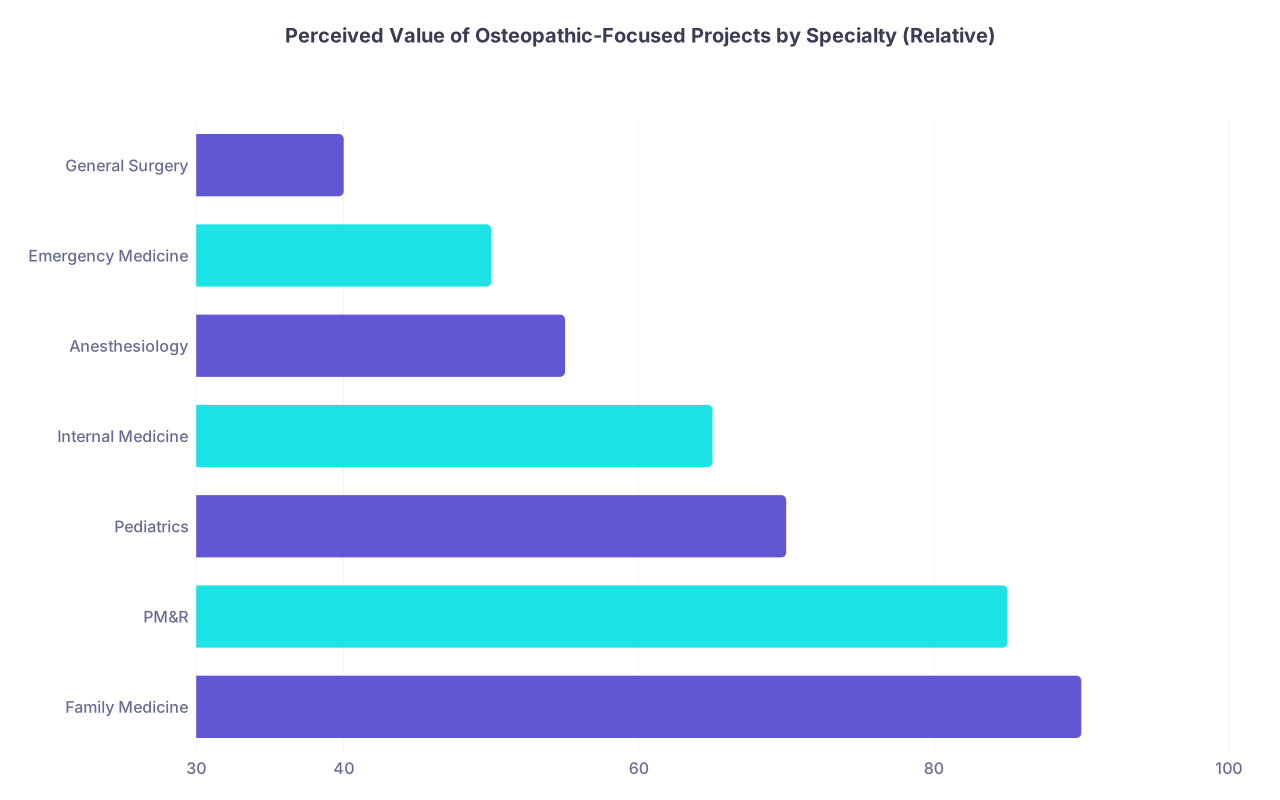
| Category | Value |
|---|---|
| Family Medicine | 90 |
| PM&R | 85 |
| Pediatrics | 70 |
| Internal Medicine | 65 |
| Anesthesiology | 55 |
| Emergency Medicine | 50 |
| General Surgery | 40 |
This is conceptual, but it reflects real behavior:
- Family Medicine / PM&R: Often genuinely interested in OMT, pain, function, musculoskeletal QI. Your projects can be a plus if framed as real clinical work.
- IM / Pediatrics: Neutral to mild positive, particularly if framed as rigorous research/QI and not as philosophy.
- EM / Anesthesia: Accepting; they like QI, ED flow, peri-op pain projects. OMT relevance depends on content (pain, throughput, LOS).
- General Surgery and some high-end subspecialties: They care about rigor and outcomes, not the word “osteopathic.” Poorly framed OMT stuff looks like fluff. Well-framed RCT/QI looks solid even if niche.
If you are applying to highly competitive programs (ortho, derm, ENT, neurosurgery), you already know that publication count, impact, and alignment with specialty research matter more than whether it was osteopathic per se. For those, you want at least some work that clearly overlaps their world (trauma, wound healing, imaging, outcome studies) even if your early projects were OMT-heavy.
Common Mistakes DO Applicants Make (And How To Fix Them)
I see the same errors every cycle.
1. Labeling everything “osteopathic” first
Bad:
“Research – Osteopathic Manipulative Medicine”
Better:
“Research – Chronic Pain Management Trial (OMT as Adjunctive Therapy)”
Lead with the clinically meaningful part. The fact that it used OMT is detail, not the headline.
2. Hiding QI in “Volunteer” or “Other”
If you wrote aims, collected baseline data, used run charts/control charts, or completed PDSA cycles, that is QI, not “I volunteered.” Put it in Research or Work/Leadership, label it QI explicitly, and describe the methods.
3. No outcomes, just “we did a project”
Always answer:
- Did anything change?
- How much?
- What did you learn even if the project “failed”?
Even if your OMT project showed no significant difference, you gain credibility by saying:
“Our pilot was underpowered and did not show a statistically significant difference in pain scores at 4 weeks; we learned a lot about recruitment barriers and refined our inclusion criteria for a larger follow-up study.”
Silence on outcomes screams “I did not understand what we were doing.”
4. Over-philosophizing osteopathy
Save the philosophy for osteopathic recognition programs, and even then, keep it grounded.
If you say, “I am deeply committed to the osteopathic philosophy” without any concrete behaviors, PDs will tune out. If you instead say, “My osteopathic training has mainly shaped how I approach pain, function, and non-pharmacologic management, which is why I invested time in OMT trials and workflow QI,” that is anchored in reality.
Example: Before and After ERAS Entries
Let’s make this concrete.
Weak ERAS research entry (realistic, anonymized)
Title: “OMM Research Project”
Description:
“Participated in osteopathic research project with faculty mentor. Helped with data collection and worked on poster for COM research day.”
Problems:
- No question, no methods, no context.
- “Helped” means nothing.
- Sounds like a required school project.
Strong revision of the same exact experience
Title:
“Prospective Cohort Study of OMT for Low Back Pain in Pregnant Patients at an Academic Clinic”
Description:
“Student co-investigator on prospective cohort study evaluating change in low back pain and functional scores among pregnant patients receiving adjunctive osteopathic manipulative treatment during routine prenatal visits. Screened eligible patients, obtained informed consent, and performed standardized OMT protocols under attending supervision. Collected and entered pain (VAS) and Oswestry Disability Index scores at baseline and follow-up. Co-authored abstract accepted for poster presentation at [COM] Research Day 2024.”
Same project. Completely different signal to a PD.
How to Prioritize Osteopathic Projects on Your Application
You might have:
- One solid OMT trial
- Two so-so school QI things
- A couple of case reports
- A non-osteopathic chart review in another department
You cannot highlight everything equally.
General strategy:
- Lead with your most rigorous, data-heavy project—osteopathic or not.
- Next, feature your most impactful QI (clear aim, measurable change).
- Then, your best-presented conference outputs (posters/talks).
- Case reports last, unless they are directly on-brand for your specialty.
For DOs with mostly osteopathic work, the question is not “hide or show,” but “translate and order.” If your strongest project is osteopathic, you feature it proudly but in standardized research language.
Integrating Osteopathic Work into Your “Scholarly Narrative”
Strong applicants do not just list random projects; they tie them together.
A clean narrative for an ACGME audience might look like:
- MS2: OMT trial → learned basic research methods and IRB.
- MS3: OMT-related inpatient QI → learned systems-based practice and how to change workflows.
- MS4: Specialty-aligned project (e.g., sleep apnea, heart failure, ED throughput) → aligned with your target field.
You can outline this arc in your personal statement or be ready to walk through it when asked, “Tell me about your research experience overall.”
Quick Visual: From “OMM Project” to “Serious Scholarship”

| Step | Description |
|---|---|
| Step 1 | School-required OMM/OMT project |
| Step 2 | Standardized title & design language |
| Step 3 | Clear role & measurable outcomes |
| Step 4 | Presentation at regional/national meeting |
| Step 5 | Integrated into PS & interview narrative |
Most DO students stop at A or B. You want to get to D and E, at least in how you present yourself.
Final Reality Check
You do not need an R01-level OMT trial to impress an ACGME program. You need:
- 1–2 projects that look structurally sound
- Evidence you can see them through to presentation or submission
- The ability to talk about them like an adult clinician, not like a pre-med describing “shadowing research”
Osteopathic content is not the obstacle. Sloppy framing is.
FAQ (Exactly 4 Questions)
1. Will ACGME programs care that most of my research is osteopathic/OMT-focused?
They will care much more about rigor, completion, and your role than about the osteopathic focus. If your projects are clearly described (design, aim, outcomes) and you can discuss them intelligently, most IM/FM/PM&R/EM/Peds programs will see them as legitimate scholarly work. Hyper-competitive subspecialties may value large multicenter or specialty-specific projects more, but osteopathic content alone is not disqualifying.
2. Should I list internal COM research day posters and school QI presentations?
Yes, but label them accurately: “Institutional research day,” “departmental grand rounds,” etc. They still show follow-through and presentation experience. You should not pretend they are national conferences, but you also should not hide them. When space is tight, prioritize multicenter/regional/national meetings first, then internal venues.
3. Where do I put mandatory QI projects from core rotations in ERAS?
If the project involved a clear aim, structured QI methodology, and actual data collection or analysis, it is acceptable to list under Research or Work/Leadership as a QI project. If it was a superficial requirement (e.g., a brief “process mapping” exercise with no follow-up), you can omit it or briefly mention it under an appropriate rotation description rather than as a standalone scholarly experience.
4. How do I handle an OMT project that never got finished or published?
You can still list it if your role and work were substantive. Be honest about its status: “Data collection completed; manuscript in preparation” or “Pilot phase completed; project discontinued due to low enrollment.” In interviews, emphasize what you learned from the process (IRB, protocol design, barriers to implementation) rather than pretending it was more successful than it was. Mature reflection on a stalled project is far better than trying to hide it.
Key points:
Translate every osteopathic project into standard research/QI language.
Lead with design, your role, and outcomes—not with the word “osteopathic.”
Use your OMT and QI work to prove you can think like a resident: data-driven, systems-aware, and able to complete what you start.