
Most osteopathic applicants are underselling their leadership on their CVs. ACGME reviewers are not “missing” your roles. You are hiding them.
Let me break this down specifically.
You are in a system where most selection committees are reading at speed, across hundreds of ERAS applications. Many are MD-trained, many do not speak “osteopathic student government jargon,” and almost none will stop to decipher what “National Liaison to the SOMA House of Delegates” meant in your life.
Your job is not to list titles. Your job is to translate DO-specific leadership into ACGME-relevant impact, responsibility, and context. That’s a very different skill than “filling out ERAS.”
This is where strong DO applicants separate themselves.
1. How ACGME Reviewers Actually Read Your Leadership
Forget the fantasy that someone will “carefully review your CV.” They won’t. Here is what actually happens on busy academic services.
Most faculty or chief residents skimming applications do three quick passes:
- Hard filters: Exams, failures, red flags.
- Pattern scan: School, geographical fit, specialty-relevant experience.
- Leadership/activities skim: 20–40 seconds total, often less.
In that third pass, they are asking:
- Does this person take on responsibility and follow through?
- Are they someone who will function on a team and step up when needed?
- Have they operated in any system that looks like ours (committees, QI, teaching, organized medicine)?
- Are they a “doer” or just a “joiner”?
They are not asking:
- What exactly is the governance structure of SOMA?
- How does the AOA House of Delegates operate?
- What is OMM Fellowship Committee X?
If you leave your roles in purely osteopathic-speak, you force reviewers to guess. Busy reviewers will guess low.
Your goal: Convert DO leadership → generalized academic medicine leadership → specialty-relevant competence.
2. The Translation Problem: DO Titles vs ACGME Language
Let’s look at how osteopathic leadership usually appears on CVs, and how it should look for ACGME eyes.
Bad version I keep seeing:
SOMA Chapter President
- Attended regional and national events
- Organized lunch meetings
- Promoted osteopathic principles
That tells a rushed reviewer almost nothing.
Now, reframe it in language that aligns with what ACGME programs actually understand and value:
Student Osteopathic Medical Association (SOMA), Chapter President
Institution, City, State | 2023–2024
- Elected leader of 250-member professional student organization focused on advocacy, service, and osteopathic identity
- Led executive board of 8; increased active membership by 35% and secured $4,000 in funding for educational and community outreach events
- Coordinated 12 interprofessional events with MD students, residents, and community physicians, including procedural skills workshops and residency panels
Same role. But now, the committee reads:
- Elected → peer trust
- 250-member → scale
- Budget + numbers → real responsibility
- Interprofessional and resident-facing → relevant to residency life
That is the translation game you need to play for every DO leadership activity.
3. Where DO Leadership Belongs on ERAS and the CV
ERAS is not your enemy, but you have to structure it right.
Your core buckets:
- Education
- Experiences
- Publications/Presentations
- Licensure/Exams
- Personal Statement (to echo major leadership arcs, not to list roles again)
Leadership lives primarily under “Experiences” and sometimes under “Education” (class officer) or “Awards/Honors” (elected or competitive positions).
Here is how I structure DO leadership for ACGME reviewers.
A. Create a dedicated “Leadership & Service” cluster
You do not want twenty micro-entries:
- SOMA member
- SOMA lunch host
- SOMA advocacy day
- SOMA regional rep…
That reads as padded and scattered.
Instead, build 3–6 high-yield entries that each tell a coherent story:
- National Osteopathic Student Leadership
- Institutional Leadership & Governance
- Clinical & Educational Leadership
- Community Outreach & Advocacy (Osteopathic-focused)
Within each, you can integrate multiple activities, as long as they are tightly related.
Example:
National Osteopathic Student Leadership
Student Osteopathic Medical Association (SOMA); AOA House of Delegates | 2022–2024
- Elected National Liaison representing 1,500+ osteopathic medical students to the AOA House of Delegates; collaborated on policy resolutions on GME funding, COMLEX–USMLE parity, and wellness initiatives
- Co-authored 3 policy resolutions; 2 were adopted and incorporated into AOA advocacy agenda
- Organized national webinar series (average 120 attendees) featuring ACGME program directors discussing osteopathic applicants and dual-board pathways
One entry. Multiple roles. Clear scale, impact, and interface with ACGME-type stakeholders.
B. Use headings that a non-DO can decipher in 1 second
I have seen entries like:
“OPP Fellows Council – SAAO”
That means nothing to a general surgery PD.
Translate the line item title, then clarify the DO specifics in the description.
Instead of:
SAAO – OPP Fellows Council, Secretary
Use:
Osteopathic Manipulative Medicine (OMM) Teaching Fellow, Executive Council Member (SAAO)
Then describe:
- Teaching hours
- Curriculum involvement
- Any leadership in scheduling, assessment, remediation, etc.
4. Ranking Your Leadership: What Goes Where and How High
You do not have unlimited attention from reviewers. You must triage.
The most common mistake: Burying your most serious DO leadership under a pile of generic volunteer work because ERAS shuffled the order or you just accepted default sorting.
A. Step one: Decide your top 3–5 “anchor” roles
These are roles that demonstrate:
- Clear leadership (elected, appointed, chair, director, founder)
- Duration (≥ 6–12 months)
- Scale (people, budget, institutional reach, national visibility)
- Relevance (to patient care, education, QI, or systems)
Typical high-yield DO leadership anchors:
- SOMA Chapter President / National Officer
- Class President or major class officer
- Student Council / College of Osteopathic Medicine (COM) governance roles
- OMM Teaching Fellow with real teaching responsibilities
- AOA or state osteopathic association student trustee or delegate
- Major COM or hospital committee: Curriculum, Admissions, Wellness, DEI, GME
These should appear:
- High in the Experiences list
- With full character usage in descriptions
- Possibly echoed in your personal statement or LORs
Low-yield items (keep them, but collapse them):
- One-off event organizing
- Short-term task force membership without concrete outputs
- Passive membership in organizations
- “Shadow leadership” without formal responsibility
Fold these into larger entries as support, not primary features.
B. Example ordering for a strong DO applicant
For an ACGME IM or FM program, a smart ordering might look like this:
- Student Organization Leadership – SOMA Chapter President
- OMM Teaching Fellow – Small Group and Lab Instructor
- Institutional Committee – Curriculum or Wellness Committee Student Representative
- Community Health / Free Clinic Leadership
- State Osteopathic Association Student Delegate
- Miscellaneous service (health fairs, short-term volunteer roles), bundled
This sequence reads like: Leader–teacher–systems thinker–community-oriented physician in training.
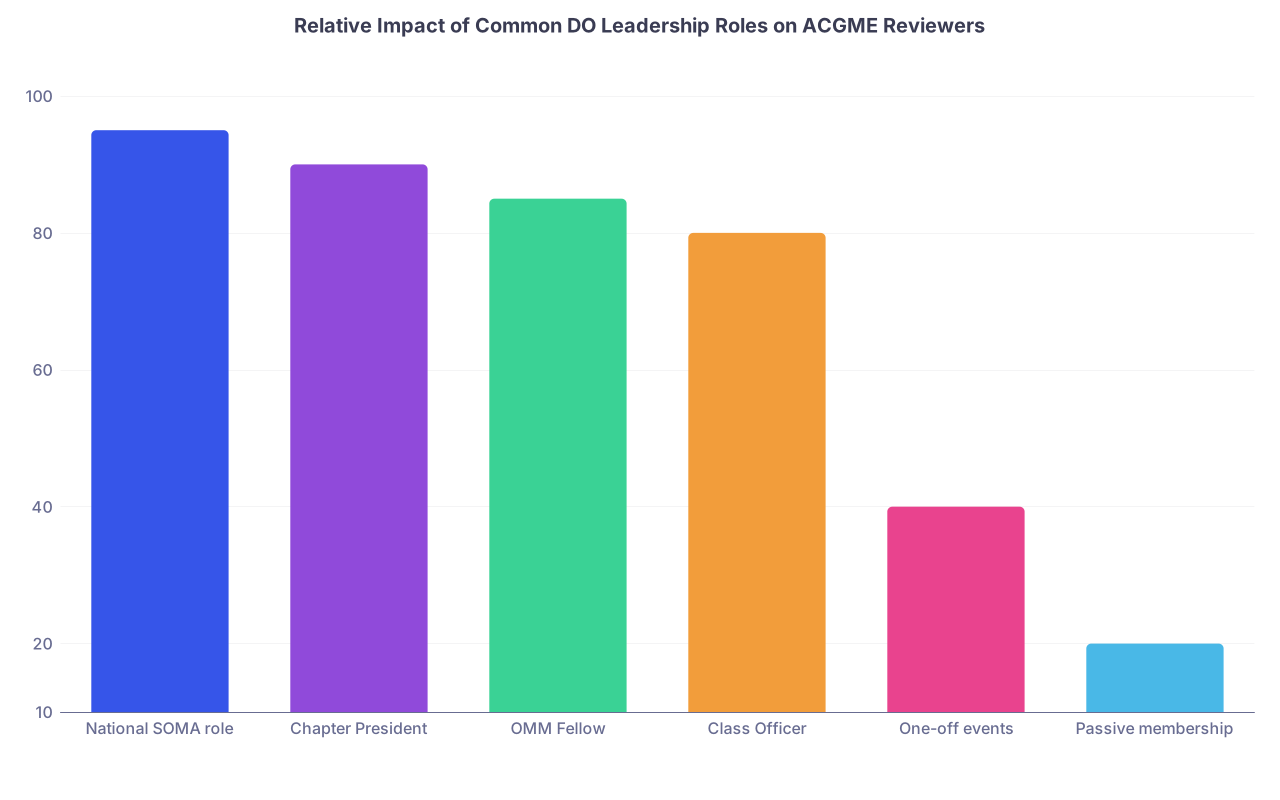
| Category | Value |
|---|---|
| National SOMA role | 95 |
| Chapter President | 90 |
| OMM Fellow | 85 |
| Class Officer | 80 |
| One-off events | 40 |
| Passive membership | 20 |
Is that numeric scale scientific? No. But it reflects how seasoned reviewers informally weight impact.
5. Writing Descriptions That Convert DO-Speak to ACGME-Speak
This is where you either win or vanish.
You get very limited characters in ERAS. Use them to communicate four things:
- Scale: how big, how many, how often
- Responsibility: what was at stake, who depended on you
- Outcomes: what changed because you did this
- Interface: who you worked with (faculty, PDs, national orgs, interprofessional teams)
A. Anatomy of a high-yield description
Take a typical DO role:
National Liaison to SOMA House of Delegates
Weak ERAS description:
- Attended national meetings
- Represented my school in osteopathic policy
- Worked with other students on resolutions
Stronger version:
- Elected by peers to represent 300+ students at national osteopathic policy forum; responsible for communicating priorities to national leadership
- Co-led workgroup drafting resolution on parity of osteopathic board exams in GME selection; coordinated feedback from 5 COMs and presented to AOA leadership
- Facilitated debriefs with class officers and administration to translate national policies into local wellness and curriculum initiatives
Notice the verbs: elected, represent, co-led, coordinated, facilitated. This reads like someone who will not melt on a busy inpatient service.
B. Quantify everything you can without lying
If you ran an OMM review series, do not write “helped with OMM review sessions.”
Write:
Designed and led 6-session OMM board review series (average 80 attendees), integrating COMLEX-style questions and live demonstrations; created shared question bank used by 3 subsequent classes
Now we have frequency, attendance, product, and longitudinal impact. All in one line.
C. Translate osteopathic jargon
Avoid unexplained abbreviations and internal names.
Bad:
Worked on OPP integration with preclinical sequence
Better:
Collaborated with course directors to integrate osteopathic manipulative medicine (OMM) skills and reasoning into 3 pre-clinical organ system blocks; piloted new cases linking MSK exam to primary care management
Again, you are showing curriculum design, interdisciplinary collaboration, and primary care relevance.
6. Positioning DO Leadership Differently by Specialty
Not every specialty cares about the same leadership flavors. Your roles do not change, but what you highlight does.
A. Primary care (FM, IM, Peds)
These programs love:
- Longitudinal community involvement
- Clinic leadership (free clinics, screening programs, rural outreach)
- Teaching peers and near-peers
- Wellness and professionalism initiatives
So for a SOMA President, I would emphasize:
- Community health projects
- Interprofessional collaboration
- Advocacy for access to care
- Student wellness and professionalism policies
Example slant for FM:
Led 10-person student team in longitudinal partnership with FQHC, providing monthly health education sessions to underserved patients; collaborated with faculty to integrate social determinants screening into project design
B. Surgical specialties (GS, Ortho, ENT, etc.)
They look for:
- Ownership
- Reliability
- Comfort with hierarchy and systems
- Performance under pressure
For DO leadership, you spin toward:
- Operational logistics (M&M-type thinking, scheduling, complex event coordination)
- High-stakes responsibilities
- Outcomes that show discipline, follow-through, and data
Example for Ortho-leaning DO with SOMA role:
Directed 4 procedural skills workshops (joint injections, suturing, splinting) with 12 resident and faculty instructors; managed scheduling, supply procurement, and post-event feedback (90% rated sessions “highly useful”)
C. Competitive specialties (Derm, Rad Onc, Ophtho, etc.)
These programs often privilege research, but they still care about leadership that demonstrates:
- Academic productivity
- Organized medicine engagement
- Long-term projects with deliverables (guidelines, curricula, policy)
From DO leadership, emphasize:
- Policy and guideline development
- Abstracts/posters that came out of your leadership or advocacy
- Collaborations with MD organizations or ACGME departments
If your SOMA or AOA involvement produced a poster at ACOI, ACOFP, AAO, etc., connect those dots in the description.
7. Integrating DO Leadership Into the Whole Application Narrative
Fine-tuning your CV in isolation is a mistake. ACGME reviewers see the pattern across:
- Personal statement
- ERAS activities
- LoRs
- Interviews
Your DO leadership should anchor a coherent story, not appear like random bullet points.
A. In the personal statement
You do not need to repeat your CV, but you should pull one or two leadership experiences that:
- Changed how you see patient care, systems, or teams
- Demonstrate growth: conflict you managed, failure you recovered from, initiative you fixed
Example approach:
- One paragraph on how serving as SOMA President exposed you to GME policy struggles for DOs, which pushed you toward being the kind of resident who improves systems for trainees.
- Tie that concretely to something you will do in residency: quality improvement, resident wellness, curriculum, advocacy.
B. In letters of recommendation
If you had a faculty advisor for your DO leadership, you want at least one letter that can say:
- “I watched this person lead over time.”
- “They did not disappear when things got hard."
- “Other students followed them voluntarily.”
Make sure your letter writers know the outcomes and specifics you are claiming on your CV. Give them the concrete bullets: budgets, numbers, initiatives. Let them echo and validate.
C. In interviews
Programs will often ask:
- “Tell me about a leadership experience.”
- “What have you done to improve your medical school community?”
- “How have you engaged with osteopathic identity?”
Your DO leadership should give you clean, rehearsable stories:
- A conflict with another officer that you handled constructively
- A failed initiative that you salvaged or learned from
- A time you advocated up the chain for your classmates and saw a policy change
Keep the anecdotes compact and focused on what you did and what changed.

| Step | Description |
|---|---|
| Step 1 | DO Leadership Role |
| Step 2 | ERAS CV Entry |
| Step 3 | Personal Statement Anecdote |
| Step 4 | Letter Writer Talking Point |
| Step 5 | Interview Story |
| Step 6 | Program Director Impression |
The point: same core experience, reinforced across platforms without sounding repetitive.
8. Common Mistakes DO Applicants Make With Leadership – And How To Fix Them
I see the same errors over and over from strong DO students who should be standing out and are not.
Mistake 1: Overloading on “osteopathic identity” language
You do not need to prove that you know what “tenets of osteopathic medicine” are. Reviewers assume you passed your OMM sequence.
Do not waste characters on:
- “Promoted osteopathic principles”
- “Emphasized mind-body-spirit”
- “Advocated for holistic care”
Those phrases are generic and unprovable.
Instead, show the concrete behaviors that reflect those tenets:
- Longitudinal community partnerships
- Interdisciplinary communication
- Attention to functional outcomes and quality of life
- Systems-level thinking about training and care
Mistake 2: Listing too many tiny roles
You look scattered and superficial when you have:
- 18 different “member” roles
- 6 short-term task forces
- 12 health fair shifts, each as a new entry
Solution: Collapse. Use phrases like:
Participated in 9 community health events (BP screenings, sports physicals, flu clinics) reaching ~700 patients over 2 years; supervised pre-med volunteers and coordinated follow-up instructions
One entry. Better story.
Mistake 3: Hiding leadership that does not “look osteopathic”
Some DO students only highlight leadership that is explicitly labeled osteopathic (SOMA, AOA, OMM). Then they underplay high-yield roles such as:
- Teaching assistant for anatomy
- Quality improvement project lead on a clinical rotation
- Research team coordinator
These are gold to ACGME programs. Integrate them alongside your DO-specific work so you look like a physician-leader in medicine, not just in “osteopathic clubs.”
Mistake 4: Being apologetic or defensive about DO status
If your DO leadership involved fighting for DO visibility, parity, or treatment on rotations, you must be careful.
Do not frame yourself as bitter or aggrieved in writing.
Bad:
Fought against discrimination of DO students in clinical placements
Better:
Collaborated with clinical education leadership to standardize orientation content for community preceptors about DO training and scope; helped design one-page guide adopted across 5 sites
Same experience, completely different vibe. One sounds angry. The other sounds like a systems-focused problem solver.
9. A Concrete Before-and-After Example
Let me show you a full transformation. This is close to what I actually see on initial drafts.
Original ERAS entry:
SOMA Leadership Roles
SOMA, AOA, SAAO | 2022–2024
- SOMA chapter president
- SOMA national liaison
- AOA delegate
- Organized meetings and taught OMM
- Went to national conferences and advocated for DOs
That is vague, redundant, and unimpressive.
Reworked version:
National and Institutional Osteopathic Student Leadership
Student Osteopathic Medical Association (SOMA); American Osteopathic Association (AOA); OMM Dept | 2022–2024
- Elected SOMA Chapter President for 250-member organization; led 8-person executive board, managed $4,000 annual budget, and oversaw 20+ educational and service events per year
- Served as National Liaison and voting delegate to AOA House of Delegates, representing perspectives of students from 5 osteopathic schools on GME policy and wellness initiatives
- Co-authored 3 policy resolutions; 2 adopted into AOA advocacy platform (COMLEX–USMLE score reporting clarity, student mental health resources)
- Co-designed OMM review series (6 sessions) for OMS-II cohort; average attendance 80 students, with 95% reporting increased confidence on post-series survey
Same roles. Now they read like what they truly were: substantive, multi-level leadership.

10. Final Checklist: Are Your DO Leadership Roles Positioned Correctly?
Ask yourself, ruthlessly:
- Could a time-pressed MD-trained PD understand your title and role in 3 seconds?
- Does each major entry show scale, responsibility, outcome, and interface?
- Are your top 3–5 roles clearly visible high in the Experiences section?
- Have you collapsed minor roles into coherent, impactful summaries?
- Would a letter writer recognize these descriptions as accurate and specific?
- Does your personal statement echo, not repeat, the leadership themes?
If you can honestly answer “yes” to most of those, your DO leadership is no longer hidden; it is working for you.
| Aspect | High-Yield Framing | Low-Yield Framing |
|---|---|---|
| Title | Translated, clear, explains scope | Internal jargon, unexplained acronyms |
| Description focus | Scale, responsibility, outcomes, collaboration | Duties, attendance, vague “advocacy” |
| Structure | 3–6 consolidated, coherent entries | 15+ tiny, fragmented entries |
| Metrics | Numbers, budgets, attendance, deliverables | “Helped,” “participated,” “was involved” |
| Tone | Systems-focused, solution-oriented, professional | Defensive, generic, or overly emotional |
| Alignment | Customized to specialty and program type | Same generic blurb for every program |
FAQs
1. Should I create a separate “Osteopathic Leadership” section on my CV or ERAS?
No. Segregating your osteopathic leadership implies it is peripheral. Integrate DO leadership into standard leadership, teaching, and service entries. You want to look like a physician-leader whose context happens to be osteopathic, not someone whose impact is confined to “osteopathic-only” circles.
2. How do I handle leadership that is mostly administrative (scheduling, emails, logistics)?
Administrative work can be high-yield if you show outcomes and complexity. Describe what you actually managed: number of events scheduled, attendance, multi-team coordination, crisis management (venue cancellations, last-minute speaker changes), and any improvements you introduced (new signup systems, feedback loops). Do not write “answered emails”; write “coordinated 15-faculty speaker schedule over 6 months without cancellations.”
3. Is it worth including leadership from before medical school (e.g., DO club president in undergrad)?
Yes, if it is serious leadership (multi-year, high-impact, or clearly relevant). But it belongs lower on the list and with shorter descriptions than your medical school leadership. Focus on roles that demonstrate continuity: teaching, organized medicine involvement, community outreach. Avoid padding with every college club you ever touched.
4. How much detail about osteopathic policy/advocacy is too much for ACGME reviewers?
You can mention policy topics (COMLEX–USMLE parity, GME funding, wellness) in one concise clause. Do not turn activity descriptions into position papers. Programs care that you worked on real, nontrivial issues with other stakeholders and produced something (resolutions, guidelines, programs). One line of issue framing, one to two lines of your actions and outcomes. That is enough.
5. What if my DO leadership caused conflict with administration or peers—should I mention that?
You do not need to air internal politics on your CV. On paper, stick to verifiable roles and outcomes. If an interviewer asks about challenges or conflict, then you can carefully describe a situation where you handled disagreement professionally and improved communication or policy. The bar: if it will not be corroborated by faculty and could sound like drama, keep it out of written materials.
6. How do I decide whether to label something “Leadership” versus “Volunteering” on my CV?
Ask: did you own outcomes or just show up? If you organized, led, taught, managed a team, controlled a budget, designed a project, or were elected/appointed—that is leadership. If you primarily staffed an event, assisted others, or participated without autonomy—that is volunteering or service. You can house both under one ERAS “Experience,” but your labels and verbs should reflect the difference.