

The usual residency advice assumes you're single and totally mobile. If you're a DO married to a non-medical partner, that advice will wreck your application strategy.
You are not just applying for a residency. You are negotiating a three- to seven-year life decision for two people with very different career ecosystems. And the rules are different for DOs than for MDs, especially in certain specialties and regions.
Let me walk you through how to make smart, concrete location decisions when you have a spouse outside medicine, and you’re applying to ACGME programs as a DO.
Step 1: Get Brutally Clear on Your Constraints (Together)
You cannot build a smart location strategy if you and your partner are fuzzy about what actually matters. “We’d like to be near family and in a city with good jobs” is useless. You need numbers and specifics.
Have a serious, no-phones conversation and answer these questions in writing:
Geography
- Are there must-be-near anchors? (elderly parents, kids from a previous relationship, legal obligations, military requirements)
- Are there hard no’s? (states you will not live in, for political, cultural, or personal reasons)
- Urban vs suburban vs rural – what is a dealbreaker?
Career for your spouse
- What are their field and level? (entry-level teacher vs senior software engineer vs tradesperson vs self-employed)
- Do they need a major metro area? Industry-specific hubs? State licensure?
- Can they work fully remote, hybrid, or on-site only?
- How long could you realistically live on only your PGY-1 salary if they cannot find work quickly?
Financials
- Current debt, savings, and your expected PGY-1 salary ranges in different regions.
- Cost of living tolerance. Can you survive in a high-cost city, or will that crush you?
Relationship stability needs
- Long distance: “No way,” “Short-term OK,” or “We’ve done it before, manageable”?
- How much family support do you need nearby (for childcare, mental health, practical help)?
You’re trying to convert fuzzy preferences into actual constraints. For example:
- “We want to be near family” → “We must be within a 3-hour drive of Chicago”
- “We like cities” → “We want to be in a city of at least 300k population with tech jobs”
- “We’d like to avoid long distance” → “We will do long distance for 1 year if absolutely necessary, but not the entire residency”
Once you have that, you can build a real strategy instead of fantasy planning.
Step 2: Understand How Being a DO Changes the Map
If you ignore this part, you’ll make bad location bets.
As a DO applicant in ACGME programs, you’re dealing with:
- Regional bias
- Specialty competitiveness
- Variable DO-friendliness
You cannot just say “We’ll only apply in Boston and San Francisco because my spouse loves them” if your scores and specialty do not make you competitive there as a DO.
Here’s the reality pattern I keep seeing:
- More DO-friendly regions: Midwest, South, many community programs, smaller cities, EM/FM/IM/psych-heavy hospitals.
- More DO-skeptical or hyper-competitive regions for some fields: Certain big-name academic centers in the Northeast, West Coast academic programs, some surgical subspecialties in major metros.
You have to match your competitiveness to your geography.
| Region | Overall DO-Friendliness | Notes |
|---|---|---|
| Midwest | High | Many community/academic mix |
| South | High | Lots of DO grads stay regionally |
| Northeast | Moderate | Varies widely by institution |
| West Coast | Lower-Moderate | More competitive, fewer spots |
| Mountain West | Moderate | Fewer programs, more rural |
Is this perfectly precise? No. But it’s directionally true enough that you ignore it at your own risk.
You also have to add your specialty risk. A DO going into family medicine with decent scores has flexibility. A DO gunning for ortho with average stats does not.
Step 3: Build a Shortlist of Target Metro Areas That Work for BOTH of You
Now you combine your shared constraints with reality.
You are looking for 3–8 metro areas that:
- Have multiple ACGME programs in your specialty (or at least several in closely related fields if you’d pivot).
- Have decent job markets for your spouse’s profession.
- Are within your acceptable geography (family, cost of living, cultural fit).
- Are not so hyper-competitive that your DO profile is a bad fit.
Do this step deliberately. Don’t wing it.
How to research this efficiently
Start with your specialty program lists
Use FREIDA and program websites; create a spreadsheet with:- City
- Program name
- Type (community vs academic vs hybrid)
- DO alumni presence (look at current residents’ bios)
- Your estimated competitiveness (green/yellow/red)
Overlay spouse’s job market
For each city on your list:- Search “[city] + [partner’s profession] jobs” on LinkedIn/Indeed.
- Filter by “posted last 30 days” to avoid stale job markets.
- Count how many realistic openings exist. Not total listings—realistic ones.
If you see “3 jobs total” in a month for their field in that city, that’s fragile.
If you see “40+ jobs” across several employers, that’s healthier.
Check cost of living vs PGY-1 salary
Use salary data for your programs (often listed, or Glassdoor/Reddit) plus cost of living calculators.
If your partner might be unemployed for 3–6 months during transition, can you still pay rent, loans, and food?
This is also where you probably realize: your partner’s dream city might not be compatible with your actual match odds. Better to be honest now than devastated on Match Day.
Step 4: Decide Your Risk Level on Long-Distance vs Geographic Flexibility
This is where couples screw themselves by not being honest.
You have three main strategies:
Tight geographic focus (low distance risk, higher match risk)
You restrict your applications to just 1–2 major areas where your spouse has strong opportunities.
Good for: competitive applicants in less competitive specialties, couples who absolutely refuse long distance.
Bad for: average DO applicant in a competitive specialty.Moderate geographic spread (balanced)
You have 3–6 main regions prioritized, plus a few pure safety options elsewhere.
You accept that you might end up far from family but stay together physically.Aggressive spread with backup plan for temporary long distance
You apply broadly, prioritize match safety, and your spouse is ready for 6–12 months of long distance if needed while they transition jobs or finalize licensure.
This is what actually saves a lot of couples from going unmatched.
Be explicit: which of these are you doing?
Do not say “We’re doing #1” and then secretly hope for the match statistics of someone doing #3. That’s how you end up in SOAP or unmatched, which is way worse for your relationship than a year of distance.
Step 5: Translate Life Priorities into a Concrete Application Strategy
Now let’s turn this into actual application moves.
1. Categorize your programs by “life fit”
For each program, create columns in your spreadsheet:
- “Spouse job market: Strong / Medium / Weak”
- “Distance from family: 0–3 hrs / 3–8 hrs / >8 hrs”
- “Overall couple-fit: A / B / C”
Then compare that to your “match likelihood” category (High/Medium/Low).
You want a mix:
- Some programs that are High Match + High Couple-Fit (gold)
- Some that are High Match + Medium Fit (safety but acceptable)
- A few Low Match + High Fit (reach programs in dream areas)
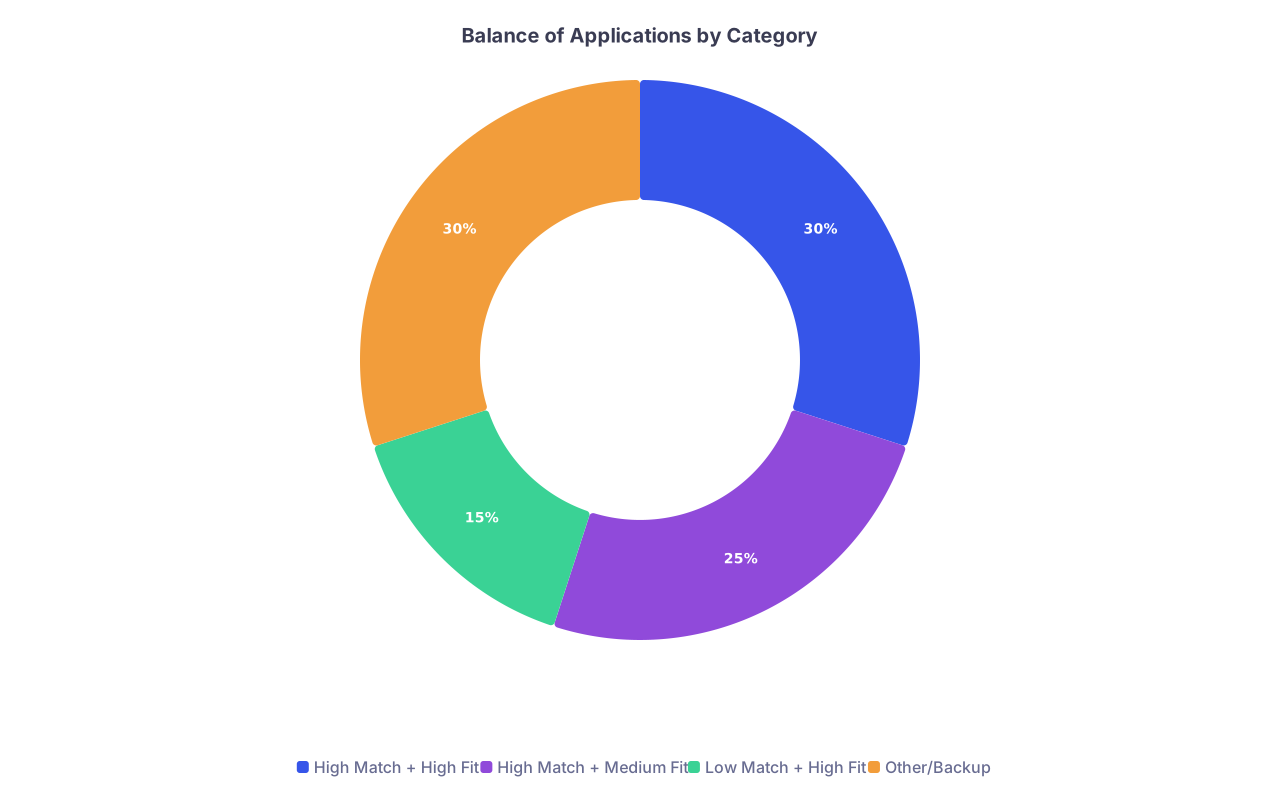
| Category | Value |
|---|---|
| High Match + High Fit | 30 |
| High Match + Medium Fit | 25 |
| Low Match + High Fit | 15 |
| Other/Backup | 30 |
Rough target for a typical DO in a moderately competitive specialty (adjust for your risk):
- 25–35%: High match + high couple-fit
- 20–30%: High match + medium fit
- 10–25%: Low match + high fit
- The rest: safety nets where at least life is not miserable
2. Adjust by specialty and competitiveness
If you’re DO + average scores + very competitive specialty (derm, ortho, ENT, etc.):
- You do not have the luxury of strict geography.
- You must apply broadly, then try to influence location via ranking, second looks, and networking.
- Your spouse needs a very flexible plan (remote work, career break, or willingness to take a less perfect job).
If you’re DO + solid scores + primary care specialty (FM, IM, peds):
- You can be more selective geographically.
- But do not go insane and only apply to 8 programs in one city because your partner likes the restaurants there.
Step 6: Talk to Your Spouse About the Match Algorithm Like It’s a Legal Contract
Most non-medical partners do not understand how little control you actually have on Match Day. You need them to.
Explain in plain language:
- You will submit a rank list.
- Programs will submit their rank lists.
- A computer algorithm will match you.
- Once matched, you’re contractually obligated.
- You cannot “wait for next year” easily. Re-applying as an unmatched or declining-the-match DO gets much harder.
You want your spouse to understand: when you rank a place, you are saying, “We are both prepared to move here and live here for years.”
No fantasy ranking. No “We’ll just see what happens.”
Use an example:
“If we put Program X in [City A] as #3, and we match there, we have to go. You’d need to be okay leaving your current job and moving to [City A] within about 3–4 months.”
This forces real conversations:
- Are they willing to leave their company?
- Can they actually work remotely full-time from that state? (Tax and licensing laws exist, and some employers are picky.)
- What if they hate the new job market?
Uncomfortable now is better than nuclear later.
Step 7: Build in an Income and Support Buffer
Here’s what often gets ignored: your spouse’s job transition and your own exhaustion.
The first year of residency is brutal. Relocating to a new city where your spouse is unemployed and isolated makes it worse.
I’ve seen this play out in very predictable patterns:
- PGY-1: Resident working nonstop, spouse job-hunting, lonely, sometimes depressed.
- Money tight, relationship strained, blame starts creeping in: “We moved for your career.”
- Arguments escalate over rent, daycare, holidays, or the fact that you’re never home.
You can make this survivable by planning:
Savings target
Try to have 3–6 months of bare minimum living expenses saved up before you move. Not idealistic expenses. Bare-bones.
Enough that if your spouse takes 4 months to find a job, no one is panicking.Backup housing plans
If you’re going to a high-cost city (NYC, SF, Boston), seriously consider: roommates, smaller apartments, slightly longer commute for cheaper rent.
You’d rather have a 30-minute commute and a calm spouse than a 10-minute commute and constant financial fights.Family proximity trade-offs
Sometimes being slightly further from your spouse’s dream job market but closer to your or their family support is worth it, especially with young kids.
Step 8: Use Interviews to Vet Fit for Your Spouse Too
Do not treat interviews as purely “me and the PD.” You’re interviewing the city and the program culture for your spouse’s sake as well.
Ask residents discreetly:
- “Do many residents here have non-medical partners? Are they happy here?”
- “What do your partners do for work?”
- “Is this city good for [tech jobs / teaching / trades / arts / whatever your spouse does]?”
- “How’s the community for young families / couples without kids / etc.?”
Take notes. Pay attention to body language and tone when they answer. People will tell you if everyone’s spouse is miserable and unemployed; they just might phrase it as “It can be a little tough for partners to find work here, but some manage.”
If the program offers a social or dinner, bring your partner if possible. See how they react to the city, the vibe, the residents’ partners.

This is especially critical if you’re considering smaller towns. Some partners thrive there. Some absolutely do not.
Step 9: Use a Structured Ranking System as a Couple
When rank list time comes, you need something more objective than “We kind of liked that one.”
Here’s a simple, ruthless system:
For each program, each of you separately rate on a 1–5 scale:
- You:
- Training quality / case volume
- DO-friendliness / vibe
- Schedule & lifestyle
- Your spouse:
- Job market fit
- City livability (for them)
- Proximity to family/support
Then discuss.
Add an extra “risk factor” column for:
- High risk of spouse unemployment >6 months
- Extreme cost of living
- Known toxic culture
- Terrible call schedule combined with no local support
You will quickly see:
- Programs that are clear “top both”
- Programs that are great for you but terrible for them
- Programs that are better for them than for you
Then you have to decide: are you optimizing for your training, for their career, or for survival as a couple? There’s no formula, but at least now you’re not guessing.
Step 10: Scenario Planning – A Few Common Setups
Let me walk through a few realistic scenarios and what I’d advise.
Scenario A: You’re a DO going into FM, spouse is a teacher, you want Midwest or Northeast, no kids yet
You have geographic flexibility and a spouse in a portable but licensure-dependent field.
Strategy:
- Prioritize metro or mid-sized cities with multiple school districts and several FM programs.
- Consider slightly less sexy midwestern cities with multiple community programs over ultra-competitive East Coast academic hubs.
- Apply broadly across 4–6 target metros.
- Rank in rough order: training quality first, then joint life quality.
Scenario B: DO in IM with average stats, spouse is a mid-career engineer needing a strong tech hub, wants West Coast
High spouse constraint, moderate competitiveness, region that can be DO-tough.
Strategy:
- Identify tech hubs that are not just SF/Seattle: e.g., Denver, Austin, Raleigh (if they’re flexible on exact coast).
- Within true West Coast, heavily target DO-friendlier community or hybrid programs rather than one or two big-name academics.
- Apply very broadly, including some non-West Coast safety programs you could tolerate if you absolutely had to.
- Have a real conversation: “If we do not match on the West Coast, are we okay going to Denver/Austin/etc.? Or are we accepting higher unmatched risk?”
Scenario C: DO in very competitive surgical subspecialty, spouse is remote-capable professional, no kids, okay with distance
You need maximal application flexibility.
Strategy:
- Go all-out on match safety: many programs, multiple regions, do not artificially constrain geography.
- Spouse keeps remote job or prepares for temporary long distance if employer balks at certain states.
- Rank almost entirely by training quality and match probability, with spouse’s preferences used mainly as a tiebreaker among similar programs.

Step 11: Don’t Ignore Your Own Future as a DO
One more thing most non-medical partners will not see coming: your first job after residency might need another move. And as a DO, your first attending job market may be slightly more regional depending on your residency’s name and connections.
So when you pick a residency location, you’re also:
- Choosing the network that will help you get your first job
- Choosing the likely region where it will be easiest to stay after graduation
Example: If all your attending physicians and alumni are in the Midwest, and your spouse’s long-term dream is to end up in NYC, you need to say that out loud and decide whether you’re okay with a two-move life: one for residency, one later for jobs.
Quick Visual: Application Strategy with a Non-Medical Partner

| Step | Description |
|---|---|
| Step 1 | Clarify couple constraints |
| Step 2 | Assess DO competitiveness |
| Step 3 | Choose 3-8 target metros |
| Step 4 | Map programs + spouse jobs |
| Step 5 | Decide risk level for geography vs match |
| Step 6 | Apply broadly with tiers |
| Step 7 | Use interviews to vet city + support |
| Step 8 | Score programs together |
| Step 9 | Build final rank list |
A Quick Word on Mental Health and Resentment
I’ve watched strong couples fall apart during residency over one core issue: unspoken resentment about the move.
If your spouse feels like they sacrificed everything for your career while you’re never home, it festers. You won’t fix that with one nice vacation.
Prevent it:
- Acknowledge up front: “This will be harder on you at times than on me. That’s real.”
- Give them a real voice in ranking. Not fake input. Actual veto power for a few locations they truly cannot stand.
- Build in small but consistent support: therapy, couples counseling, deliberate weekends off, trips to see family.

If you treat your spouse like luggage you’re dragging between cities, it will show up later—probably during PGY-1 when you’re too tired to deal with it.
Final Takeaways
You’re not just “matching.” You’re committing two careers and one relationship to a location. Treat that like a serious joint decision, not an afterthought.
As a DO, you cannot pretend geography is neutral. Some regions and specialties are less accessible. Build your spouse’s needs into a realistic, data-backed strategy, not fantasy.
Use structure: shortlist metros, map job markets, score programs together, and be explicit about your risk tolerance for geography vs match security. Clarity now saves misery later.


