Most DO applicants think the biggest red flag is being a DO. It is not.
The real red flags are quieter, uglier, and rarely spelled out. And they’re absolutely killing strong osteopathic applications every single cycle.
I’ve sat in those rank meetings. I’ve watched PDs scroll right past DO applicants with solid scores and strong rotations because of one unspoken problem in the file. Nobody tells you this directly because it sounds bad, sometimes discriminatory, and occasionally indefensible. But it happens.
Let me walk you through what really gets DO candidates quietly moved to the “no” pile in ACGME programs—especially in competitive or pseudo-competitive specialties.
The Real Game: You’re Being Compared to MDs, Not to Other DOs
In most ACGME programs, here’s the unspoken premise:
“Would I rather give this spot to this DO… or to an MD with similar numbers but fewer question marks?”
That’s the frame. Especially in IM, EM, Anesthesia, PM&R, Psych, and definitely in anything surgical.
When a DO applicant is strong on paper—good scores, decent clinicals—and still gets passed over, it’s usually because of one or more of these specific, under-the-table red flags.
I’ll start with the ones PDs talk about out loud behind closed doors.
1. COMLEX-Only With No Strategic Explanation
This one hurts strong DO applicants more than any other.
Program directors may say they accept COMLEX. The website may have a nice inclusive line about “DO and MD applicants welcome” and “COMLEX or USMLE accepted.”
Behind the scenes? I’ve heard this sentence more times than I can count:
“We say we accept COMLEX, but I don’t know what to do with a 594. Is that good? Is that average? I can’t risk a poor test taker.”
So what happens? The committee quietly bumps USMLE takers higher—especially for DOs.
Here is how this plays out:
- DO applicant A: COMLEX 620, no USMLE
- DO applicant B: COMLEX 580, Step 1 and 2 both 230s (Pass/230s if old scoring)
- MD applicant C: Step 1 pass, Step 2 232
The PD, in a borderline interview slot discussion, is picking B or C over A, nine times out of ten. Even though A is objectively the better test taker. Why? Comfort and risk-aversion.
The unspoken red flag:
“Strong DO candidate, but COMLEX-only—we’ll never know how they stack up.”
If you’re reading this early enough and planning on applying to anything even moderately competitive (EM, Anesthesia, PM&R, Neuro, Rads, Ortho, anything surgical, or strong academic IM), skipping USMLE is a liability. I’ve heard PDs say, verbatim:
“If a DO doesn’t take Step, I assume they didn’t think they could pass it.”
Is that fair? No.
Does it affect interview offers? Absolutely.
If you’re already COMLEX-only and cannot fix it now, the damage control is this:
- Your advisor and letters must explicitly state that your COMLEX scores are in the top X% and that you’re a strong standardized test-taker.
- Your personal statement for SOME programs can briefly explain: due to cost, timing, adviser recommendation, etc.—but this has to be concise and not defensive.
- You must destroy COMLEX Level 2. A mediocre Level 2 on top of COMLEX-only is a double red flag.
But do not kid yourself—COMLEX-only is an unspoken yellow-to-red flag at many ACGME programs, especially where PDs grew up in an MD world.
2. The Osteopathic Letter Problem: Weak, Generic, or Insular LORs
Another quiet killer: your letters.
You think, “They’re strong DO faculty who love me. That’s great.”
The PD is thinking, “I don’t know who these people are.”
Behind the door, PDs will say things like:
“Three letters from all-DO community hospitals and nobody I recognize? I have no idea how to calibrate this.”
or
“Where’s the letter from an academic person I trust, or at least someone who trains in a similar environment?”
The unspoken pattern:
Strong DO candidate + letters from only DO family med docs at small hospitals + no one with academic weight = automatic downgrade.
I’ve seen DO applicants crushed by this. Great rotations, glowing comments, but all from unknown names in tiny places. Meanwhile, a weaker MD with one letter from “Dr. XYZ, Program Director at ___” gets the interview.
You need at least one of these if you want to be competitive at ACGME programs:
- A letter from an ACGME academic faculty member, ideally at a teaching hospital with residents.
- A letter from a PD, APD, or clerkship director—DO or MD—who routinely writes for applicants into that specialty.
- A letter from a recognizable institution or service line (VA, large regional medical center, university affiliate).
If all your letters are versions of: “Great DO student, rotated here at a small community site, we like them a lot,” you’re underpowered. On paper, you’re strong. In the room, you’re a risk.
3. DO School Reputation + No Signal of “Overachiever”
Another uncomfortable truth: PDs have mental tiers for DO schools. They’ll deny it at conferences. They’ll absolutely discuss it in ranking meetings.
You know the names:
- “Top-tier” DO schools with long match histories into competitive ACGME programs
- The middle-of-the-pack regionals
- The newer or less-established schools where PDs have been burned by underprepared grads
I’ve heard:
“We took two from that school five years ago. Both struggled. I’m cautious about them now.”
So what happens when you’re a strong DO student from a school a PD is lukewarm on?
If your application does not scream “exceptional for their context,” you get quietly filtered out. The red flag here isn’t your school itself. It’s:
School + no signal that you’re one of their top 10–15% performers.
Those signals are things like:
- Honors in core clerkships (IM, Surgery, EM if applying EM, etc.), not just Pass across the board
- A clear upward trend in performance or narrative comments like “top 5% of students I’ve worked with in 10 years”
- Research with output—actual poster, abstract, or publication—not just “helped with a project”
- An acting internship/sub-I at a recognizable ACGME program with strong feedback
Here’s how PDs are actually talking:
“She’s from [new DO school], but look—IM honors, Surg honors, strong Step 2, and a letter from our colleagues at ___ saying she’s top tier. She’s probably one of the best from that place. Let’s invite.”
Versus:
“He’s from [same school], all Passes, COMLEX-only, rotated only at local sites. I don’t have proof he’s different from the last ones we struggled with.”
That second scenario? You’re done. Not because you’re DO. Because you look average from a place they don’t trust to produce average.
4. The “Osteopathic Identity” Misfire in Personal Statements
Let me be blunt: overselling your “osteopathic identity” in a generic way can absolutely hurt you at some ACGME programs.
Do PDs hate OMM? Most don’t care, to be honest. They just don’t want to hear a sermon about it.
I’ve seen statements that read like this:
- “As an osteopathic physician, I believe in treating the whole person…”
- “My training has emphasized holistic care and OMT, which I plan to incorporate into… [insert highly procedural specialty that barely uses it]”
What some PDs hear:
“This person might be more focused on philosophy and OMT than on the bread-and-butter of this ACGME specialty.”
I’m not telling you to deny being a DO. I’m telling you the truth: if your entire narrative is, “I am DO, hear me talk about OMT,” you trigger a subtle mismatch flag in a lot of programs.
You want the theme to be:
- Competence
- Work ethic
- Fit for that specialty
- Team culture
With a light seasoning of: “And yes, my osteopathic background helps me connect with patients and see the bigger picture.”
If you’re applying to something like PM&R or FM? You can lean a bit more into OMT. But even there, PDs care more about whether you’ll survive their workload than about your cranial technique.
5. Strange or Weak Third- and Fourth-Year Rotations
DO students often get stuck with fragmented, community-based rotations that don’t map nicely to the classic MD core clerkships. PDs notice this.
There are a few red flags that consistently bother them:
- Very few or no rotations in true teaching hospitals with residents.
- No audition/sub-I in the specialty you’re applying to, at an ACGME site.
- Long gaps or “Elective – Independent Study” during prime clinical time (especially M4 July–January).
I’ve sat in meetings where someone says:
“I don’t see any rigorous inpatient IM rotation at a teaching hospital. Everything looks outpatient, or 2–3 week ‘experiences’. Are they ready?”
Or:
“They’re applying EM, but I don’t see a single ED rotation at an ACGME site with residents. Just one DO community site we’ve never heard of.”
For DOs, the quiet bias is this:
If your clinical exposure doesn’t look like what MD students get at university hospitals, you’re assumed to be less prepared—unless you prove otherwise.
You counter this by:
- Securing at least one audition/sub-I at an ACGME program in your specialty, or at minimum in a closely related inpatient field
- Making sure your MSPE and letters explicitly describe scope and acuity: “managed complex inpatients, cross-cover, night float, etc.”
- Avoiding long, unexplained blocks of fluff electives during application season
6. Hidden Red Flags in the MSPE and Narrative Comments
You know what PDs read more carefully than your personal statement? The MSPE and clerkship comments.
And they’re not only reading what’s there. They’re reading what’s missing.
For DO students, there are three silent killers in this section:
- “Quietly negative” language – phrases like “met expectations,” “performed appropriately,” “required some guidance but improved,” “pleasant to work with” with no mention of initiative, ownership, or clinical reasoning.
- Inconsistency – one or two clerkships with very bland or slightly negative language while others are positive. It doesn’t have to be a fail. Just one rotation where the tone drops. That gets screenshotted and discussed.
- No comparative language – nothing like “above average,” “among the top,” “outstanding compared to peers.” For DO schools that rarely give strong comparative statements, this is a systemic problem. But PDs still subconsciously ding you for it.
I’ve been in debriefs where someone says:
“Her IM comments are just… fine. No ‘top,’ no ‘strong.’ I don’t see evidence she stands out.”
Versus an MD student with an almost identical performance but with wording like: “Among the top third of students this year.”
You need at least one rotation narrative, ideally in your chosen specialty or IM/Surg, that clearly sells you as better than average. If your school is notoriously bland, your letters and PD contacts must compensate by stating your ranking openly.
7. Unexplained Time Off, Extra Years, or Scattered Timelines
PDs do not automatically reject people with non-traditional paths. But here’s the key difference:
- MD applicant with a clear explanation in MSPE and personal statement about a research year, leave of absence, or prior career = often fine.
- DO applicant with a weird M3/M4 timeline, extra time, or shuffled rotations with no clean explanation = red flag.
Why? Because they already feel like they know less about DO curricula. Any deviation looks more suspicious.
I’ve heard:
“Why did he do EM in February but then medicine in June of fourth year? That’s backwards. Was he remediating something?”
or
“She took a leave for ‘personal reasons’ but no one explains whether it’s health, academic, or professionalism. I don’t want a mystery.”
If ANYTHING about your timeline is irregular, you must control that narrative:
- Make sure your Dean’s letter or a short addendum explains it cleanly: medical issue resolved, family obligation, research year, administrative delay due to site availability, etc.
- If it was due to academics, own it and show the rebound: “I struggled first with X, sought help, repeated, and since then have had strong performance in…”
Mystery kills DO apps faster than MD apps. Because PDs already feel out of their comfort zone.
8. Professionalism “Soft Flags” That DOs Underestimate
Here’s the uncomfortable part. A few bad DO students from a school can taint an entire pipeline for years. And the issues are almost always around professionalism.
The specific quiet red flags:
- Chronic lateness or poor communication mentioned in one clerkship comment
- An incident report or “professionalism concern” vaguely referenced but not fully detailed
- A letter that damns with faint praise: “With continued growth, I believe they will make a good resident”
I’ve watched PDs shut down entire discussions with:
“We had a DO from that school who was constantly late and defensive. I’m not interested in repeating that.”
Is that fair to you? No.
Does that bias exist underneath “holistic review” language? Yes.
For strong DO candidates, this means your professionalism must be completely unassailable on paper:
- Email patterns with programs and coordinators must be prompt, respectful, concise. Coordinators do tell PDs when someone is a headache.
- Your letters should ideally mention reliability, work ethic, and being “someone we would gladly have as a resident.”
- Any past issue needs to be clearly addressed and resolved with support from your Dean or advisor.
One mediocre comment about reliability can outweigh two strong comments about knowledge for a DO candidate.
9. No Real Connection to the Program’s Region or Setting
This one is subtle, but it bites DO applicants hard—especially those casting a wide net in ACGME programs that are not used to taking many DOs.
You think: “I’m strong. They should want me.”
They think: “Why would this DO from New Jersey suddenly want our midwestern community program with no DO presence?”
If your app doesn’t show:
- Ties to the region (family, prior schooling, grew up there, spouse/partner work)
- Genuine interest in that type of practice (rural, community, VA, underserved urban)
- Or at least some prior experience in a similar setting
Then you’re an unknown who might rank them very low. That’s a risk for them, and PDs hate ranking people who won’t actually come.
For MDs from state schools, geography is often implicit. For DOs applying far from their home turf? Not so much.
You fix this by:
- Explicitly mentioning regional ties in your personal statement (briefly) or program-specific communication.
- Making sure at least one rotation or experience shows that you’ve worked in a similar environment.
- Having a letter from that region when possible.
No regional roots + DO + no clear reason for picking them = unspoken “probably not interested” → no interview.
How PDs Actually Sort DO Applications: A Reality Snapshot
Let me give you a rough mental model of what an honest PD does with DO apps in an ACGME program.
| Category | Typical Outcome |
|---|---|
| DO + USMLE + strong letters | High interview chance |
| DO + COMLEX-only + great clinicals | Mixed, depends on bias |
| DO + unknown school + no stand-out signals | Often screened out |
| DO + professionalism concerns | Near-automatic reject |
| DO + strong regional ties + solid file | Elevated consideration |
Is this every program? No.
Is this behavior common enough that you should plan around it? Yes.
Putting It Together: How a “Strong DO” Becomes a “Silent Reject”
Picture this file:
- COMLEX Level 1: 615, Level 2: 640
- No USMLE
- DO school that’s mid-tier, two states away from the program
- Clinical rotations mostly at small community sites, one EM rotation at a DO hospital
- Letters: All DOs, none academic, all sound “positive but generic”
- Personal statement: Heavy on osteopathic philosophy
- MSPE: All Passes with “met expectations,” one slightly lukewarm comment in Surgery
On paper, to you, this is a very strong DO candidate. Above-average COMLEX, no failures.
In a busy PD’s office, late at night, scrolling:
- COMLEX-only → mild discomfort
- Unknown letters → no calibration
- No regional ties → less likely to rank us highly
- No academic rotation → unknown preparedness
- MSPE language bland → may be average at a school we don’t know well
End result? They slide right past you to an MD with less impressive test scores but fewer question marks.
That’s the part no one says out loud.
What You Can Still Control (Even Late in the Game)
If you’re already in the application cycle or close to it, some damage is done. But not all.
You can still:
- Upgrade at least one letter by doing a late sub-I or away at a stronger ACGME site and asking very directly for a comparative, detailed LOR.
- Have your advisor or Dean explicitly contextualize your performance: “top 10–15% of our class,” “among the strongest DO students we’ve sent into X specialty in years.”
- Clean up your communications and interview interactions so coordinators and PDs report you as low-drama, high-professionalism.
- Tailor your personal statement away from generic osteopathic language and toward competence, grit, and fit for the specialty.
- Emphasize regional ties and realistic interest whenever that’s true.
The DO initials are not the death sentence.
The unspoken red flags around those initials are.
Your job is to strip as many of those away as possible so that when a PD looks at your file, the only thought they’re left with is:
“This is a strong candidate. I’d be comfortable having them on our team.”
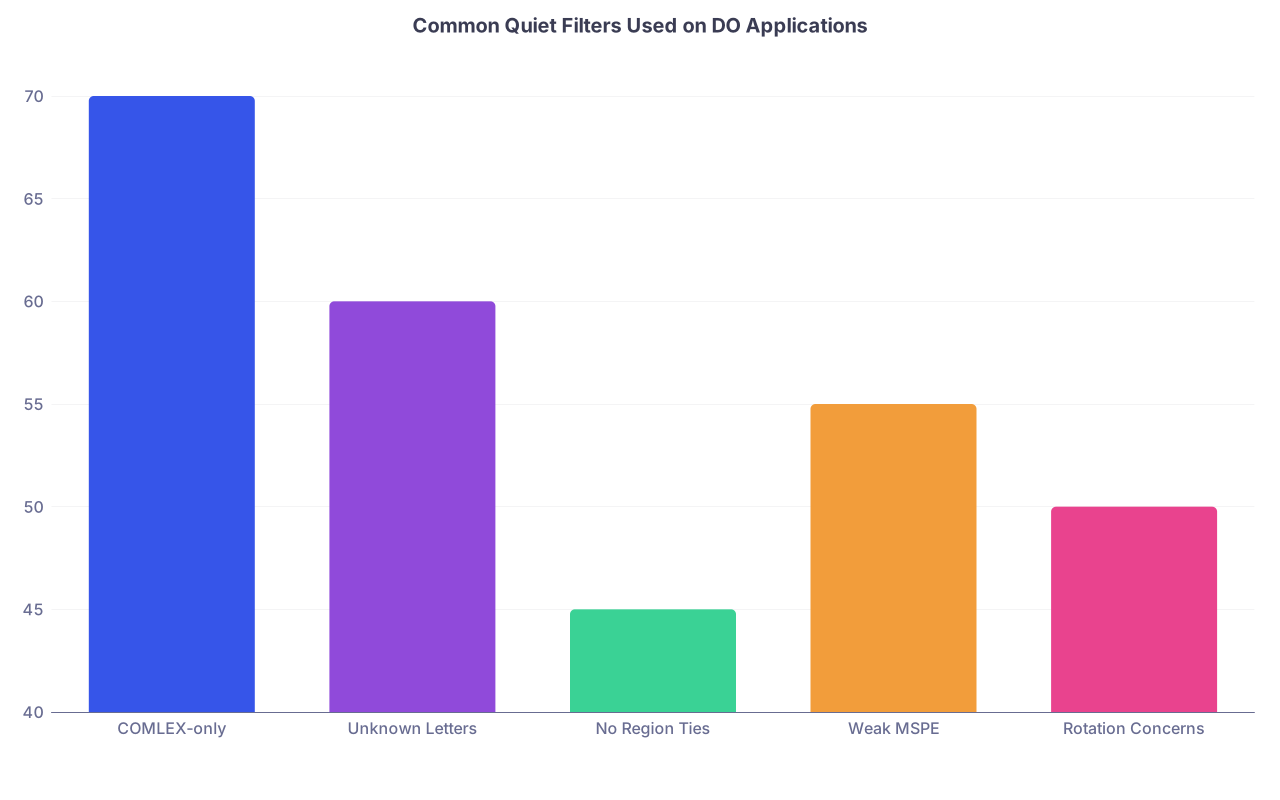
| Category | Value |
|---|---|
| COMLEX-only | 70 |
| Unknown Letters | 60 |
| No Region Ties | 45 |
| Weak MSPE | 55 |
| Rotation Concerns | 50 |

| Step | Description |
|---|---|
| Step 1 | DO Application Received |
| Step 2 | Assess Scores vs MDs |
| Step 3 | Comfort with COMLEX? |
| Step 4 | Screened Out |
| Step 5 | Review Letters |
| Step 6 | Review MSPE & Comments |
| Step 7 | Downgrade Priority |
| Step 8 | Low Interview Priority |
| Step 9 | Invite to Interview |
| Step 10 | USMLE Taken? |
| Step 11 | Recognizable Letter Writers? |
| Step 12 | Any Professionalism/Prep Concerns? |
| Step 13 | Region/Program Fit? |

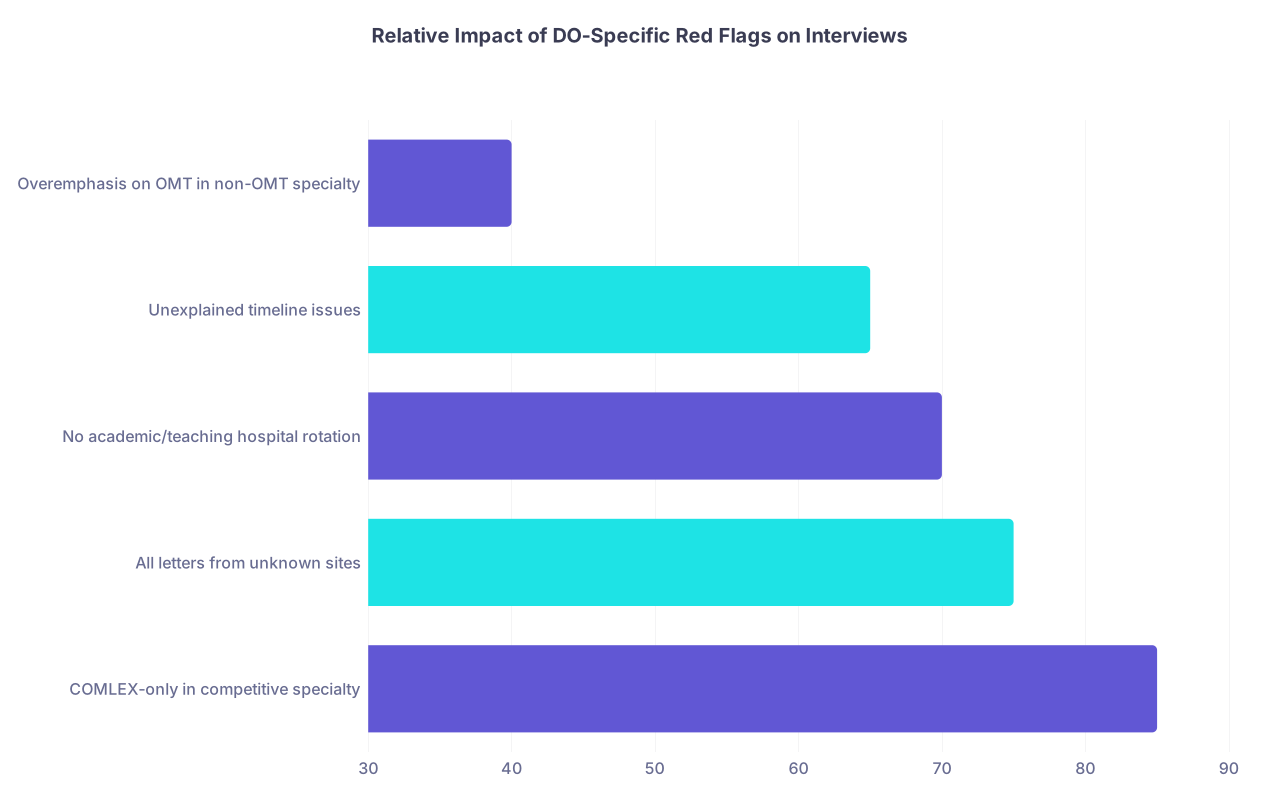
| Category | Value |
|---|---|
| COMLEX-only in competitive specialty | 85 |
| All letters from unknown sites | 75 |
| No academic/teaching hospital rotation | 70 |
| Unexplained timeline issues | 65 |
| Overemphasis on OMT in non-OMT specialty | 40 |