
It’s mid-September. You just clicked “submit” on ERAS. Your name, your DO school, your class rank, your Dean’s letter – all of it is now sitting in dozens of program directors’ inboxes.
On your side of the screen, it feels random and opaque.
On their side of the screen, it’s not.
Let me walk you through what actually happens when a PD sees:
- Your osteopathic school name
- Your class rank / quartile
- Your MSPE / Dean’s letter
Because they absolutely are inferring things from each of those – some fair, some lazy, and some just the reality of an overworked system with too many applications and not enough time.
1. The DO School Name: What They Really Read Between the Lines
First truth: program directors don’t view all DO schools the same way. Not even close.
They won’t say this on a webinar. But in the closed-door ranking meeting, or in the “we’re screening 2,000 apps” conversation with the chief resident, the school name is a fast proxy for risk.
The mental buckets PDs actually use
No one has a formal list, but mentally, people sort DO schools into rough categories. Something like this:
| Bucket | What They Think | Example Perception |
|---|---|---|
| Known Quantity | We’ve had them; they perform fine | MSUCOM, CCOM, UNECOM |
| High-Trust Source | Historically solid, low risk | DMU, PCOM, KCU |
| Neutral / Unknown | No strong opinion, few grads here | Many newer DO schools |
| Question Mark | Variable quality, need stronger Step/clinical proof | Newest or lower-performing campuses |
Do not get hung up on which school belongs in which bucket. That varies by region and by PD’s past experience. The point is: they absolutely build mental models based on their experience with prior grads.
Here’s what’s really going on behind the scenes.
1. Track record beats reputation
If a program has had five grads from your DO school in the last 10 years and all of them were solid – showed up, did the work, didn’t scare anyone on patient care – your school gets an automatic credibility bump.
I’ve sat in meetings where someone said:
“She’s from [X DO school]. The last two we had were great. I’d interview her even with that Step 2.”
That is exactly how it gets said. Very casual. Very consequential.
Flip side: if your school has sent one or two residents who flamed out, were unprofessional, or struggled on the wards, the school name creates immediate caution. Nobody cares what the admissions brochure says at that point. They care how your predecessors behaved.
2. Regional familiarity matters more than national “ranking”
A DO school might be “top tier” in your mind, but if that program has literally never had a resident from there, your supposed prestige buys you almost nothing. What matters is who they actually know: local grads, former rotators, and people they’ve worked with.
So:
- Northeast IM program knows PCOM, UNECOM, NYITCOM.
- Midwest FM program knows MSUCOM, CCOM, DMU, KCU.
- Southeast EM program knows NSU-KPCOM, LECOM, VCOM.
If you apply far from your school’s usual geographic zone, your school often just becomes… another DO school. No baggage, but no bonus either. You’re evaluated more off scores and letters.
3. Newer DO schools: the unspoken bias
For the newer DO schools (and some branch campuses), there’s a quiet skepticism. PDs will phrase it like:
- “We don’t really know their clinical training yet.”
- “Their rotations are all community-based – not sure how strong the supervision is.”
- “Let’s see their Step 2 and letters.”
Translation: you don’t get the benefit of the doubt. You have to prove you’re strong with:
- A solid Step 2 (for competitive fields, usually 235+ to really neutralize any doubt, often higher for EM/ortho/anesth)
- Strong, convincing letters from recognizable attendings or academic centers
- Great comments on your MSPE
Some newer schools produce excellent grads. I’ve seen it. But those students had to outperform their MD peers to overcome the built-in suspicion.
4. “Old guard” bias against DO schools still exists
In some specialties – surgery, ortho, ENT, derm, radiology, anesthesia – there are still PDs and faculty who quietly (or not-so-quietly) think DO = lower caliber.
They might say things like:
- “We can take a chance on a DO if the board scores are rock solid.”
- “If we’re ranking a DO, I want to see they’ve worked in a high-acuity setting and impressed people I trust.”
Is that fair? No. Is it real? Yes.
For these programs, your school name plus your specialty choice frames how high the bar is. A DO from a “known quantity” school with a 250 Step 2 is considered “low risk.” A DO from an unknown or newer school with the same score might still be a question mark unless your rotation performance and letters are excellent.
2. Class Rank: How PDs Decode It (Even When They Pretend They Don’t)
You know that little line: “Top 25% of class” or “Third quartile” or “No official rank reported.” PDs absolutely use that as a key filter.
They don’t care about the exact number. They care where you sit in your peer group.
What different ranks actually signal to them
Let’s be blunt.
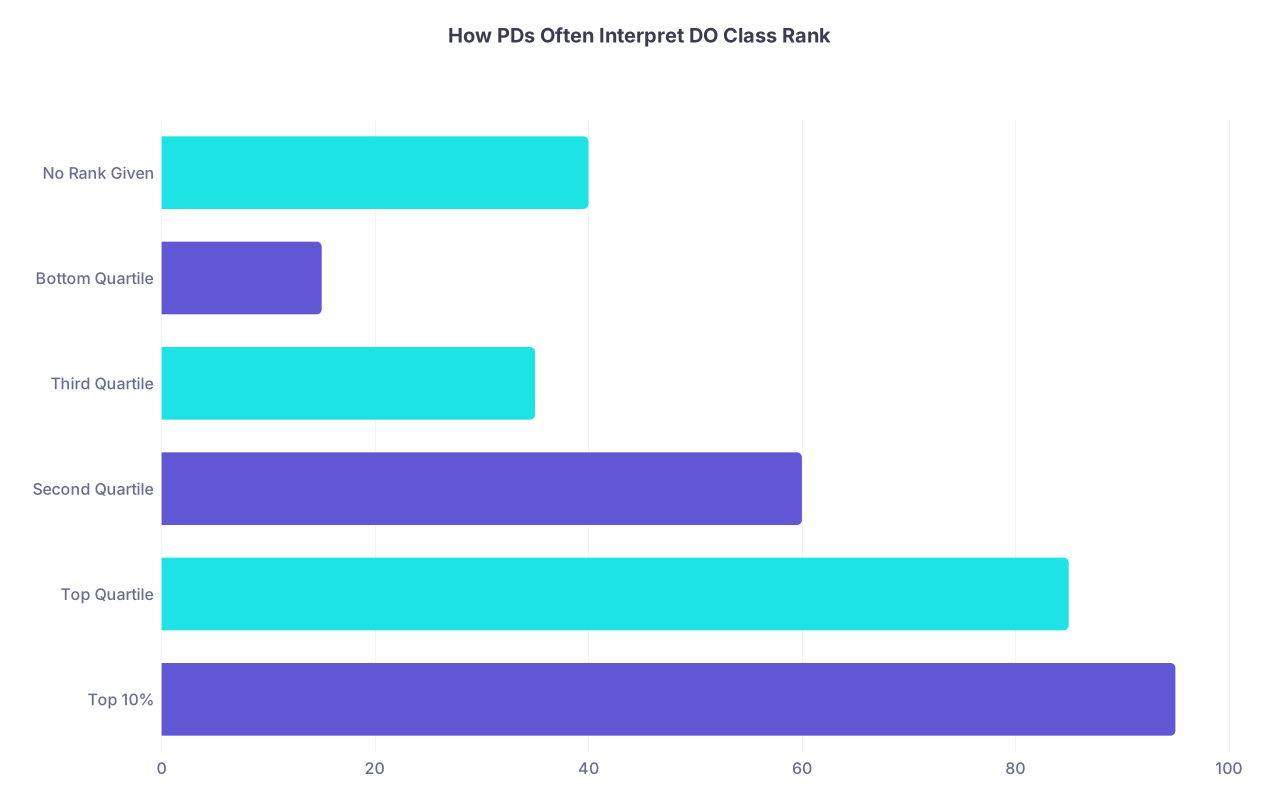
| Category | Value |
|---|---|
| Top 10% | 95 |
| Top Quartile | 85 |
| Second Quartile | 60 |
| Third Quartile | 35 |
| Bottom Quartile | 15 |
| No Rank Given | 40 |
Think of those “values” as the rough confidence level a PD feels when they see that line, not a real percentage.
Top 10% / AOA / Sigma Sigma Phi leader-type
This is the golden ticket in the DO world. It screams:
- You outperform your peers consistently.
- You probably handle volume and complexity well.
- You’re unlikely to be a problem resident academically.
When PDs are over-screening, this is the group that gets moved to the “safe to interview” pile even when Step scores are a bit soft.
Top quartile
Strong. PDs read this as: “solid, smart, maybe not a superstar, but no concern.” If your specialty isn’t insanely competitive, this plus a good Step 2 is enough to get serious looks.
Second quartile
Here’s where nuance kicks in. PDs start asking:
- Is there an upward trend in clinical grades?
- Are the comments on the MSPE strong or lukewarm?
- Are the letters saying “excellent” or just “performed at expected level”?
For community FM/IM/psych, second quartile is totally fine if the rest of your app backs you up. For EM, anesthesia, surgery, you usually need something else strong (Step 2, SLOEs, rotation at their site) to offset being middle-of-the-pack.
Third quartile
This makes committees nervous. In closed doors, you’ll hear:
- “Why are they so low in the class?”
- “Any red flags in the MSPE?”
- “Did they have fails or professionalism issues?”
You’re not automatically dead in the water for primary care, but you’ve lost the automatic “safe” feeling PDs like. You now rely more heavily on a narrative: strong clinical comments, clear improvement, or a compelling background.
Bottom quartile
This is where most programs quietly stop reading, unless something else jumps out:
- Very high Step 2
- Non-traditional applicant with prior career and stellar letters
- Strong rotation performance at that exact program
Many PDs will filter out bottom quartile sight unseen because they’re overloaded with applications and this is one of the simplest risk screens they have.
When schools “don’t rank” – what PDs really do
A lot of DO schools say they don’t rank. That’s half-true.
PDs look for proxies:
- Distribution of honors / high pass / pass
- Comments like “among the top students I’ve worked with this year”
- Any “quartile-like” language the school sneaks into the MSPE appendix
- Whether your grade pattern clusters near the top, middle, or bottom
If you’ve got mostly Pass with few Honors in a non-ranked school, PDs don’t call it “rank,” but they mentally place you lower. They’re human. They pattern-match.
So if your school doesn’t rank, your clinical narrative becomes much more important. Those clerkship comments are your class rank in disguise.
3. Dean’s Letters / MSPE: What’s Actually Being Read and Scored
Most students wildly overestimate how carefully PDs read MSPEs. The truth is more cynical.
For many programs, MSPEs are triaged, skimmed, or mined for a few specific things:
- Red flags
- Clinical performance summary
- Pattern of comments from attendings
I’ve watched junior faculty speed-read MSPEs: scroll, scroll, stop at “Internal Medicine,” skim comments, scroll to “Surgery,” look for any major issues, glance at “Summary,” done.
The silent code words PDs look for
Every Dean’s office claims their MSPE is “narrative” and “holistic.” Behind closed doors, PDs read it like code.
Things that help you:
- Phrases like “among the top students I have worked with”
- “Will excel in a rigorous residency”
- “Outstanding team member”
- “Self-directed, required minimal supervision”
Those are high-signal statements. Especially if they’re repeated across multiple rotations.
Things that hurt you:
- “Met expectations” repeated over and over with no stronger praise
- “Required more supervision than typical at their level”
- “Needed frequent reminders about timeliness or documentation”
- “Showed improvement over the course of the rotation” (usually means they started weak)
If a PD sees:
“She will be an excellent resident in any program fortunate enough to recruit her.”
They relax. If they see:
“He will benefit from ongoing close supervision as he continues to develop his clinical reasoning.”
They get nervous. No amount of webinar fluff corrects that gut reaction.
How much do they care about the Dean’s actual summary?
Depends on the school.
Some DO schools write mushy, generic, “everyone is great” summaries. PDs learn to ignore those and instead dive into individual clerkship narratives.
Other schools stratify more honestly. If your Dean writes:
“Ranked in the top quartile of her class, with exceptional performance in internal medicine and pediatrics.”
That matters.
Where DO students get burned: some schools purposefully compress the language to avoid hurting anyone. PDs hate that. When every single student “performed at or above expectations,” the comments become worthless, and they stop weighting the MSPE as heavily for that school.
They’ll then lean more on Step 2 and class rank, if provided.
4. How These Three Factors Interact in PDs’ Heads
You’re not evaluated on school name, class rank, and Dean’s letter separately. PDs synthesize them into a rough “risk score” very quickly.
Here’s the kind of mental calculus that actually goes on:
- “DO school we know. Top quartile. Strong comments. Step 2 is 240. Safe interview.”
- “Newer DO school. No rank. Comments are all ‘met expectations.’ Step 2 is 225. Pass.”
- “Unknown DO school. Third quartile. But MSPE says ‘top student on the team’ multiple times and Step 2 is 250. Worth an interview.”
- “Known DO school. Second quartile. Great EM rotation comments at our site. SLOE strong. Bring them in.”
They’re always asking:
If we bring this person in, how likely are they to sink in our program?
Your job is to lower that perceived risk.
5. Common Scenarios (and How PDs Actually View Them)
Let’s run through a few realistic combos you might recognize.
Scenario 1: Mid-tier DO school, second quartile, Step 2 = 238, solid but not glowing MSPE
What a typical IM or FM PD thinks:
- School: “We’ve had them before, they’re fine.”
- Rank: Middle-of-the-pack, no panic.
- Step: Good enough.
- MSPE: Not remarkable, but not alarming.
Call it “safe but not special.” If they have space, you get interviewed. If the program is overwhelmed with apps, you’re the kind who is easily lost in the crowd unless you rotated there or have a strong letter from someone they know.
Scenario 2: Newer DO school, “no rank,” Step 2 = 252, excellent clinical comments, strong letter from well-known academic attending
What a competitive EM or anesthesia PD thinks:
- School: Unknown. Mild concern.
- No rank: Annoying, but not disqualifying.
- Step: Strong. Helps a lot.
- MSPE comments + big-name letter: This is where you win.
They’ll say something like:
“I don’t know the school, but this student has clearly done well in real clinical environments. Worth interviewing.”
You leveraged clinical proof to overcome school skepticism.
Scenario 3: Known DO school, bottom quartile, Step 2 = 220, mixed comments with “needed direction early in the rotation”
Most PDs don’t get past the second line before moving on.
The internal monologue is brutal:
- “Bottom quartile + weak Step 2 + concerning language. Hard pass.”
You might still match FM in a less competitive area, but the number of doors that shut on you silently is huge.
Scenario 4: Osteopathic school with strong regional reputation, top 10%, Step 2 = 242, uniformly glowing comments
This is your best-case DO applicant who doesn’t even realize how reassuring they are to a PD.
The PD reaction:
- “This one’s going to be fine. Interview.”
Your school name is a mild positive; your rank and comments are the real signal. This is how DO grads end up competitive for academic IM, EM, anesthesia, and even the occasional surgical specialty – not magic, just stacking reassuring signals.
6. What You Can Actually Control From Here
You cannot rename your DO school. You cannot retroactively climb from second to top quartile. Your Dean’s letter is probably already written or almost done.
So what can you do that moves the needle at this stage?
A few levers still matter:
Where you apply. Apply more heavily to regions where your school has a footprint and alumni trail. Those PDs are more likely to see your school as “known quantity” rather than “question mark.”
Who writes your letters. If your school name is weak or unknown, the name and content of your LOR authors become your credibility. A strong letter from a respected MD/DO at a known hospital carries more weight than yet another generic home IM letter.
How your personal statement and experiences frame your trajectory. No, these won’t completely override class rank, but they can explain context: late bloomer, upward trend, or significant improvement in clinical years.
Communication on rotations and interviews. Once you get in the door, how you present yourself can neutralize a lot of quiet bias. PDs remember the student who owned their weaknesses and showed insight far more than the one who recited perfect stats.
Honest targeting of specialty. A third quartile student from a newer DO school chasing ortho with a 225 Step 2 is walking into a buzzsaw. That same student aiming at community IM or FM can still build a very good career. Reality-based planning is underrated.
7. Quick Reality Check: How This Will Feel in 10 Years
Right now, your brain is wrapped around:
“Is my DO school good enough? Is my rank good enough? Is my Dean’s letter good enough?”
Here’s the uncomfortable secret from the other side:
Ten years out, nobody cares about any of that.
They care if you’re competent, if patients trust you, and if your colleagues like being on call with you. Program directors remember whether you made their life harder or easier, not where you sat in MS2.
But you’re not there yet. You’re at the gate, and people are scanning your ticket.
So treat the DO school name, class rank, and Dean’s letter for what they are: early filters in an overloaded system. They don’t define your worth. They just change how much extra work you need to do to convince someone to take a chance on you.
And you can absolutely still win that argument.
Years from now, you won’t remember the exact language in your MSPE or how many programs quietly judged your school name. You’ll remember the handful of people who looked past the label and decided to bet on you – and how you proved them right.