The way most DO students answer “Why ACGME?” is sabotaging their interviews.
You mumble something vague about “more opportunities,” “better training,” or “I just want to keep all my options open,” and then wonder why the interview feels flat. Programs are not asking this to make small talk. They are testing identity, insight, and fit.
I am going to give you scripted, plug‑and‑play responses that actually work. And then I will show you how to customize them so you do not sound like every other applicant parroting Reddit.
1. What Programs Are Really Asking With “Why ACGME?”
Let us strip the politeness. When an interviewer looks at a DO and asks, “So, why ACGME?” they are often asking:
- Are you running from something (prestige anxiety, internalized DO insecurity), or toward something (specific training environment)?
- Do you understand the history: AOA vs ACGME, single accreditation, what that actually changed?
- Are you going to be weird about being a DO here?
- Are you a flight risk who will whine about “not matching MD” or leave after PGY-1?
- Will you integrate your osteopathic training or abandon it the moment you see “ACGME” on the door?
If you answer with:
- “I just want the best training possible.”
- “I wanted to keep my options open.”
- “I do not really see a difference between DO and MD.”
You fail the test. Those answers are:
- Generic
- Defensive
- And signal that you have not thought deeply about your professional identity
You need an answer that:
- Acknowledges your DO background clearly and confidently
- Shows you chose this environment, not defaulted into it
- Connects your goals to what ACGME programs actually offer
- Reassures them you are not abandoning osteopathy, just broadening your scope
Let us build that.
2. Core Strategy: Your Answer Structure
Use this 4-part structure. Do not wing it. Script it.
- Identity anchor (DO-positive, not DO-apologetic)
- Rational reason for ACGME training
- Specific connection to their program or ACGME environment
- Reassurance that your osteopathic background is an asset here
Think 4–6 sentences total. Concise, controlled, confident.
Here is the skeleton:
“I chose osteopathic medicine because [identity anchor].
As I moved into clinical training, I realized [reason for ACGME environment].
What draws me to ACGME programs like this one is [specific fit].
I see my osteopathic training as [value add] within a broader ACGME framework.”
Now let’s make this real.
3. Scripted Responses for Common Situations
I will give you exact language. Then we will tweak it by specialty and context.
Scenario A: DO applying to competitive ACGME specialty (e.g., anesthesia, EM, rads)
You must sound deliberate and grounded. Not “I am here because DO options are limited.”
Script #1 – Competitive specialty, high-volume ACGME program
“I chose osteopathic medicine because I liked the emphasis on whole-person care and hands-on skills, and that perspective still shapes how I see every patient.
As I got deeper into clinical rotations and into [specialty], I realized that the type of cases I want – high acuity, multidisciplinary management, exposure to advanced procedures – are concentrated in ACGME programs affiliated with large health systems.
What draws me to ACGME training, and to this program in particular, is the case volume, subspecialty exposure, and the track record of graduates matching into fellowships that align with my long-term plans.
I do not see my DO background as something I am leaving behind; I see it as an extra lens I bring to an ACGME environment – especially when it comes to communication, functional assessment, and understanding how disease impacts the person, not just the organ system.”
Why this works:
- You start with why you chose DO—confident, not apologizing
- You tie ACGME to case mix, system structure, fellowships—not “prestige”
- You explicitly keep your DO identity on the table
Scenario B: Primary care–oriented DO choosing ACGME over traditional “DO-heavy” options
You must show you did not “sell out” on primary care or osteopathy, but want an environment that amplifies it.
Script #2 – FM/IM/peds with primary care focus
“I went DO because I care a lot about longitudinal, relationship-based medicine and I liked how osteopathic schools prioritize that from day one.
As I moved through rotations, I realized that many ACGME programs, especially in internal medicine and family medicine, are now integrating population health, QI, and team-based care in ways that mirror how real-world primary care is evolving. That is the environment I want to train in.
So when I say I am looking for ACGME programs, what I actually mean is: I am looking for programs that combine robust clinical exposure, exposure to diverse patient populations, and strong systems-based practice training. Your clinic structure, [mention FQHC, continuity clinic, integrated behavioral health, etc.], fits exactly what I hope to be doing after residency.
My osteopathic background gives me a strong foundation in patient communication and functional assessment; I see that complementing, not conflicting with, an ACGME framework focused on systems, outcomes, and multidisciplinary care.”
Again: DO identity integrated, not denied.
Scenario C: “Why ACGME and not an osteopathic residency?” (old-school attending question)
Some older attendings still think in “AOA vs ACGME” terms. You need a historically aware but future-focused answer.
Script #3 – Asked directly why not AOA / osteopathic program
“A lot has changed over the last decade with the single accreditation system. When I started school, my mentors were very clear: by the time I applied, the distinction between AOA and ACGME programs would mostly be structural, not philosophical.
For me, the decision was not ‘osteopathic vs ACGME.’ It was: where will I see the right breadth of pathology, get strong mentorship, and come out prepared for the kind of practice I want? The programs that best matched that, in my research and away rotations, happened to be ACGME-accredited.
That said, I absolutely carry forward the osteopathic mindset – especially the emphasis on understanding how a patient’s environment, function, and body mechanics influence their disease. I think that perspective belongs in all residencies, not just those that historically had the AOA label.”
Clean. Respectful. Future-oriented.
4. Customizing by Specialty (Concrete Templates)
You should not sound like a generic template robot. Swap in concrete program traits that actually match your field.

Internal Medicine
Use these elements:
- Inpatient volume and complexity
- Subspecialty exposure and fellowship pipeline
- QI and research infrastructure
IM-focused version:
“In internal medicine, I am drawn to complex inpatient care and the opportunity to build a strong foundation for subspecialty or academic work. ACGME programs like this one typically offer the higher tertiary-care volume, subspecialty services, and research infrastructure that support those goals.
My DO training gives me a strong grounding in relationship-building and functional assessment, which I think is crucial when managing chronic disease. I want to bring that osteopathic lens into an ACGME environment where I can also develop skills in systems-based practice, QI, and working within large multidisciplinary teams.”
Emergency Medicine
Use:
- Trauma, airway, procedures
- EMS exposure
- Research / toxicology / ultrasound tracks
EM-focused version:
“I am pursuing ACGME EM programs because the environments I am most interested in – high-volume EDs with trauma, strong EMS integration, and a wide range of procedures – are typically within large ACGME institutions.
As a DO, I am very comfortable thinking about the whole patient: their function, their environment, and their trajectory after discharge. I see that as a strength in EM, where decisions are made quickly but have long-term consequences. I want that osteopathic perspective to sit alongside the resources, volume, and subspecialty exposure that an ACGME EM residency like this offers.”
Family Medicine
Use:
- Continuity clinics
- OB, procedures, behavioral health integration
- Community and population health
FM-focused version:
“In family medicine, what matters most to me is continuity, scope, and community impact. The ACGME family medicine programs I am drawn to, including this one, have strong continuity clinic structures, integrated behavioral health, and meaningful exposure to procedures and OB – all within diverse communities.
The osteopathic focus on whole-person care and social determinants of health aligns perfectly with that. I do not see a tension between DO and ACGME here – I see an opportunity to practice that philosophy in a setting that mirrors the systems I will be working in after graduation.”
Surgery (GS or surgical subspecialties)
Use:
- Case numbers
- Complexity and subspecialty exposure
- ICU, trauma, fellowship outcomes
Surgery-focused version:
“For surgery, I am looking for high-volume, high-acuity training where I will be in the OR early and often, exposed to complex cases, and surrounded by mentors who can guide me toward fellowship if I choose that path. ACGME programs at tertiary centers are where that environment tends to exist.
My DO background gives me a strong appreciation for postoperative function, biomechanics, and the impact of surgery on the whole person. I want to carry that perspective into an ACGME surgical program where the operative experience and ICU exposure are as strong as possible.”
You get the idea. Same skeleton. Different organs.
5. Mistakes That Kill Your Answer (And How To Fix Them)
You can have the right content and still blow the delivery. I have watched this happen across the table.
Mistake #1: Sounding defensive or insecure about being a DO
Phrases that scream insecurity:
- “Even though I am a DO…”
- “I know I am just a DO but…”
- “I hope you will still consider me…”
Cut all of that. Replace with calm, matter-of-fact language:
“As a DO, I bring [X strength]. I chose ACGME training because [Y reason].”
Mistake #2: Bashing osteopathic programs or DO peers
You will lose every osteopathic ally on the faculty.
Bad:
- “DO residencies do not have the same quality.”
- “I did not want to be limited to DO programs.”
Reframe:
“With the single accreditation system, I looked broadly at programs that matched my goals, and the ones that fit best happened to be ACGME-accredited.”
Neutral. Professional.
Mistake #3: Centering prestige instead of training
Interviewers can smell prestige-chasing a mile away.
If your internal monologue is “I want ACGME because it sounds more MD-like and my parents will be happier,” fine. Just do not say it.
Phrase it like this:
- Focus on:
- Case mix
- Volume
- Systems-based practice
- Fellowship pathways
- Research infrastructure
Not:
- “Better reputation”
- “More respected”
- “More competitive”
Mistake #4: Rambling past 45–60 seconds
You are not giving a TED talk. You are answering a targeted question.
Practice until your answer:
- Starts strong
- Hits the 4 elements
- Ends clearly
Time yourself. If you are over a minute, tighten.
6. Step‑By‑Step: Build Your Custom Script
Here is the actual protocol I want you to follow. Not “think about.” Do.

| Step | Description |
|---|---|
| Step 1 | Identify goals |
| Step 2 | Clarify DO identity |
| Step 3 | Define ACGME advantages |
| Step 4 | Map to specific program traits |
| Step 5 | Write 4-part script |
| Step 6 | Practice aloud & trim |
| Step 7 | Get feedback & refine |
Step 1: Identify your real goals
Write down (on paper, not in your head):
- 1–2 likely practice settings you want (academic, community, rural, etc.)
- 1–2 interests (procedures, research, specific populations, etc.)
- 1–2 things you want out of residency (mentorship, volume, work-life balance, etc.)
Step 2: Clarify your DO identity in one sentence
Answer this bluntly:
- “I chose osteopathic school because ________.”
Examples:
- “I wanted a school that took primary care and longitudinal relationships seriously.”
- “I liked the emphasis on hands-on skills and functional assessment.”
- “I was drawn to a more holistic philosophy of care.”
You need this anchor sentence.
Step 3: Define what ACGME actually brings to your goals
Not generic. Yours.
Examples:
- “Higher trauma volume and complex surgical cases”
- “Stronger academic infrastructure and subspecialty presence”
- “Integrated behavioral health and population health tools”
Write 2–3 bullet points that connect ACGME environments to your goals.
Step 4: Map to each specific program
This is where most people get lazy and sound generic.
Use the website, rotation experience, or chats with residents to pull 2–3 specifics:
- “Your [X] clinic with [Y population]”
- “Your [night float / ICU rotation / trauma exposure] setup”
- “Your track record of graduates matching into [fellowship]”
Plug them into your script.
Step 5: Write your 4-part script
Use this exact scaffolding:
- “I chose osteopathic medicine because [identity].”
- “As I moved into clinical training, I realized [why ACGME helps me reach my goals].”
- “What draws me to ACGME programs like this one is [program-specific details].”
- “I see my osteopathic training as [specific value] within that framework.”
Write it long first. Then trim.
Step 6: Practice out loud until it feels boring to you
You want muscle memory, not improv.
- Record yourself on your phone
- Listen once: are you rambling, apologizing, or hedging?
- Fix it. Re-record.
- Stop when the answer is:
- 30–45 seconds
- Steady pace
- No “um, like, kind of, sort of”
7. Advanced Layer: Handling Follow‑Up Questions
Strong interviewers will not stop after your first answer. They will push.

Follow-up #1: “So do you still plan to use OMT?”
If you have zero interest in doing manipulative medicine, do not lie. But do not disrespect it.
Two good tracks:
Track A – You want to use OMT selectively
“Yes, selectively. I have found OMT very helpful in [specific scenario: e.g., musculoskeletal back pain in pregnancy, rib dysfunction in COPD, tension headaches]. In residency, my priority is to become an excellent [specialty] physician first, but I would like to incorporate OMT when it clearly benefits the patient and fits the flow of the clinic or floor.”
Track B – You do not plan to use it much
“I do not see myself running an OMT-focused practice, but the training has still shaped how I examine and think about patients—especially around biomechanics, pain, and function. So while I may not be doing frequent manipulative treatments, that osteopathic perspective absolutely influences how I diagnose and manage.”
Follow-up #2: “Would you consider osteopathic recognition?”
If the program has osteopathic recognition, they are testing if you understand what that even means.
“Yes, I would be very open to that. I see osteopathic recognition as a way to formalize and strengthen the parts of my DO training that I already value—especially around physical diagnosis, manual skills, and whole-person care—within the structure of an ACGME program.”
If you are unsure, stay neutral-positive.
Follow-up #3: “Do you feel disadvantaged as a DO applicant?”
Never say yes, even if you believe it. You reframe.
“I see my path as different, but not disadvantaged. I have had to be very deliberate about my choices—boards, rotations, research—to be competitive in an ACGME environment, and that has made me more intentional. I am proud of my DO training and confident I can perform at the level you expect of your residents.”
8. Quick Reference Table: Weak vs Strong Phrasing
| Situation | Weak Phrasing | Strong Phrasing |
|---|---|---|
| General reason | “More prestigious.” | “Higher volume and complexity of cases.” |
| DO identity | “Even though I’m a DO…” | “As a DO, I bring…” |
| Comparing to osteopathic programs | “DO residencies aren’t as strong.” | “The programs that fit my goals best were ACGME.” |
| OMT use | “I probably won’t use it.” | “I’ll use it selectively where it clearly helps.” |
| Perceived disadvantage | “Yes, it’s harder as a DO.” | “My path is different, but I’m well-prepared.” |
9. How This Plays Out In A Real Interview
Picture this.
You are in a small conference room. Two attendings, one PGY-3. You are on your third question. The senior attending leans back and asks:
“So you are a DO. Why ACGME?”
Most applicants freeze, stall, or mumble something half-baked. The room’s energy drops.
You, instead, say (calmly):
“I chose osteopathic medicine because I wanted a training environment that took whole-person care seriously and emphasized hands-on skills from the first year.
As I got deeper into clinical rotations and into internal medicine specifically, I realized that the kind of practice I am aiming for—complex inpatient care with the option to pursue subspecialty training—tends to be concentrated in larger ACGME programs with strong ICU, subspecialty, and research exposure.
What draws me to your program in particular is the mix of high-acuity patients, the dedicated ICU rotations in each year, and the track record of graduates matching into cardiology and pulmonary critical care. That lines up with where I could see myself heading.
I see my osteopathic training as an added strength here—especially in how I communicate with patients and think about their function and environment—within the structure of an ACGME program that will push me clinically and academically.”
The attending nods. The PGY-3 scribbles something that does not say “generic answer.” The next question comes.
That is the point. Not perfection. Control.
10. Visual: Where Your Effort Should Actually Go
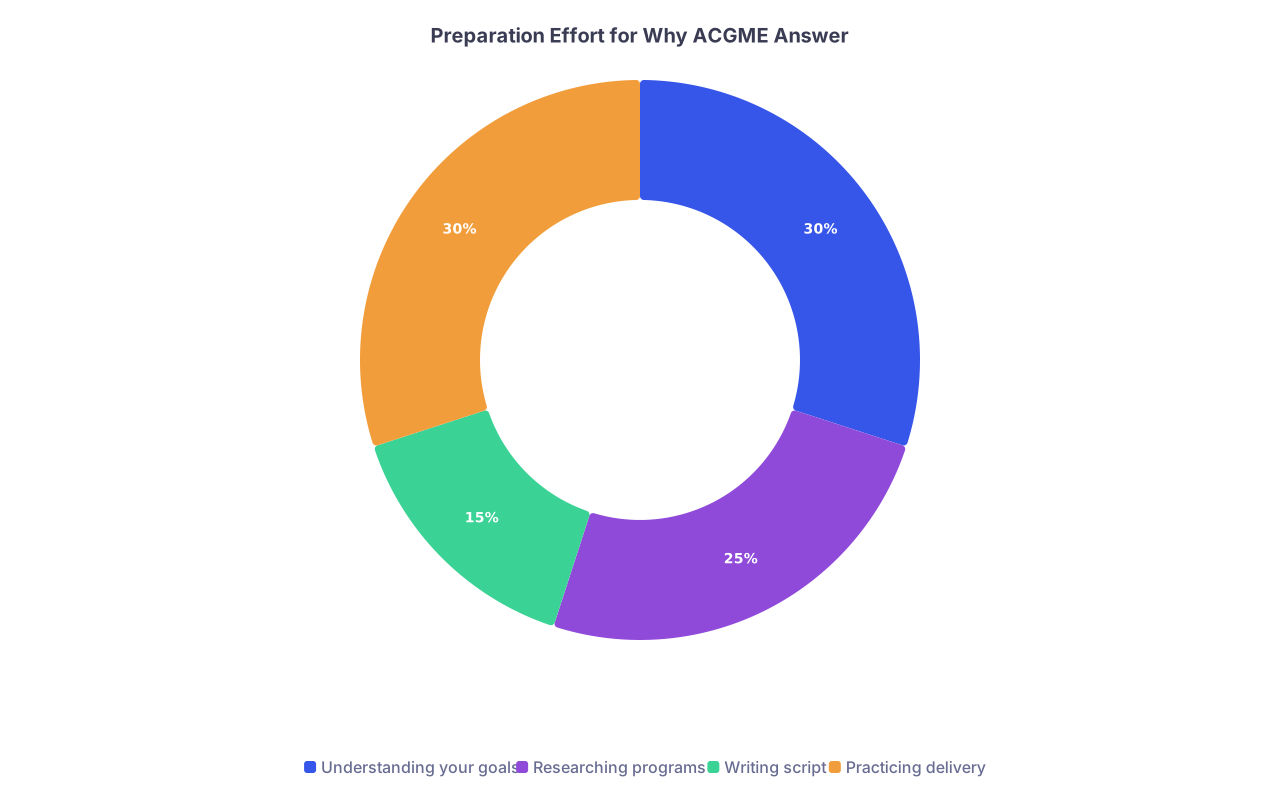
| Category | Value |
|---|---|
| Understanding your goals | 30 |
| Researching programs | 25 |
| Writing script | 15 |
| Practicing delivery | 30 |
Most people burn all their time memorizing words. The real leverage comes from:
- Knowing what you want
- Understanding why ACGME aligns with that
- Practicing until you sound like yourself, not a teleprompter
Words are last, not first.
11. Final Tight Script You Can Adapt Today
Here is one more compact, all-purpose template you can tweak per program:
“I chose osteopathic medicine because I wanted a curriculum that emphasized whole-person care, functional assessment, and strong patient relationships.
As I moved into clinical training, I realized that the type of environment I am aiming for—[high-volume tertiary care / broad-spectrum community practice / strong subspecialty and research exposure]—is most often found in ACGME programs.
What specifically attracts me to this program is [concrete program feature 1] and [feature 2], which align with my goals in [career direction, e.g., academic cardiology, community EM, full-spectrum family medicine].
I see my osteopathic training as a value-add here: it shapes how I listen to patients, how I examine them, and how I think about their function and environment, within the broader ACGME framework of systems-based and team-based care.”
Print that. Mark it up. Replace the brackets with your reality. Then practice.
FAQ (Exactly 4 Questions)
1. Should I mention the single accreditation system explicitly in my answer?
You can, but only briefly and only if you understand it. One clean sentence is enough: “With the single accreditation system, I looked broadly at programs based on fit rather than AOA vs ACGME labels, and the programs that matched my goals best happened to be ACGME-accredited.” Do not turn it into a history lecture. Programs care more about your goals than policy timelines.
2. What if I am genuinely indifferent between ACGME and osteopathic programs?
Then your frame is not “ACGME is better,” it is “this specific program fits me.” You can say: “I applied broadly, including programs with osteopathic recognition and ones that were historically AOA. What mattered to me was [case volume, mentorship, clinic structure]. Your program’s [X, Y, Z] is what draws me here, and those features happen to sit within an ACGME framework.” Indifference between systems is fine; indifference to fit is not.
3. How much should I lean into OMT in an ACGME interview?
Enough to show you respect it and understand its value, not so much that you sound unrealistic for the environment. One or two sentences is plenty. If you are applying to a program with osteopathic recognition or robust OMT, go stronger. If not, frame OMT as part of your diagnostic toolkit and clinical reasoning, not the core of your future practice—unless the specialty clearly supports that.
4. Do I need a different “Why ACGME?” answer for every program?
You need the same core answer with program-specific details swapped in. The skeleton—DO identity, why ACGME aligns with your goals, what about this program, and how DO training is a value-add—stays the same. The custom part is 1–2 sentences in the middle naming their clinics, patient population, call structure, or fellowship outcomes. If you cannot name anything specific, your application to that program is probably weak anyway.