Most osteopathic applicants completely misunderstand how much OMT actually matters for residency—and in which rooms it really counts.
Let me tell you what happens when your file is opened behind closed doors. Because the way schools market “the osteopathic difference” and the way PDs, faculty, and rank committees actually talk about OMT are two very different stories.
The Uncomfortable Truth: OMT Is Rarely the Deciding Factor
Inside selection meetings, OMT training is almost never the first, second, or even third thing discussed about you.
For most programs—especially ACGME community IM, EM, surgery, anesthesia, ERAS-flooded specialties—your osteopathic manipulative training is background flavor, not the main course. The committee looks at:
- Scores (COMLEX, USMLE if you have it)
- Clinical evals and narrative comments
- Where you rotated and who’s vouching for you
- Fit, professionalism, any red flags
Then, maybe, someone says:
“He’s DO. Any OMM stuff?”
And most of the time, the response is something like:
“Yeah, standard DO curriculum. Did the required OMT rotations. Nothing special.”
Conversation moves on.
That’s the default reality.
But here’s the nuance no one explains to you: there are specific circumstances where your OMT training absolutely can swing an interview invite, influence your rank, or make you memorable. The problem is students either overplay it in the wrong places or completely underuse it where it would actually help.
Let’s separate the myth from what really happens in those conference rooms.
Where OMT Actually Matters (And Where It Doesn’t)
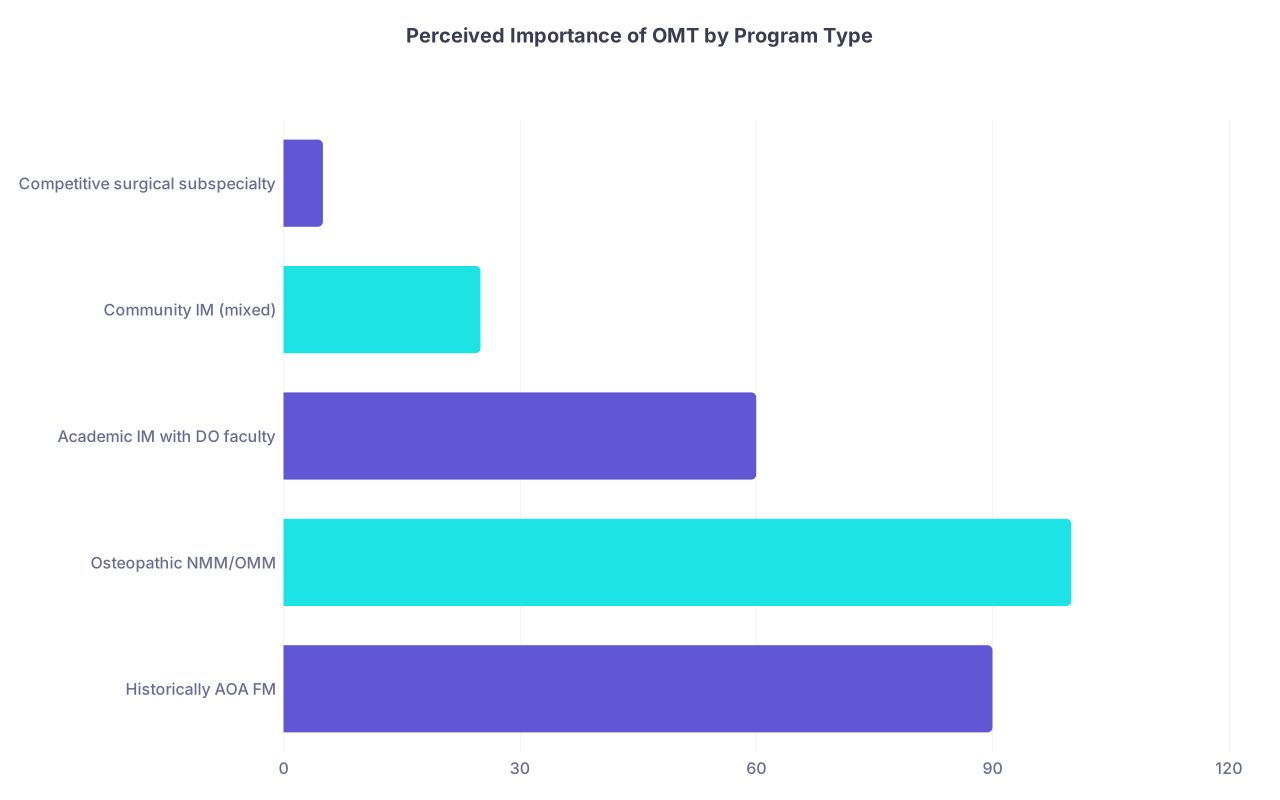
| Category | Value |
|---|---|
| Historically AOA FM | 90 |
| Osteopathic NMM/OMM | 100 |
| Academic IM with DO faculty | 60 |
| Community IM (mixed) | 25 |
| Competitive surgical subspecialty | 5 |
1. NMM/OMM and OMM-Heavy Fellowships
Here, OMT is the currency. Period.
In NMM/OMM residencies or FM programs with a strong OMT track, your manipulative skill and commitment aren’t “bonus points”—they’re the foundation. In closed-door discussions, I’ve heard exact phrases like:
- “If they can’t do a basic HVLA cervical safely, I don’t want them.”
- “She talks a good game about osteopathic principles but there’s no evidence she actually uses her hands.”
- “He’s solid clinically, but honestly his OMM is weak for someone applying to NMM.”
At these programs they care about:
- How early and how deeply you engaged in OMT
- Whether you actually used it in clinical rotations, not just lab
- If your LORs say you teach OMT to peers or use it with patients
- Whether you can talk biomechanics and rationale at a level beyond “I like holistic care”
If you’re aiming here, your OMT training is absolutely central. Weak OMT in this lane will kill your application faster than an average COMLEX.
2. Historically Osteopathic Family Medicine and Primary Care Programs
These are the programs that used to be AOA-only or still have strong DO leadership. Here’s the behind-the-scenes vibe:
They don’t necessarily expect you to be a magician with your hands. But they absolutely notice if your OMT background is generic versus intentional.
In their meetings, OMT comes up like this:
- “She actually documented OMT in clinic during her FM sub-I. The preceptor loved it.”
- “He did OMM clinic regularly and talked about teaching it to classmates.”
- Or, on the negative side: “He’s a DO with zero mention of OMT anywhere. That’s odd.”
Will OMT compensate for low scores? No. But among two similar DO applicants, the one who can actually integrate manipulative medicine into real patient care often gets the nod.
Here, OMT is a tiebreaker and a “fit signal.” It tells them you understand and value the osteopathic culture they’re proud of.
3. Academic IM / EM / Pediatrics With DO Faculty Leadership
In mixed ACGME environments with a few proud DO attendings or PDs, OMT is more identity than selection metric.
You might hear variants of:
- “Nice, another DO. Any OMM experience?”
- “Could be someone who helps us build out more OMM in continuity clinic.”
But they won’t dump a USMD with a 245 for you because you know Still techniques.
OMT helps you primarily as:
- A conversation anchor in interviews (“Tell me how you’ve used OMT on the wards”)
- A way to differentiate yourself in a generic, overqualified applicant pool
- A justification to invite you over another DO with an empty, cookie-cutter application
It matters, just not in a binary yes/no way. Think of it as: if you’re already in range, good OMT exposure and genuine use pushes you a notch up.
4. Highly Competitive, Procedure-Heavy Specialties
Ortho. Neurosurgery. Dermatology. ENT. Highly sought-after anesthesia spots. Interventional fields.
Here’s the blunt truth: OMT training is almost irrelevant. Not offensive, not harmful. Just not something they seriously weigh.
Discussions sound like:
- “He’s DO, but he has a 250+ and three ortho pubs.”
- “She’s top of her class with strong letters. DO is fine.”
- Rarely: “Cool that she’s DO, but we’re not using OMM here.”
Trying to sell yourself as “the OMT person” in these interviews is usually a mistake. It makes them question whether your priorities and theirs match.
You can mention it as part of your background, but the people in those rooms care more about:
- Case volume
- Operative skill potential
- Research
- Efficiency and grit
Not whether you can treat a rib.
How Program Directors Actually Read “OMT” In Your Application
Let me walk you through what really happens when a PD or selection committee member sees osteopathic content in your file.
The Default Mental Filter
When they see “DO,” here’s the quick internal checklist:
- Do they have USMLE scores? If yes, how do they compare?
- Any big red flags? Failures, professionalism issues, massive score gaps?
- Are their clinical comments strong enough to suggest they’ll function on our service?
Then:
- Did they do anything interesting with their osteopathic background, or are they just “standard DO”?
That last question is where your OMT training either becomes an asset or just filler.
What Actually Impresses Them
They’re not counting how many hours of OMM lab you had. Frankly, they assume your school’s curriculum is whatever it is.
They do get interested when they see:
- Specific, repeated examples of you using OMT on rotations
“Used OMT effectively to treat hospitalized patients with musculoskeletal pain and reduced opioid needs.” - Letters that describe your hands-on skill and judgment
“She safely and effectively performed OMT in clinic, tailoring techniques to complex patients with multiple comorbidities.” - Leadership in OMM
“He routinely taught OMT to junior students and led review sessions before practicals.” - Integrating OMT in mainstream settings
“On IM sub-I, applied gentle OMT techniques to help a COPD patient with rib dysfunction breathe more comfortably.”
The key is this: they want evidence you can use your DO background to add value in their environment. Not just that you passed your OMM practicals.
What Makes Them Roll Their Eyes
There are some patterns that come up again and again in meetings:
- Personal statements waxing poetic about “the healing power of my hands” with zero clinical examples.
- Vague lines like “I plan to incorporate OMT into all my future patient encounters” without any proof you’ve done so.
- Students applying to hardcore non-OMM specialties selling OMT as their central identity. That mismatch sets off alarms.
I’ve literally heard comments like:
“If OMT is their main thing, why are they applying here? This is a high-volume trauma center, not an OMM clinic.”
OMT is useful when it shows maturity, practicality, and a real sense of how medicine works. It hurts when it feels naïve, over-romanticized, or disconnected from the specialty you’re pursuing.
How Much OMT Skill You Actually Need (By Goal)
| Target Program Type | Expected OMT Level | How Much It Really Matters |
|---|---|---|
| NMM/OMM Residency | High, near-expert for student | Critical |
| FM with strong OMT culture | Moderate–High, clinic-ready | Very Important |
| Standard IM / EM / Peds (mixed) | Basic–Moderate, real use | Helpful but not decisive |
| Hospitalist-focused IM | Basic, judicious use | Minor tiebreaker |
| Competitive Surgical Subspecialties | Basic understanding only | Almost negligible |
Here’s the real benchmark most programs use subconsciously:
- Can this person safely and appropriately use OMT when it actually helps?
- Do they know when not to use it?
- Does their DO training translate into better clinical thinking, not just more techniques?
No one is ranking you based on how many cranial courses you attended. They’re assessing judgment.
The Real Hidden Value of Strong OMT Training
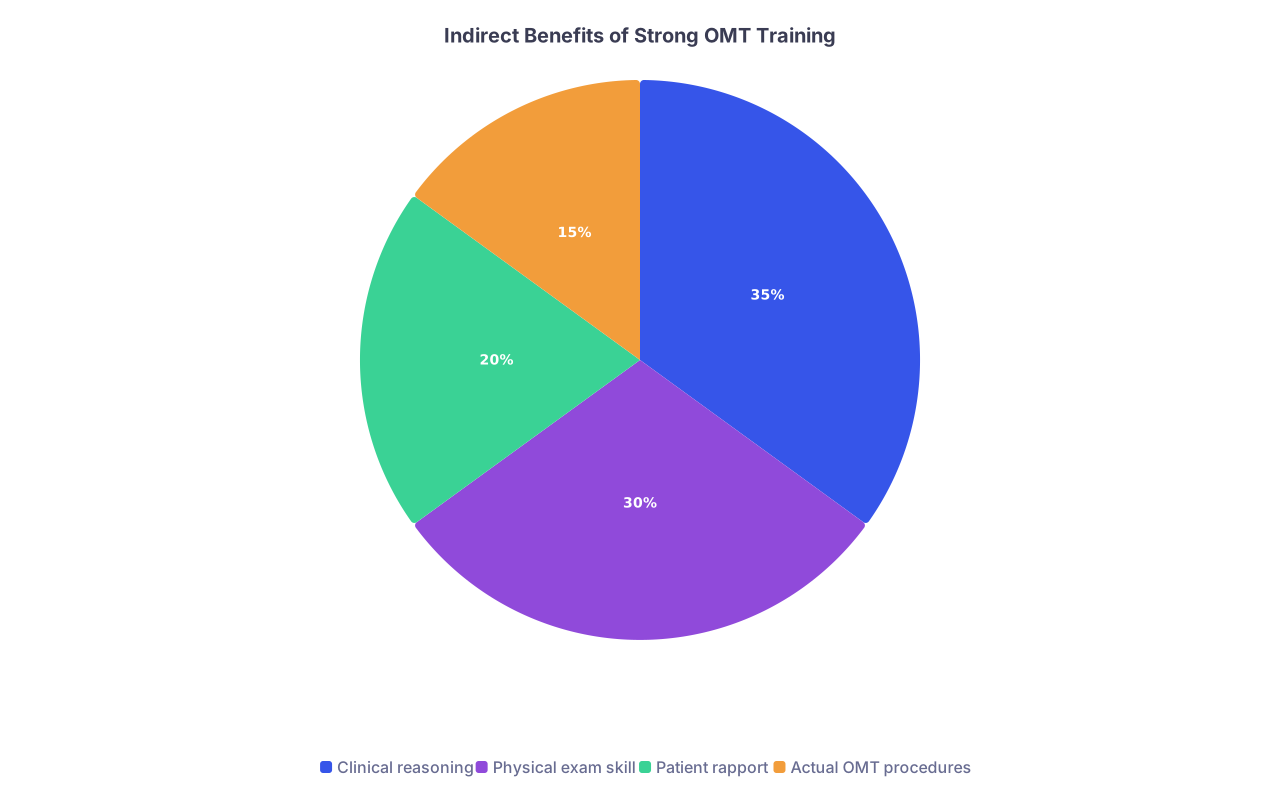
| Category | Value |
|---|---|
| Clinical reasoning | 35 |
| Physical exam skill | 30 |
| Patient rapport | 20 |
| Actual OMT procedures | 15 |
Let me tell you the part almost no advisor explains: the biggest advantage of solid OMT training isn’t the procedures themselves. It’s everything that comes bundled with it.
1. Physical Exam Skill
Students who took OMT lab seriously often have better hands. Literally.
- They pick up subtle tenderness, tissue texture changes, joint restriction.
- They’re more comfortable laying hands on patients confidently and respectfully.
- They can localize pain and dysfunction faster.
On rounds, attendings notice. They may never say “this is because of your OMT training,” but they see that you examine patients better than your peers.
2. Clinical Reasoning and Biomechanics
Good OMT teaching forces you to think in 3D about anatomy and function. That spills over into:
- Understanding why this patient’s shoulder hurts when the real problem is their neck.
- Recognizing how posture, habitus, or surgery affects symptoms.
- Thinking beyond “image, inject, cut” as reflex solutions.
In selection meetings, this shows up as comments like:
“He thinks about the whole patient instead of just chasing numbers.”
No one connects it explicitly to OMM, but you and I both know where you learned that type of thinking.
3. Rapport and Time at the Bedside
Using your hands—appropriately—forces you to slow down, touch the patient, and talk. It builds connection.
Patients routinely say things like:
“Doctor, you’re the only one who actually examined me.”
Those comments end up in narrative evals. And those narratives are very much read in residency selection.
The irony: your OMT time may matter less for the treatment and much more for the reputation you build as someone who genuinely shows up at the bedside.
How To Talk About OMT So PDs Actually Respect It
Most DO students either:
- Oversell OMT in weird, tone-deaf ways, or
- Bury it completely, out of fear it’ll make them seem less “serious” or less “mainstream”
Both are mistakes.
You want to frame OMT as a practical, patient-centered skillset that fits your target specialty’s reality.
For Family Medicine, NMM, Primary Care-Heavy Programs
You can be more explicit:
- Describe 1–2 specific cases where OMT clearly improved pain, function, or reduced meds.
- Mention any continuity clinic where you followed patients over time using OMT as part of multimodal care.
- Talk about how you decide when not to do OMT—contraindications, time constraints, patient preference.
This shows maturity, not idealism.
For IM, EM, Peds, Hospitalist Path
Focus less on techniques, more on effect:
- Relief of acute musculoskeletal pain in ED/urgent care
- Helping inpatients with rib dysfunction breathe better
- Managing headaches or back pain without escalating opioids
You want to position OMT as: “another tool I’m comfortable using when appropriate,” not “the center of my identity.”
For Competitive, Procedure-Heavy Fields
You keep it brief and grounded:
- Acknowledge your DO background and OMT training as part of how you learned to think anatomically and with your hands.
- Emphasize how that sharpened your palpation, spatial reasoning, and comfort in procedural settings.
- Do not promise to build some major OMT clinic in the ortho department. That’s how you get silently crossed off the list.
You’re showing that OMT helped build your foundation, not that you want to turn their OR into an OMM lab.
How Much OMT Do You Need To Actually Practice It In Residency?

| Step | Description |
|---|---|
| Step 1 | OMT Lab in DO School |
| Step 2 | Clinical Rotations Using OMT |
| Step 3 | Residency with Some OMT Opportunity |
| Step 4 | Electives/Workshops During Residency |
| Step 5 | Confident, Independent OMT Use |
Here’s the piece students rarely grasp until it’s too late:
If you genuinely plan to use OMT with your future patients, you need intentional exposure before and during residency. You will not magically “pick it back up” after ignoring it for 6 years.
Behind closed doors, attendings say things like:
“Most DOs forget their OMM within a year if they don’t actively use it.”
And they’re not wrong.
If you want to actually keep your skills:
- Use OMT meaningfully on 3rd and 4th year rotations, not just when an “OMM preceptor” is watching.
- Seek out at least one audition where OMT is welcomed and observed.
- During residency, look for at least a few attendings (FM, PM&R, pain, NMM) who are open to you using OMT on appropriate patients.
The difference between the DO who still confidently uses their hands 5 years out and the one who barely remembers counterstrain is simple: repetition. Real patients. Real supervision.
Your residency environment does matter. Programs that explicitly mention OMT in their description or have DO leadership are more likely to give you the freedom to keep your skills alive.
Common Myths About OMT and Residency Selection
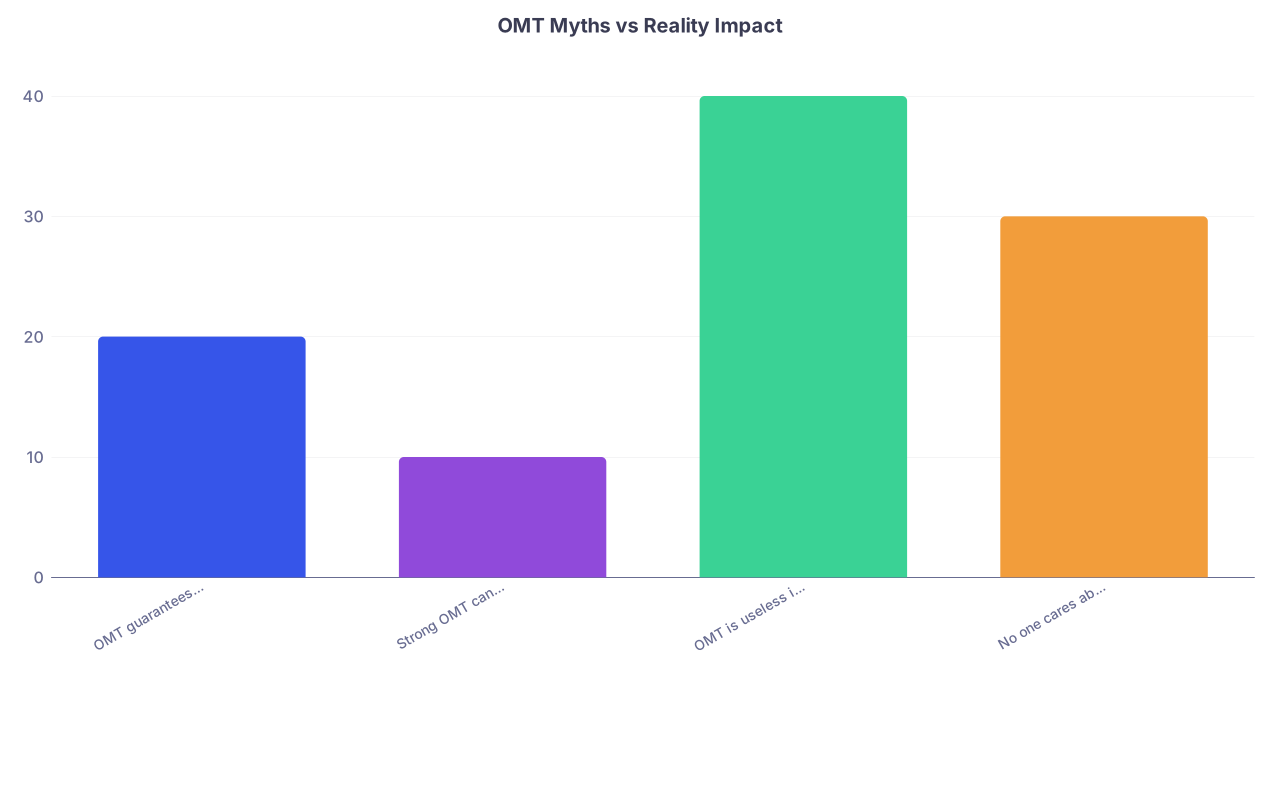
| Category | Value |
|---|---|
| OMT guarantees DO-friendly status | 20 |
| Strong OMT can offset weak scores | 10 |
| OMT is useless in non-primary care | 40 |
| No one cares about OMT at all | 30 |
Let’s kill a few bad ideas I hear every cycle.
Myth: Programs that mention OMT are automatically DO-friendly.
Reality: Some are. Some just haven’t updated their website since the AOA days. You still need to look at their current residents and leadership. If there are no DOs in the last 3 classes, that “OMT-friendly” language is just ancient marketing.
Myth: Strong OMT can compensate for mediocre scores.
Reality: Not for most programs. At best, it breaks ties between candidates with similar numbers. It does not rescue a failing transcript.
Myth: OMT is useless unless you’re doing FM or NMM.
Reality: It’s less directly used in some fields, sure. But the palpation skill, clinical reasoning, and patient rapport are universally valuable. The procedures may be niche; the habits are not.
Myth: No one cares about OMT anymore in ACGME world.
Reality: Plenty of people do. Especially DO faculty who fought hard to build osteopathic tracks in merged systems. They just care about smart, grounded use of it—not performative osteopathy.
FAQ: The Real Questions You’re Afraid to Ask
1. If I’m not great at OMT, should I hide it on my application?
No. You’re a DO; pretending you never touched OMT looks strange. But don’t overcompensate. Be honest: you got solid foundational training, you use it when appropriate, and you’re still refining your skills. What you shouldn’t do is market yourself as an OMT superstar if you barely passed your practicals and never touched a patient on rotations.
2. Do programs ever test OMT knowledge in interviews?
At NMM or OMM-heavy FM programs, yes. They might ask how you’d approach a specific complaint osteopathically, or what techniques you’d consider for a type of patient. At standard IM/EM programs? Almost never. They might ask how you’ve used OMT with patients, but they’re checking judgment and practicality, not whether you can recite Fryette’s laws from memory.
3. Will not using OMT much in clinical rotations hurt me as a DO?
It can, subtly. When an attending writes that you “never demonstrated OMT” and you’re at a place that welcomes it, it looks like you didn’t care about your own training. It also means you’re probably rusty. You don’t need to treat everyone, but if you go through all of third and fourth year without a single documented OMT use, that’s not a good sign—especially for osteopathic-focused programs.
4. If I really want to keep doing OMT, do I have to choose FM or NMM?
No. I’ve seen hospitalists, PM&R docs, pain specialists, even a few anesthesiologists and EM physicians who still use OMT meaningfully. But they all had two things in common: they were truly strong at it in school, and they actively sought ways to incorporate it during residency. If you choose a field that doesn’t naturally lend itself to OMT, you’re swimming upstream. Not impossible—just harder. You’ll need to be deliberate about finding mentors and opportunities.
You now know the part they never put on the glossy brochures: OMT training isn’t a magic ticket, and it isn’t dead weight. It’s a tool that matters a lot in a few specific lanes and quietly shapes your clinical identity everywhere else.
Used thoughtfully, it can make you the kind of DO who stands out for the right reasons—someone whose hands, eyes, and brain are just a bit sharper than the average applicant. Misused or ignored, it becomes another wasted advantage.
You’ve got your degree path. You’ve got your hands. The next step is choosing where you want them to matter most—and aligning your application, rotations, and interview story accordingly.
With that clarity, you’re ready to stop guessing what programs “think about OMT” and start presenting yourself as the kind of osteopathic applicant committees actually remember. The interview room is waiting. But that’s a strategy conversation for another day.