You Are Here
You are a rising OMS-3 or OMS-4. Your school is hammering COMLEX. Your classmates talk almost exclusively in “Level 1/Level 2” language. Meanwhile, every time you look up ACGME programs, you keep seeing the same thing:
- “USMLE required”
- “USMLE strongly preferred”
- “USMLE scores used in screening”
You want to be realistic. You are not going to grind USMLE 8 hours a day while also being crushed by COMLEX prep and clinicals. You are going to be COMLEX heavy, USMLE light.
The question is: how do you do that without quietly killing your shot at the Match?
That is what I am going to solve for you.
You will get a step-by-step, calendar-level plan to:
- Prioritize COMLEX (because you have to pass it)
- Add the minimum effective dose of USMLE to stay competitive in ACGME
- Pick specialties and programs strategically so your lighter USMLE profile is not a death sentence
- Fix damage if COMLEX did not go as planned
I am going to be blunt: there is a right way and a dumb way to be “USMLE light.” The dumb way is to wing it, hope COMLEX converts “okay,” and then be shocked when programs filter you out. You are here to avoid that.
Step 1: Decide If You Actually Need USMLE – For Real, Not Vibes
Start with a clear decision. “Maybe I’ll take USMLE” is how people end up with no score and limited options.
1. Know Your Specialty’s Reality
Here is the quick version. If you are early in training and not fixed on a specialty, this matters a lot.
| Specialty / Path | USMLE Importance | Comment |
|---|---|---|
| Derm, Ortho, Plastics, ENT, NSGY | Critical | No USMLE = almost impossible at most programs |
| EM, Anesthesia, Rad, Gas, PM&R | High | Many programs require or strongly prefer |
| IM, Gen Surg, Peds, OB/GYN | Moderate-High | USMLE often used when available |
| Psych, FM | Moderate-Low | Many DO-friendly programs accept COMLEX-only |
| Transitional/Prelim | Variable | USMLE helpful, especially for medicine prelim |
If you are going after a competitive specialty (ortho, derm, ENT, neurosurgery, plastics, diagnostic/interventional radiology, anesthesia in some regions), “USMLE light” often really means “still serious, but not insane.” Not “I’ll sort of glance at UWorld an hour a week.”
For core/primary care specialties, you can play this more flexibly. But you still should not ignore USMLE entirely unless:
- Your COMLEX scores are strong, and
- You have clear lists of COMLEX-friendly programs, and
- You accept a narrower set of geographic/program options
2. Look Up Your Actual Target Programs
Stop guessing. Spend 1–2 hours and actually check.
- Go to FREIDA + individual program websites
- Look for:
- “USMLE required for DOs?”
- “COMLEX accepted?”
- “Minimum USMLE/COMLEX scores?”
- Check recent interview data (Reddit, SDN, specialty-specific Discords) for DOs who matched there
If 70%+ of the programs you like clearly want USMLE, then “USMLE light” means you still take it, just without wrecking yourself over an arbitrary 260 fantasy.
If fewer than ~40–50% care, you can more reasonably do:
- COMLEX-heavy
- USMLE optional or narrower targeting (e.g., take Step 2 only, or skip entirely if you accept a smaller net)
Step 2: Build a Timeline – COMLEX First, USMLE as an Extension
Here is the safest principle I have seen work over and over:
Use COMLEX prep as the foundation. Add focused USMLE work on top, instead of trying to run two separate universes.
You are not doing double prep. You are doing COMLEX… plus targeted USMLE-style conditioning.
1. Basic Timeline Template
Assume you are an OMS-2/early OMS-3 planning Level 1 and Step 1, then Level 2 and Step 2.
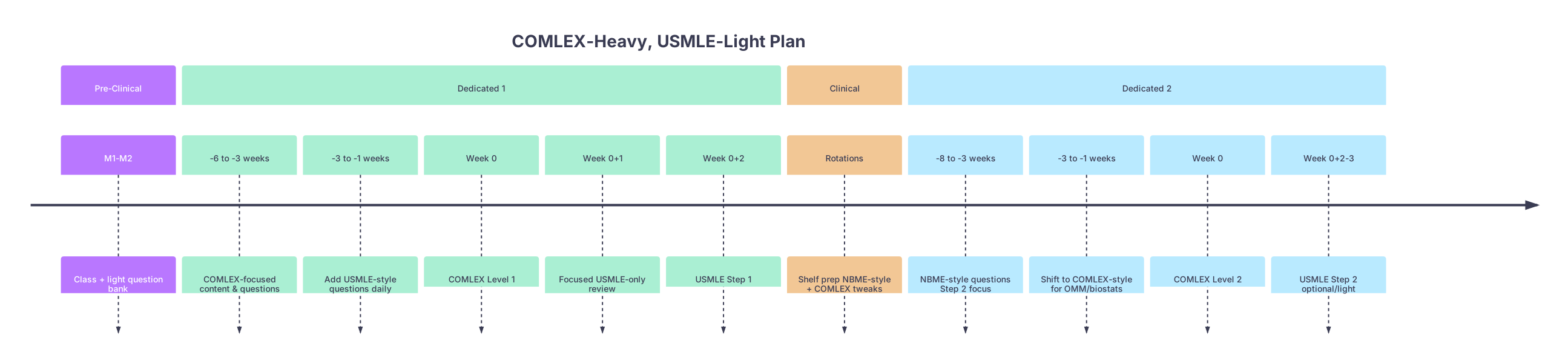
| Period | Event |
|---|---|
| Pre-Clinical - M1-M2 | Class + light question bank |
| Dedicated 1 - -6 to -3 weeks | COMLEX-focused content & questions |
| Dedicated 1 - -3 to -1 weeks | Add USMLE-style questions daily |
| Dedicated 1 - Week 0 | COMLEX Level 1 |
| Dedicated 1 - Week 0+1 | Focused USMLE-only review |
| Dedicated 1 - Week 0+2 | USMLE Step 1 |
| Clinical - Rotations | Shelf prep NBME-style + COMLEX tweaks |
| Dedicated 2 - -8 to -3 weeks | NBME-style questions Step 2 focus |
| Dedicated 2 - -3 to -1 weeks | Shift to COMLEX-style for OMM/biostats |
| Dedicated 2 - Week 0 | COMLEX Level 2 |
| Dedicated 2 - Week 0+2-3 | USMLE Step 2 optional/light |
You can adjust weeks, but the pattern holds:
- Train COMLEX first
- Keep a consistent but low-volume USMLE-style exposure during prep
- Take USMLE shortly after COMLEX when the core content is freshest
Step 3: Daily/Weekly Study Structure – Minimum Effective USMLE
Let me spell out what “USMLE light” actually looks like. I am talking about real hours.
1. During Pre-Dedicated (M2 / Early OMS-3)
COMLEX heavy means:
- 70–80% of your board prep time = COMLEX-oriented resources
- 20–30% = USMLE-style conditioning
Concrete weekly structure (assuming 15 hours/week of board prep):
- 10–12 hours: Mixed systems/path with:
- COMBANK or COMQUEST questions
- Pathoma or Boards & Beyond or similar
- Sketchy if that is your style
- 3–5 hours: USMLE-specific:
- UWorld blocks (10–15 questions, 3–4x/week) in tutor mode, focus on learning style of questions
- Carefully read explanations, not just answers
You are not chasing high UWorld percentages. You are training your brain to think NBME-style:
- Mechanism-based questions
- More layered vignettes
- Less OMM/no OMM, slightly different biostats style
2. Dedicated for COMLEX Level 1
Assume 4–6 weeks.
Basic daily template (8–10 hours):
COMLEX Core (6–7 hours/day)
- 2–3 COMLEX-style blocks (40–60 questions total)
- OMM review (1 hour)
- Sketchy/Anki for weak systems (30–60 minutes)
USMLE Light (1.5–2 hours/day)
- 1 USMLE-style block (20–25 UWorld questions)
- Review explanations thoroughly
- Keep running log of:
- Frequently tested mechanisms
- Classic USMLE-style associations (paraneoplastic, immunodeficiencies, etc.)
This way, when you take COMLEX:
- Your underlying knowledge is strong
- You are not shocked by NBME-style later, because you have been seeing it consistently in small doses
3. Post-COMLEX: 7–14 Day USMLE Sprint
You finish COMLEX Level 1. You are tired. Tough. If you are going to be USMLE light and still competitive, you use the next 1–2 weeks very cleanly.
Daily plan (6–8 hours):
- 2–3 UWorld blocks (40–60 questions)
- UWorld-based Anki/notes in the evening
- One NBME practice exam mid-way (if available)
- Zero OMM. Zero COMLEX-specific content.
You are not “relearning” anything. You are simply:
- Adapting your timing to USMLE block structure
- Seeing higher-yield NBME quirks
- Tightening up weak systems exposed by COMLEX
If you skip this phase and wait months, your COMLEX prep decays, and Step 1 becomes a heavier lift than it needs to be.
Step 4: Resource Strategy – Pick One Primary, One Secondary
You do not have time to hoard resources. People who try to use everything end up mastering nothing.
Use this simple rule:
One primary question bank for COMLEX. One primary question bank for USMLE. Everything else is secondary/optional.
1. COMLEX-Focused Stack
Use:
- Question bank: TrueLearn COMBANK or COMQUEST
- Content: Pathoma + Boards & Beyond (or equivalent)
- OMM:
- Savarese or similar concise OMT review
- 15–30 minutes daily in the 4–6 weeks before Level 1 and 2
2. USMLE Light Stack
Keep this tight:
- Question bank (non-negotiable): UWorld – your main USMLE conditioning tool
- Practice exams:
- NBME practice tests if your budget allows
- Extra content (only if you need it):
- First Aid as a reference, not a textbook
- Step Up to Medicine for clinical years (doubles as Step 2/Level 2 prep)
Do not build a library of eight USMLE books you will never read. That is not “light”; that is just disorganized.
Step 5: COMLEX Level 2 / USMLE Step 2 – Where You Can Be Strategic
For residency competitiveness right now, Step 2 (and Level 2) matter more than Step 1/Level 1, especially for ACGME programs.
You have three main paths:
You already took Step 1
- You should almost always take Step 2. Many programs expect it ✅
You skipped Step 1 but want some USMLE presence
- Take Step 2 only, and do it well. This is common and absolutely workable.
You skip USMLE entirely
- Possible in FM, psych, some IM and peds programs, but it shrinks your options significantly
- Only accept this if you are truly okay with restricting geography and program type
1. Clinical Year Study Setup
During rotations, do not separate “shelf prep” from “Step/Level 2 prep.” That is wasteful.
Instead, set it up like this:
- For each rotation (say Internal Medicine):
- 60–70%: UWorld or NBME-style questions for that clerkship
- 30–40%: COMLEX-style questions for that content area
- OMM:
- 2 short sessions/week (20–30 minutes) to keep OMM fresh leading into Level 2
This keeps:
- Your NBME-style reasoning strong for Step 2
- Your COMLEX format familiarity active
2. Dedicated for Level 2 and Step 2
You can again stack these exams smartly.
Sample 8–10 week structure:
Weeks -10 to -4 (Pre-dedicated during rotations or light period)
- UWorld Step 2 questions (40/day, 5 days/week)
- Review wrongs + key notes/Anki
Weeks -4 to -1 (COMLEX-leaning phase)
- 50–60%: COMLEX-style questions (Level 2 banks)
- 40–50%: UWorld Step 2 questions
- OMM daily (20–30 minutes)
- 1–2 COMSAEs
Week 0: COMLEX Level 2
- Rest 1–2 days afterwards
Weeks +1 to +3: Step 2 Sprint
- UWorld-only blocks
- 1–2 NBMEs
- Fix targeted weaknesses exposed by COMLEX/rotation performance
Take Step 2 at +2 to +3 weeks after Level 2. This window tends to optimize retention + burnout balance.
Step 6: Application Strategy – Make “USMLE Light” Look Deliberate, Not Weak
Your scores are only one piece of your application. The problem is that too many DO students let the USMLE question hang over them like a cloud, then end up with a story that looks unplanned.
You want your plan to look intentional. You are COMLEX-heavy because you are a DO, and you used USMLE strategically.
1. If You Have Both COMLEX and USMLE
Your goals:
- Show that your performance is consistent
- Use USMLE as a “translation layer” for ACGME PDs who are COMLEX-illiterate
Actions:
- Always report both scores accurately in ERAS
- If your USMLE is slightly lower than what you hoped but aligned with COMLEX:
- Use your personal statement and MSPE to highlight:
- Strong clinical evals
- Shelf performance
- Sub-I comments like “functioned at intern level”
- Use your personal statement and MSPE to highlight:
- On interview day, if asked:
- “I focused primarily on COMLEX, as required by my curriculum, and used USMLE to demonstrate that the foundation I built applies across both licensing pathways. My performance on rotations is the best reflection of how I function clinically.”
2. If You Only Have COMLEX
You must compensate in 3 areas:
-
- Heavily favor:
- Programs with explicit “COMLEX accepted only” language
- Historically DO-heavy rosters
- Verify with:
- Current resident lists
- Emailing coordinators if language is ambiguous
- Heavily favor:
Signal Clinical Strength
- Honors on core rotations
- Strong letters from MD attendings who can vouch for you in ACGME terms
- Solid sub-I performances at ACGME institutions
Application Signaling
- In ERAS, avoid defensiveness. If asked about USMLE:
- “My focus was on excelling in COMLEX and in my clinical rotations. I chose not to take USMLE so that I could maximize my performance on the exams directly required for my license and on my rotations, which I believe better reflect my readiness for residency.”
- In ERAS, avoid defensiveness. If asked about USMLE:
You are not apologizing. You are framing.
Step 7: If COMLEX Went Poorly – Damage Control Protocol
Sometimes Level 1 or Level 2 does not go as planned. Single attempt, low pass. Or even a fail and a retake.
This is where USMLE light can actually help you instead of hurt, if you do it correctly.
1. Scenario A: COMLEX Pass, But Low Score
Say Level 1 barely passed or is in a low percentile.
Fix strategy:
- Crush Level 2 and Step 2
- Step 2 becomes your rehab tool
- Intense UWorld + NBME focus
- Tighten test-taking skills (timing, reviewing patterns of misses)
- Target Programs Wisely
- Emphasize programs that:
- State “no score cutoffs”
- Focus more on clinical evals and letters
- Emphasize programs that:
- Narrative (if asked)
- Own it plainly:
- “My Level 1 score was not where I wanted it to be. I adjusted by doing X, Y, Z for Level 2 and Step 2, and my later scores reflect that change. I also consistently honored rotations after that point.”
- Own it plainly:
Do not overshare. Do not emotionally dump. Show adjustment and trajectory.
2. Scenario B: COMLEX Fail, Then Pass
You are not dead in the water, but you must be very disciplined.
Protocol:
Rebuild Content and Test-Taking Mechanically
- Full question bank reset
- Weekly simulated blocks with fixed timing
- Post-block analysis: make a spreadsheet of:
- Content misses
- Misread questions
- Changed-right-to-wrong patterns
Consider USMLE Carefully
- If your eventual COMLEX pass is solid and Step-style practice tests are decent, you can still take:
- Step 2 (likely skip Step 1)
- If you barely passed and continue to struggle with practice exams:
- Focus on:
- Rotations
- Letters
- COMLEX Level 2
- DO-heavy programs
- Skip USMLE if it risks another weak score that just adds red flags
- Focus on:
- If your eventual COMLEX pass is solid and Step-style practice tests are decent, you can still take:
Application Positioning
- Some programs will automatically filter a fail. You cannot fix those.
- Your job is to find the ones that will read your story, then give them a better chapter 2 (strong Level 2 / Step 2 and excellent clinical performance).
Step 8: Specialty-Specific Adjustments
“COMLEX heavy, USMLE light” looks different if you are applying to psych versus ortho. Let me strip out the fluff.
1. Primary Care (FM, Peds, Many IM, Some Psych)
You can often do:
- COMLEX-heavy
- USMLE optional or:
- Take only Step 2 with a focused 4–6 week block
Key priorities:
- High-quality outpatient evals
- Longitudinal continuity or community experiences
- Letters from program-aligned faculty
2. Moderately Competitive Fields (OB/GYN, General Surgery, EM, Anesthesia, PM&R, Many IM Tracks)
You should really plan to:
- Take Step 2 at minimum
- Treat UWorld + NBME practice seriously
- Use away rotations/Sub-I’s at ACGME sites to:
- Show you can thrive in MD-heavy environments
- Get letters from respected attendings
Programs may tolerate “USMLE light,” but they rarely like “no USMLE at all.”
3. Highly Competitive Fields (Derm, Ortho, Neurosurgery, ENT, Plastics, IR, some Rad)
Let me be blunt: being “USMLE light” in these fields usually means:
- You still take Step 1 and Step 2
- You just do not obsessively chase a 260+, because your time is also going into:
- Research
- Away rotations
- Connections and mentorship
If you tell me you want ortho but you “do not feel like” taking USMLE, I will tell you to either change your expectations or change your plan.
Step 9: Protect Your Sanity – Efficiency Moves That Actually Matter
You are trying to be competitive in ACGME while juggling two exam ecosystems. That is a recipe for burnout if you are not deliberate.
Here is how you keep this sustainable while still being serious.
Unify Content, Split Style
- For each organ system:
- Learn the physiology/pathology once
- Then practice in both COMLEX and USMLE question styles
- Do not keep separate notebooks for “USMLE facts” and “COMLEX facts.” That is idiotic duplication.
- For each organ system:
Cap Daily Question Volume
- Sweet spot for most people:
- Preclinical: 40–60 questions/day
- Dedicated: 80–120 questions/day total (both exams combined)
- More than that and your review becomes garbage.
- Sweet spot for most people:
Consolidate Mistakes Into One Master Document or Deck
- One ongoing file (Notion, Google Doc, Anki deck):
- Sections by system (cards or bullets)
- Mark which are “USMLE-leaning” vs “COMLEX-leaning” only if necessary
- Review this 15–20 minutes daily
- One ongoing file (Notion, Google Doc, Anki deck):
Build Short, Non-Negotiable OMM Habits
- OMM is where DOs sabotage themselves:
- Ignore it for 10 months
- Cram for 3 days
- Get destroyed on Level 1/2
- Fix:
- 15–20 minutes, 4–5 days/week in the 6 weeks pre-exam
- High-yield:
- Chapmans
- Autonomics
- Counterstrain points
- Sacrum/innominate patterns
- OMM is where DOs sabotage themselves:
Key Takeaways
- Use COMLEX as your foundation and USMLE as a targeted overlay, not two separate universes. COMLEX-heavy, USMLE-light works only if it is planned and consistent, not improvised.
- Let your specialty and target programs drive your USMLE decisions, not rumors. Competitive fields and many ACGME programs still expect some USMLE presence, especially Step 2.
- Make your pattern look deliberate and upward-trending: strong Level 2/Step 2, solid clinical evals, focused program list. That is how you stay competitive in ACGME without living in a permanent dual-exam grind.