
Most DO students with mixed COMLEX/USMLE scores build their program lists backwards—and it costs them interviews.
If you start by “What specialties will take me?” or “Where do I want to live?” you are already behind. With mixed scores, your margin for error is thinner. You cannot afford a lazy, generic program list. You need a targeted, data‑driven, brutally honest strategy.
I am going to walk you through exactly how to do that.
Step 1: Get Extremely Clear on Your Real Competitiveness
You cannot build a smart list until you stop guessing about your profile.
1. Inventory your actual numbers
Write this down in one place. Not “in your head.”
- COMLEX Level 1: score / pass-fail / attempts
- COMLEX Level 2: score / attempts
- USMLE Step 1: score / pass-fail / attempts
- USMLE Step 2 CK: score / attempts
- Any failures or repeats: which exam, how many times
- Class rank or quartile if available
- Red flags: LOA, professionalism issues, failed rotations, etc.
Do not sugarcoat. Programs will see everything.
Now annotate them with reality:
- Above average
- Around average
- Below average
Use your DO peers, not MD averages, as your baseline.
2. Understand how programs actually read DO + mixed scores
Here is how I have watched PDs and selection committees behave in real life:
Programs that accept both COMLEX and USMLE and genuinely understand DO training
- They will accept either exam for screening.
- If you took USMLE, they will look at it. Closely.
- A weak USMLE can absolutely drag you down, even with a decent COMLEX.
Programs that “accept DOs” but actually screen primarily with USMLE
- They may list COMLEX as accepted, but their entire score infrastructure is USMLE-centric.
- A low USMLE can put you below their auto-screen, regardless of your COMLEX.
Programs that accept only COMLEX
- Growing but still not the majority in some specialties.
- Ideal targets if your COMLEX is significantly stronger than your USMLE.
If your USMLE is significantly weaker than your COMLEX, stop pretending it does not matter. It does. But you can work around it with proper targeting.
3. Benchmark your scores against your chosen specialty
Do not pick specialties in a vacuum. One of the smartest things you can do is compare yourself to typical matched DOs in several specialties.
| Specialty | DO-Friendly? | Typical Matched DO Profile* |
|---|---|---|
| Family Medicine | High | COMLEX 1: 470–520; Step 2: 220–235 |
| Internal Medicine | High | COMLEX 1: 500–550; Step 2: 225–240 |
| Pediatrics | High | COMLEX 1: 490–540; Step 2: 225–240 |
| Psychiatry | Moderate | COMLEX 1: 500–550; Step 2: 230–245 |
| General Surgery | Low-Moderate | COMLEX 1: 520–580; Step 2: 235–250 |
| Anesthesiology | Moderate | COMLEX 1: 520–570; Step 2: 235–250 |
*These are approximate, not guarantees. Individual programs vary.
If you want a competitive specialty as a DO (ortho, derm, ENT, ophtho, urology, radiology), you already know the game: you need significantly above-average scores and strong research / letters / audition rotations. If your scores are mixed or weak, you will need a very aggressive backup plan.
Step 2: Choose Your Specialty Strategy (Primary + Backup)
Before you touch a spreadsheet, answer this blunt question:
Are you going to bet your entire match on your dream specialty, or are you willing to build a real backup path?
There are three basic strategies I see DOs take with mixed scores:
Single-Specialty All-In (high risk)
- 60–80+ applications in one field.
- No or token backup.
- Works only if:
- Scores are at least near-average for DOs in that specialty.
- You have strong letters and often home/away rotations.
- If your USMLE is dramatically weaker than COMLEX, this is dangerous in USMLE-heavy fields.
Primary + Realistic Backup (smart for most)
- Primary specialty: 40–60 applications.
- Backup specialty: 20–40 programs you would genuinely attend.
- Backup chosen to match your score profile (more DO-friendly, more COMLEX-accepting).
- You signal intelligence and humility, not indecision.
Backup-First, with selective primary shots (very risk-averse)
- For applicants with multiple failures, very low scores, or serious red flags.
- Heavy focus on a more open specialty (FM, IM, psych) with a handful of “reach” applications at your dream field.
You know your risk tolerance. But if your scores are mixed and you are a DO, strategy #2 is usually the sweet spot.
Step 3: Build Your Program Universe (Before You Filter)
Now you start building a program universe. Not your final list. Just everything that might possibly accept someone like you.
You will need:
- FREIDA
- Programs’ own websites
- Past match lists from your school
- Any DO-specific lists shared by your dean’s office or upperclassmen
1. Collect basic data for each program
Set up a spreadsheet with at least:
- Program name
- City/State
- Specialty
- Type (academic, community, hybrid)
- DO-friendliness (quantified, see below)
- Exam requirements:
- Accept COMLEX?
- Require USMLE?
- Prefer USMLE?
- Historical DO residents (yes/no + count if obvious)
- Minimum scores or stated cutoffs (if any)
- Visa policy (if you are an IMG or need a visa)
- Geographic preference (your own: Strong, Neutral, Avoid)
This looks tedious. It is. But it is also the difference between 12 interviews and 3.
2. Quantify DO-friendliness
Do not rely on vibes. Use real numbers. Go to each program’s website and resident roster.
Ask:
- How many DO residents per class?
- Are there any DO chiefs?
- Any leadership with DO degrees?
- Any explicit language about DOs?
Assign a DO-friendliness score 1–3:
- 3 – Very DO-friendly: DOs routinely in each class; DO faculty or PD; explicit DO-accepting language.
- 2 – Moderately DO-friendly: DOs present intermittently; at least some precedent.
- 1 – Low DO-friendliness: Virtually no DOs historically; all MD faculty.
Put that number in your sheet.
3. Map COMLEX vs USMLE expectations
You need to know where your mixed scores will matter most.
Categorize each program:
Category A: COMLEX only
- Program explicitly states COMLEX accepted and USMLE not required.
- Ideal if COMLEX > USMLE.
Category B: COMLEX or USMLE equally
- Language like “we accept either COMLEX or USMLE.”
- Check if their current DO residents list only COMLEX or both.
Category C: USMLE required / heavily preferred
- “USMLE Step 1 and Step 2 required” or “strongly preferred.”
- They may still take DOs, but your weaker USMLE will hurt here.
Color-code these in your sheet. Later, you will use this to filter ruthlessly.
Step 4: Translate Your Scores into Target / Reach / Safety
Blindly applying to 80 programs is not a strategy. It is panic.
You are going to build three tiers relative to your actual scores and each specific program’s trends.
1. Define your tiers
For each specialty, for each program, estimate where you stand:
Safety
- DO-friendly (score 3).
- COMLEX-accepting and not USMLE-obsessed if your USMLE is weaker.
- Their average matched DO scores appear at or below yours.
- Historically have several DOs and some lower-end scores in past match data (ask advisors if they have this).
Target
- DO-friendly or at least moderate (score 2–3).
- Your scores are around their apparent average, maybe a little below.
- Some DOs in recent classes.
Reach
- Limited DO presence or historically very strong scores.
- Heavy academic reputation, “top” university affiliations.
- Or: your scores are clearly below what they usually take.
2. Use rough score bands to assign tiers
Helpful rule of thumb for many core specialties (FM, IM, peds, psych):
Compare your scores against DO benchmarks and adjust by DO-friendliness.
Example for IM (as a DO):
- COMLEX Level 1 540 / Level 2 560, Step 2 CK 242
- At a DO-heavy community IM program: likely Target/Safety.
- At a mid-tier academic university with some DOs: Target.
- At a top 20 academic IM: Reach.
If instead your profile is:
- COMLEX Level 1 470 / Level 2 505, Step 2 CK 220
- DO-heavy community program: Target/Safety.
- Community/university hybrid: Target/Reach.
- Pure academic flagship: Mostly Reach.
Be honest. If you mislabel reaches as targets, you will feel “blindsided” in March. You were not. You were just wrong in October.
Step 5: Factor In Your Mixed Scores Strategically
Here is where many DOs with mixed COMLEX/USMLE scores screw up. They treat programs that “accept COMLEX” as equivalent, regardless of whether those programs also demand USMLE.
You need a more surgical approach.
1. If your COMLEX >> USMLE
Example:
- COMLEX Level 1 570, Level 2 590
- Step 2 CK 223
This is common: strong COMLEX test taker, average or weak USMLE.
Your priorities:
Maximize applications to COMLEX-only or COMLEX-primary programs (Categories A and B).
- Where USMLE is optional, your weak USMLE is less damaging.
- Many community and DO-heavy university programs fall here.
Limit or strategically select USMLE-heavy programs (Category C).
- Only apply to those if:
- They are very DO-friendly.
- Or they are geographically crucial for you.
- Recognize your low USMLE may trip auto-filters. You might be screened out before anyone admires your COMLEX.
- Only apply to those if:
Heavily individualize your personal statement and letters.
- In some cases, you can briefly contextualize the USMLE performance in your MSPE or advisor letter.
- Do not volunteer excuses in your personal statement unless there is a legitimate, documented reason and you discuss it with an advisor.
2. If your USMLE >> COMLEX
Example:
- COMLEX Level 1 480, Level 2 495
- Step 2 CK 244
This is less common but does happen. Maybe you figured out the testing game later or had a bad Level 1.
Your priorities:
Lean into USMLE-heavy programs (Category C).
- Programs that barely understand COMLEX may still see your Step 2 as “good enough” to ignore weaker COMLEX numbers.
- Play in the MD-dominated sandbox more confidently.
Still apply to COMLEX-centric programs, but recognize their mindset.
- Some DO programs are weirdly attached to COMLEX and may give more weight to that than Step 2.
- Check if their DO residents usually list high COMLEX.
Make sure your transcript and MSPE show clear improvement.
- Elevate everything that screams “upward trend” to offset any worry from a weaker Level 1.
3. If everything is mid-range or weak
Example:
- COMLEX Level 1 455, Level 2 470
- Step 2 CK 218
This is where cold-blooded honesty matters most.
You have three levers:
- Volume of applications: You likely need more.
- Breadth of specialties: You should seriously consider a backup that is DO-friendly (FM, IM, psych, peds).
- Program type: Focus heavily on DO-heavy community programs and less on academic flagships.
You are not out. But you do not have the luxury of a short, “I only want big-name university programs” list.
Step 6: Build the Actual Program List (Numbers That Work)
Let us translate this into concrete numbers.
1. Decide total application volume
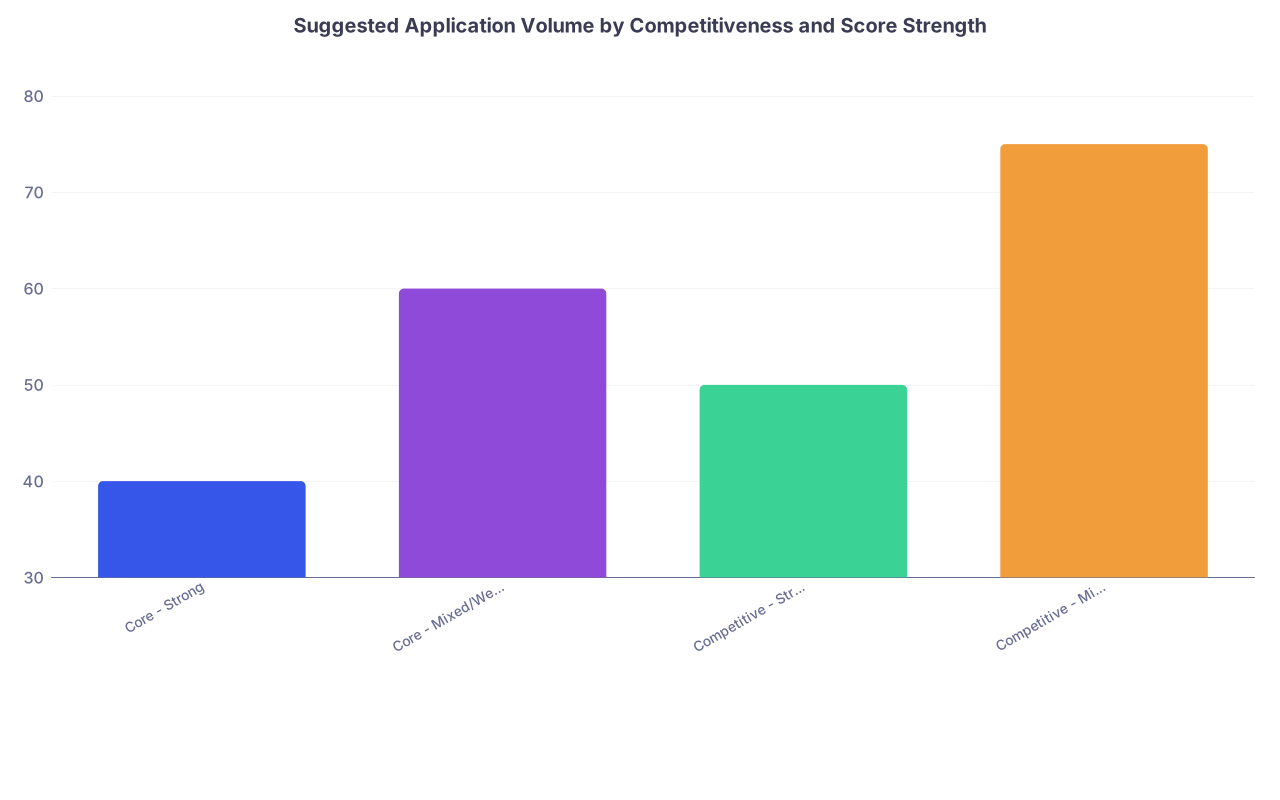
Assuming a DO with mixed scores, targeting non-ultra-competitive specialty:
Core specialty (FM, IM, peds, psych, EM in some regions):
- If scores are solid: ~30–45 programs.
- If scores are mixed/weak: ~45–70 programs.
More competitive specialty (gas, gen surg, rads, etc.):
- If scores are solid: ~40–60.
- If scores are mixed/weak: ~60–80 plus a real backup.
This is not gospel. But if you are way below these ranges, you are probably being too optimistic. Way above, and you are wasting money on programs that will never seriously consider you.
| Category | Value |
|---|---|
| Core - Strong | 40 |
| Core - Mixed/Weak | 60 |
| Competitive - Strong | 50 |
| Competitive - Mixed/Weak | 75 |
2. Allocate by tier
For your primary specialty, a reasonable split for a DO with mixed scores:
- 20–30% Safety
- 40–50% Target
- 20–40% Reach
If your scores are weaker, that mix shifts more toward Safety/Target.
For your backup specialty (if you have one):
- 30–40% Safety
- 40–50% Target
- 10–20% Reach
Do not build a backup list that is mostly reach. That defeats the purpose.
Step 7: Geographic and Lifestyle Filters (Applied Last, Not First)
Now that you have a rough, score-aligned draft, you can apply reality filters:
- Regions where you have strong geographic ties (family, medical school, undergrad).
- Regions where you have no intention of living, no matter what.
- Cost-of-living, partner’s job, visa constraints if relevant.
Rank your geographic preferences:
- Must-have regions (where you genuinely want to end up)
- Acceptable regions
- Would-rather-not regions
Then cross-check:
- Do you have enough Safety/Target programs in the Must-have + Acceptable buckets?
- If not, you either:
- Broaden geography, or
- Accept higher match risk.
A common DO mistake: restricting to “only East Coast major cities” or “only California” with middling scores. That is how you end up unmatched with 40 applications.
Step 8: Final Filtering with Red Flags and Extras
Now layer in the “soft” factors that still matter.
1. Red flags filtering
If you have:
- Any exam failures
- Rotation failures
- LOA
- Documented professionalism issues
Then:
- Give more weight to programs that explicitly mention “holistic review” or that have a history of taking applicants with non-traditional paths.
- Consider reaching out privately to a few PDs or coordinators (after talking with your dean) to see if they consider applicants with your specific red flag.
- Increase the number of Safety programs.
2. Audition / away rotation influence
- Those programs move up in priority, if the feedback was good.
- If feedback was mediocre or you sensed coolness, be cautious—do not overapply in that same region assuming “they know me.”
3. Extra strengths as tiebreakers
If you are choosing between similar programs, look at:
- Research match with your CV
- Special tracks (rural, global health, osteopathic recognition)
- Procedural volume for your interests
Use these to trim your list down to something financially and logistically sane.
Step 9: Test Your List Before You Submit
Before you press submit on ERAS, stress-test your list like you would a board question.
Ask yourself:
If I got zero interviews at my Reach programs, would I still have a shot via my Target/Safety programs?
- If no, restructure.
Are there any regions where I applied mostly to competitive academic programs with poor DO representation and strong USMLE bias?
- If yes, add more community / DO-heavy options if you want that region.
Does my list reflect my actual score profile, or my fantasy of what I “should” have been?
- Brutal question. Important answer.
If you have a trusted advisor, residency director, or recent graduate in your specialty, show them your spreadsheet. Make them tear it apart.
Step 10: Example Scenarios
Let me give you two concrete walkthroughs to see how this plays out.
Scenario A: DO, strong COMLEX, weak USMLE, wants IM
- COMLEX 1: 560
- COMLEX 2: 585
- Step 2 CK: 223
- No failures, mid-high class rank.
Strategy:
- Primary: Internal Medicine
- No backup needed if list is smart.
Program list:
- Total IM programs: ~55
- 15 Safety: DO-heavy community, COMLEX-mainly, multiple DO residents.
- 25 Target: Mix of community and hybrid programs, accept COMLEX or USMLE equally, some DOs in each class.
- 15 Reach: Mostly academic centers that accept DOs but are more USMLE-centric.
Filter aggressively toward Category A/B (COMLEX-accepting), particularly in regions where they want to live. Minimize Category C to maybe 8–10 dream academic programs they would actually attend.
Scenario B: DO, middling everything, wants psych with FM backup
- COMLEX 1: 470
- COMLEX 2: 500
- Step 2 CK: 222
- One failed COMLEX 1 attempt, passed on second.
Strategy:
- Primary: Psychiatry
- Backup: Family Medicine
Program list:
Psych: ~40 programs
- 10 Safety (DO-heavy, rural or community-based, COMLEX-friendly)
- 20 Target (community, hybrid, some DOs)
- 10 Reach (urban academic with occasional DOs)
FM: ~30 programs
- 15 Safety (very DO-heavy, often COMLEX-only)
- 10 Target
- 5 Reach (university-affiliated but DO-friendly)
This applicant survives on volume + DO-friendliness + geographic flexibility. No fantasy about matching at the most prestigious psych programs in major coastal cities.
Quick Visual: Program Selection Flow

| Step | Description |
|---|---|
| Step 1 | Start: Know Your Scores |
| Step 2 | Assess DO-Friendliness by Program |
| Step 3 | Classify Score Strength vs Specialty |
| Step 4 | Add Realistic Backup Specialty |
| Step 5 | Stay Single-Specialty |
| Step 6 | Build Program Universe (Primary + Backup) |
| Step 7 | Tag Programs: COMLEX vs USMLE Priority |
| Step 8 | Assign Tiers: Safety/Target/Reach |
| Step 9 | Apply Geographic & Personal Filters |
| Step 10 | Stress-Test Risk Balance |
| Step 11 | Finalize Program List & Submit ERAS |
| Step 12 | Choose Primary Specialty |
| Step 13 | Mixed or Weak Scores? |
The Bottom Line
You are not just “a DO with mixed scores.” You are a data problem that can be solved.
If you remember nothing else:
Stop guessing about your competitiveness. Put your numbers, red flags, and specialty data in one place and be brutally honest about what they mean for you as a DO.
Target DO-friendly, COMLEX-aware programs on purpose. Especially if your USMLE is weaker. Category A/B programs should be the backbone of your list, not an afterthought.
Use tiers and volume intelligently. Build a list with a rational mix of Safety, Target, and Reach across primary (and if needed, backup) specialties, then apply geography and lifestyle filters last, not first.
Do that, and you are no longer “hoping to match.” You are executing a plan.