The way most osteopathic students build their CV for ACGME programs is wrong. They list everything they have ever done and hope something sticks. ACGME PDs do not have time for that, and they definitely do not speak “osteopathic extracurricular” by default.
You are not trying to document your life. You are trying to translate a primarily osteopathic background into a language ACGME program directors understand and respect. That is a very different job.
Here is how to fix it.
Step 1: Understand What ACGME Programs Actually Look For
Forget the mythology for a moment. ACGME program directors, when scanning a CV, are essentially asking five questions:
- Can this person handle the workload and complexity of residency?
- Will this person be safe with patients?
- Is this person reliable and not a headache?
- Has this person shown any initiative beyond the bare minimum?
- Will this person fit with our culture and accreditation requirements?
Every major section of your CV needs to answer at least one of those questions clearly. If it does not, it is filler.
Here is how ACGME PDs mentally chunk your CV:
- Education / Exams → baseline competence and trajectory
- Clinical experiences / rotations → readiness for day 1
- Research / scholarly work → intellectual curiosity, academic orientation
- Leadership / service → professionalism, initiative
- Awards → external validation
- Skills / interests → minor tie-breakers and interview fodder
Your problem as an osteopathic applicant: many of your experiences happen in DO-specific contexts (OMM clinic, COMSAE, campus osteopathic clubs, small community preceptors, AOA research days). None of that is “bad.” It just needs translation and framing.
Step 2: Use an ACGME-Friendly CV Structure
If your CV looks unconventional, you lose points before content is even read. Use a structure that mirrors what ACGME faculty see from MD schools.
Core sections (in order):
- Contact Information
- Education
- Examination Scores / Certifications (USMLE/COMLEX, BLS/ACLS, etc.)
- Clinical Experience (Core and Sub-I / Acting Internships)
- Research and Scholarly Activity
- Teaching and Leadership
- Service / Volunteer Experience
- Honors and Awards
- Professional Memberships
- Skills and Interests
Optional, if strong:
- Presentations and Posters
- Publications (separate from “Research” if you have several)
Avoid odd categories like “Osteopathic Activities” or “Holistic Experiences.” That screams “I do not know how to align with your system.”
Step 3: Translate Osteopathic Education into ACGME Language
Education Section: Clean and Neutral
You do not need to explain or apologize for being DO. You simply present it clearly and professionally.
Example:
Education
- Doctor of Osteopathic Medicine (D.O.), Kansas City University College of Osteopathic Medicine
Kansas City, MO | Expected May 2026 - Bachelor of Science in Biology, University of Iowa
Iowa City, IA | May 2021 | GPA: 3.72
Do:
- Use full school names and city/state.
- Include graduation month/year for both degrees.
- Include undergrad GPA only if it is a strength.
Do not:
- List your high school.
- Over-explain “osteopathic philosophy” here. Save that for a personal statement if needed.
Exams: Make Your Dual-Exam Story Obvious
ACGME PDs understand USMLE better than COMLEX. You must make this section idiot-proof.
Licensure Examinations
- USMLE Step 1: Pass (January 2024)
- USMLE Step 2 CK: 246 (August 2024)
- COMLEX Level 1: Pass (June 2023)
- COMLEX Level 2-CE: 630 (July 2024)
Do not bury it. Do not make them hunt.
- COMLEX Level 1: Pass (June 2023)
- COMLEX Level 2-CE: 635 (July 2024)
Then compensate in other sections with clarity and strength: strong clinical narratives, strong letters from MD/ACGME settings, research if possible.
Step 4: Rebuild Your Clinical Experience to Sound ACGME-Native
This is where most osteopathic CVs fall apart. They list 30 preceptor experiences with zero context.
Your goal: fewer entries, more impact, written in residency language.
Core Strategy
- Group routine core rotations under “Core Clinical Clerkships” with brief bullets.
- Highlight 3–6 key experiences (sub-Is, audition rotations, high-impact electives) individually.
- Emphasize responsibility, complexity, systems familiarity, and supervision level.
Example: Core Clerkships (Grouped)
Core Clinical Clerkships – Third Year
Various locations, Midwest Region | July 2024 – June 2025
- Internal Medicine – 8 weeks (community hospital, 250 beds)
- General Surgery – 8 weeks (level II trauma center)
- Pediatrics – 6 weeks (urban academic children’s hospital)
- Obstetrics & Gynecology – 6 weeks (community program with residency)
- Psychiatry – 6 weeks (inpatient and outpatient)
- Family Medicine – 6 weeks (FQHC and continuity clinic)
You do not need bullets for every core unless something special happened. The goal is to show breadth and setting.
Example: High-Impact Rotation (Sub-I / Audition) – Detailed
Acting Intern – Internal Medicine
University Hospital, ACGME-Accredited Residency Program | Chicago, IL
August 2025
- Managed 6–8 patients daily under direct supervision of PGY-2/PGY-3 residents and attending.
- Wrote daily progress notes, placed admission orders, and presented on rounds using structured assessment plans.
- Coordinated workup and management for patients with sepsis, DKA, COPD exacerbations, and decompensated heart failure.
- Participated in daily noon conferences and morbidity & mortality reviews.
Notice the language: “managed X patients,” “wrote daily progress notes,” “presented on rounds.” That is ACGME-speak.
What to Do with Osteopathic-Specific Clinics
Let us say you did an OMM clinic for several months.
Wrong version:
OMM Clinic Rotation – Treated patients using osteopathic manipulative medicine.
Better version:
Outpatient Musculoskeletal and OMM Clinic
College-Run Continuity Clinic | Des Moines, IA
January 2025 – March 2025
- Evaluated 6–10 patients per half-day with back pain, neck pain, headache, and chronic musculoskeletal complaints.
- Performed full H&P, developed differential diagnoses, and discussed management with supervising DO faculty.
- Integrated osteopathic manipulative treatment as part of multimodal pain management plans, focusing on function and patient education.
You are framing OMM as part of standard musculoskeletal care, not a mystical side pursuit.
Step 5: Turn “Small DO Projects” into Real Scholarly Activity
ACGME programs want to see some sign of scholarly engagement. That does not have to be NEJM-level research.
You probably have more scholarly material than you think:
- School research electives
- Quality improvement projects at rotation sites
- Case reports prepared with DO preceptors
- Posters at local or regional osteopathic conferences
- Student-led chart reviews that never got published (yet)
Your job is to:
- Categorize properly (Publication, Poster, Abstract, Project).
- Use standard citation format.
- Use strong, neutral, academic language.
Example: Case Report at DO Conference
Posters and Presentations
- Smith J, Your Name, Lee A. “Recurrent Syncope in a Young Athlete: An Unusual Presentation of HCM.” Poster presented at: American College of Osteopathic Internists Regional Meeting; October 2024; St. Louis, MO.
That reads just like any MD academic entry. No one cares that it was at an osteopathic meeting. They care that you produced something, presented it, and can talk about it.
Example: QI Project from a Community DO Site
If it was never formally presented, move it under “Research and Scholarly Activity” or “Quality Improvement.”
Research and Quality Improvement
- “Reducing Unnecessary Telemetry Use on a Community Hospital Service.” Quality improvement project conducted during internal medicine clerkship. Collected baseline data on telemetry utilization, implemented an educational intervention for residents, and measured 4-week post-intervention changes.
No need to pretend it was a randomized trial. Just be precise about your role and outcomes if you have them.
Step 6: Reframe Osteopathic Leadership and Service So ACGME PDs Care
You probably have roles like:
- SOMA officer
- OMM table trainer
- Anatomy/OMS tutor
- DO school wellness committee
- Pre-med mentoring
These are not second-class. They are just unfamiliar. Translate the function, not the label.
Leadership Example – SOMA
Weak:
SOMA Treasurer – Attended meetings and managed finances.
Strong:
Treasurer, Student Osteopathic Medical Association (SOMA)
Kansas City University | May 2023 – May 2024
- Managed a $12,000 annual budget for student advocacy, outreach, and educational events.
- Coordinated funding for 5 regional conferences and 3 campus-wide physician speaker events.
- Implemented a reimbursement tracking system that decreased processing time from 6 weeks to 2 weeks.
Now you sound like an adult who can handle logistics and systems, not “a club kid.”
Teaching Example – OMM Table Trainer
Weak:
OMM Table Trainer – Helped students with OMM.
Better:
Teaching Assistant, Osteopathic Principles and Practice Laboratory
Kansas City University | August 2023 – May 2024
- Instructed first-year students in musculoskeletal examination techniques and osteopathic manipulative treatment under faculty supervision.
- Led small groups of 6–8 students, demonstrating techniques and providing real-time feedback on positioning and safety.
- Assisted faculty in developing practice checklists and skills evaluation rubrics.
Again, ACGME-friendly teaching language.
Step 7: Handling the “Mostly DO, Little MD/ACGME Exposure” Problem
This is the reality for many. Your CV is loaded with DO faculty, DO clinics, DO conferences. That is not fatal, but you should plug the gaps.
Here is the protocol.
1. Get at Least Some ACGME/MD Touchpoints
You want at least one of the following clearly visible in the CV:
- One or more sub-Is / audition rotations at ACGME programs in your desired specialty.
- Research with an MD or faculty at an ACGME institution (even retrospective chart reviews).
- Volunteer work or longitudinal clinic at a large hospital system.
- National society membership that is dual-recognized (ACP, AAFP, ACC, etc.).
Then highlight those experiences harder. Put those ACGME-linked rotations at the top of your Clinical Experience section.
2. Be Explicit about Collaborative and Interdisciplinary Work
When everything is DO-heavy, you can still show that you function in a mixed environment.
Wrong:
“Rotated with DO preceptor in family medicine.”
Better:
“Worked within an interprofessional team including MD/DO attendings, NPs, PAs, pharmacists, and social workers to manage adult primary care patients in an FQHC setting.”
3. Build a Short-Term Plan if You Are Early (MS2–MS3)
If you are not in application season yet, you still have time to retrofit:
- Aim for at least 1–2 audition rotations at strong ACGME programs in your target region.
- Ask about joining small QI or research projects the moment you hit your first hospital-based rotation.
- Submit at least 1 poster to a regional or national conference (osteopathic or not).
Even a modest MD-attached QI project on your CV changes how your whole DO story reads.
Step 8: Clean Up the Noise and Red Flags
ACGME-friendly means professional, restrained, and relevant. A lot of osteopathic CVs are cluttered.
Cut or Minimize:
- High school achievements. Nobody cares.
- Random shadowing from college unless it is extraordinary.
- Non-clinical jobs that have no leadership, responsibility, or continuity.
- Overly spiritual or philosophical descriptions of osteopathy. Save that for essays if you must.
Fix Gaps and Oddities:
- Unexplained time gaps → briefly address with a simple entry:
- “Personal Leave (Family Responsibilities)” – Jan 2023 – March 2023.
- Failures/remediations → not on CV, but know how to discuss them honestly when asked.
- Grade language like “Pass with Remediation” → do not list on CV. That lives in transcripts/MSPE.
Step 9: Formatting Rules That Make You Look ACGME-Ready
You are applying to physicians who scan dozens of CVs in a sitting. Make yours painless.
Basic rules:
- Font: 10–12 point, single standard (Calibri, Arial, Times).
- Consistent date format (e.g., “Aug 2023 – May 2024”).
- Reverse chronological order within each section.
- 1–2 pages for students is normal. 3 is fine if you have real content (research, degrees, etc.).
- Use bold for roles/titles or institutions consistently, not both randomly.
Big red flag: grammar or spelling errors. Have at least two people proofread; ideally one DO who knows your story and one MD/ACGME faculty who will be brutally honest.
Step 10: Example – Before and After CV Entry Transformations
Let us concretely show how to turn a very osteopathic-sounding CV into something ACGME programs like.
| Original Entry (Weak) | Reframed Entry (ACGME-Friendly) |
|---|---|
| OMM Clinic Rotation – Treated patients with OMT. | Outpatient Musculoskeletal/OMM Clinic – Evaluated and managed common musculoskeletal complaints; performed focused exams and integrated OMT into multimodal treatment plans under faculty supervision. |
| SOMA Member – Attended meetings. | Member, Student Osteopathic Medical Association – Participated in local advocacy events and campus-wide health education initiatives. |
| DO Research Elective – Did research on hypertension. | Research Elective – Assisted with retrospective chart review examining hypertension control in a community internal medicine clinic; responsibilities included data extraction, database entry, and preliminary descriptive analysis. |
| OMM Club Table Trainer – Helped with techniques. | Teaching Assistant, Osteopathic Principles and Practice Lab – Taught first-year students physical exam and OMT techniques in small-group labs; provided real-time feedback and assisted with practical exam preparation. |
| Pre-med Mentor – Talked to undergrads. | Pre-med Mentor, University Pipeline Program – Met monthly with 3–4 pre-medical students; advised on coursework, application strategy, and professional development. |
The experiences did not change. Only the framing did.
Step 11: Put It All into a Coherent ACGME-Facing Narrative
A CV does not stand alone. It feeds your ERAS application, your personal statement, your letters, and your interview story.
You want all of it to say something like:
“I trained in an osteopathic environment, but I function comfortably in mainstream ACGME systems, understand team-based care, and have already operated at near-intern level on relevant rotations. I am reliable, I show up, and I produce scholarly or QI work when given the opportunity.”
That means:
- Your Clinical section shows increasing responsibility, especially on audition/sub-I rotations.
- Your Research/Scholarly section proves you can move a project to completion.
- Your Leadership/Teaching section shows you are not a passive passenger.
- Your Service shows some level of commitment beyond yourself.
If your CV pulls in that direction, ACGME PDs do not care that most of your early experiences were at DO institutions. They care whether you look like a safe, teachable, collegial resident.
A Simple Build-Order if You Are Starting Now
If you feel like your current CV is “too osteopathic” and not competitive, here is a straight roadmap.

| Step | Description |
|---|---|
| Step 1 | Audit Current CV |
| Step 2 | Standardize Structure |
| Step 3 | Rewrite Clinical Experiences |
| Step 4 | Reframe Leadership/Teaching |
| Step 5 | Document Research/QI Clearly |
| Step 6 | Add or Seek ACGME Exposure |
| Step 7 | Proofread and External Review |
- Audit: Remove fluff, fix structure to the standard sections.
- Rewrite Clinical: Group cores, highlight sub-Is, use responsibility-focused bullets.
- Reframe Leadership/Teaching: Translate DO-specific roles into generic leadership/teaching language.
- Document Research/QI: Pull every scholarly thing you have done into one coherent section.
- Seek ACGME Exposure (if time): Add 1–2 audition rotations or small QI projects.
- External Review: Have an ACGME faculty member or MD resident review for clarity.
Add one more pass for polish and consistency, and you are ahead of a large fraction of DO applicants.
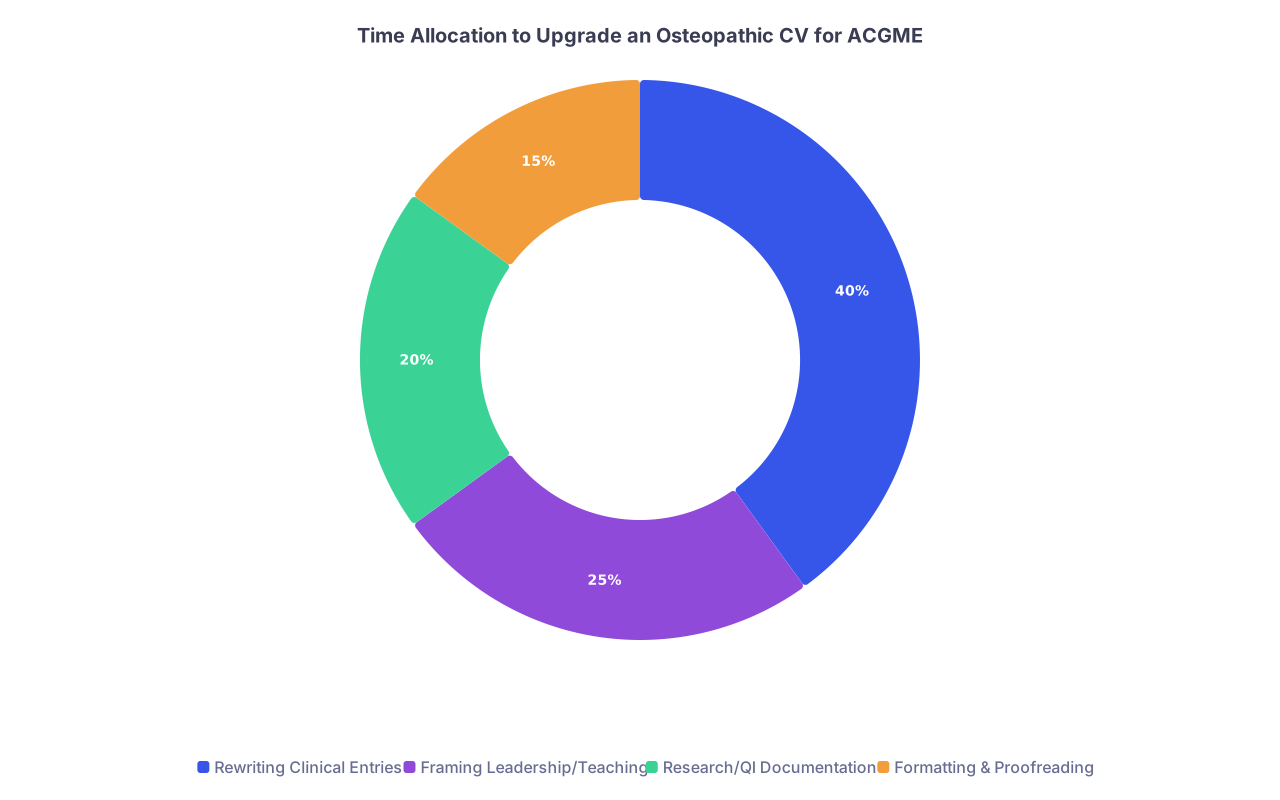
| Category | Value |
|---|---|
| Rewriting Clinical Entries | 40 |
| Framing Leadership/Teaching | 25 |
| Research/QI Documentation | 20 |
| Formatting & Proofreading | 15 |
Key Takeaways
- ACGME-friendly does not mean “less osteopathic.” It means your experiences are translated into standard residency language focused on responsibility, systems, and outcomes.
- Your primarily osteopathic background is not the problem. Unstructured, overly niche, or poorly framed descriptions are. Fix the framing, and you fix the perception.
- If you plug a few strategic gaps (ACGME-linked rotations, a basic QI or research project, clear teaching/leadership roles), your DO-heavy CV can look as strong and familiar to PDs as any MD applicant’s.