
It is August. You just pulled up your unofficial transcript from the registrar so you can start filling out ERAS.
And your stomach drops.
Internal Medicine: Pass.
Surgery: Pass.
Pediatrics: Pass.
OB/GYN: High Pass.
Psych: Pass.
Family Med: Pass.
No Honors in core clerkships. Maybe one or two borderline evaluations. Maybe a “Needs Improvement” comment that still makes you cringe.
You are a DO student aiming for ACGME residency. Maybe even in a semi‑competitive field. And now you are staring at the part of your application that program directors take very seriously: third‑year performance.
Here is the good news: this is fixable. Not with wishful thinking. With a deliberate, structured repair plan that changes what program directors see and how they interpret those grades.
I am going to walk you through exactly how to do that.
Step 1: Diagnose Exactly What Is Wrong (Not Just “My Grades Are Bad”)
“Bad clerkship grades” is vague. Program directors do not see “bad.” They see patterns.
First thing you do: get precise.
1. Pull every relevant document
You need:
- Full transcript with:
- All pre‑clinical grades
- All core rotations with final grades
- Any sub‑I / advanced rotation grades
- COMLEX (and USMLE if taken) score reports
- Individual rotation evals if accessible:
- Attending comments
- Resident comments
- Professionalism flags
- Shelf / COMAT scores
Do not guess. Have the data in front of you.
2. Classify your problem
You are usually in one (or more) of these buckets:
Straight Passes with no disasters
- Mostly P’s, maybe 1 HP, no Honors
- Evaluations “fine but not exceptional”
- This screams: “Average; did not stand out clinically.”
One or two bad rotations dragging you down
- Example: One Fail or Conditional Pass on Surgery or IM
- Or a documented professionalism concern
- This screams: “Risk. Could be a problem resident.”
Weak shelves / COMATs overshadowing decent evals
- Narrative evals say “great to work with,” but low test scores
- Step/COMLEX decent or borderline
- This screams: “Questionable medical knowledge under pressure.”
Across‑the‑board mediocrity: Pre‑clinicals + clerkships
- No obvious strength anywhere on the academic side
- PDs think: “Is this someone who can handle residency?”
You need to write down, in one or two sentences, what your actual issue is.
Example:
- “Mostly Passes in cores, with one conditional in Surgery for poor documentation and time management, COMLEX 1: 515, no USMLE.”
- “All Passes in cores, strong narrative evals, but COMATs in IM and Peds <30th percentile. COMLEX below national mean.”
If you cannot summarize the problem cleanly, you will not fix it cleanly.
Step 2: Reality Check – How Much Does This Hurt You for ACGME?
Program directors do not weigh everything equally. You need to know where your weak grades hurt the most.
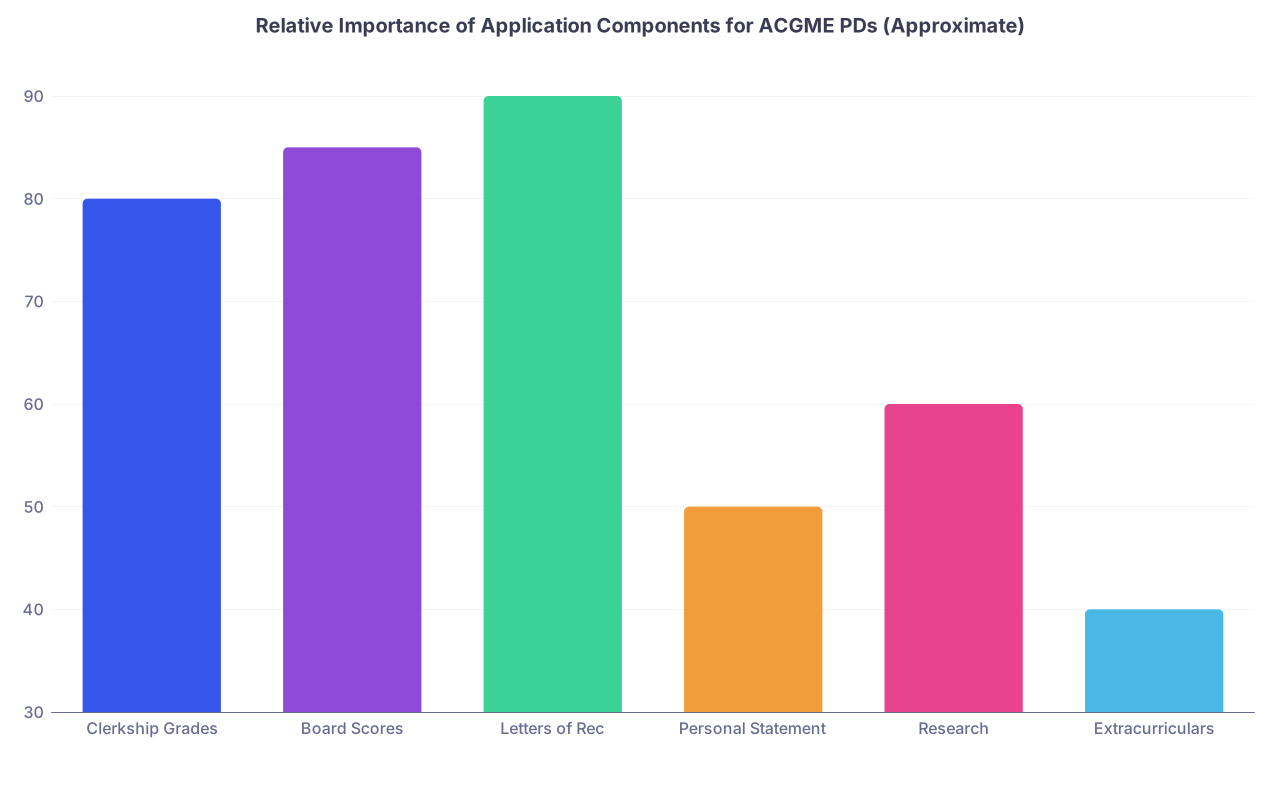
| Category | Value |
|---|---|
| Clerkship Grades | 80 |
| Board Scores | 85 |
| Letters of Rec | 90 |
| Personal Statement | 50 |
| Research | 60 |
| Extracurriculars | 40 |
These are rough, but directionally accurate for many ACGME PDs:
- Board scores and clinical evaluations: highest signal.
- Letters of recommendation: can override some weaknesses.
- Personal statement, research, leadership: modifiers, not foundations.
Specialty matters
Weak core clerkship grades hurt differently by specialty.
| Specialty Type | Impact of Weak Core Clerkship Grades |
|---|---|
| Primary Care (FM, IM) | Moderate – can be offset with strong 4th-year FM/IM rotations and letters |
| Psych, Neuro | Moderate – narrative comments and fit can compensate more |
| EM | High – SLOEs and rotation performance heavily scrutinized |
| OB/GYN, Gen Surg | Very high – third-year core performance is a major screen |
| Competitive (Derm, Ortho, ENT) | Extreme – weak cores usually fatal without exceptional strengths elsewhere |
If you are aiming for dermatology with a transcript full of Passes in Medicine and Surgery and no strong research or board scores, I am not going to sugarcoat it. You have a structural problem, not a cosmetic one.
But if you are targeting:
- ACGME Internal Medicine
- Family Medicine
- Psychiatry
- Pediatrics
- Community EM
Then weak core clerkship grades are a problem, not a sentence. You fix a problem.
Step 3: Build a 4th‑Year “Repair Plan” – Not Just a Schedule
You do not “fix” 3rd year by explaining it away. You fix it by:
- Outperforming your past self in 4th year.
- Creating hard evidence that the weaknesses are now strengths.
- Making sure the right people see that evidence and write it down.
Here is how to structure that.
1. Choose rotations strategically, not emotionally
Your instinct may be to do “fun” electives early. That is a mistake. Your first 4–5 blocks should be:
- Sub‑I in your target specialty (or closely related)
- For IM: IM wards, Hospitalist Sub‑I
- For FM: Inpatient FM or strong outpatient FM with heavy responsibility
- For Psych: Inpatient psych or CL psych
- Away rotation(s) in ACGME programs if possible
- Especially crucial in EM, OB/GYN, Surgery, PM&R, and some IM programs
- A “redemption” rotation in the area you struggled
- Bad in IM third year? Do a strong IM Sub‑I and crush it
- Struggled in Surgery? Do a focused, high‑intensity surgery elective and document the improvement
Front‑load these before ERAS submission (or before most interviews). You want:
- Strong evaluations
- Letters ready early
- Improved performance documented by September/October
2. Set explicit performance goals on each rotation
Do not just “hope to do better.” On day one of a key rotation, you say to your attending:
“I want to be explicit about my goals. I underperformed in [IM/Surgery/etc] during 3rd year, mostly around [time management / documentation / confidence in presenting]. My goal here is to show I can function at an intern level in those domains. I would really value specific feedback and I plan to improve week to week.”
Is that uncomfortable? Yes. Do serious students do it? Yes.
I have watched PDs change their minds about an applicant because of this kind of transparency + documented improvement.
Then you:
- Ask for mid‑rotation feedback and write it down
- Correct the problems in real time
- Ask the attending at the end if they feel you improved and could function like an intern
You are building a narrative: “I struggled, I identified the problem, I fixed it, and here is proof.”
3. Time your “repair” rotations against ERAS
Use this simple timeline mindset:
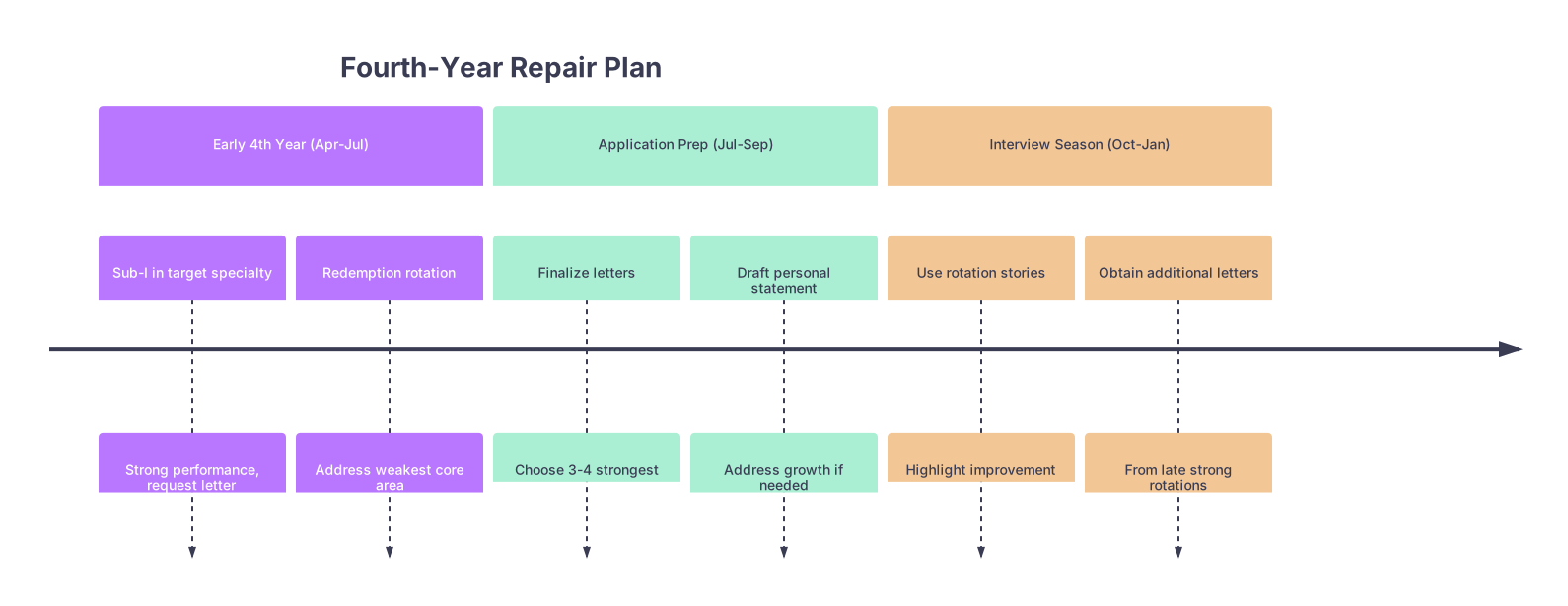
| Period | Event |
|---|---|
| Early 4th Year (Apr-Jul) - Sub-I in target specialty | Strong performance, request letter |
| Early 4th Year (Apr-Jul) - Redemption rotation | Address weakest core area |
| Application Prep (Jul-Sep) - Finalize letters | Choose 3-4 strongest |
| Application Prep (Jul-Sep) - Draft personal statement | Address growth if needed |
| Interview Season (Oct-Jan) - Use rotation stories | Highlight improvement |
| Interview Season (Oct-Jan) - Obtain additional letters | From late strong rotations |
If your school allows, schedule:
- Block 1–2: Sub‑I in target specialty at home institution
- Block 3: Away rotation in target specialty or high‑impact elective
- Block 4: Redemption rotation in previously weak core
So by the time PDs look at your file:
- They see weak 3rd‑year grades
- But also see:
- “Honors – Sub‑I Internal Medicine”
- “Outstanding performance” comments
- A letter saying you function at or above intern level
That is how you neutralize old data.
Step 4: Fix the Core Signals PDs Actually Read: LORs, MSPE, Transcript
Your transcript is not the only thing they see. And it is not always the most powerful thing.
1. Letters of recommendation: your single best weapon
You want at least one letter that explicitly addresses and counters your weak clerkships. Ideally from:
- Your Sub‑I attending in your target specialty
- A faculty member who knows you across time (saw you improve)
You do NOT say, “Please write that I improved from third year.” You say:
“I had some weaker core clerkship grades, especially in [X]. Since then I have worked hard on [A, B, C] and I think this rotation reflected that growth. If you feel comfortable, it would help a lot if you could speak to my current level of performance and whether you would trust me as an intern.”
Good attendings know what PDs care about:
- Reliability
- Work ethic
- Teachability
- Clinical reasoning under pressure
- Professionalism
You are asking them to attest that your recent performance is not “average DO student trying to survive” but “ready for intern year.”
2. MSPE (Dean’s letter): control what you can
You do not write your MSPE, but you can influence what ends up there in two ways:
Address professionalism or failure issues early with your dean’s office
- If you had a failure or remediation, meet with Student Affairs
- Explain your repair work and ask if they can include context on growth, not just the problem
- Deans are more willing to do this when you show insight and a concrete plan
Make your later rotation narratives undeniable
- You cannot rewrite old evals
- You can create a cluster of “top student,” “functions at intern level,” “among the strongest students I have worked with this year” comments in 4th year
- Those narratives often carry more weight than a P on Surgery from a year and a half ago
3. Transcript: minimize how ugly it looks
You cannot repaint a failing grade. But you can:
- Remediate quickly and successfully
- A fail remediated after a year of drifting looks worse than a fail remediated promptly with strong subsequent performance
- If your school allows, add explanatory notes
- Very school‑specific, but some transcripts / MSPEs include explanatory language for medical leave, documented personal crises, etc.
- Do not fabricate drama. If there was something real, talk to your dean about how it is documented.
Step 5: Decide How, When, and If to Explain Weak Grades
This is where many applicants either overshare or hide everything.
Rule of thumb
Is there a single, contained, understandable cause?
- Example: “During my surgery rotation, my father was critically ill and I was flying home every weekend.”
- Or: “I entered clerkships extremely anxious and hesitant, and my early evaluations reflect that. Since then…”
- Then a short, clear explanation can help.
Is it just overall mediocre performance with no clear story?
- Then do not spin fairy tales. Focus on what changed and the evidence of improvement.
Where to address it
Personal statement (only if it serves the story)
One short paragraph, not the centerpiece:“Early in third year, I struggled with time management and confidence presenting patients. My evaluations in Internal Medicine and Surgery reflect that. After explicit feedback from my advisors, I created a structured system for pre‑rounding, note templates, and daily self‑reflection. On my subsequent rotations and Sub‑I, I consistently received comments that I function at the level of an intern, which I believe better reflects my current readiness.”
Then move on. The rest of the statement should not be you apologizing.
Interview answers
You must have one clean, non‑defensive answer to:“Walk me through your grades / any challenges you faced in clinical rotations.”
Structure:
- Own it
- Name the specific issue
- Describe what you did to fix it
- End with evidence
Example:
“My third‑year grades are mostly Passes, and I had one borderline evaluation on Surgery. The main issue was my efficiency with pre‑rounding and documentation, which meant I was always half a step behind. I went to my advisor, we built a very structured system – checklists, time blocks, and daily feedback with residents. On my Medicine Sub‑I this year, I was able to carry a full intern‑level list, get notes in on time, and my attending specifically commented that I was functioning at or above the level of some interns. So while my early grades are not impressive, I think my recent performance is much closer to how I will function as a resident.”
Supplemental application/secondary essays (if offered)
Use them if there is a dedicated “academic challenges” section. Again, short + specific + solution‑focused.
Step 6: Use Other Parts of Your Application to Counterbalance
You cannot hide weak clerkship grades. But you can surround them with powerful positives.
1. Boards: decide where you stand and act
If your COMLEX and/or USMLE are:
Strong (≥ mean, ideally >60th–70th percentile):
- That helps your case a lot
- PDs will think: “Knowledge is there, maybe just slower clinical maturation.”
- Do not retake anything just to chase perfection.
Weak:
- You need to be brutal about specialty choice.
- Consider:
- ACGME FM, psych, community IM
- Osteopathic programs still friendly to DOs
- Focus your energy on:
- Stellar 4th‑year rotations
- Memorable interviews
- Strong letters, especially in community programs that read the whole file
If Step 2 / COMLEX 2 is pending and you realistically can improve: plan your dedicated time like it matters. Because it does.
2. Research, leadership, non‑clinical strengths
These will not erase poor clinical grades, but PDs are human. They fill in a mental picture.
- Substantial research with posters or publications in your target field
- Leadership where others trusted you with real responsibility
- Longitudinal service or continuity clinic work, especially for primary care
- Teaching roles: TA, tutor, peer mentor
Projects that show:
- Reliability over months–years
- Ability to see something through
- Evidence that people who know you trust and value you
That matters more than a one‑off club membership.
3. Program list strategy: aim correctly
You fix part of this problem by not applying stupidly.
- Mix:
- Some reach programs
- A solid core of realistic programs (academic and community)
- A healthy number of safety programs where your stats are clearly competitive
Do not apply exclusively to “top 20 academic IM” with mediocre transcript and boards. You will get burned.
For DOs targeting ACGME:
- Include programs known to be DO‑friendly
- Include community and regional academic centers, not just big‑name university programs
- Use current residents (especially DOs) as intel: “How do they view third‑year grades? Are they board‑score heavy? How many DOs per class?”
Step 7: Behavioral Changes You Need to Make Right Now
There is usually a reason your clerkship grades were weak. If you do not change your behavior, 4th year will reproduce 3rd year.
Here are the usual culprits and what fixes them.
Problem: Passive on the wards
You “blend in,” do what is asked, do not cause trouble. Guess what? That is the recipe for “Pass.”
Fixes:
- Volunteer to present
- Ask for one extra task daily (“Is there anything else I can take off your plate?”)
- Own 1–2 follow‑ups for each patient:
- “I will track the cultures”
- “I will call the PCP”
- Speak up with tentative plans:
- “I was thinking of starting X for Y because of Z. Does that make sense?”
Problem: Slow and disorganized
Residents see it instantly. You are always behind. Your notes are late. You forget tasks.
Fixes:
- Standardize your pre‑rounding routine (same order every patient, every morning)
- Use a paper or digital checklist for:
- Labs
- Imaging
- Consults
- To‑do’s by time (before noon, afternoon, end of day)
- Time‑box charting: 15–20 minutes per note, move on, refine later
Problem: Poor clinical reasoning under questioning
You freeze on rounds. Presentations ramble. Attendings sense you are not synthesizing.
Fixes:
- Use structured frameworks:
- For H&P: OPQRST, OLD CARTS, etc.
- For assessment: “Problem – most likely – most dangerous – next test – first treatment”
- On each patient, force yourself to write:
- 3–5 item differential
- Short one‑liner per problem: “67‑year‑old with new CHF exacerbation likely from dietary indiscretion and med non‑adherence”
- Ask residents to pimp you on purpose and give feedback on your reasoning, not just your knowledge
Step 8: If Things Are Truly Bad – Consider a One‑Year Tactical Delay
Sometimes the honest answer is: you are not ready to apply this cycle and have a viable shot.
You should at least consider delaying if:
- Multiple core fails or remediation
- Low board scores plus weak clerkship grades
- No strong letters yet from your field
- Major personal issues during 3rd year now resolved, but no time yet to demonstrate the “new you”
What a tactical delay (or gap year) can look like:
- Extra clinical year as a pre‑residency fellow or research fellow with heavy clinical exposure
- Dedicated year of structured clinical work (e.g., as a research coordinator embedded in a hospital team, or an advanced student fellow where allowed)
- Repeating or adding multiple Sub‑Is with Honors‑level performance
Downside: time, money, emotional fatigue.
Upside: you avoid burning an application cycle with a weak file and instead submit when you have hard evidence of improvement.
Not everyone needs this. But some do. And pretending otherwise is how people end up SOAPing into something they never wanted, or not matching at all.
Today’s Action Step
Do this today. Not “soon.”
- Pull your transcript, board scores, and as many clerkship evaluations as you can access.
- Write a two‑sentence problem statement about your application: exactly what is weak and why.
- Then draft a 4th‑year repair plan with:
- The next two rotations you can use as “redemption” or “proof of readiness”
- The one attending you will target for a strong, growth‑focused letter
Open a blank document and write those three items right now. That becomes your blueprint. Everything else you do this year should line up behind fixing that specific problem.