Most DO students fail to get the MD letters they actually need because they treat them like a checkbox, not a strategic weapon. That is a mistake. In ACGME programs—especially competitive ones—high-quality MD letters are often the difference between “auto-filtered” and “shortlisted.”
You are not competing for “a” letter. You are competing for anchoring letters that make a program director stop scrolling.
Here is how you build them. Step by step. With a plan that works even if your school is community-heavy, your exposure to MD faculty is limited, or you are late to the game.
1. Understand What ACGME Programs Actually Want From MD Letters
Before you hustle for MD letters, you need to understand what they are used for. Otherwise you ask the wrong people and get bland fluff that does nothing for you.
What PDs are scanning for in MD letters
When I have seen PDs and selection committee members move through letters, they skim for very specific things:
- Source credibility
- MD or DO in an ACGME setting
- Academic title: Program Director, APD, Core Faculty, Clerkship Director
- Specialty match: Internal Medicine letters for IM, etc.
- Comparative language
- “Top 5% of students I have worked with in the last 5 years”
- “Among the best DO students I have supervised”
- Concrete behaviors
- Shows up early, follows up on tasks
- Owns patient care plans, not just a passive observer
- Can present succinctly and think on the fly
- Trust signal
- “I would be pleased to have this student in our program”
- “I would trust them with my own family member’s care”
What they do not care about:
- Generic phrases like “a pleasure to work with” without details
- Letters from distant relatives or non-clinical mentors trying to sound clinical
- Name-dropping without substance (“He worked with Dr. Famous for a week”)
Why MD letters matter extra for DOs
You already know the bias exists, so let us talk about what actually addresses it:
- MD letters show you perform well in allopathic environments
- They reassure PDs that your clinical skills and professionalism are cross-compatible
- They counter lazy assumptions about “osteopathic training quality”
For many ACGME programs, a DO with:
- 2+ strong MD letters
- Solid scores
- Decent research or scholarly activity
is much easier to rank highly than a DO with only DO letters, regardless of how impressive those DO writers are.
So the goal is clear: you want 2–3 strong, specific MD letters, ideally including:
- One from core faculty / PD / APD in your target specialty
- One from another MD in the same specialty (or a closely related field)
- Optional: one from an MD in a different field who can speak to work ethic, teachability, and team fit
2. Build Your MD Exposure Map (Even If Your School Is Weak on ACGME Rotations)
The main excuse I hear from DO students: “My school does not have a big university affiliate. I just do not see MDs.” That is not a dead end. It just means you need a deliberate map, not wishful thinking.
Step 1: Inventory your current and upcoming rotations
Grab a blank sheet and make three columns:
- Site / Hospital
- Attending list (even partial)
- Credential (MD/DO, academic role if known)
Then fill what you know from:
- Clerkship schedules
- Site orientation emails
- EMR attending lists
- Prior students’ intel (“IM at St. Mary’s has 3 MD hospitalists who love teaching”)
You are looking for MD attendings in ACGME or academic settings, especially:
- University hospitals
- Large community teaching hospitals
- Sites with residents or fellows
Step 2: Identify your anchor opportunities
From that map, circle:
- Rotations in your target specialty at ACGME institutions
- Rotations where MDs are known to teach a lot
- Any elective or sub-I where you can spend 4+ weeks with the same MD or small group of MDs
That is where your best letters will come from.
If your map looks thin, your job is:
- Add audition rotations at ACGME sites (VSLO, institutional electives, away rotations)
- Negotiate with your school to prioritize those blocks before ERAS opens
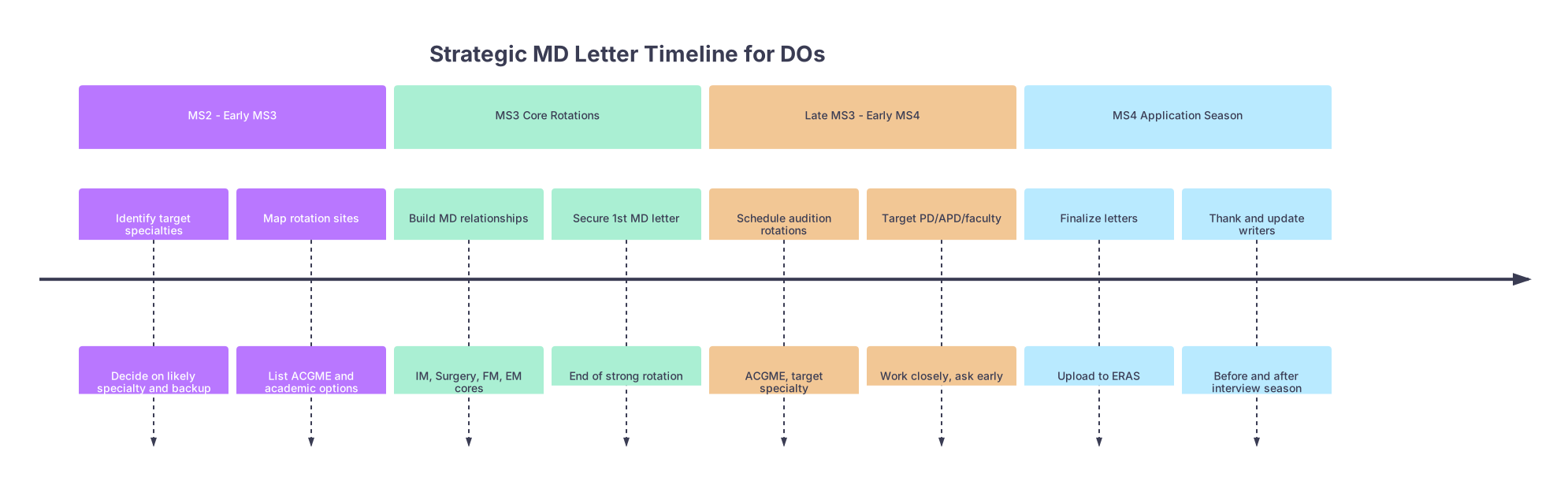
| Period | Event |
|---|---|
| MS2 - Early MS3 - Identify target specialties | Decide on likely specialty and backup |
| MS2 - Early MS3 - Map rotation sites | List ACGME and academic options |
| MS3 Core Rotations - Build MD relationships | IM, Surgery, FM, EM cores |
| MS3 Core Rotations - Secure 1st MD letter | End of strong rotation |
| Late MS3 - Early MS4 - Schedule audition rotations | ACGME, target specialty |
| Late MS3 - Early MS4 - Target PD/APD/faculty | Work closely, ask early |
| MS4 Application Season - Finalize letters | Upload to ERAS |
| MS4 Application Season - Thank and update writers | Before and after interview season |
3. Make Yourself “Letter-Worthy” on Day 1 of an MD Rotation
You do not earn a powerful letter by being “nice and interested.” You earn it by being impossible to ignore. That starts on day 1.
Your day-1 script with an MD attending
You can modify the wording to sound like yourself, but hit these beats:
“Dr. Smith, I am a third-year osteopathic student strongly interested in [specialty] and planning to apply ACGME. I know strong clinical letters are a big part of that. I want to make sure I am focusing on the right things this month—what do your top students do that makes you confident writing for them?”
That does three things:
- Signals your ambition without being obnoxious
- Frames you as someone who cares about feedback and standards
- Plants the seed that you want a letter, without asking on day 1
The behaviors that actually generate strong MD letters
I have seen the contrast over and over: same site, same attending, two DO students—one gets a monster letter, one gets a generic paragraph. The difference is not intelligence. It is how they work.
Focus on these:
Ownership of 1–3 patients
- Know your patients better than anyone else on the team
- Anticipate questions about labs, imaging, overnight events
- Update problem lists and plans before rounds
Efficient, structured presentations
- Practice SOAP style or your service’s preferred format
- Time yourself: 3–5 minutes for a complex inpatient, less for stable follow-ups
- Accept corrections without defensiveness
Visible reliability
- Arrive earlier than your attending
- Volunteer to call consults, follow up on test results, update families (if allowed)
- Close the loop: “Dr. Lee, I called GI; they will see the patient by 2 pm and recommended…”
Proactive feedback loop
- Mid-rotation: “Dr. Patel, could you give me feedback on my presentations and clinical reasoning so I can improve these next two weeks? I am hoping to eventually ask you for a letter if I earn it.”
- End-rotation: Review growth points, then ask for the letter.
You are building a case file in their head: “This student was essentially a low-level intern already.”
4. Convert Good Rotations Into Powerful MD Letters
Doing a great rotation is necessary. It is not sufficient. Many strong students still end up with vague letters because they botch how they ask.
The optimal moment to ask
Ask during the last 3–5 days of a rotation, not weeks later.
If possible, do it in person, then follow up by email the same day.
Your in-person script:
“Dr. Nguyen, thanks for the teaching this month. I have really valued working here. I am applying [specialty] through ACGME as a DO, and strong MD letters are very important for me. Based on the performance you have seen, would you feel comfortable writing a strong letter on my behalf?”
Key points:
- You directly use the word strong.
- You give them an exit if they hesitate.
- If they say “yes,” you have a green light. If they hesitate: do not push. Get a different writer.
Follow-up email structure
That same day:
- Subject:
[Letter of Recommendation](https://residencyadvisor.com/resources/do-residency-applications/how-do-letters-of-recommendation-are-read-differently-in-acgme-committees) – [Your Name], [Rotation/Year] - Thank them briefly.
- Attach:
- CV
- Draft personal statement (even if not final)
- ERAS AAMC ID, specialty list
- Include a short bullet list of cases and strengths they saw.
Here is a skeleton you can literally adapt:
Dear Dr. Nguyen,
Thank you again for agreeing to write a strong letter of recommendation on my behalf. I genuinely appreciated your teaching on the [service] at [Hospital] this month.
As discussed, I am a third-year osteopathic student applying to ACGME [specialty] programs. I have attached my CV and a working draft of my personal statement for context.
For your convenience, here are a few aspects of my performance that you observed and that align with the qualities programs value:
- Took primary responsibility for daily management and presentations of [X] inpatients in weeks 3–4
- Independently prepared and delivered [Y] topic presentations on rounds
- Helped coordinate discharge planning and follow-up for complex cases (e.g., [brief example])
My AAMC ID is [ID]. Letters will be uploaded through [ERAS portal / institution’s process]. The deadline I am aiming for is [date, ideally 3–4 weeks away].
Thank you again for your support,
[Your Full Name]
[DO School, Graduation Year]
You are not writing the letter for them. You are making it very easy for them to recall specific things to write about—and specific things are what PDs trust.
5. Target the Right MD Letter Writers, Not Just Any MD
A mediocre letter from a big-name MD is less useful than a detailed, glowing letter from someone who actually worked with you day to day.
Here is how to prioritize when you have options.
| Priority Level | Writer Type |
|---|---|
| Highest | PD/APD/Core Faculty in target field |
| High | Academic MD who directly supervised |
| Medium | Community MD with strong detail |
| Lower | MD who barely knows you |
| Lowest | Non-clinical or family MD |
Best targets for anchor MD letters
Program Directors / Associate PDs
- Gold standard if they worked with you directly
- Their name is recognizable and they know what PDs want to read
Core faculty at ACGME programs
- Hospitalists for IM
- Academic surgeons for surgery
- EM core at busy EDs, etc.
MDs at your audition rotations
- Especially in your target specialty
- Aim to make at least one letter per audition if you perform at that level
Less ideal, but still usable
- Community MDs who directly supervised you for weeks and are very enthusiastic
- Non-target specialty MDs who can speak to your work ethic and reliability, when you lack enough same-specialty letters
Actually weak options (avoid if you can)
- MDs who just “heard you presented once”
- Letters from “family friend” or “someone who knows your parents”
- Generic “To Whom It May Concern, I met this student twice in clinic…”
If someone barely worked with you, do not chase their title. Chase the depth of interaction.
6. Fixing Common DO-Specific Obstacles
You are not starting from a level field. Let us deal with that directly and talk solutions, not hand-wringing.
Obstacle 1: “My core sites are mostly DOs; MDs are rare”
You are not trapped. You just need to be strategic.
Concrete moves:
- Ask your clerkship director:
“I am applying to ACGME [specialty] programs and I need at least 2–3 solid MD letters. Which rotations or sites have MD attendings who enjoy teaching and writing for DO students?” - Use VSLO or your school’s electives office to book at least 1–2 audition rotations at ACGME-heavy hospitals with MD faculty.
- Join institutional clinics run by MDs (student-run clinics, specialty clinics) and show up consistently so you can eventually ask for a letter.
Obstacle 2: “I am late in MS4 and do not have solid MD letters yet”
You are behind, not doomed.
Your priorities:
- Book an immediate 4-week rotation in your target specialty at an ACGME site—even if it is not your dream city. You need the letter first; location comes second.
- On that rotation, be explicit within week 1:
“Dr. X, I am applying this cycle and need one more strong MD letter to complete my application. I would be grateful for feedback on how I can perform this month to earn that.” - Time your ERAS submission with what you can reasonably get:
- Submit on time with available letters
- Add “late” letters as they come, especially if from high-yield MD faculty
- Email select programs (if appropriate) when a major PD letter arrives
Obstacle 3: “My MD attending does not know DO education and seems skeptical”
You cannot fix every bias, but you can shift some.
Tactics:
- Be quietly excellent the first week. No monologues about osteopathic philosophy.
- When asked about being a DO, keep it short and confident:
“My preclinical and clinical education have prepared me the same way as MD colleagues—plus additional training in OMT. My goal is to match at a strong ACGME program and work alongside allopathic and osteopathic physicians alike.” - Let the quality of your work dismantle their assumptions.
7. Coordinating MD vs DO Letters for Maximum Impact
The question I get constantly: “How many MD letters vs DO letters should I have?”
You are not trying to erase your DO identity. You are trying to show you can thrive in both worlds.
General structure that works for most DOs in ACGME applications
For many core specialties (IM, FM, Peds, EM, Psych, etc.), a solid pattern is:
- 2 MD letters in your target specialty (or 1 MD + 1 DO in target, plus 1 additional MD)
- 1 DO letter that shows strong support from your home institution or osteopathic mentor
- Optional: a research letter (MD or DO) if the field is research-heavy (e.g., IM subspecialties, radiation oncology, some surgical fields)
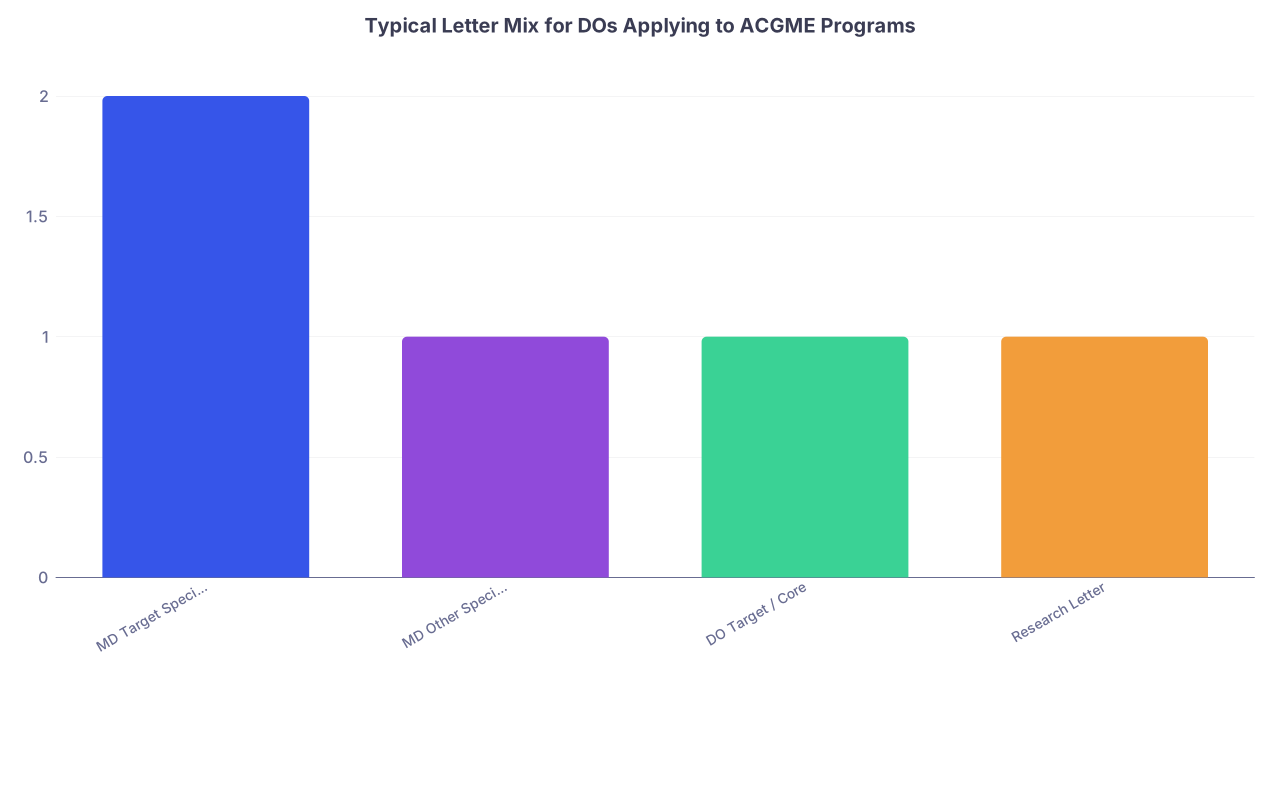
| Category | Value |
|---|---|
| MD Target Specialty | 2 |
| MD Other Specialty | 1 |
| DO Target / Core | 1 |
| Research Letter | 1 |
Specialty-specific tweaks
- Emergency Medicine (check current SLOE guidelines; they evolve)
- Aim for 2 SLOEs (often MD-heavy faculty groups)
- Additional MD/DO letters are secondary to strong SLOEs
- Surgical fields
- At least 2 letters from surgeons (MD or DO), ideally at ACGME centers
- If you can, get at least 1 MD academic surgeon letter
- Highly academic IM / subspecialty-leaning
- Strong MD hospitalist or subspecialist letter
- Research mentor letter carries extra weight, even if not in IM
The theme is consistent: you want MDs to confirm that you handle ACGME-style clinical demands while DOs reinforce that you have been consistently strong across training.
8. Packaging and Protecting Your Letters in ERAS
You can line up great writers and still shoot yourself in the foot with poor logistics.
Protect your letters: waive your rights
Always:
- Select “Yes, I waive my right to view this letter” in ERAS.
PDs tend to trust letters more when the student has waived access. Non-waived letters are routinely viewed as weaker or less candid.
Do not clutter your application with weak letters
More letters is not always better. ERAS limits how many letters a program sees per application (often 3–4). Sending a lukewarm fourth letter can dilute your strong ones.
General rule:
- Have a pool of 4–6 letters total
- Assign the best 3–4 for each program based on:
- Specialty
- Academic vs community focus
- Research orientation
Communicate timelines clearly to writers
Faculty are busy. Vague requests lead to late letters.
Be explicit:
- “ERAS opens to programs on [date]. To keep my application competitive, I am hoping letters are uploaded by [earlier date].”
Then send one polite reminder 10–14 days before that date, not every 48 hours.
9. How to Maintain and Use MD Letter Relationships Long-Term
You are not just collecting letters for this cycle. You are building a professional network.
After they submit the letter
Two simple emails that most students never send:
- Confirmation / gratitude email
- “Thank you for submitting the letter. I truly appreciate your support in my ACGME applications.”
- Outcome email
- After Match: “I wanted to let you know that I matched into [Program, Location]. Your support with my MD letters was a major part of that, and I am genuinely grateful.”
This is not flattery. It is closing the loop like a professional.
Why this matters later
These MDs may:
- Become fellowship recommenders
- Connect you with job opportunities
- Serve as informal advisors when you hit residency or career decisions
Treat them as colleagues you will likely cross paths with again, not vending machines for letters.
FAQ (Exactly 2 Questions)
1. If I can only get one strong MD letter and the rest are DO letters, is that enough for ACGME applications?
It can be, depending on your specialty and how strong that MD letter is. For less competitive fields (Family Medicine, some Internal Medicine programs, Pediatrics, Psychiatry), one very strong MD letter combined with excellent DO letters, solid scores, and strong clinical evaluations is usually acceptable. For more competitive specialties or academic-heavy programs, one MD letter is the minimum, but you will be at an advantage if you can secure at least two MD letters. If you are stuck at one, make sure that letter is from someone who worked closely with you in an ACGME environment and speaks in specific, comparative terms.
2. Should I ever see or edit my MD letter before it is submitted?
No. Do not ask to see or edit the letter. Waive your right to view it in ERAS and keep the process clean. If a writer says, “Why do not you draft something and I will sign it,” that is a red flag. Push back gently: offer a detailed CV, personal statement, and bullet points of clinical experiences instead of a full draft. You want the letter to be in the attending’s authentic voice. Program directors can spot self-written or heavily “coached” letters, and it immediately undermines credibility. Your job is to provide raw material and context; their job is to write the letter.