
The dirty secret is simple: most ACGME program directors do not trust COMLEX-to-USMLE conversion charts. They trust real USMLE scores, patterns across many applicants, and their own experience.
You can either plan around that reality or get blindsided by it.
Let me walk through what the data actually show, what PDs actually do, and how you should think about COMLEX, USMLE, and all these “conversion” formulas that circulate on Reddit and in Facebook groups.
1. What PDs Actually Look At: COMLEX vs USMLE in Practice
Strip away the mythology. Residency selection is a large-n screening problem.
A typical mid-sized internal medicine program might receive 3,000–4,000 applications for 30–40 positions. A competitive dermatology or orthopedic program may see 600–800 applications for 3–5 spots. That volume forces PDs into a numbers-first workflow.
Here is how that usually breaks down for DO applicants:
If you have both COMLEX and USMLE:
- PDs use the USMLE scores (especially Step 2 CK) as the primary “comparator” metric.
- COMLEX is used as a secondary signal: consistency, outliers, fails, retakes.
If you only have COMLEX:
- Some PDs treat you as roughly “unknown scale” and either:
- Use internal, rough heuristics (e.g., “COMLEX 600 feels like ~235–240 Step 1”) built from past residents.
- Or, avoid making strong score-based comparisons and rely more on school reputation, class rank, and narrative signals.
- A non-trivial slice of programs (especially in very competitive specialties) simply screen out COMLEX-only apps when they are overwhelmed with USMLE-having MD and DO applicants.
- Some PDs treat you as roughly “unknown scale” and either:
If you have COMLEX with a very high score:
- Many PDs interpret that as “strong test taker” even if they are unsure of exact USMLE equivalence.
- The higher you go above the mean, the less anyone worries about perfect conversion.
If you have COMLEX with a marginal or low score:
- Now they start trying to map it in their heads: “Is this equivalent to below-average USMLE? Risky?”
The key pattern: USMLE is the common currency. COMLEX is a parallel currency with less liquidity. Conversion formulas try to bridge that gap, but the bridge is shaky.
2. The Problem With COMLEX-to-USMLE Conversion Charts
Most of the score conversion tables floating around are built in one of three ways:
- Small institutional datasets (e.g., 50–200 students at one DO school who took both exams).
- Self-reported data from forums or spreadsheets (which are biased, noisy, and truncated).
- Very old correlations from pre-Step 1 pass/fail era and different COMLEX score distributions.
The statistics problem is not subtle.
Correlation between COMLEX Level 1 and USMLE Step 1 in most studies runs roughly 0.70–0.85. That sounds high. But a correlation of 0.80 still leaves 36 % of the variance unexplained (1 – 0.8²). That translates into huge uncertainty at the individual level.
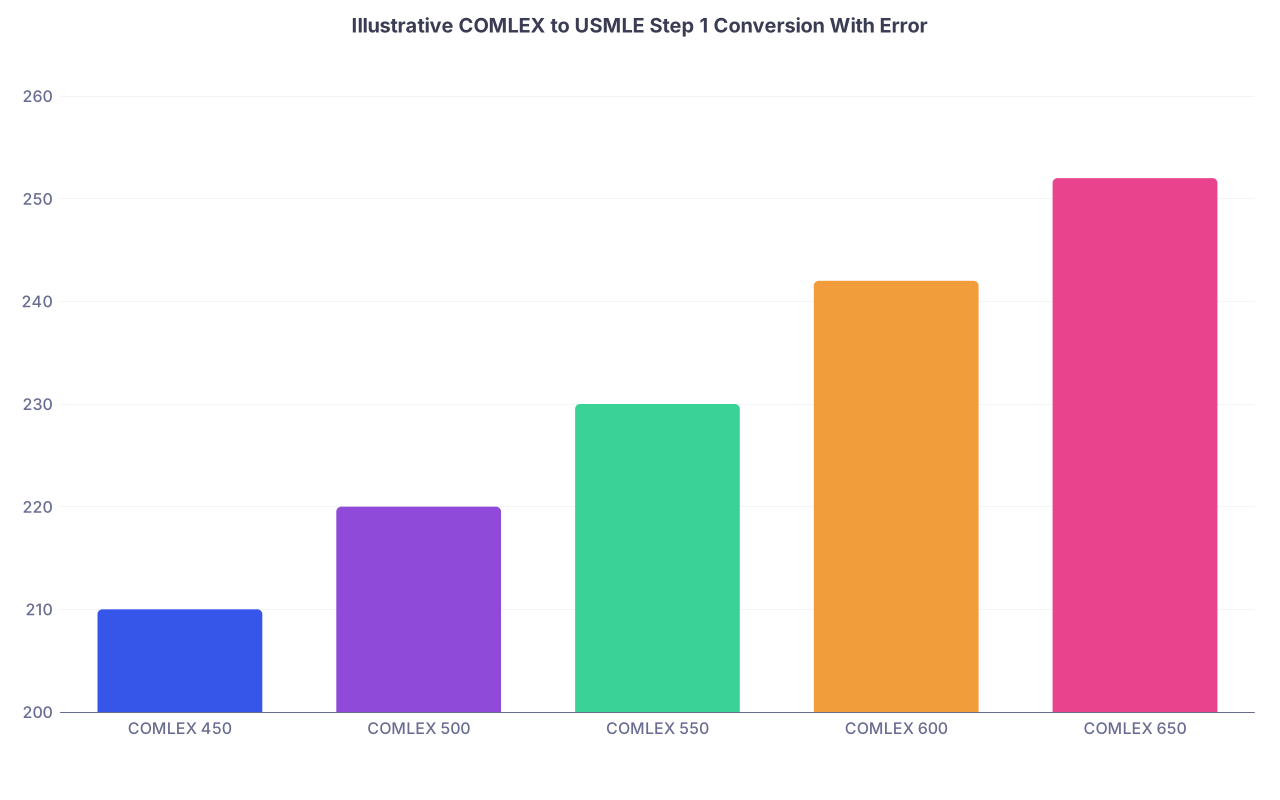
So, what does this mean in practice? An approximate regression line may predict:
- COMLEX Level 1 500 ≈ USMLE Step 1 220
- COMLEX Level 1 600 ≈ USMLE Step 1 240–245
- COMLEX Level 1 650 ≈ USMLE Step 1 250+
But with a standard error easily in the 10–15 USMLE point range for an individual. That is the difference between “borderline for derm” and “very competitive.” No PD is going to stake a rank list on that level of noise.
To make this concrete:
| Category | Value |
|---|---|
| COMLEX 450 | 210 |
| COMLEX 500 | 220 |
| COMLEX 550 | 230 |
| COMLEX 600 | 242 |
| COMLEX 650 | 252 |
Now assume ±10–12 points prediction error for each bar. That means:
- A COMLEX 500 could correspond to something like USMLE 208–232.
- A COMLEX 600 might map to 230–254.
Statistically, any single-point “equivalent USMLE” number is fiction. At best, you have a band.
And PDs—especially those who have been reading applications for 10+ years—know this from experience. They have seen students with “identical” COMLEX scores spread across 20–25 USMLE points.
So here is my blunt position: using COMLEX-to-USMLE conversion tables as if they are precise is wrong. Using them as rough, directional guidance is acceptable. PDs, by and large, behave accordingly.
3. How ACGME PDs Actually View COMLEX Data
You can measure behavior by what PDs require and what they filter on.
Survey data (NRMP, program director surveys, and multiple specialty-specific surveys) show a few consistent themes:
- A clear majority of ACGME PDs feel “more comfortable” interpreting USMLE than COMLEX.
- There is wide variability in how confident they feel about COMLEX score meaning.
- Competitive specialties (derm, ortho, plastics, ENT, neurosurgery) are much more likely to prefer or require USMLE.
- Among programs that accept DOs, many still quietly prioritize applicants with USMLE scores for comparison purposes.
Here is a simplified snapshot, based on aggregated survey trends and observational data from several recent match cycles. Numbers are approximate, but the relative ranking is what matters:
| Specialty | USMLE Required* | Strongly Prefers USMLE | COMLEX-Only Common? |
|---|---|---|---|
| Dermatology | ~70% | ~25% | Rare |
| Orthopedic Surg | ~65% | ~25% | Rare |
| General Surgery | ~40% | ~40% | Occasional |
| Internal Med | ~20% | ~35% | Common |
| Family Med | ~10% | ~20% | Very common |
*“Required” here means either explicitly listed in program materials or used as a de facto filter in screening.
When PDs do look at COMLEX seriously, what do they actually look for?
Pattern consistency
- Does Level 1 performance align with Level 2?
- Did you improve on the clinically oriented exam (Level 2 vs Level 1)?
Score position relative to COMLEX mean
- COMLEX Level 1 mean is usually around 500 with SD ~85–90 (varies by year).
- A score of 600 puts you about +1.1 SD above the mean—roughly ~85th percentile.
- A 650 puts you closer to +1.6 SD—around ~94th–95th percentile.
Outliers or red flags
- Fails, big score drops, multiple attempts.
The exact “USMLE equivalent” is usually not the core question. The core is: “Is this applicant above, at, or below the level of my current residents?” That is a relative, local comparison.
Many PDs use internal mental models like:
- “Our successful DOs typically had COMLEX Level 1 in the 580–650 range and Level 2 in the 600–680 range. This applicant is 520 and 540. That is below our historical norm.”
- “We had a resident with COMLEX 600 and Step 1 238 who struggled. Let us not overweight test scores this year.”
Those kinds of comments are routine in rank meetings.
4. Step 1 Pass/Fail Changed the Equation
You cannot talk about score conversions now without acknowledging the Step 1 pass/fail shift.
Before:
- Many PDs used Step 1 as the primary hard screen (e.g., cutoffs at 220, 230, 240).
- COMLEX Level 1 conversions were often used to approximate Step 1.
After Step 1 became pass/fail:
- The weight shifted heavily to USMLE Step 2 CK (and COMLEX Level 2 CE).
- Step 1 is now binary; “conversion” to COMLEX Level 1 is largely irrelevant for selection.
So the relevant conversions now are:
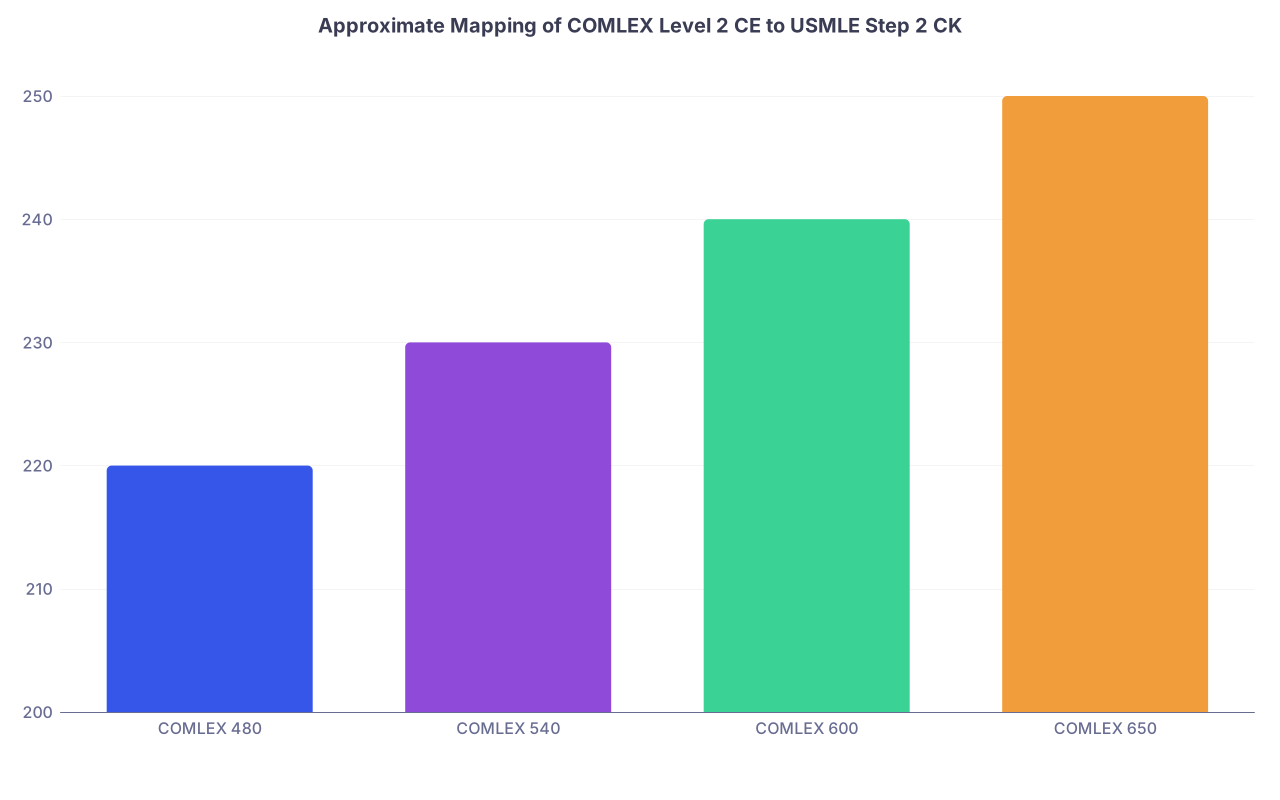
- COMLEX LEVEL 2 CE → USMLE STEP 2 CK (conceptually, not literally)
- With most PDs thinking: “How do I interpret a 580 or 620 on COMLEX Level 2 in my Step 2 CK mental scale?”
Again, the statistics remain messy. Correlations are similar (roughly 0.75–0.85). Prediction error is still large at the individual level.
But PD behavior has changed in one important way: they care less about Level 1/Step 1 conversions and far more about “how strong is this person on a clinical board-style exam” (Level 2 / CK).
Let us use an illustrative comparison:
| Category | Value |
|---|---|
| COMLEX 480 | 220 |
| COMLEX 540 | 230 |
| COMLEX 600 | 240 |
| COMLEX 650 | 250 |
Again, with ±10 points or more of uncertainty. So a COMLEX 600 could easily “represent” somewhere between 232 and 248 CK in real people.
What PDs do in practice:
- They anchor by percentile if they know it.
- They cross-check with your clinical grades, class rank, and narrative evaluation patterns.
- They do not sit there with a conversion table and debate whether your 600 is a “240 vs 242”.
5. Program Director Math: How They Mentally Convert Scores
Here is the part you rarely see written explicitly.
Over the last decade I have seen PDs and selection committee members do roughly four kinds of mental “conversions”:
Percentile matching
- “Our MD applicants at the 75th percentile Step 2 CK are around 245–248. A DO applicant at roughly 75th percentile COMLEX Level 2 gets treated similarly.”
Cohort benchmarking
- “The DOs we have loved had COMLEX 620–680. I am comfortable with that range.”
- This is internal, program-specific calibration, not a universal converter.
Range bracketing
- “This COMLEX score is clearly strong / above average / borderline / weak.”
- No one cares if the equivalent is 238 vs 241 once they have labeled you “strong”.
Heuristic shortcuts
- “COMLEX 600 is probably like mid-240s Step 2; COMLEX 500 is probably low 230s; below 450 we rarely see applicants do well in our program.”
These are fuzzy. Human. But they are the reality.
So, how do you, as an applicant, align yourself with that thinking?
6. How You Should Use (and Not Use) COMLEX-to-USMLE Conversions
You will not change how PDs think. But you can decide how to use the data intelligently on your side.
Here is a practical framework.
6.1. Use conversions for strategic planning, not self-worth
Appropriate uses:
- Deciding whether to sit for USMLE Step 2 CK if you already have COMLEX Level 2.
- Estimating competitiveness for a given specialty tier (e.g., “My COMLEX 590 probably puts me in the ballpark of mid-230s–low-240s CK; how does that stack up for EM vs anesthesia vs IM?”).
- Triage of target program list (highly competitive vs mid-tier vs safety).
Misuses:
- Obsessively calculating 10 different online conversions and averaging them.
- Telling PDs in your personal statement that your “equivalent USMLE score is 243.”
- Using conversions to rationalize applying to hyper-competitive programs when other aspects of your file are average.
If you want a rough sense of relative position, conversions can be helpful. If you want precision, they will mislead you.
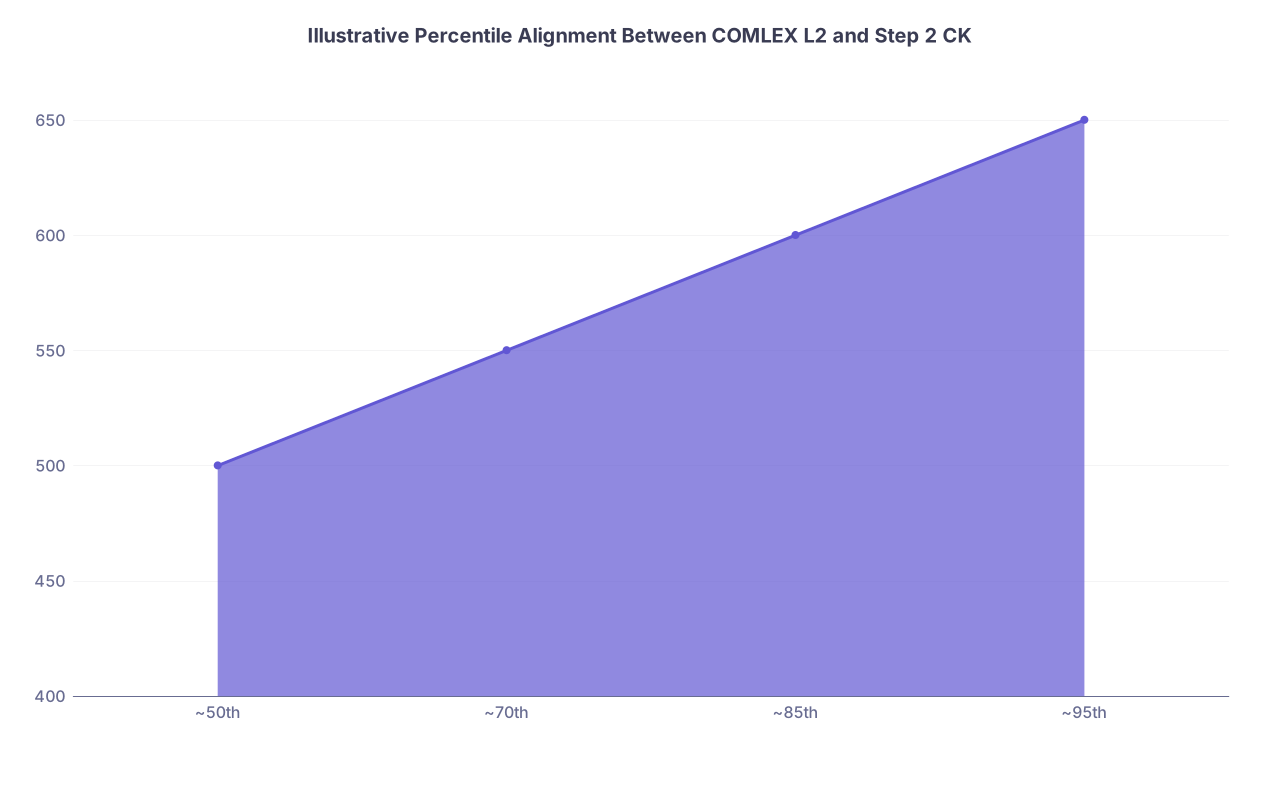
6.2. Think in percentiles, not raw “equivalent” numbers
COMLEX is designed with a mean and standard deviation that change slightly year to year. The raw number—580, 610, 540—means much less than your percentile.
For example, very roughly:
- 500 ≈ 50th percentile
- 550 ≈ 70th–75th percentile
- 600 ≈ 85th percentile
- 650 ≈ 94th–95th percentile
And Step 2 CK distributions show similar percentiles around:
- 230–235 ≈ ~50–60th percentile
- 240 ≈ ~65–70th percentile
- 250 ≈ ~80–85th percentile
- 260+ ≈ ~90–95th percentile
So mapping percentiles is more honest than obsessing over exact numeric equivalents.
| Category | Value |
|---|---|
| ~50th | 500 |
| ~70th | 550 |
| ~85th | 600 |
| ~95th | 650 |
If you know your COMLEX percentile, you can say to yourself: “I am around the 80th percentile clinically.” That is a better mental model than “I am a 243 equivalent.”
6.3. Decide on taking USMLE based on your direction of travel
Here is the cold data logic I use with DO students:
- If your COMLEX performance is clearly above average (e.g., ≥ 580–600 on Level 1 and your Level 2 practice tests are trending similarly), taking USMLE Step 2 CK usually strengthens your application at ACGME programs. It gives PDs a familiar metric.
- If your COMLEX is solidly average (around 480–520) and you have no reason to believe you will “overperform” on USMLE, you are taking on both time cost and risk. Some will do this anyway if they are chasing a competitive field. But they should be realistic.
- If your COMLEX is already struggling (e.g., ≤ 450, or a fail), adding a mediocre or low USMLE score does not “fix” anything and sometimes makes things worse.
Many PDs, especially in IM, FM, psych, peds, will interview strong DO applicants with COMLEX-only scores if everything else looks good. The problem is not that COMLEX is worthless; it is that in very competitive contexts PDs prefer the clean comparability USMLE provides.
7. What Actually Matters Most to ACGME PDs (Beyond Conversion)
You are obsessing about converting 580 to “USMLE 238 or 242.” PDs are often asking more basic questions:
- Did this applicant pass everything on the first try?
- Are scores trending up from preclinical to clinical boards?
- Are clinical evaluations strong and consistent with the test performance?
- Does the rest of the file (research, letters, rotations) confirm or contradict the board exam story?
The ranking in a typical PD’s head looks more like this:
Fails / multiple attempts
Automatic red flags. Much more impactful than minor differences between 540 vs 570.Trend: improvement vs stagnation vs decline
Level 1: 510, Level 2: 580 → strong narrative.
Level 1: 610, Level 2: 550 → concerning for some PDs, especially in demanding specialties.Relative strength compared to cohort
Top 10–20 %? Middle? Bottom third?Concrete USMLE scores (if present)
Used for fine-grained comparison when choosing between two otherwise similar applicants.COMLEX scores as supportive context
Useful, but less central unless PD is very COMLEX-savvy or in a historically DO-heavy program.
To anchor this with a simple comparison:
| Applicant | COMLEX L1 | COMLEX L2 | USMLE CK | PD Reaction (Typical) |
|---|---|---|---|---|
| A | 520 | 595 | 244 | “Upward trend, solid clinical strength.” |
| B | 610 | 575 | None | “Strong overall, slight concern on drop.” |
| C | 480 | 515 | None | “Borderline but improving; context key.” |
Trying to force precise COMLEX-to-USMLE equivalence on these is missing the point. PDs are reading patterns.
8. How to Present Your Scores Strategically
Now the practical question: what should you actually do or say in your application?
Do not invent your own “equivalent USMLE score.”
It looks unserious. PDs know the conversions are approximations and do not want you doing their interpretation for them.Emphasize the pattern, especially if it is favorable.
- “My performance improved from pre-clinical to clinical boards, as reflected by a X-point increase from COMLEX Level 1 to Level 2 CE.”
- PDs like that sentence. It is honest and points to trend, not fake converted numbers.
If you have strong USMLE scores, highlight them cleanly.
- Let ERAS display them; mention them briefly if relevant to a narrative of overcoming earlier struggles or validating improvement.
If your scores are modest but you have strong clinical performance, lean into that.
- Honors in core clerkships.
- Strong narrative comments in MSPE.
- Solid sub-I evaluations at ACGME sites.
And do not over-explain. One or two lines in your personal statement or a brief comment in the additional info section is enough if there is something unusual (like a fail, a large score swing, or a significant leave of absence).
9. The Real Takeaways: What Matters for ACGME PDs
Let me strip this down to the data-backed essentials:
- COMLEX-to-USMLE conversions are statistically noisy at the individual level. Any single-number “equivalent” is false precision.
- ACGME PDs mostly use COMLEX as a relative indicator (strong / average / weak, improving / declining) rather than as a proxy for a specific USMLE score.
- USMLE Step 2 CK remains the gold-standard numeric comparator in mixed MD/DO applicant pools. Having it removes ambiguity.
- Percentiles and trends are more meaningful than raw score “equivalents.” A COMLEX Level 2 CE 600 is compelling because it is high percentile, not because a spreadsheet calls it “USMLE 243.”
- Program behavior varies by specialty and by institutional history. DO-friendly IM or FM programs may be very comfortable with COMLEX-only. Derm, ortho, neurosurgery? Much less so.
You are not trying to win an argument about exam equivalence. You are trying to cross a noisy screening system and signal: “I belong in your residency cohort.”
Use conversions as rough planning tools. Stop treating them as destiny.
Once you have that mindset in place, the next serious questions are: where to apply, how to tier your programs, and how to use audition rotations and letters to offset any numerical weaknesses. That is the next layer of strategy—and a separate discussion entirely.