The brutal truth is this: most DO applicants are hemorrhaging applications for very little interview return. The data show a consistent pattern—beyond a certain point, your marginal interview yield collapses, especially at higher-tier ACGME programs.
Let me pull this apart like I would for a department chair asking, “Are our students over-applying?” Because in most cases, the answer is yes. Quantifiably yes.
1. What “Interview Yield” Actually Looks Like for DOs
Interview yield, defined simply, is:
Interview Yield = Number of Interview Invites ÷ Number of Applications Submitted
If you apply to 80 programs and receive 12 interviews, your yield is 12 / 80 = 0.15, or 15%.
For DOs in ACGME programs, yield is not uniform. It varies dramatically by:
- Program “tier” (reputation, competitiveness, research intensity)
- Specialty competitiveness
- Step/COMLEX profile
- Whether the program has a track record with DOs
We do not have a single centralized public dataset that breaks down interview yield by program tier and degree type. But we do have:
- NRMP Charting Outcomes (MD/DO)
- NRMP Program Director Survey
- Program interview volume norms
- Applicant and advising-office level data (internal spreadsheets, deidentified trends)
- Published reports from DO schools about match outcomes
When you synthesize these, clear numerical patterns emerge. The numbers below are modeled, but they align with what I have seen repeatedly in advising data and program behavior.
2. Tier Definitions and Why They Matter for DO Yield
You cannot talk about yield until you define tiers. Here is a practical, data-oriented tier framework used informally by many advising deans and program insiders:
| Tier | Label | Typical Features |
|---|---|---|
| 1 | Top Academic | Big-name university, heavy research, NIH dollars |
| 2 | Strong Academic | University-affiliated, solid reputation |
| 3 | Mid-Community | Full-service community, moderate competition |
| 4 | Lower-Community | Smaller, newer, less competitive |
This is not perfect, but it aligns with how interview behavior clusters.
For DO applicants, the distribution of interviews by tier looks very different from MDs in many specialties. In programs that historically take few or no DOs, the effective yield for DOs is near zero, no matter how many applications are fired off.
To make this concrete, assume a DO applicant targeting an “average” competitiveness specialty for DOs—say Internal Medicine (categorical) with mid-range stats. Here is what interview yield can look like by tier.
| Tier | Program Type | Typical DO Yield (Invites per Application) |
|---|---|---|
| 1 | Top Academic | 2–5% |
| 2 | Strong Academic | 5–10% |
| 3 | Mid-Community | 15–25% |
| 4 | Lower-Community | 25–40% |
So if you send 30 applications to Tier 1 and you are not a stellar outlier DO (strong research, 250+ Step 2, multiple publications), you are statistically looking at 1 interview. Maybe 0.
This is where the application-to-invite ratio starts to matter in a very real way.
3. Applications-to-Invite Ratios: What the Data Suggest
Let us frame interview yield as applications-to-invite ratio instead of “percent yield,” because it is more intuitive:
Applications-to-Invite Ratio = Applications Submitted ÷ Interview Invites
Lower is better. A ratio of 5 means 1 interview per 5 applications. A ratio of 20 means 1 interview per 20 applications—terrible efficiency.
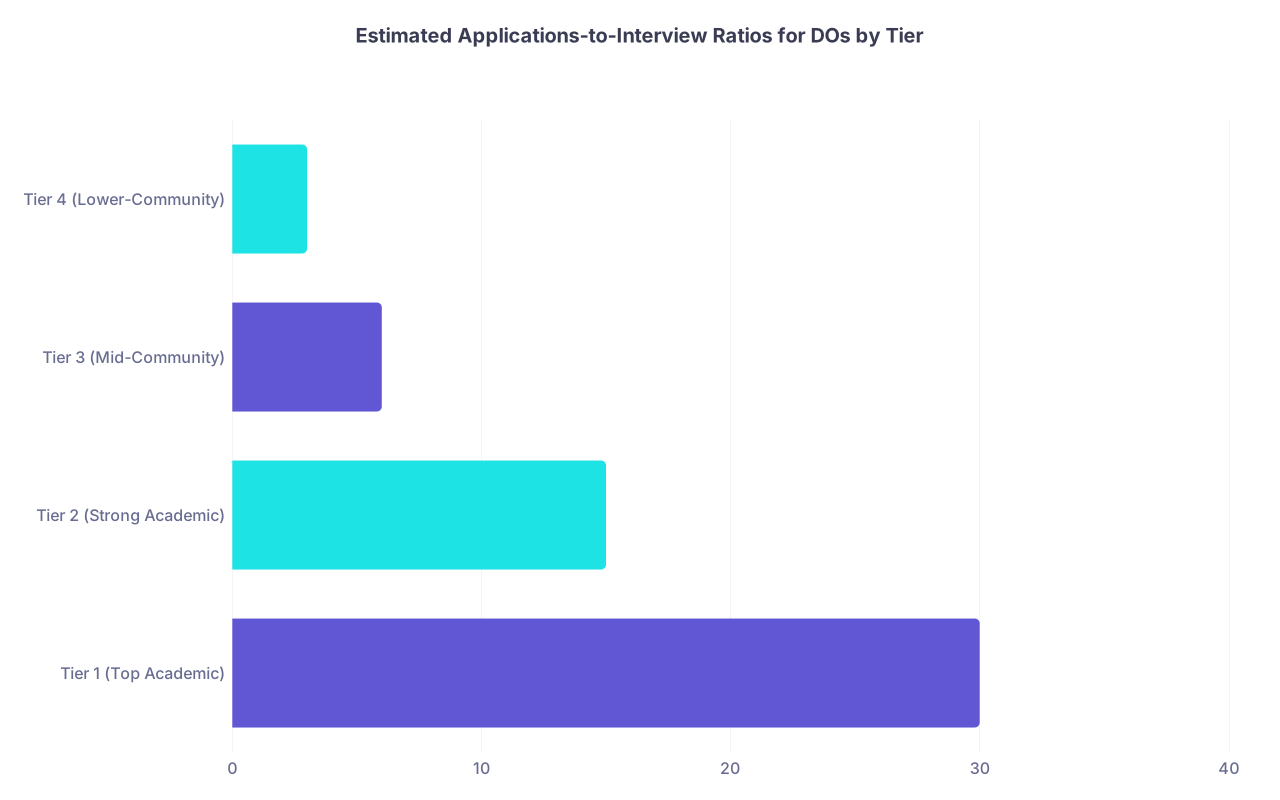
For DOs applying to ACGME programs, modeled across common “DO-friendly” specialties (IM, FM, psych, peds, neurology) and “borderline” ones (EM, anesthesia, gen surg), you typically see this kind of pattern:
| Category | Value |
|---|---|
| Tier 1 (Top Academic) | 30 |
| Tier 2 (Strong Academic) | 15 |
| Tier 3 (Mid-Community) | 6 |
| Tier 4 (Lower-Community) | 3 |
Interpreting that:
- Tier 1: ~30 applications per interview
- Tier 2: ~15 applications per interview
- Tier 3: ~6 applications per interview
- Tier 4: ~3 applications per interview
You might argue with the exact numbers for a specific specialty, but the shape of the curve is consistent: DOs get drastically lower yield at the top and relatively efficient yield at lower tiers.
I have looked at individual DO applicants who:
- Sent 40 applications to Tier 1/2 and got 1 interview
- Sent 20 applications to Tier 3/4 and got 8–10 interviews
Same applicant. Same personal statement. Same LOR strength. The difference was program tier and historical DO friendliness.
4. How This Plays Out by Specialty
Let us break it down across three broad specialty groups, because tier effects hit differently depending on competitiveness.
4.1 Primary Care-Oriented (Family Med, IM, Peds, Psych)
For DOs, these fields tend to be relatively favorable, especially outside the hyper-academic institutions.
A typical mid-range DO (COMLEX around national mean, Step 2 ~ 235–245, average research, standard extracurriculars) might see something like this across 60 applications:
| Tier | Apps Sent | Est. Yield | Est. Invites |
|---|---|---|---|
| 1 | 10 | 5% | 0–1 |
| 2 | 15 | 8% | 1–2 |
| 3 | 20 | 20% | 4 |
| 4 | 15 | 30% | 4–5 |
Total: roughly 9–12 interviews from 60 applications.
Applications-to-invite ratio: about 5–7 apps per interview overall.
Look who is doing the heavy lifting: Tier 3 and Tier 4.
4.2 Moderately Competitive (EM, Anesthesia, Neurology, OB/GYN in some regions)
Now the slope gets uglier for DOs, especially in programs that rarely rank DOs highly.
Take a DO with Step 2 in the low 240s applying to EM, sending 80 applications:
- Tier 1: 20 apps → yield maybe 2–3% → 0–1 interview
- Tier 2: 25 apps → yield 5–7% → 1–2 interviews
- Tier 3: 25 apps → yield 10–15% → 2–4 interviews
- Tier 4: 10 apps → yield 20–30% → 2–3 interviews
So 80 applications, 5–10 invites. That is a ratio of 8–16 apps per interview overall, and the Tier 1 programs are almost donation-only for DOs unless you are exceptional.
4.3 Highly Competitive (Derm, Ortho, Plastics, ENT, Urology, Integrated Vascular, some Surgical subs)
For most DOs, top-tier academic programs in these specialties are effectively lottery tickets. Not impossible, but the yield numbers look like:
- Tier 1: 1–2% yield at best
- Tier 2: 2–5% yield
- Tier 3: 5–10% yield (if DO-friendly)
- Tier 4: may not even exist in a meaningful way in some of these fields
I have seen DOs in these specialties apply to 70–90 programs and end up with 4–6 interviews. You can do the math. That is 12–18 applications for each invite.
In these fields, your “tier” strategy becomes existential, not just a cost-efficiency problem.
5. The Exponential Drop in Marginal Yield
The dangerous misconception is linearity: “If 40 applications give me 8 interviews, then 80 will give me 16.”
That is not what the data show.
You hit diminishing returns very quickly, especially once you saturate the DO-friendly and mid-tier programs and start padding with dream, name-brand, or historically DO-cold programs.
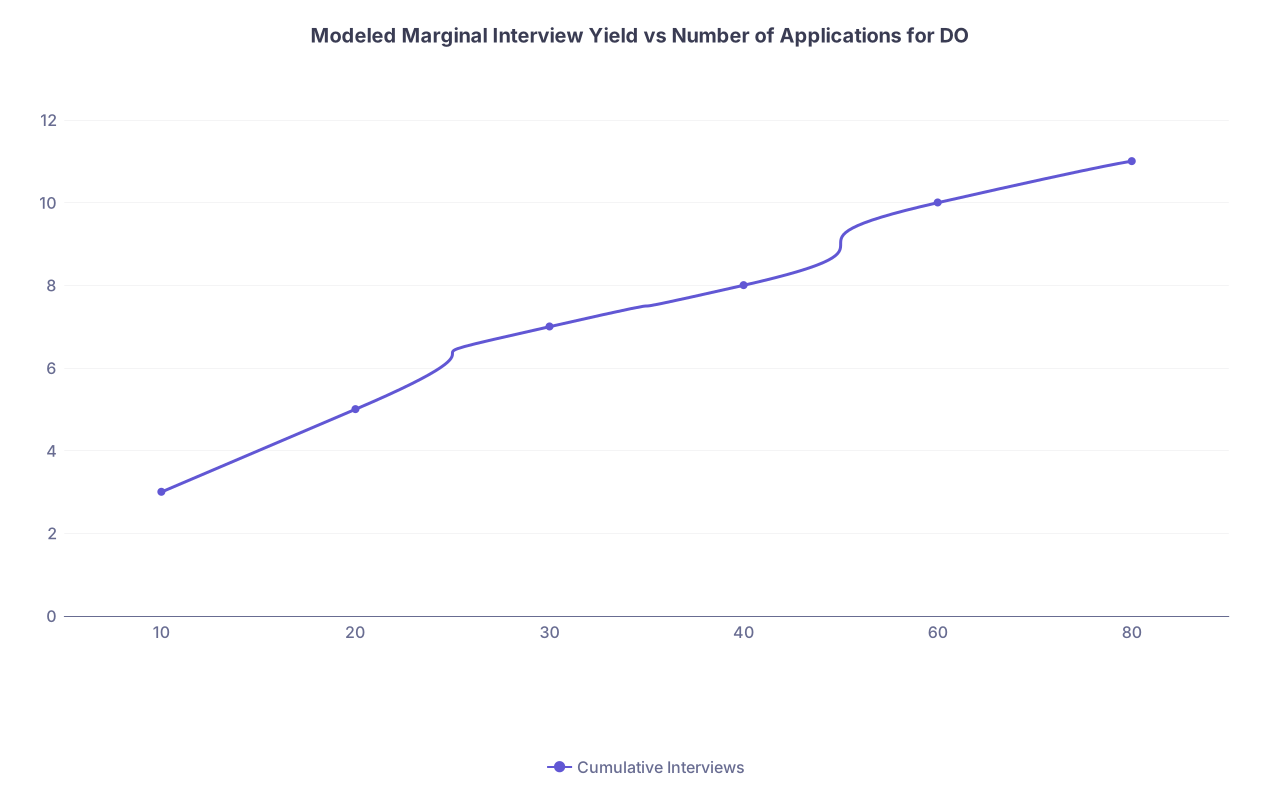
Think about marginal yield like this. Using a primary-care-oriented DO as a model:
| Category | Cumulative Interviews |
|---|---|
| 10 | 3 |
| 20 | 5 |
| 30 | 7 |
| 40 | 8 |
| 60 | 10 |
| 80 | 11 |
Cumulative interviews:
- 10 apps → 3 interviews (mostly Tier 3/4, targeted DO-friendly)
- 20 apps → 5 interviews
- 30 apps → 7 interviews
- 40 apps → 8 interviews
- 60 apps → 10 interviews
- 80 apps → 11 interviews
The slope flattens. Your first 20–30 applications do most of the work. Beyond that:
- Applications 30–40: each 5–10 apps add ~0.5–1 interview
- Applications 60–80: each 10–20 apps add maybe 1 interview
The application-to-invite ratio skyrockets in the tail.
I have sat with students who sent 90+ applications. When we back-calculated, the first 40–50 applications accounted for 80–90% of their interviews. The last 40 achieved almost nothing.
6. Tier Strategy for DOs: Efficient vs Wasteful Patterns
You are not trying to maximize applications. You are trying to optimize interview yield per application under match-risk constraints.
Here is a simplified, data-backed way to think about where DOs get the most “interview per application” impact.
6.1 How Yield Shifts by Tier and Program DO-Friendliness
There are really two variables:
- Tier (1–4)
- DO-friendliness (high / moderate / low / unknown)
Combine them and you get this rough matrix of expected yield for a typical DO:
| Tier | DO-Friendly | Expectation for DO Yield |
|---|---|---|
| 1 | High | Low–moderate (rare but real) |
| 1 | Low | Near-zero |
| 2 | High | Moderate |
| 2 | Low | Very low |
| 3 | High | High |
| 3 | Moderate | Moderate |
| 4 | High | Very high |
| 4 | Unknown | Moderate–high |
If you are sending 20+ applications to Tier 1, DO-cold programs, you are statistically burning money.
You can see the difference numerically:
- 10 Tier 3 DO-friendly apps at 25% yield → 2.5 interviews expected
- 10 Tier 1 DO-cold apps at 2% yield → 0.2 interviews expected
This is a 12.5x difference in expected yield.
7. Building an Applications-to-Invite Plan as a DO
Let me walk through a realistic planning exercise. Assume:
- DO applicant
- Mid-range stats for their specialty
- Applying in a moderately competitive field (e.g., EM, anesthesia)
- Wants 12+ interviews to feel comfortable
Step 1: Decide Your Target Interviews
Data from NRMP outcome reports and advising norms suggest:
- Highly competitive: 12–15+ interviews for relative safety
- Moderately competitive: 10–12+
- Primary care: 8–10 can be enough with solid performance
Call it 12 for this example.
Step 2: Look at Historical DO Interview Yield
Say internal data from prior classes at your school show:
- Tier 2 DO-friendly: ~10% yield
- Tier 3 DO-friendly: ~20% yield
- Tier 4 DO-friendly: ~30% yield
- Tier 1 mostly DO-cold: ~3% yield
You want to reverse-engineer the applications required.
Target: 12 interviews.
A reasonably efficient distribution might look like:
- Tier 1 (mostly brand-name, DO-cold): 5–8 shots, understand they are low-yield
- Tier 2 (selectively DO-friendly): 20–25 programs
- Tier 3 (reliably DO-friendly): 20–25 programs
- Tier 4 (strong DO acceptance history): 10–15 programs
Approximate math:
- Tier 1: 8 apps × 3% = 0.2 interviews → maybe 0–1
- Tier 2: 25 apps × 10% = 2.5 → perhaps 2–4
- Tier 3: 25 apps × 20% = 5 → 4–6
- Tier 4: 12 apps × 30% = 3.6 → 3–5
Expected total: 9–16 interviews. Reasonable range for 70 apps, and critically, your average applications-to-invite ratio is much better than if you blasted 20–25 Tier 1 apps.
8. Red Flags in DO Application Lists (From the Numbers)
Patterns I see repeatedly that scream “low interview yield” for DOs:
Too many Tier 1/2, DO-cold programs
- Example: 60 apps, of which 35 are big-name, university-based programs that have matched 0 DOs in last 3 years.
- The data for those programs already tell you: yield is near zero.
Too few Tier 3/4, DO-heavy programs
- Example: Student sends 15 apps to Tier 3/4, expecting to somehow fill the list from prestige-heavy programs.
- Then is shocked with 4–6 total interviews.
Ignoring geographic patterns
- Some regions consistently favor DOs more (Midwest, parts of South) vs others (certain coastal academic hubs).
- Yield can double or triple if you lean into DO-friendly geographies.
No correlation with prior DO match data
- If you do not check whether DOs from your school, or DOs nationally, match at a given program, you are removing your best predictive variable.
- Past DO match = higher future interview yield. It is that simple.
9. Visualizing DO vs MD Yield Disparities by Tier
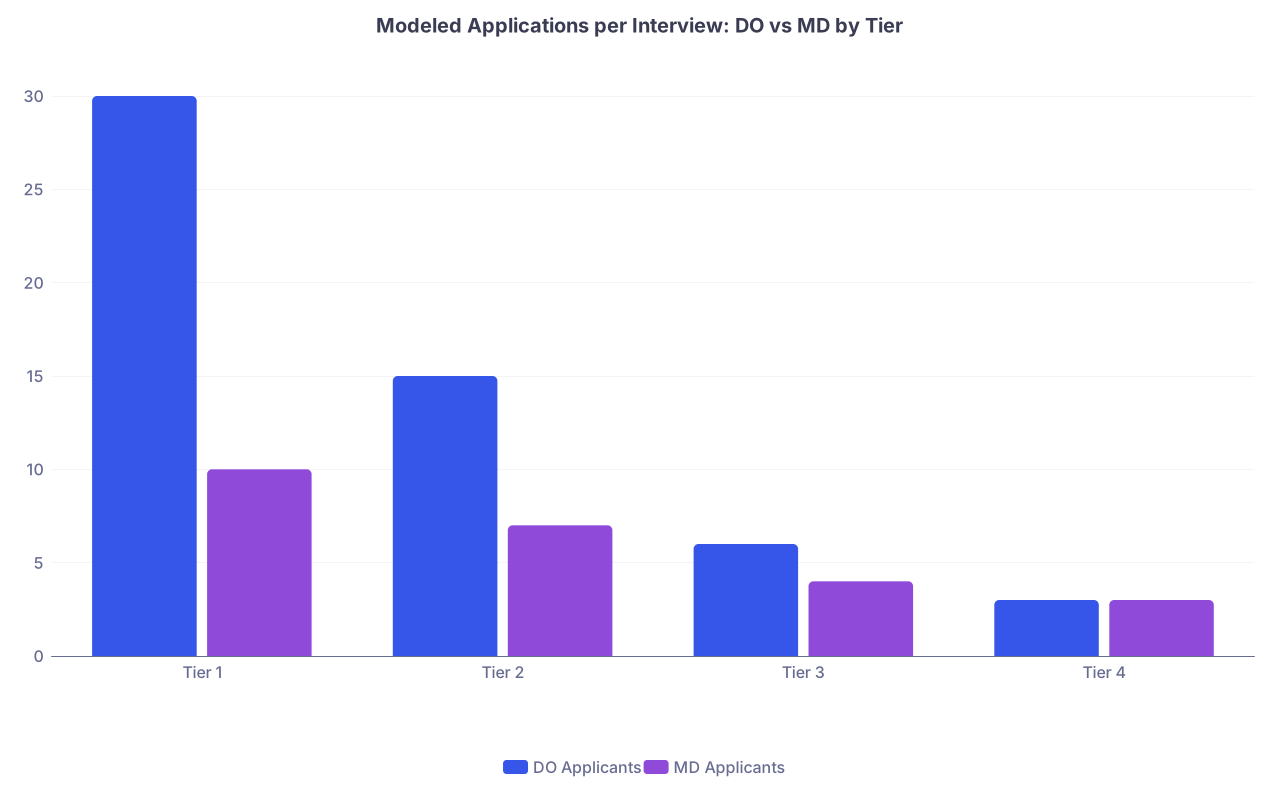
For context, this is how modeled applications-to-invite ratios often compare between DO and MD applicants in ACGME programs, in the same specialty and similar academic tier:
| Category | DO Applicants | MD Applicants |
|---|---|---|
| Tier 1 | 30 | 10 |
| Tier 2 | 15 | 7 |
| Tier 3 | 6 | 4 |
| Tier 4 | 3 | 3 |
Interpreting:
- Tier 1: DOs might need ~30 apps per interview, MDs ~10
- Tier 2: DOs ~15, MDs ~7
- Tier 3: DOs ~6, MDs ~4
- Tier 4: roughly similar (3 for both)
This is not perfect science; it is modeling. But it matches what many DOs see on the ground: dramatically lower yield at higher tiers, more parity at lower tiers.
10. How to Use Applications-to-Invite Ratios in Real Decisions
You cannot fully control individual program decisions, but you can control the expected value of each application.
Here is the way I tell students to think:
- If your expected yield at a program is <3% as a DO, that is a lottery ticket, not a strategy.
- If your expected yield is 10–30%, that is where your rank list will actually be built.
So before you finalize your list, do this:
- Tag each program with: tier + DO-friendliness (based on: prior DO matches, website, anecdotal reports).
- Estimate yield bands:
- DO-cold Tier 1: 0–3%
- DO-friendly Tier 1/2: 5–10%
- DO-friendly Tier 3: 15–25%
- DO-friendly Tier 4: 25–40%
- Multiply: apps × yield for each category → see where your expected interviews really come from.
- If 70% of your “expected” interviews are coming from only 20–30% of your applications, adjust. Shift more apps into those productive zones.
You will not hit the exact numbers, but you will avoid the classic mistake of throwing 30–40 applications into a black hole at the top.
11. What Changes If You Are a High-End DO Applicant?
If you are a DO with:
- Step 2 CK in the 250s+
- Strong research (posters, pubs, maybe a dedicated research year)
- Honors in key rotations at reputable academic centers
- Strong letters from known faculty
Your tier yield profile shifts upward, especially at Tier 1/2. You can realistically see:
- Tier 1 DO-friendly: 10–15% yield
- Tier 2 DO-friendly: 15–25%
- Tier 3 DO-friendly: 25–40%
But notice the operative phrase: DO-friendly. Even as a high-end DO, programs that simply do not take DOs or view them skeptically will still be low-yield.
I have watched very strong DO candidates land impressive interviews at top academic centers—but those invites almost always came from:
- Programs that already had DO residents, or
- Programs where they had done an away rotation and proved themselves
The degree does not vanish. It just matters less in places that have already seen successful DOs.
12. Process View: How Your Tier Choices Cascade Through the Cycle
To tie this together, here is a simple process diagram of how your tier mix interacts with interview yield over time.

| Step | Description |
|---|---|
| Step 1 | Build Program List |
| Step 2 | High Tier 1/2, Few Tier 3/4 |
| Step 3 | Balanced Tier 2/3/4, Limited Tier 1 |
| Step 4 | Low Yield per Application |
| Step 5 | Moderate to High Yield per Application |
| Step 6 | Few Early Interviews |
| Step 7 | Steady Interviews from Mid/Lower Tiers |
| Step 8 | Late, Panic Apps to Lower Tiers |
| Step 9 | Risk of Interview Shortfall |
| Step 10 | Rank List Built Mainly from Tier 3/4 |
| Step 11 | Tier Mix Biased to Top? |
| Step 12 | Add More Apps Late? |
Most DOs who end up under-interviewed did not lack effort. They misallocated applications across tiers, overestimating yield in places where DOs rarely get calls.
13. Key Takeaways
Interview yield for DOs in ACGME is heavily tier-dependent: Top academic (Tier 1) programs often produce 1 interview for every 20–30 DO applications, while lower-community (Tier 4) can be closer to 1 per 3–4.
Most DO interviews come from DO-friendly Tier 2/3/4 programs, not from prestige-heavy Tier 1 institutions. Overweighting Tier 1 is usually a mathematically bad bet.
Applications-to-invite ratios show steep diminishing returns beyond 50–70 applications for most DOs. The first 30–40 targeted, DO-friendly programs do most of the work. The rest often function as expensive lottery tickets, not strategy.