What subtle red flag are you raising when you write multiple paragraphs defending osteopathic training to an ACGME program that already knows what a DO is?
You are in a strange spot as a DO applicant. You know bias exists. You know some programs still quietly prefer MDs. And you have likely heard older residents say things like, “Make sure they know you are just as good as the MDs.”
That is how people end up writing tortured personal statements and secondary essays that sound like this:
“As a Doctor of Osteopathic Medicine, I have faced misconceptions about my degree. I want to reassure you that my training is equivalent to that of an allopathic physician…”
Or:
“Despite being a DO student, I worked hard to score competitively on Step 2 to prove that I can perform at the level of my MD peers…”
I have read versions of this dozens of times. Faculty pick up on it within seconds. And it does not do what you think it does.
It does not “educate” them.
It does not “preempt bias.”
It quietly signals insecurity. It redirects attention away from your strengths and onto the thing you are afraid they will hold against you.
You cannot afford that.
Let’s walk through the specific mistakes DO applicants make when they overexplain, when it actually hurts them, and how to handle the DO issue without sounding defensive, apologetic, or like you are asking for permission to exist.
The Core Mistake: Turning “DO” into the Center of Your Application
The big mistake is simple: you make “being a DO” the main character of your application instead of your performance, your judgment, and your fit for the specialty.
You do it in predictable ways:
- Long paragraphs “clarifying” DO vs MD training in the personal statement
- Repeated mentions of “as a DO” in every section
- LOR requests where you ask faculty to “explain osteopathic medicine”
- Interview answers that immediately jump to defending your degree when no one asked
You think you’re preemptively addressing bias. What you’re actually doing is forcing the reader to focus on a difference they might not have cared about at all.
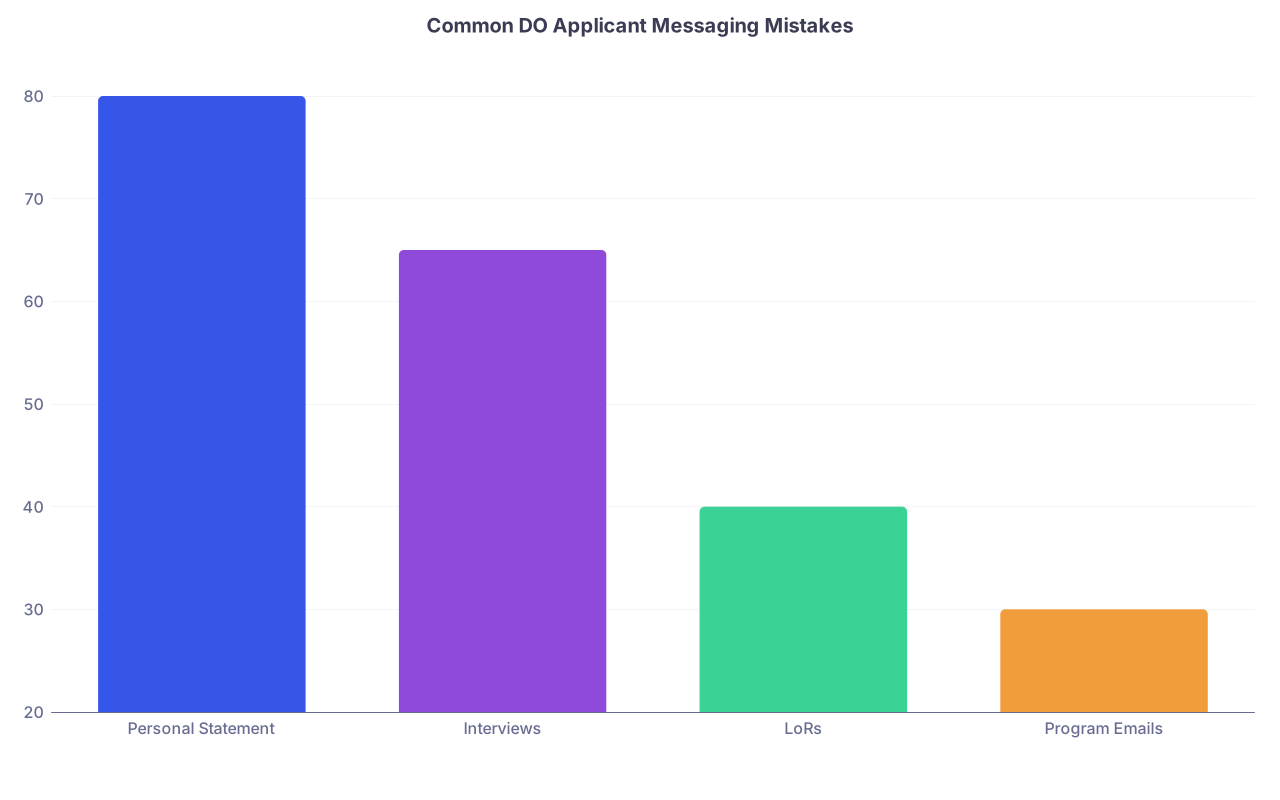
| Category | Value |
|---|---|
| Personal Statement | 80 |
| Interviews | 65 |
| LoRs | 40 |
| Program Emails | 30 |
Those numbers are illustrative, but the pattern is real: overexplaining shows up everywhere.
You know what most program directors care about first?
Scores. Clerkship comments. How you function on a team. Whether your letters actually say anything meaningful. Whether you will survive their call schedule without drama.
When you lead with a defensive DO narrative, you are telling them, “Let us talk about the one thing I am worried you will not like about me.”
Stop doing their bias work for them.
Why Overexplaining Backfires (Even When Your Intentions Are Good)
Overexplaining being a DO creates a few specific problems. None of them help you.
1. It sounds insecure
Faculty are very tuned in to tone. They read hundreds of applications. They can spot insecurity in three sentences.
When you write:
“Although I attended an osteopathic medical school, I have proven that I can succeed in an allopathic system by…”
What they see is:
- You believe DO is second-class
- You assume they believe DO is second-class
- You feel the need to justify yourself preemptively
Confident applicants do not pre-apologize for their degree. They present what they have done and let the record speak.
2. It hijacks space that should be about value, not defense
You have limited real estate:
- A one-page personal statement
- 1020-character ERAS activity descriptions
- A few minutes per interview answer
If 20–40% of your written content is you defending your degree, that is 20–40% less content showing your clinical judgment, grit, insight, or specific fit for that program.
Programs will not reject you because you are a DO who never explained it.
They might reject you because they never got a clear, sharp picture of who you are as a resident.
3. It triggers bias instead of neutralizing it
Here is something applicants underestimate: some MD program directors genuinely do not care about DO vs MD. They care about:
- USMLE Step 2 CK
- Clinical evaluations
- How their residents liked working with you on audition rotations
If you bring up “misconceptions about DOs” in your first paragraph, you plant a thought that was not top of mind. You remind them that some people see DOs as “less than.” Not all readers will consciously resist that framing.
Why volunteer to prime a negative stereotype?
4. It can read as defensive or argumentative
There is a thin line between “explaining” and “arguing.”
Statements like:
“Despite common misconceptions, DOs receive training equivalent to MDs…”
or
“Although osteopathic programs are sometimes misunderstood…”
Make you sound like you walked into the room ready for a fight no one started.
Programs are selecting colleagues, not advocates for a political cause. You are allowed to be proud of being a DO. Just do not turn your pride into a lecture.
The Subtle Ways You Overemphasize Being a DO (That You Probably Do Not Notice)
This problem shows up in more than just one obvious paragraph. Let’s pull out the quiet ways DO applicants sabotage themselves.
Personal statements that open with the DO disclaimer
Common mistake: first or second sentence is about being a DO.
For example:
“As a DO student at X College of Osteopathic Medicine, I have had to work especially hard to prove my capabilities…”
You just told the reader: “The defining feature of my medical identity is that I had to compensate for my degree.”
Better move: “I am a medical student at X, and here is what I have actually done.”
Activity descriptions that constantly say “Osteopathic” for no reason
You see this a lot:
- “Osteopathic student leader, I advocated for osteopathic principles…”
- “Promoted osteopathic manipulative medicine (OMM) among peers…”
If the activity is actually about OMM or DO-specific advocacy, fine. But DO applicants sometimes label perfectly standard roles with “osteopathic” unnecessarily, turning the whole CV into a DEI statement instead of a record of what you actually did.
Your title is already “Student Doctor of Osteopathic Medicine” in the demographic section. You do not have to cram it into every bullet.
Letters where you ask faculty to explain DO vs MD
This one is painful.
I have seen students ask letter writers to “mention that osteopathic training is equivalent to allopathic training” or “clarify that DO rotations are rigorous.”
You know what that does? It forces the attending to either:
- Write a generic, awkward paragraph that sounds canned
- Ignore your request and leave you anxious
- Or subtly confirm to the reader that you were worried enough to ask for it
Letters should talk about your performance. Your reasoning on rounds. The time you stayed to help with a complicated discharge. Not the politics of your degree.
Interviews where you answer questions that were not asked
Here is the most common trap:
Interviewer: “Tell me about your medical school experience.”
DO applicant: “Well, as a DO student, I know there can be misconceptions about our training, but I have worked hard to show that I can perform at the same level as MD students…”
No one raised the DO issue. You did. Now the interviewer has your insecurity front and center.
You can mention osteopathic elements of your training without turning it into a defensive monologue.
When You Should Mention Being a DO (And How to Do It Right)
You are not supposed to pretend you are not a DO. You are supposed to stop apologizing for it.
There are a few situations where strategic, concise mention of being a DO makes sense.
1. Explaining OMM skills or osteopathic perspective when it directly adds value
If you are applying to FM, IM, EM, PM&R, sports, pain, or any specialty where manual medicine and functional assessment matters, DO training can be a clear value-add.
You might write:
“My osteopathic training has made me comfortable with detailed musculoskeletal exams and manual assessment of function, which I have used frequently on my FM and EM rotations.”
Short. Concrete. Not defensive.
Wrong approach:
“As a DO, I have had to overcome the misconception that OMM is not real medicine, but I have found that it is equivalent, and sometimes superior, to traditional approaches…”
You are fighting a war the program did not sign up for.
2. Answering a direct question about why you chose DO
If they ask, you answer. Calmly. Confidently. Without sounding like you regret it.
Good answer style:
- 1 short line on why you were drawn to osteopathic training
- 1–2 lines on what you gained from it that helps you as a resident
- Then pivot back to the specialty and your experiences
Example:
“I chose a DO school because I liked the emphasis on seeing patients in the context of their whole lives, not just disease. The OMM curriculum forced me to really understand anatomy and function, which has helped my physical exam skills on rotations. Ultimately, though, what shaped me most were my IM and ICU rotations at [hospital], where I…”
No apology. No defense. No “equivalent to MD” language.
3. Clarifying dual exams (COMLEX and USMLE) or score reporting
One place DO-specific explanation is actually necessary: exams.
You might need to clarify:
- That you took both COMLEX and USMLE
- Why you took only COMLEX, if you did
- A gap between exams or a retake
Even here, do not turn it into a manifesto.
Wrong:
“As a DO student I was required to take COMLEX, but I knew some programs do not understand COMLEX, so I took USMLE as well to prove that I can compete with MD students…”
Better:
“I took both COMLEX and USMLE Step 2 CK to broaden the range of programs I could apply to. My Step 2 CK score of 245 reflects the same knowledge base assessed in COMLEX Level 2.”
Functional. Factual. Not emotional.
A Cleaner Framework: Identity vs Evidence
If you need a mental model to avoid overexplaining, use this:
Your application should be built on evidence, not identity defense.
Identity: “I am a DO.”
Evidence: “Here is how I performed on rotations, exams, and in actual clinical situations.”
When you catch yourself writing a sentence that starts with:
- “As a DO, I…”
- “Despite being in an osteopathic program…”
- “Although DOs are sometimes misunderstood…”
Stop. Ask: “Am I defending my identity, or am I presenting evidence of my ability?”
If it is identity defense, delete it or tighten it drastically.
Your DO status belongs in:
- The demographics
- The transcript
- Brief matter-of-fact mentions when explaining OMM exposure or exam choices
It does not need a dedicated “defense section” in your statement.
Programs That Truly Do Not Want DOs: You Cannot Essay Your Way Out of That
Here is the harsh piece: there are still programs that heavily favor MDs.
Some hide it. Some do not.
You will not “overexplain” them into changing their rank list philosophy.
You will not write such a compelling defense of osteopathic training that the PD who has never taken a DO suddenly decides to start now.
You know what actually matters here?
Choosing your programs wisely.
| Signal | What It Often Means |
|---|---|
| 0–1 current DO residents | DOs rarely taken, possible bias |
| No DOs in last 3–5 years | Pattern, not an accident |
| Website lists only MD board pass data | They are not thinking about DOs |
| Repeated “USMLE required, COMLEX not accepted” | Narrow applicant pool by design |
| Residents or PD dodges DO questions on meet-and-greets | Discomfort or lack of interest |
If their last DO resident graduated in 2015, your 800-word explanation of osteopathic equivalence will not fix that.
Strategy beats explanation.
Apply more broadly. Target DO-friendly and DO-neutral places. Use your energy where it counts.
How to Rewrite DO-Heavy Content Without Losing Yourself
You might be reading this after already drafting your statement and activities. Good. You are in time to fix it.
Here is how to repair overexplaining.
Step 1: Highlight every “as a DO” sentence
Literally go into your personal statement and ERAS entries. Find:
- “As a DO…”
- “Although I am a DO…”
- “Despite being in an osteopathic school…”
- “Because DOs are sometimes misunderstood…”
Highlight them.
Step 2: Ask what you were trying to say
Usually you were trying to convey one of three things:
- You worked hard despite a perceived disadvantage
- You value whole-person care and manual skills
- You had to prove yourself in MD-dominated environments
Now rewrite those points without centering the DO debate.
Example before:
“As a DO student, I felt I needed to work twice as hard on my IM rotation to show that I could function as well as MD students…”
After:
“On my IM rotation, I pushed myself to take on new admissions and present on rounds daily, which helped me grow from hesitant to independent in assessing undifferentiated patients.”
You just converted identity defense into performance evidence. That is what programs want.
Step 3: Keep at most 1–2 brief DO mentions in the entire statement
You can still acknowledge your identity. Just do not drown in it.
One example of a clean, single mention:
“My osteopathic training emphasized careful physical examination and functional assessment. I saw the value of this during my EM rotation when…”
That is it. You do not need more.
Interview Pitfalls: DO Overexplaining in Real Time
Written overexplaining is bad. Verbal overexplaining is worse, because you cannot edit it afterward.
Here are common traps and how to avoid them.
Trap 1: Volunteering DO defense in generic questions
Q: “Tell me about yourself.”
Bad answer start: “I am a fourth-year DO student at…”
Better: “I am a fourth-year medical student at [school]. I grew up in [X], and what really pulled me toward internal medicine was…”
Your DO status is already on your file and in your badge. You do not need to shout it in sentence one.
Trap 2: Overcorrecting when they say “MD”
Sometimes interviewers will casually say “MD” when they mean “physician” (sloppy but common).
Wrong reaction: stiff correction, long explanation of DO philosophy.
Better: brief, neutral correction if needed, then move on.
“Actually I am a DO student, but yes, in my training I have seen…”
You do not need a monologue on ACGME merger history.
Trap 3: Turning bias questions into therapy sessions
Sometimes a program will ask, “Have you ever experienced bias as a DO student?”
They are not your therapist. They want to see if you can discuss challenges without spiraling.
Bad: ten minutes of rage about MD arrogance and the system.
Better: one concrete example of a challenge, what you did, what you learned, and how you still function professionally with MD colleagues.
The danger is turning the answer into proof that you walk around with a chip on your shoulder. No one wants that in their call room.
Visualizing the Right Priority: DO Identity vs Actual Metrics
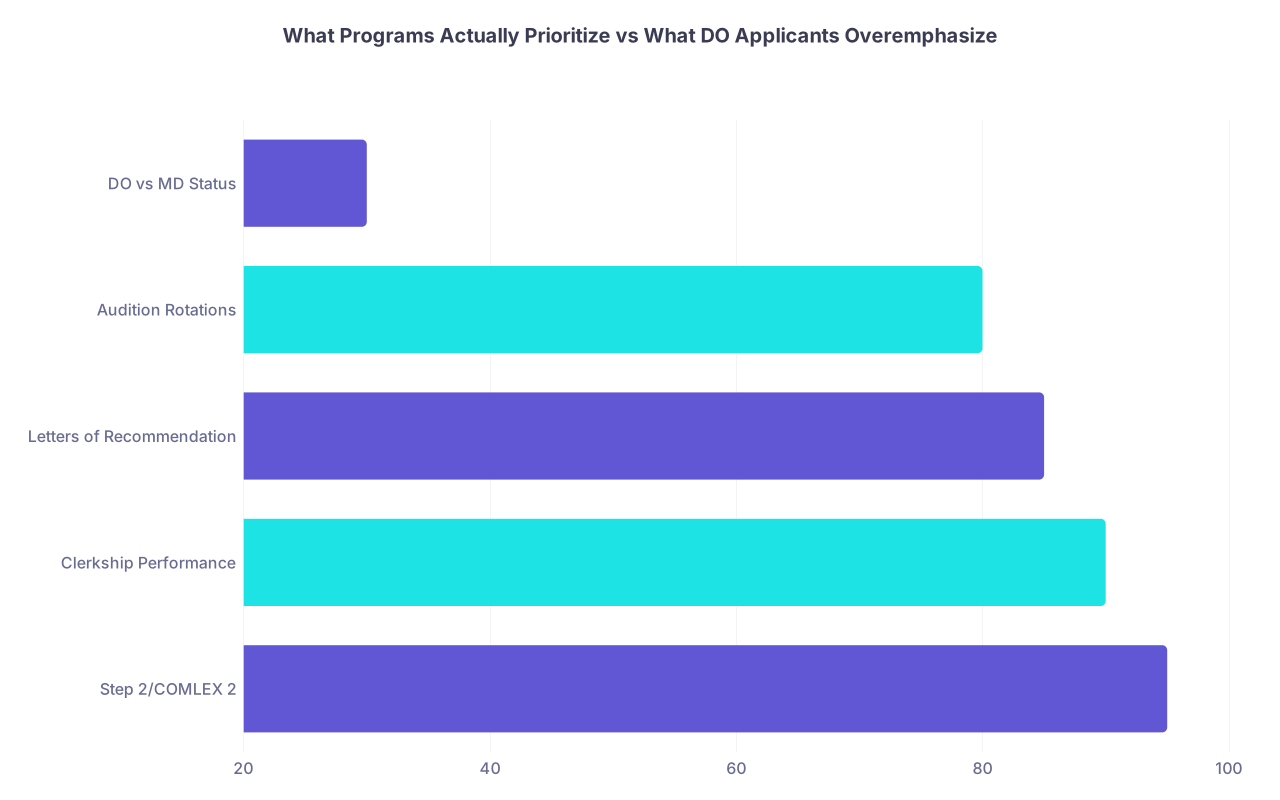
| Category | Value |
|---|---|
| Step 2/COMLEX 2 | 95 |
| Clerkship Performance | 90 |
| Letters of Recommendation | 85 |
| Audition Rotations | 80 |
| DO vs MD Status | 30 |
Again, the numbers are stylized, but the ranking is real. Most programs still care far more about:
- How you perform clinically
- How your letters describe you
- Your exam performance
Yet many DO applicants act like “DO vs MD” is 70% of their portfolio. It is not.
FAQ: The Hidden Risk of Overexplaining Being a DO
1. Should I ever directly address DO bias in my personal statement?
Only if you have a very specific, high-yield reason. For most applicants, the answer is no. Mentioning generic “bias” or “misconceptions” usually sounds defensive and adds nothing concrete. If you had a specific situation where you handled bias with maturity and it genuinely shaped your approach to patients or teamwork, you can include one short, factual example. Keep it about your response and growth, not a speech about fairness.
2. If a program director asks why I chose a DO school instead of MD, how honest should I be?
Be concise and straightforward, without self-sabotage. It is acceptable to say you liked the holistic philosophy, OMM training, or the mission of your school. It is also acceptable to say you applied broadly and your DO acceptance was your best opportunity. What you should not do is apologize, sound regretful, or act like DO was a consolation prize. Frame it as a path that gave you solid training and experiences that prepared you to be a strong resident.
3. Do I need to “educate” MD programs about COMLEX or osteopathic training in my application?
No long lectures. If they routinely take DOs, they already understand COMLEX and osteopathic schools. If they never take DOs, a detailed tutorial will not change their minds. The right move is brief clarification where necessary: list both COMLEX and USMLE scores clearly, maybe one line in the additional information section explaining score context if needed. Beyond that, let your performance—scores, evaluations, letters, and behavior on rotations—do the talking.
Key points: Do not turn your DO status into the centerpiece of your application. Stop defending and start presenting evidence of performance. Use short, matter-of-fact mentions of your osteopathic background only where it clearly adds value or clarity, and spend the rest of your word count showing why you will be a resident they are glad they matched.