
Program directors do not hate COMLEX-only DO applicants. They hate confusion and extra work. And COMLEX-only often equals both.
Let me tell you what actually gets said in PD offices and rank meetings, not what gets printed in the “we are DO-friendly” blurbs on program websites.
The Unfiltered Truth: COMLEX in a USMLE World
Here’s the core problem: the residency selection machine was built around USMLE. COMLEX was bolted on later. Some programs have adapted. Many have not. And a surprising number only pretend they have.
Behind closed doors, the thought process is usually not “We don’t like DOs.” It’s:
“Do I actually know what a 585 on Level 1 means for how this intern will handle our ICU month?”
If the answer is “I’m not sure,” you’re already at a disadvantage against the MD with a 238 Step 1, because every PD in the country has an internal sense of what 238 looks like on the wards.
This is why you hear so many mixed messages. Faculty will say, “We accept COMLEX only.” The coordinator will tell you, “We don’t require USMLE.” And then, when you look at their resident roster, every single DO in the program has taken Step 1 and Step 2.
That disconnect is not an accident.
 Conversion Tables](https://cdn.residencyadvisor.com/images/articles_svg/chart-pd-comfort-interpreting-exam-scores-9224.svg "PD Comfort Interpreting Exam Scores")
| Category | Value |
|---|---|
| USMLE Step Scores | 95 |
| COMLEX Scores | 40 |
| [COMLEX-to-USMLE](https://residencyadvisor.com/resources/do-residency-applications/how-pds-interpret-dual-usmlecomlex-scores-from-do-residency-applicants) Conversion Tables | 25 |
How Program Directors Actually Screen COMLEX-Only Applicants
Let me walk you through how this plays out during real application review. I’ve watched this happen in internal medicine, surgery, EM, and anesthesia program offices.
A stack of ERAS applications hits the PD’s desk or the screening faculty’s inbox. They open filters:
- “USMLE Step 2 CK ≥ 230”
- “USMLE Step 1 – pass” (for older cycles)
No COMLEX filter. Why? Because many ERAS filters for COMLEX are clunky, and more importantly, USMLE is what they actually know.
What happens to COMLEX-only DOs at that moment?
Three scenarios.
Scenario 1: The Programs That Truly Know COMLEX
These are mostly:
- Historically DO-heavy community programs
- Certain EM, FM, IM, and psych programs that have had strong DO residents for years
- Some Midwest and South regional programs where DO schools feed directly into the residency
In these places, when someone sees a 640 Level 1 and 675 Level 2, they don’t need to “convert” it. They’ve watched residents with those scores crush their rotations and ABSITE-style exams.
PD mindset here:
“We know COMLEX. We’ve matched DOs for a decade. COMLEX-only is fine if the rest of your app is solid.”
These programs will not punish you for skipping USMLE—if your COMLEX is strong and the rest of the application backs it up. But don’t kid yourself: “strong” means clearly above whatever internal cutoffs they’ve built in their head.
Scenario 2: The Programs That Say They Accept COMLEX, But Don’t Really Trust It
This is the majority of mid-tier university and hybrid academic/community programs.
Official line on website:
“We accept COMLEX or USMLE scores. We value osteopathic applicants.”
Reality in the selection meeting:
- They screen USMLE first because it’s easy and familiar.
- COMLEX-only DOs get looked at late, quickly, or not at all.
- If you’re COMLEX-only, you must trigger a second look: honors, strong letters, known DO-friendly away rotation, or a personal connection.
Actual dialogue I’ve heard in these rooms more than once:
Faculty: “This DO looks good.”
PD: “USMLE?”
Faculty: “No, COMLEX-only. 585 Level 1, 590 Level 2.”
PD: pause “Do we know what that is?”
Another faculty: “I think that’s… decent?”
PD: “We’ve got 80 MDs with 235–245 Step 2. Let’s start with them.”
They’re not actively rejecting you. They’re prioritizing the candidates they understand.
Scenario 3: The Programs That Are COMLEX-Hostile (Whether They Admit It or Not)
You’ll almost never see this written anywhere. But I’ve been in enough PD meetings to tell you: some programs are simply not interested in COMLEX-only applicants. Especially in:
- Competitive surgical subspecialties
- Top-20 academic IM/EM/anesthesia/OB programs
- Some high-status coastal university programs that barely take DOs at all
The real internal rule is essentially:
“We ‘accept’ COMLEX… but we don’t rank COMLEX-only above our backup tier.”
Or more bluntly:
“If a DO is serious about us, they’ll take USMLE.”
You may still get an interview with a phenomenal application, but you’ll be climbing a steep slope the entire time.
The Score Translation Games No One Explains to You
You’ve seen the pseudo-scientific COMLEX-to-USMLE “conversion calculators.” You know how PDs feel about those?
They ignore them. Or actively distrust them.
I’ve listened to PDs flip through ERAS and say:
“I don’t care what some calculator says; I’ve had a DO with a ‘predicted 245’ fail our in-service exam.”
So what do they actually do with COMLEX scores?
The Rough Mental Buckets
Most PDs who see DOs regularly develop a very crude mental mapping like:
| COMLEX Level 1/2 | Rough Bucket |
|---|---|
| < 450 | Concerning |
| 450–520 | Borderline to OK |
| 520–600 | Solid / Competitive |
| > 600 | Strong / Top Tier DO |
They won’t say that out loud. But they think like this:
- Sub-450 → “This will be a problem unless something else is exceptional.”
- 500–550 → “Probably fine for primary care, many IM/FM/psych programs.”
- 550–600 → “Good; let’s read the rest of the file seriously.”
- 600+ → “We should look at this DO even if we’re mostly MD-heavy.”
The details vary by specialty. A 620 in family medicine gets you treated like royalty. A 620 in neurosurgery barely gets attention. But the bucket thinking is there.
Why “COMLEX-Only” Raises Anxiety in PDs’ Heads
Here’s the quiet suspicion you’re fighting against:
“If this DO thought they were going to crush Step 2, they would’ve taken it.”
Is that always true? No. Many DOs skip USMLE for money, burnout, bad advising, or because they committed early to ACGME community programs.
But the assumption in PD minds is harsh: skipping USMLE is interpreted as either:
- You or your school thought you might underperform on USMLE, or
- You didn’t understand the game you were playing.
Neither of those is favorable.
Specialty-Specific Reality: Where COMLEX-Only Can Survive
Let’s cut through the noise. Here’s where COMLEX-only is actually viable, and where you’re voluntarily handicapping yourself.
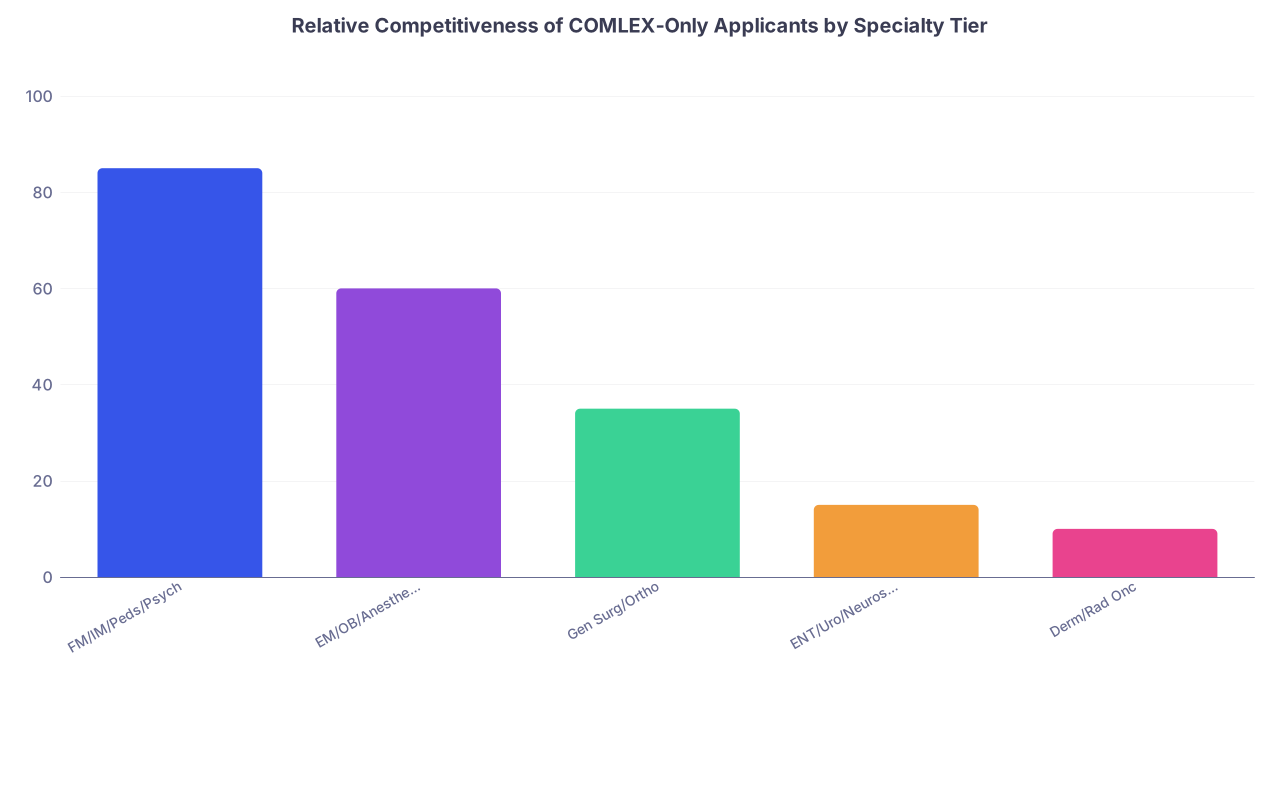
| Category | Value |
|---|---|
| FM/IM/Peds/Psych | 85 |
| EM/OB/Anesthesia/Neuro | 60 |
| Gen Surg/Ortho | 35 |
| ENT/Uro/Neurosurg/Plastics | 15 |
| Derm/Rad Onc | 10 |
Safer for COMLEX-Only
Family medicine, psychiatry, community internal medicine, pediatrics, PM&R at DO-heavy institutions, and certain mid-tier EM and anesthesia programs.
In these spaces:
- PDs often trained with DOs or are DOs.
- They’ve watched years of COMLEX scores paired with in-training exam performance.
- Their “best resident in 10 years” story is often a DO.
In those programs, a high COMLEX score and strong clinical letters absolutely can outweigh USMLE absence.
Risky but Possible
Academic internal medicine, mid-tier EM, OB/GYN, anesthesia, neurology, PM&R at major academic centers.
Here, COMLEX-only is a yellow flag, not a hard stop. You’ll need:
- Clear excellence in something: research, home institution prestige, away rotations, or near-650+ COMLEX scores.
- Strong letters from people they know or respect.
- A story that explains, indirectly, why your application is still a safe bet.
Borderline Self-Sabotage
General surgery, ortho, ENT, urology, neurosurgery, plastics, derm, rad onc, highly competitive radiology programs.
I’ve seen DOs match these with COMLEX-only. It happens. But it’s almost always via:
- A very DO-friendly program with a long DO history
- A strong connection: home program, away rotation superstar, or inside advocate
- COMLEX scores that are objectively outstanding
If you’re aiming at these fields and you’re COMLEX-only, understand what PDs are thinking:
“If this person can’t handle (or chose not to take) USMLE, what happens when they hit ABSITE, in-service, and boards?”
Fair or not, that’s the lens.
What COMLEX-Only Applicants Can Do To Offset the Disadvantage
You cannot magically transform COMLEX into USMLE. But you can control how much anxiety your application generates.
1. Make Your COMLEX Scores Undeniably Strong (If the Window is Still Open)
If you haven’t taken Level 2 yet, this is your leverage point. PDs care much more about recent, clinical-heavy exams than the early one.
You want Level 2 to say:
“Whatever doubts you had about Level 1, forget them. I can clearly handle clinical medicine.”
A Level 2 jump (say 515 → 585) changes conversations in rank meetings. I’ve watched PDs say:
“Level 1 is average but Level 2 is strong. This trend is what we want.”
If you’re COMLEX-only, that “trend” is one of your few quantifiable weapons. Use it.
2. Become Unignorable on Clinical Performance
PDs trust one thing more than any test: direct observation from someone they know.
This is where DOs win or lose:
- An away rotation where you’re described as “top 5% of all students I’ve worked with in 10 years” erases a lot of COMLEX uncertainty.
- A home program letter that says “better than our recent categorical residents” shifts the discussion.
I’ve watched extremely skeptical PDs go from “COMLEX-only, meh” to “We’re ranking this DO high” after reading a letter from a colleague they trust.
3. Be Strategic About Where You Apply
Blindly applying to 80 programs, half of which barely interview DOs and all of which are USMLE-obsessed, is delusion.
Focus your energy and money on:
- Programs with DO faculty or APDs
- Places with several DO residents per class
- Mid-tier university-affiliated community programs that routinely rank DOs high
You can do a quick reality check:
- Look at current residents. How many DOs? Spread across PGY levels or just a token one?
- Ask upperclass DOs from your school where they actually got interviews with COMLEX-only. Not where they applied. Where they were called.
How PDs Evaluate a COMLEX-Only File: The Real Mental Checklist
When a PD is trying to decide what to do with your COMLEX-only application, the thought process goes roughly like this:
“Are these scores obviously weak?”
- If yes, you’re done unless there’s an advocacy email or a known connection.
“If I don’t understand COMLEX well, do I have any reason to trust this applicant anyway?”
- School reputation, known letter writers, strong away rotation at their institution.
“Does this file give me evidence that they’re better than my average MD applicant with a Step score?”
- Honors, research, leadership, narrative coherence.
“If I rank this person, will my faculty complain later that they struggled with exams or clinical load?”
- This is where a strong Level 2 and strong clinical letters matter.
If the answers lean positive at each step, you survive the COMLEX-only handicap.
The Ugly Part: Things PDs Won’t Say Out Loud but Definitely Think
Let’s talk about two biases that you should know exist.
Bias 1: “USMLE = Serious About Competitive Training”
There’s an unspoken hierarchy in some academic circles that goes like this:
- MD with strong USMLE → “Serious candidate, can handle boards.”
- DO with strong USMLE + COMLEX → “Ambitious, hustled, can function in MD world.”
- DO COMLEX-only → “Unclear if they’d be competitive on a common metric.”
Unfair? Yes. Real? Absolutely.
I’ve heard a surgery PD say:
“If a DO really wants to be here, they’ll take the same test my MDs took.”
You don’t have to like that logic. But you do need to understand that it’s operating under the surface.
Bias 2: “School Culture Predicts Exam Culture”
Programs that regularly take DOs often have an internal mental list of “strong DO schools” and “less strong DO schools.” They won’t publish this. They talk about it at lunch.
A COMLEX-only applicant from a DO school they’ve had great experiences with will get more benefit of the doubt than one from a school they associate with mediocre in-training exam performance.
That’s reality. If you’re from a less-established school, your individual story and performance matter more.
If You’re Already COMLEX-Only: Do You Need to Add USMLE Now?
I get this question constantly, usually from third-years who realize too late how this game is played.
Here’s the truth PDs will tell you privately:
Taking Step 2 only as a DO is sometimes worth it if:
- You still have time before applications, and
- You’re aiming for a semi-competitive field or academic spot, and
- You’re realistically going to score well.
Taking Step 1 late now that it’s pass/fail? Much lower yield. It does not fix anything for most PDs.
If you’re already well into fourth year and applications are out, adding USMLE late is usually theater. Programs have already made up their minds from your existing board history, clinical record, and letters.
The worst move? Sitting for USMLE unprepared and posting a mediocre or bad score. That confirms every anxiety they had about you. If you can’t do well, don’t take it just to “check the box.”
Final Reality Check: What Matters More Than COMLEX vs. USMLE
Let me be brutally clear: COMLEX-only is a disadvantage in many places. But it’s not the whole story.
I’ve watched:
- COMLEX-only DOs match strong university IM programs because they destroyed their sub-I and earned killer letters.
- DOs with both exams and solid scores still go unmatched in competitive fields because their clinical reputation was bland or their interviews were flat.
- PDs fight for a COMLEX-only applicant in rank meetings because the resident advocates in-house said, “We need someone like this on our team.”
Program directors don’t lie awake thinking about COMLEX vs USMLE. They worry about one thing:
“Will this intern make my life easier or harder over the next three years?”
Your job is to build an application that makes the answer obviously “easier,” even if you only have COMLEX in your board section.
With that foundation in your head, you’re ready to start thinking about something much more important than your score report: which programs are actually worth your time and how to get in front of the ones that will value you. But that’s a strategy conversation for another day.