
The rank meeting is not a debate about your personal statement. It’s a knife fight over limited spots, dictated by time pressure, politics, numbers, and who actually remembers you.
You want to understand how DO applicants get discussed and scored? Let me walk you into that room. Because what you imagine is happening—and what really happens when programs rank DO applicants—are not the same thing.
The Reality of the Rank Meeting for DO Applicants
First truth: there is rarely a “separate DO pile” anymore at ACGME-accredited programs. But there is absolutely a mental filter.
Even in programs that “love DOs,” this is the quiet hierarchy you’ll hear in side conversations:
“She’s a DO but rotated here and crushed it—she’s basically one of ours.”
“He’s DO, scores are average, no rotation with us… do we really need to take that risk this year?”
No one writes that in policy. But you will hear it, especially from older faculty and program leadership trained pre-single-accreditation.
The rank meeting is where that bias either gets neutralized by your advocates—or sinks you quietly.
How the Meeting Is Actually Structured
Most osteopathic and formerly AOA programs do not walk into a room cold and “just talk applicants.” The rank meeting is the endpoint of a filtering and scoring process that’s been happening for weeks:
- Initial screen (USMLE/COMLEX, red flags, basic criteria).
- Application scoring (often by residents + faculty).
- Interview performance scoring.
- Preliminary rank list from the PD or coordinator.
- Final rank meeting where names move up, down, or off.
The rank meeting isn’t where they meet you. It’s where they remember—or forget—you.
Before the Meeting: How You’re Scored on Paper
Let’s start with how PDs walk into that room with a stack of “numbers” attached to your name.
Every program has its own system, but they all boil down to the same buckets: exams, academics, clinical performance, “fit,” and risk.
Here’s a very typical scoring framework I’ve seen (and used) in DO-heavy programs:
| Domain | Typical Weight |
|---|---|
| Board Scores (USMLE/COMLEX) | 20–30% |
| Clinical Grades/Dean’s Letter | 15–25% |
| Letters of Recommendation | 15–20% |
| Interview Score | 25–35% |
| Research/Scholarship | 5–10% |
| “Fit”/Subjective Factors | 10–20% |
The weights change, but those categories do not.
How Board Scores Really Get Used for DOs
For DO applicants, a few behind-the-scenes truths:
- Programs that care about USMLE will absolutely rank a DO with strong USMLE above a DO with only COMLEX, all else equal.
- Some surgery, EM, anesthesia, and competitive IM programs quietly soft-screen DOs without USMLE, even if they interviewed you. They won’t say this out loud.
- At historically osteopathic programs, COMLEX is fine—but the discussion in the room still often sounds like:
“Her COMLEX 1/Level 1 is 580, Level 2 is 640—she’s solid.”
versus
“COMLEX 1 was 430… did anyone work with him in person?”
And one more ugly truth: a low COMLEX gets more skepticism than a slightly low USMLE at some formerly AOA programs, because faculty know COMLEX score distributions less well. When they don’t understand a test, they overreact to the bottom range.
Clinical Performance and the DO School Effect
Where you went to school matters more than they’ll admit.
If your DO school has a strong track record at that program, the PD will say things like:
“She’s from LECOM; their students usually hit the ground running. Her evaluations fit what we know.”
If your school is less known, someone will ask:
“Anyone familiar with [your school]? Are their clinicals solid?”
No answer? That hurts you more than your dean’s letter.
Strong core clerkship comments and strong sub-I evaluations are gold. Programs know DO grading can be inflated, so the narrative comments matter more:
- “Functions at or above intern level”
- “Would happily work with this student again as a resident”
- “Excellent work ethic, strong fund of knowledge”
Those phrases get quoted in the room. I’ve heard PDs literally read them aloud to push someone up the list.
The Interview Score: Your Real Trump Card
Let me be blunt: on rank day, your interview performance is more powerful than your personal statement, your “story,” and your extracurriculars combined.
For DO applicants, especially at MD-heavy or competitive programs, the interview is where you either erase residual bias—or confirm it.
Typically, every interviewer submits a score right after your interview. Something like 1–5 or 1–9, or “Definitely Rank / Maybe Rank / Do Not Rank.” Those raw scores are averaged or standardized and become your “interview score.”
But that’s not the full truth.
What Interviewers Actually Say About You
Along with the number, they usually enter brief free-text notes. These are much more brutal and much more honest than what they say to your face. Real examples I’ve seen in scoring systems:
- “Quiet but thoughtful. Seems mature. Would be solid on nights.”
- “Robotic answers. Felt rehearsed. Not sure how she’d work with nurses.”
- “Strong DO applicant. Great attitude. Would fit our culture.”
- “Said he wants academic career but has zero research. Feels inconsistent.”
- “Top DO this season. Would fight to rank high.”
On rank day, when your name comes up, the PD or chief resident will often read those notes verbatim. This is where your fate gets decided in less than 60 seconds.
If you’re a DO applicant in a mixed-program, the phrase that saves you is usually some version of:
“One of the best interviews we had this year.”
That alone has moved DO applicants above MDs with better scores. I’ve seen it. Multiple times.
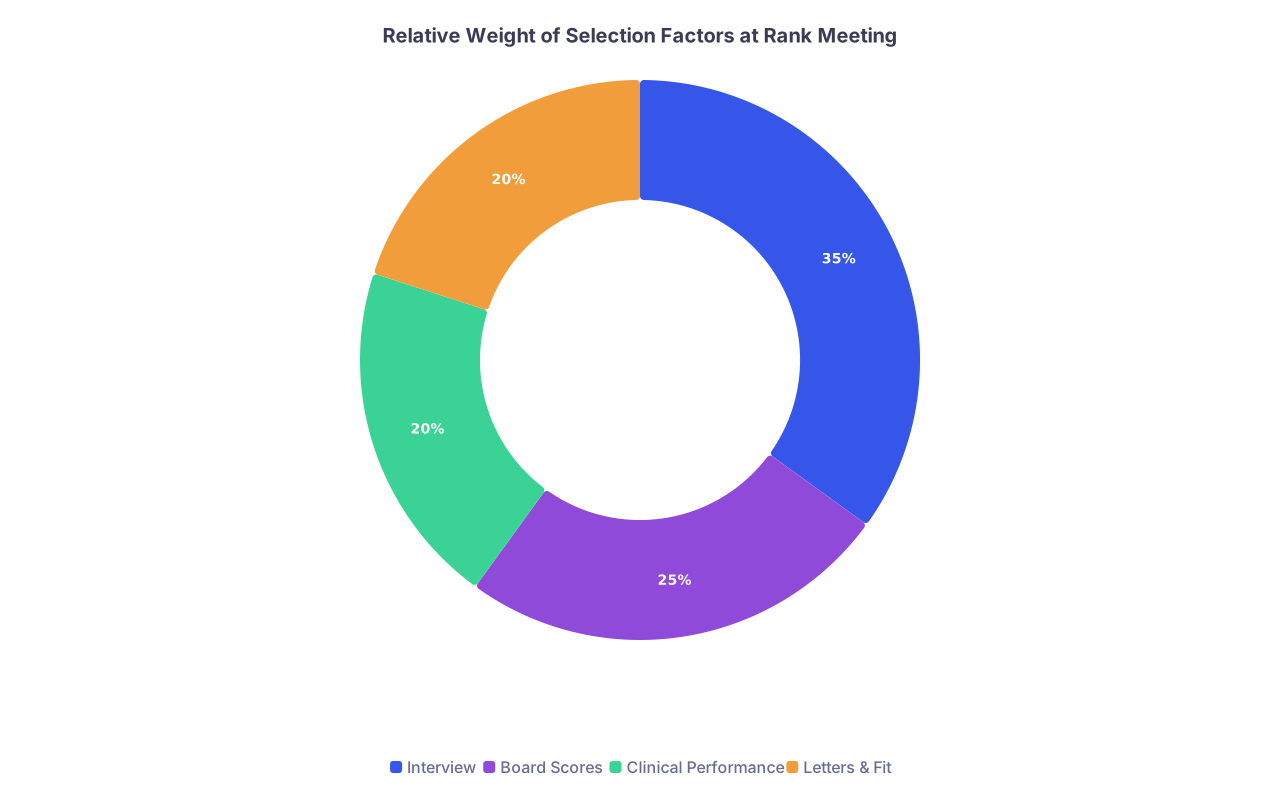
| Category | Value |
|---|---|
| Interview | 35 |
| Board Scores | 25 |
| Clinical Performance | 20 |
| Letters & Fit | 20 |
Inside the Room: How DO Applicants Are Actually Discussed
Now to the part nobody explains: what that rank meeting actually feels like from the inside.
Picture a conference room. PD at the head. APDs, a few core faculty, maybe the chief residents, maybe a program coordinator pulling up files. Coffee. Laptops. Fatigue.
There is a draft list already on the screen. You are not starting from zero.
The Starting Point: Pre-Meeting List
Before the meeting, the PD usually builds a preliminary order based on composite scores. Something like:
- Tier 1: Automatic high rank (great scores + great interview + no red flags).
- Tier 2: Probable rank.
- Tier 3: Bubble.
- Tier 4: “Only rank if we really need to fill.”
- DNR: Do not rank.
If you’re a DO and you never rotated there, never had someone champion you, and your scores are average—they probably dropped you into Tier 2 or Tier 3.
This is where you either get rescued or slowly sink.
How the Discussion Flows
The meeting rarely spends equal time on everyone. The top 10 and the controversial ones get 80% of the oxygen.
It goes something like:
- PD scrolls through the top group. “Anyone want to move someone up or down?”
- Quick comments:
“She was amazing on her sub-I.”
“He seemed a bit arrogant.”
“This one’s DO from DMU, we know that school, she’s strong.” - They tweak a few spots.
- Then the middle and bubble group get rapid-fire, sometimes brutal assessments.
For DO applicants, listen to the actual phrases that matter:
- “Strong DO candidate.”
- “For a DO he’s as good as any MD we saw.” (Yes, that gets said. I’ve heard it.)
- “She rotated here. Residents loved her. She fits.”
- “We’ve had great luck with DOs from that school.”
- “We already have two DOs per class; do we want another this year?”
That last one is the quiet quota effect. Nobody will call it a quota, but some programs get nervous if their class “looks too DO” on paper, especially if leadership thinks the hospital cares about optics. Outdated? Yes. Still real in some regions? Absolutely.
The Advocate Effect
Your single biggest asset in that room is not your Step score. It’s your advocate.
This could be:
- The faculty who interviewed you and loved you.
- The attending from your away rotation.
- The chief who spent a month with you on nights and trusted you.
When your name comes up, the difference between:
“Yeah, she was fine.”
and
“No, I really liked her. She was excellent on rotation, great with patients, and the team loved her. I’d be very happy to work with her as a resident.”
…is the difference between being rank #12 and rank #42.
If you’re a DO at an MD-heavy program, you need someone in that room willing to say:
“She’s just as strong as any of our MD top picks.”
Without that voice, you’re relying purely on numbers and a thin narrative. That’s not where you want to be.
How COMLEX vs USMLE Plays in That Room
Let me be blunt again: the COMLEX vs USMLE issue is not an abstract debate to them. It’s a ranking problem.
Here’s what happens:
- If you have both USMLE and COMLEX, they will almost always anchor on USMLE for comparison because it’s easier for them. COMLEX just becomes a secondary check.
- If you only have COMLEX and the program is MD-heavy, someone will ask, “So what does a 540 mean again? Is that like 220? 230?” And the room guesses.
- If the PD doesn’t fully understand COMLEX, borderline scores scare them more than they should.
At historically osteopathic programs, it’s different. They know COMLEX percentiles cold. A PD might say:
“Level 1: 510, Level 2: 590. He improved. I like that trajectory.”
Or:
“420, 430… that’s concerning. Any evidence he’s going to keep up?”

How “Fit” Actually Gets Weaponized
Fit is the most overused and misunderstood word in this whole process. It’s also where subtle DO bias lives.
Translation of what they actually mean:
- “Fit” = Will this person survive our workload, not make drama, and mesh with our culture?
- “Fit” also = Do we feel comfortable with them? Do they seem like “our type” of resident?
Now connect that to DO stereotypes.
If the program sees DOs as:
- “Hardworking, less entitled, solid clinicians” → that boosts your fit.
- “Less academic, lower boards, not research-focused” → that hurts you at academic-heavy programs.
So what moves you into the “good fit” category as a DO?
- You rotated there and clearly understood their culture.
- Residents specifically said they’d like to work with you.
- You communicated maturity and resilience in your interview without sounding like a victim.
- You showed you actually want that program and not “any IM spot in the region.”
In the rank discussion, this sounds like:
“She told me she’d pick us over [bigger-name program] because she cares more about teaching and less about research. I believed her.”
Or the opposite:
“He said he’s very research-oriented but didn’t know our research tracks. I’m not convinced he really wants to be here.”
Red Flags and How They Sink DO Applicants Faster
I’ve seen this pattern too many times to ignore: the same red flag hits a DO harder than an MD.
One failed COMLEX attempt? For an MD with otherwise strong files, that might get rationalized as “immature first year, then improved.” For a DO, it sometimes reinforces pre-existing doubt about school quality or preparation.
Common red flags that blow up in the rank meeting:
- Failed or multiple-attempt COMLEX/USMLE.
- Big unexplained gaps in training.
- Vague or lukewarm letters from home institution.
- Unprofessional behavior on rotation (even small things).
The difference is in the commentary:
For an MD:
“He had a rough start but really turned it around.”
For a DO:
“Given the failed COMLEX and not amazing interview, are we sure we want to take that chance?”
Is it fair? No. Is it happening? Yes.
This is why for DO applicants, you can’t afford a mediocre interview or a neutral away rotation. You don’t just need to “be fine.” You need people to go out of their way to say you’re strong.
The Final Adjustments: Politics, Quotas, and Quiet Rules
Near the end of the meeting, once the rough order is set, that’s when the quiet rules show up.
Things like:
- Balance of MD vs DO this year.
- Internal candidates vs outsiders.
- Students from affiliated schools.
- Geographic preferences.
You may hear:
“We should make sure we don’t end up with zero DOs; our DOs have been fantastic.”
“We already have three DOs in each PGY; let’s keep the mix similar.”
“Our osteopathic partner school will be pissed if we don’t take at least one from them this year.”
Your name is not being ranked in a vacuum. You’re being slotted into a class composition puzzle.
At some osteopathic programs, being DO is actually a plus at this stage—they want to keep an osteopathic identity, keep OMT clinics alive, maintain relationships with DO schools.
At some MD-heavy programs with a history of taking only one or two DOs a year, you’re basically fighting for that “DO spot.” They will never call it that publicly. But you’ll see the pattern in their past match lists.

| Step | Description |
|---|---|
| Step 1 | Applications Submitted |
| Step 2 | Initial Screen |
| Step 3 | Score & Tier Applicants |
| Step 4 | Interview Selected |
| Step 5 | Interview Scores & Notes |
| Step 6 | Preliminary Rank List |
| Step 7 | Rank Meeting Discussion |
| Step 8 | Adjust for Fit & Politics |
| Step 9 | Finalize Rank List |
What You Can Actually Control as a DO Applicant
You cannot walk into that room and argue for yourself. But you can decide what ammo your advocates have.
If you’re still in the process, this is what actually moves your position in that unseen discussion:
Do an away rotation where you want to match
And not just show up. Be the hardest-working, most teachable student on that team. That’s how you get the “I would love to have them here” comment that wins rank meetings.Secure at least one letter from someone who will be in that room
A letter from a big name across the country is nice. A letter from Dr. Smith, who literally sits in the rank meeting for your target program, is better.Absolutely crush your interview
Especially at programs with few DOs. Come in prepared, clear about why them, specific about what you know of their program, and with coherent, confident answers about your path.If possible, take USMLE as a DO for MD-heavy fields/programs
Not because COMLEX is bad, but because they understand USMLE instinctively. You reduce friction and doubt.Make your “story” easy to defend in one sentence
On rank day, your champion might get 30 seconds. If they can say:
“She’s our top DO applicant—rotated here, strong COMLEX, residents loved her, and she absolutely wants to be here”
you’ve done your job.
You are not just an application. You are a talking point someone has to sell in a crowded room. Make it easy for them.