Most DO applicants do not lose ACGME interviews because of bias. They lose them because their personal statements quietly kill their chances before a human ever fights for them.
I’m going to walk you through the seven mistakes I see osteopathic applicants repeat every single year. I’ve watched strong DOs get filtered out of solid IM, EM, anesthesia, and even FM programs while weaker MDs sailed through—purely because of how they framed (or failed to frame) their DO background.
Do not let that be you.
1. Hiding Your DO Identity Instead of Owning It
The worst move isn’t being a DO. The worst move is acting like you’re vaguely ashamed of it.
Program directors read thousands of statements. They can smell insecurity. When you:
- Never mention osteopathic principles
- Avoid the word “osteopathic” entirely
- Downplay your OMM/OPP exposure
- Write a statement indistinguishable from a generic MD applicant
…it signals one thing: this applicant might be defensive, unsure, or trying to pass as something they’re not.
Here’s the subtle trap: you may think “I’ll just make it neutral so I don’t trigger bias.” Reality? You just erased the one dimension of your training that differentiates you.
Common “hiding” patterns I see:
- “During my medical education…” (zero hint you’re at a COM)
- Not a single mention of osteopathic manipulative treatment, even in clinical anecdotes
- No connection between whole-person care and your specialty choice
That doesn’t make programs forget you’re a DO. ERAS shows it in 2 seconds. What it does is remove any positive narrative about why your DO training matters.
Do this instead:
- Explicitly name it: “As an osteopathic medical student, I…”
- Tie OPP/OMM to reasoning, not magic: improving function, reducing pain, understanding biomechanics.
- Show that osteopathic philosophy influences how you approach complex, multi-system patients.
Bad line:
“I attended medical school where I learned to treat patients.”
Better line:
“Osteopathic training forced me to see beyond isolated lab values. In clinic, that meant asking why my COPD patient kept missing appointments instead of just increasing her inhaler dose.”
You don’t need a manifesto about osteopathy. But if I read your statement and couldn’t tell you’re a DO, you’ve already made a critical mistake.
2. Overcompensating With “Osteopathic Philosophy” Word Salad
The equal and opposite failure: overdoing the philosophy to the point of parody.
You know the ones:
- “The body is a unit, structure and function are reciprocally interrelated…”
- “I am committed to the integration of mind, body, and spirit…”
- “I will always treat the whole person rather than just the disease…”
I’ve seen PDs literally groan and skip ahead when they hit that boilerplate. They told me, “If they’re just reciting the COM curriculum, they’re out of ideas.”
Here is the problem:
- You’re repeating textbook phrases, not showing how you think.
- It screams “I do not know how to convert this philosophy into actual clinical behavior.”
- It makes osteopathy sound like a slogan, not a practice.
Programs are not impressed by:
- Copy-pasted tenets
- Generic “holistic care” clichés
- Spiritual buzzwords with zero context
They are impressed when you show:
- How those principles changed your approach in a specific patient encounter
- How they influence your interest in a particular specialty
- How they shape your team behavior during busy, chaotic moments
Instead of this:
“The osteopathic principles of treating the whole person and the interrelationship of structure and function guide my care.”
Try this:
“When a frequent-flyer back pain patient returned to our clinic, I resisted the urge to just renew meds. My DO training pushed me to examine gait, posture, and work demands. After a detailed MSK exam and targeted manipulation, we also adjusted his job ergonomics. His ED visits dropped. What mattered wasn’t the technique—it was refusing to treat his spine in isolation from his life.”
Notice: no buzzword salad. Same philosophy. Way more believable.
3. Writing a “Redemption Arc” That Sounds Like Damage, Not Growth
DO applicants with non-traditional paths or academic bumps often swing too far into confessional mode. They think honesty equals dumping every failure on the page.
Here’s where you go wrong:
- Long descriptions of why your Step/COMLEX score is low
- Emotional paragraphs about burnout, mental health, or family crises with no professional framing
- Trying to pre-defend your application instead of presenting your value
What PDs actually read between the lines when you over-explain:
- “This applicant might be unstable.”
- “They’re still raw about this.”
- “I’ll have to fix a lot of their issues.”
You do NOT fix a weak score in your personal statement by:
- Blaming COVID, a toxic preceptor, or your school
- Giving a multi-paragraph play-by-play of test anxiety
- Telling the entire story of a leave of absence with every emotional detail
You just spotlight the biggest risk in your application.
Use this standard:
If I removed the “bad thing” from your story, would the paragraph still show maturity, insight, or professional growth? If not, cut or rewrite.
Acceptable to briefly address:
- LOA with one line of context + one line of growth
- Significant early academic difficulty that later clearly improved
- A career change that explains timing, not your worth
Example of a harmful paragraph (real pattern):
“I failed COMLEX Level 1 during a time of great personal stress. My grandmother was ill, I was struggling with mental health, and I felt unsupported by my school. It was a dark time where I questioned if medicine was right for me…”
This just makes PDs nervous.
Tighter, safer version:
“Early in my training I underperformed on COMLEX Level 1. Addressing test-taking gaps and time management with faculty mentors not only improved my later exam performance but changed how I approach struggling teammates and patients: with structure, honesty, and a concrete plan instead of avoidance.”
Short. Professional. Growth-focused. No drama.
4. Sounding Like a Generic MD Applicant in a Competitive ACGME Pool
Many DOs, especially aiming at ACGME programs in EM, anesthesia, surgery, or radiology, make this mistake: they try to “blend in” with MD applicants.
Bad move.
Here’s what happens when your statement reads like a generic MD’s:
- You erase the one clear differentiator in your training.
- You compete purely on test scores and school name in a game that was never weighted in your favor.
- You become forgettable. “Another applicant who likes procedures and teamwork.”
Programs do not need another bland story about:
- Loving “fast-paced environments”
- Enjoying “the intersection of medicine and surgery”
- Wanting to “combine critical thinking with hands-on care”
They need a reason to remember you specifically and to take a chance on a DO if their default habit is MD-heavy.
Your edge as a DO in ACGME programs:
- More MSK exposure than most MD peers
- Often more comfort with hands-on exams and physical diagnosis
- Stronger primary care grounding even if you’re going specialty
- Demonstrated resilience through COMLEX/USMLE juggling, rotations in varied systems, and sometimes weaker institutional name recognition
You sabotage that when your entire statement could belong to any second-year MD at [Insert Big-Name School].
Example:
“EM attracts me because it offers variety, fast-paced decision-making, and the chance to care for patients at critical moments.”
That tells them absolutely nothing. Everyone says that.
Better version for a DO:
“Osteopathic training forced me to be comfortable with diagnostic uncertainty early—palpating, examining, and making decisions before every lab was back. In the ED, that same instinct to use my eyes and hands first, not just the CT scanner, is what excites me.”
Now your DO background is an asset, not an afterthought.
5. Using OMM as a Party Trick Instead of a Clinical Tool
This one is brutal because it looks like you’re “highlighting osteopathy,” but you’re actually undermining it.
Common mistakes:
- Telling a dramatic OMM miracle story with no nuance (“After my manipulation, her chronic pain vanished.”)
- Presenting OMM as a magic fix when nothing else worked
- Making OMM the only story you tell about patient care
- Using language that sounds quasi-alternative instead of medically grounded
Why this backfires:
- Many ACGME attendings have limited OMM exposure. Wild claims confirm their worst stereotypes.
- It makes them wonder if you’ll be evidence-averse, or “that resident” trying to adjust everyone instead of following standard care.
- It makes you look narrow. You’re training to be a physician, not just a manual therapist.
You want OMM/OPP to show:
- Clinical reasoning
- Respect for guidelines and multi-modal treatment
- Appreciation of structure-function relationships
- Good hands, good exam skills, good patient rapport
Wrong framing:
“After the team had tried everything, I offered OMT, and the patient’s headache disappeared. This confirmed my belief in the power of osteopathic treatment above all.”
Better framing:
“Our team had optimized this patient’s migraine regimen, but she remained miserable. I proposed adding gentle OMT focused on cervical and suboccipital dysfunction. Combined with improved sleep hygiene and medication adjustments, her pain scores dropped and she requested OMT at follow-up. The experience reinforced for me that hands-on care belongs inside, not outside, evidence-based medicine.”
See the difference? Team-based, integrated, non-magical.
6. Writing a Personal Statement That Fights Your Specialty Choice
Several DOs apply ACGME because they think it’s their “better shot” for certain specialties. That’s reality. But they then write statements that scream “I don’t actually understand this field.”
For osteopathic applicants, the bar is subtly higher. PDs will ask themselves: “Does this DO actually know what this specialty is in our environment?”
You damage yourself when you:
- Use family-medicine language to apply to radiology, anesthesia, or EM
- Over-idealize lifestyle in fields where that’s obviously naïve
- Talk about “holistic care” while clearly misunderstanding what residents actually do day-to-day
Patterns that kill DO apps fast:
- Anesthesia PS that reads like a primary care personal essay
- Surgery PS full of “I love clinic continuity” but almost nothing about long cases, team dynamics, or operating room culture
- Radiology PS that mentions zero imaging experiences and focuses on OMM
PDs will not gamble on a DO who might bail or be miserable because they picked the wrong field for the wrong reasons.
You do not need to have seen everything. But you must show:
- Specific exposure to the specialty in some setting (core rotation, sub-I, shadowing)
- An understanding of unglamorous realities (call, documentation, team hierarchy, patient mix)
- A clear, grounded fit between your temperament and the work
Example of mismatch (for surgery):
“I value long conversations with patients and the ability to follow them for years, building continuity and trust.”
Great. For FM or IM. For surgery? That risks sounding clueless unless you immediately tie it to longitudinal surgical care.
Fixed version:
“While I value continuity and long-term trust, I’ve learned that for many surgical patients, that continuity is compressed into a highly intense, vulnerable window—pre-op counseling, perioperative decision-making, and post-op recovery. Being the physician who navigates patients through that arc is what draws me to surgery.”
Align your story with the job you’re asking for. Especially as a DO asking them to stretch their comfort zone.
7. Ignoring the Unspoken DO–ACGME Gap: Scores, Signals, and Strategy
The final, quiet killer isn’t in what you write. It’s what you fail to address strategically.
Many DOs treat the personal statement like an isolated essay instead of one piece of a tactical application. The mistake: you write a beautiful narrative that does not support how your scores, experiences, and program list actually look.
Here’s how that sabotages you:
- You talk about academic curiosity and research while having no research at all.
- You declare life-long dedication to a competitive specialty with very borderline metrics and zero realistic backup.
- You pitch yourself as “deeply committed to academic medicine” while only applying to community programs.
PDs do pattern recognition. When the story doesn’t match the data, they assume:
- This applicant lacks insight.
- Or worse, they’re not honest with themselves.
Use your personal statement to reinforce your overall strategy, not contradict it.
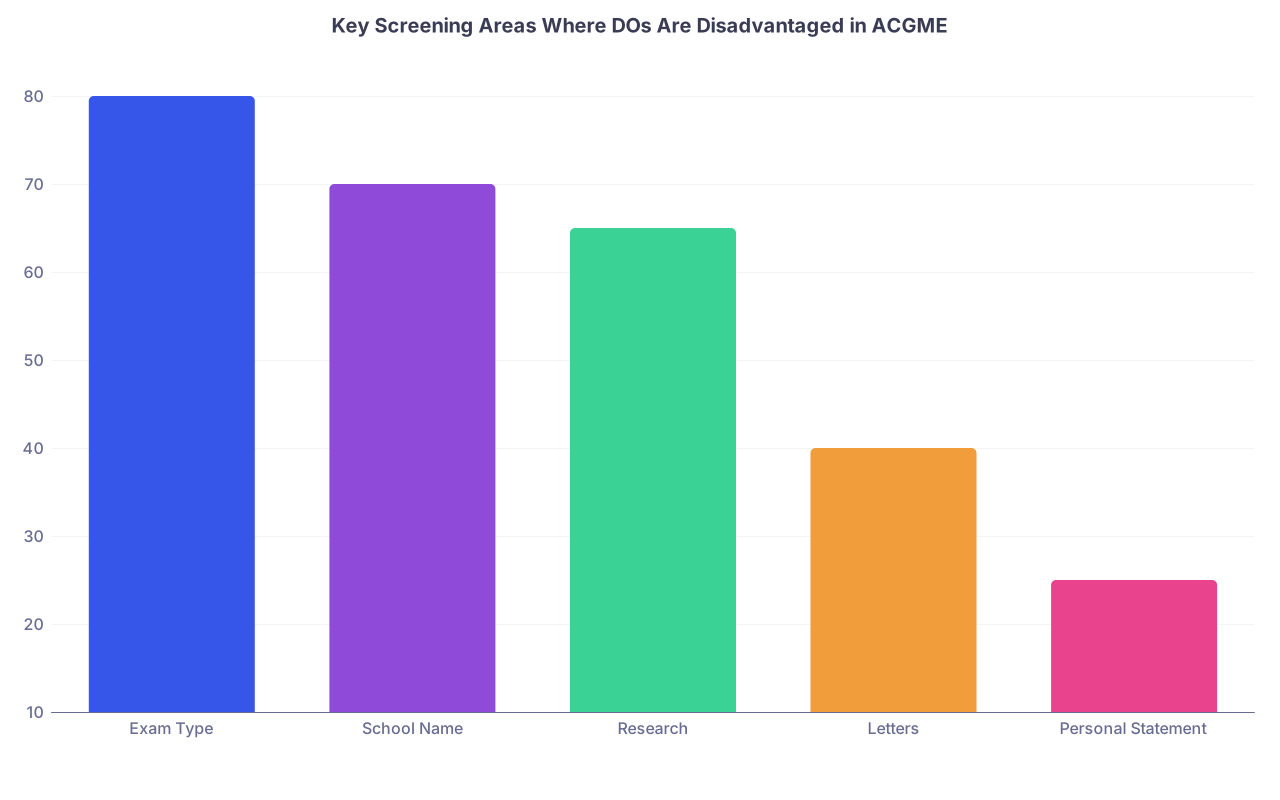
| Category | Value |
|---|---|
| Exam Type | 80 |
| School Name | 70 |
| Research | 65 |
| Letters | 40 |
| Personal Statement | 25 |
(Interpretation: DOs are most disadvantaged where objective filters dominate; the personal statement is one of the few levers where you can actually pull ahead.)
Ways DOs blow this:
- Pretending COMLEX-only is a non-issue for programs that clearly prefer USMLE
- Writing a statement for “competitive academic neurology” while applying mostly to community FM as a backstop
- Avoiding any mention of why you picked your particular tier of programs, leaving PDs to assume you just mass-applied
No, you do not name programs. But you can align:
- If your app skews community: emphasize hands-on learning, continuity, resourcefulness.
- If you have weaker scores but strong work experience: highlight grit, performance under pressure, and growth over time.
- If you’re a DO with strong USMLEs going for competitive ACGME: explicitly own that you’ve sought out higher-acuity or academic experiences to prepare.
Example alignment:
“My most meaningful clinical time has been in community hospitals where resources were limited, and residents were on the front line of decision-making. That environment, and the chance to know my patients beyond a single encounter, is where I see myself training.”
Now your program list (which PDs see) and your narrative actually match.
Quick DO Personal Statement Self-Check
Before I wrap, run your current draft through these blunt questions:
If I deleted every mention of “osteopathic” and “whole person,” would anything concrete change?
→ If no, you’re using slogans, not substance.Could this statement belong to a generic MD from any school?
→ If yes, you’ve erased your differentiators.Do I sound like I’m defending myself more than presenting myself?
→ If yes, trim the explanations and focus on value.Does this make sense for the specialty and the kinds of programs I’m actually applying to?
→ If no, fix the mismatch before you hit submit.
A Simple, Safe Structure for DO Applicants
To keep you out of the most common traps, here’s a straightforward structure that works for most DOs applying to ACGME:
Opening paragraph:
One specific patient or moment that illustrates how you think, not your childhood dream.Second paragraph:
How your osteopathic training shaped the way you responded in that moment—real behaviors, not tenet recitation.Middle paragraph(s):
- Concrete experiences in the specialty (rotations, sub-Is, relevant work).
- What you learned about the unromantic side of the field.
- How your strengths (grounded in DO training) match that reality.
Brief challenge/growth paragraph (only if needed):
One specific issue (if absolutely necessary), one line of context, 2–3 lines of growth and resolved behavior. No drama.Closing paragraph:
- Who you are as a resident teammate.
- The kind of environment where you’ll thrive (aligned with your actual program list).
- A forward-looking, grounded statement about contributing, not just “following my passion.”
Stay out of the weeds, stay out of your feelings diary, and stop trying to “prove” you deserve a chance. Show it with clear, composed, adult-level writing.

| Step | Description |
|---|---|
| Step 1 | Start Draft |
| Step 2 | Clarify with mentor & rotations |
| Step 3 | Choose 1 concrete clinical story |
| Step 4 | Add osteopathic angle with real behavior |
| Step 5 | Align with specialty realities |
| Step 6 | Skip explanation paragraphs |
| Step 7 | Write 3-4 line growth-focused note |
| Step 8 | Check for generic MD language |
| Step 9 | Revise to sound like DO asset |
| Step 10 | Have non-DO reader sanity-check |
| Step 11 | Finalize and upload |
| Step 12 | Clear Specialty Fit? |
| Step 13 | Address red flag needed? |
FAQ (Exactly 4 Questions)
1. Should I explicitly say I’m a DO in my personal statement for ACGME programs?
Yes. Avoiding the word “osteopathic” does not trick anyone; it just makes you look evasive or bland. The key is to reference being a DO in the context of your approach—how your training shapes your exam style, patient relationships, or clinical reasoning—rather than just listing your degree.
2. How much should I talk about OMM/OPP for non-primary-care specialties?
Use it as a seasoning, not the main dish. One strong, realistic example of how OMM informed your understanding of anatomy, pain, or function is enough. If OMM becomes the centerpiece for anesthesia, radiology, or EM, it can make you look out of touch with the core work of the field and feed stereotypes.
3. Can I use my personal statement to explain a low COMLEX or USMLE score as a DO?
Only briefly, and only if you clearly show stable improvement afterwards. One or two sentences maximum: name the issue, name the correction, demonstrate the result (better scores, sustained performance, changed habits). Do not turn your statement into a justification essay; you will just spotlight your weakest point.
4. Do I need different personal statements for ACGME vs osteopathic residencies?
You don’t need completely different essays, but you may need targeted tweaks. For ACGME programs, show that your DO background enhances your fit in their environment—team-based, evidence-driven, often less familiar with OMM. For osteopathic residencies, you can lean a bit more into explicit OMM use and osteopathic culture. At minimum, adjust the framing and emphasis even if 70–80% of the content stays the same.
Open your current personal statement file right now and do a ruthless pass: highlight in one color every phrase that could belong to any random MD, and in another color every sentence that clearly shows you’re a DO who’s an asset, not a consolation prize. If the MD color wins, you know what you need to fix tonight.