The fastest way for a DO applicant to sabotage an ACGME interview is to mishandle osteopathic identity and OMM. It happens every cycle. Smart, qualified DO students walk in strong on paper and walk out having quietly signaled: “I do not understand what being a DO means in this environment.”
You are not going to be one of them.
This is not about being “more DO” or doing showy HVLA in the conference room. It is about avoiding the very specific missteps that make programs question your judgment, your self-awareness, and your ability to function in an MD-majority training world without either hiding or overcorrecting your DO background.
Let me walk you through the traps I keep seeing—and exactly how to step around them.
1. Treating OMM as Either a Party Trick or a Dirty Secret
Here is the single worst pattern I see:
- On paper: “Passionate about OMM, 300+ hours, OMED membership, OMM fellow.”
- In the interview: Deer-in-headlights when asked, “So how do you see OMM fitting into your future practice?”
Or the opposite:
- On paper: Barely mentions OMM.
- In the room: Suddenly eager to demonstrate HVLA on the APD’s neck when they joke, “So, are you going to fix my back?”
Both extremes are a problem.
The “party trick” mistake
What it looks like:
- Over-eager to talk about techniques instead of clinical reasoning.
- Offering to “do a quick treatment” on faculty or other applicants.
- Describing OMM like a magic bullet: “I can fix most back pain in one visit.”
- Talking technique names nonstop: “I love FPR, still technique, counterstrain…” with no link to outcomes.
Why it kills you:
- Faculty worry you do not understand evidence, indications, or limitations.
- You come across as ungrounded, even if your intentions are good.
- In surgical or high-acuity fields, it sounds like misaligned priorities.
Better approach:
- Anchor OMM in clinical logic and patient benefit.
- Focus on:
- Pain control
- Function
- Reducing meds / adjunctive therapy
- Patient satisfaction
- Emphasize when you do not use OMM (red flags, when imaging first, etc.).
Concrete answer that works:
“I see OMM as an adjunct, not a replacement. During my FM rotation, I used simple muscle energy and soft tissue for acute low back pain when there were no red flags and imaging was not indicated. Patients often reported better function and less anxiety about their pain. But if I hear red-flag symptoms or neurologic deficits, I do not touch them until imaging and a full workup are done. Safety first.”
That is the tone you want. Calm. Rational. No circus tricks.
The “dirty secret” mistake
Equally bad is pretending OMM never existed.
Signals that hurt you:
- When asked about OMM, you say, “Honestly, I have not really used it,” with a dismissive shrug.
- You joke: “I am basically an MD with extra back-cracking training.”
- Your ERAS is packed with OMM experiences, but you minimize them in person: “That’s just part of the curriculum; I’m not really into it.”
Programs read this as:
- Poor insight into your own training.
- Possible shame around your DO degree.
- Unwillingness to own your background, which raises questions about how you will handle patients asking “What is a DO?”
You do not have to be an OMM evangelist. But you must not act like your osteopathic education is an accident you are trying to hide.
Balanced answer if you do not love OMM:
“I do not see myself as an OMM-heavy clinician, but the training changed how I approach physical exam, biomechanics, and chronic pain conversations. I still use simpler techniques like soft tissue and muscle energy when appropriate, especially for patients who prefer non-pharmacologic options. I value having it in my toolbox, even if it is not the centerpiece of my practice.”
If you cannot say at least that much convincingly, you look disconnected from your own degree.
2. Fumbling the “Why DO?” and “What Is Our Osteopathic Identity?” Questions
You will get this question. Sometimes gently: “Tell me why you chose a DO school.” Sometimes bluntly: “Why did you not go MD?”
There are three ways to blow this:
- Blaming circumstances (“I did not get into MD schools”).
- Giving vague marketing fluff (“I liked the holistic philosophy”).
- Pretending osteopathic and allopathic are identical.
The “I ended up DO by accident” story
You can be honest about not getting MD acceptances, but if that is your only answer, it sounds like:
- Lack of intention.
- Settling.
- Possibly still resentful.
Admissions and PDs have heard this too many times:
“I applied MD and DO and only got into DO, but it ended up being great.”
It is a weak frame. It makes you sound like someone things just “happen to,” rather than someone who chooses.
How to fix it:
- Acknowledge reality briefly.
- Pivot to what you actively embraced and how it shaped you.
- Name specific, concrete elements of osteopathic training.
For example:
“I applied broadly to MD and DO programs. My DO acceptance came first, and once I learned more about the curriculum, especially the emphasis on MSK, chronic pain, and longitudinal patient relationships, I realized it fit how I wanted to practice. The osteopathic training really sharpened my physical exam and my approach to functional complaints in clinic.”
Notice: no drama, no apology, no pretending you wrote an essay about A.T. Still at age 12.
The fluff trap: “Holistic, body-mind-spirit” with no substance
DO students overuse the word “holistic” like it is a spell. It is not.
If your answer sounds like:
- “I really like treating the whole person.”
- “Body-mind-spirit really spoke to me.”
- “I just felt DOs were more humanistic.”
…with no specific behaviors attached, it sounds memorized and hollow.
Instead:
- Tie philosophy to actual behaviors and decisions.
- Give one or two short cases where your osteopathic lens changed what you did.
Better:
“The osteopathic focus on function and the MSK system affects how I take a history. For example, in clinic, when a patient comes in with recurrent headaches, I am thinking about posture, work setup, neck strain, and sleep position, not just meds. That frame came directly from my DO training and OMM lab.”
That is osteopathic identity you can defend.
3. Misreading the Room on How Much OMM to Push
Not every ACGME program wants the same thing from a DO applicant. Treating them all as identical is a rookie mistake.
Some programs:
- Are osteopathic-recognized or DO-friendly.
- Actively want you using OMM on service.
- Have DO faculty who will support it.
Others:
- Have had bad experiences with overzealous OMM usage.
- See it as fine “extra,” but not a priority.
- Just want to know you can function like everyone else.
Walk in oblivious to this, and you are guessing at what they value.
Quick reality check: not all settings tolerate the same OMM use
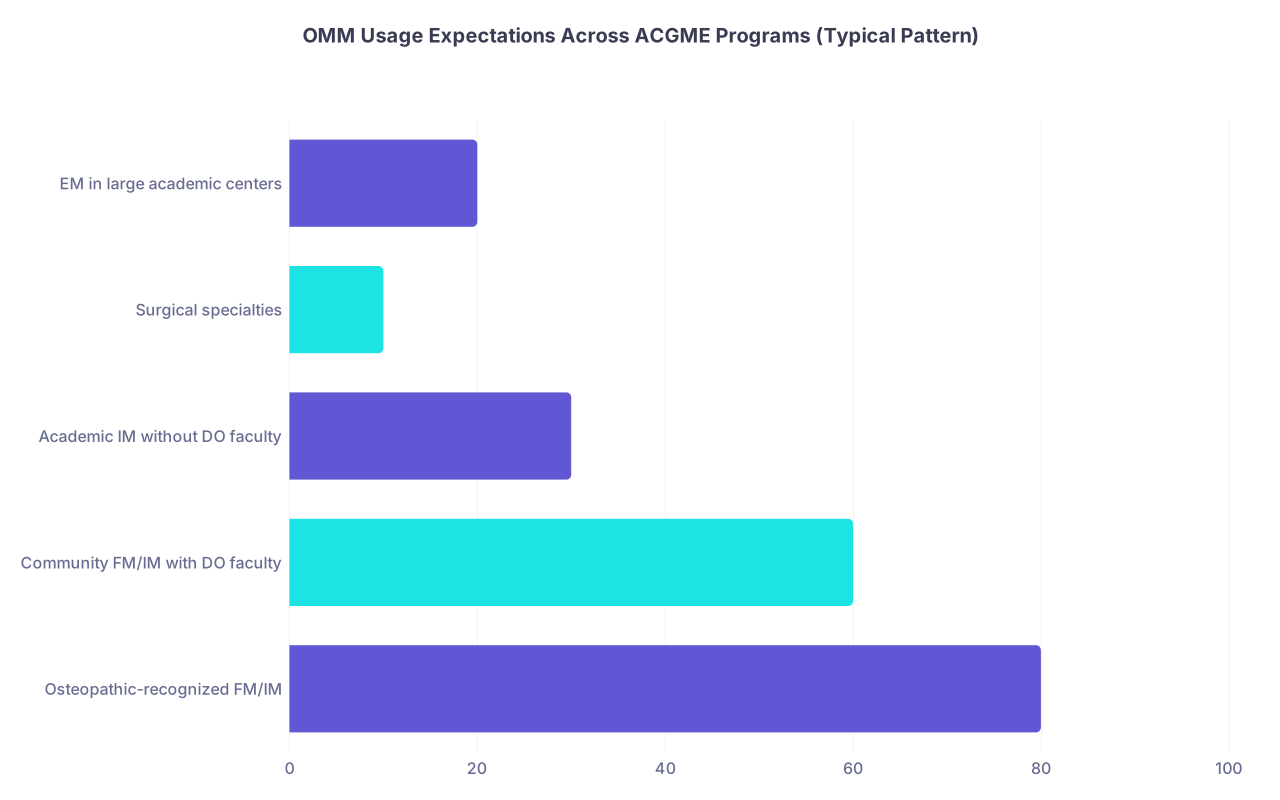
| Category | Value |
|---|---|
| Osteopathic-recognized FM/IM | 80 |
| Community FM/IM with DO faculty | 60 |
| Academic IM without DO faculty | 30 |
| Surgical specialties | 10 |
| EM in large academic centers | 20 |
These percentages are not exact numbers from a paper; they reflect actual patterns people see on the trail. Ignore them at your peril.
How to avoid miscalibrating
Before interviews:
- Check the program’s website for:
- Osteopathic recognition status.
- DO faculty in leadership.
- Any mention of OMM or osteopathic tracks.
- Look at current residents:
- Are there several DOs? A majority? None?
- Ask residents on pre-interview socials:
- “Do DO residents use OMM in clinic or inpatient here?”
- “How is OMM viewed by attendings?”
During interviews, adjust your emphasis:
If they are clearly DO-friendly / osteopathic-recognized:
- You can speak more openly about using OMM.
- Still stay grounded: emphasize evidence and appropriate indications.
- Avoid sounding like you want to turn everything into an OMT session, but do not hide your skills.
If OMM is not used and there are few DOs:
- Focus on osteopathic identity as an approach to exam, function, and patient communication.
- When asked about OMM, frame it as:
- Valuable in certain outpatient settings.
- Limited in time-pressured or procedure-heavy contexts, but still helpful in targeted ways (e.g., chronic pain, pregnancy-related back pain, certain post-op situations).
- Emphasize flexibility: you will not disrupt workflow to chase OMM.
Typical safe line:
“My priority is to meet the expectations of the program and provide evidence-based, efficient care. When the setting and time allow, I like to incorporate simple OMM techniques that relieve pain and improve function, but I am very sensitive to workflow and team norms.”
If they push: “But we do not really do OMM here,” do not argue. You say:
“That is completely fine. Even when I am not using hands-on techniques, the osteopathic training still informs my physical exam, my understanding of biomechanics, and how I talk to patients about chronic pain and function.”
You have answered the question. You are not there to convert them.
4. Mishandling Step/Level Scores and Competitiveness as a DO
The osteopathic identity conversation often bleeds into test score defensiveness. And this is another place DO applicants stumble.
The defensive DO script that backfires
You know this one:
- “Honestly, COMLEX is just as hard as Step.”
- “PDs should not care what test I took.”
- “The system is biased against DOs.”
You are not wrong that there is structural bias. But saying this in an interview? Suicide.
Programs want:
- Ownership of your choices.
- Clear understanding of the current landscape.
- Evidence that you can talk about unfair systems without melting down or sounding bitter.
Typical missteps:
- Explaining at length why you “did not need” Step 1.
- Arguing scores are not predictive of clinical performance (even if there is nuance there).
- Sounding angry at MD applicants or the system.
Instead, you want calm realism.
If you took both exams:
“I took both COMLEX and USMLE because I knew I wanted a broad range of ACGME programs, some of which still prefer or require USMLE. I treated them as parallel but different exams and made sure I was ready for both.”
If you only took COMLEX and they ask why:
“At the time I made that decision, I was targeting primarily DO-heavy and COMLEX-accepting programs, and I allocated my energy toward being as strong as possible clinically and on that exam. I understand some programs still prefer USMLE, and I accept that may limit a few options, but I feel well prepared for the training environments I am applying to.”
No whining. No blame. Just ownership.
5. Ignoring How Your Osteopathic Background Plays in Different Specialties
Osteopathic identity lands differently in family medicine than in orthopedic surgery. Pretending otherwise is naïve.
Here is how programs typically weigh it:
| Specialty | How OMM/Osteopathic Identity Is Usually Viewed |
|---|---|
| Family Medicine | Strong positive if grounded and practical |
| Internal Medicine | Mild positive, especially for MSK and pain |
| Pediatrics | Positive for procedures, MSK, and chronic pain |
| EM | Neutral to mild positive if not workflow-breaking |
| Surgery (all) | Neutral; focus on technical skill and stamina |
Mistake: using the same osteopathic pitch everywhere
Bad strategy:
- “I want to bring OMM to the OR.”
- “I plan to integrate OMM on every rotation.”
- “My main goal is to increase OMM usage in your program.”
That may sound great on an osteopathic school panel. It sounds tone-deaf at a busy academic surgery or EM program.
Adapt instead.
For FM/IM/Peds:
“In continuity clinic, I would love to incorporate appropriate OMM for selected patients, especially those with chronic MSK pain or pregnancy-related complaints, as long as it fits within the clinic schedule and clinic leadership is supportive.”
For EM:
“In EM, I am realistic about time constraints and acuity. I see OMM as something that might help with specific low-risk pain presentations when workflow allows, but not as a core part of my emergency care. The main osteopathic impact for me is in my physical exam and functional assessment.”
For surgery:
“I do not expect to be doing OMM frequently in surgical training. The osteopathic benefit for me has been a very tactile, anatomy-focused education and a strong respect for how form affects function, which I think translates well to surgery.”
Notice the pattern: you never apologize for being a DO. You show you understand context.
6. Failing the Patient-Question Test: Explaining DO vs MD Poorly
Every DO applicant should be able to handle this cold:
“What would you say to a patient who asks, ‘What is a DO?’”
I have watched strong applicants absolutely freeze here. Or worse, give answers that make everyone wince.
Disastrous versions:
- “We are basically the same as MDs, just with extra OMM.”
- “We are more holistic than MDs.”
- “We are like chiropractors but physicians.”
Programs do not just hear your words; they imagine you saying them to their patients. That is the test.
You need a script that:
- Is short.
- Respectful to MD colleagues.
- Distinguishes your training without bragging.
Solid version:
“I am a fully licensed physician, like an MD, with the same training in medicine and surgery. As a DO, I also had additional training in the musculoskeletal system and hands-on techniques that can help with pain and function. Practically, it means I pay a lot of attention to how your symptoms relate to your body mechanics and daily activities, and I have a few extra tools when appropriate to address that.”
If you want even shorter:
“I am a fully trained physician, like an MD, but my schooling included extra training in the musculoskeletal system and some hands-on techniques that can help with pain and function when appropriate.”
If you cannot do this clearly and calmly, fix it before you hit the interview trail. Program directors absolutely notice.
7. Looking Unprepared When Asked for Concrete OMM Examples
You knew OMM would come up. Yet many DO applicants act surprised when asked:
- “Can you give an example of a patient where OMM helped?”
- “When would you not use OMM?”
- “Which techniques do you actually use?”
Red flag answers:
- “I have not really used it much in clinic.” (When your CV says OMM clinic or fellowship.)
- “I mostly just did what my preceptor told me.”
- “I like HVLA and cranial a lot.” (With no clinical context.)
Prepare 2–3 specific, safe, non-heroic OMM cases:
- One outpatient MSK (e.g., acute low back pain with no red flags).
- One chronic pain / adjunctive treatment.
- One “I chose not to treat” example (red flag, concerning symptoms).
Example #1 – acute low back pain:
“In family medicine clinic, a middle-aged patient came in with acute low back pain after lifting. No red-flag symptoms, normal neuro exam. I did a focused musculoskeletal exam, talked through activity modification, and used gentle muscle energy and soft tissue techniques. The patient reported modest but immediate improvement in motion and felt more confident about staying active. We avoided unnecessary imaging and set expectations clearly.”
Example #2 – when you did not use OMM:
“On my IM rotation, a patient complained of new severe back pain with a history of cancer. Even though some residents joked about ‘cracking his back,’ I insisted we hold off on any OMM and got imaging and oncology involved. That is a clear setting where OMM would be inappropriate until we knew what was going on.”
That second one matters more than you think. It shows safety, judgment, and that you are not blinded by your skillset.
8. Acting Either Overly Defensive or Overly Grateful as a DO
Here is a subtle but fatal dynamic.
Some DO applicants enter ACGME interviews with a chip on their shoulder:
- Trying to prove they are “as good as MDs.”
- Overcompensating by bashing OMM or osteopathic schools.
- Sounding bitter about bias.
Others do the opposite:
- Radiating gratitude: “Thank you so much for even considering a DO like me.”
- Over-apologizing for COMLEX or school name.
- Minimizing their achievements to seem “humble.”
Both are unattractive. Programs want residents who:
- Understand the system.
- Are realistic without being resentful.
- Have self-respect without arrogance.
How to thread that needle:
- Use matter-of-fact language:
- “As a DO, I know some programs are less familiar with COMLEX, so I am glad to discuss how my training has prepared me for your environment.”
- “My school had strong clinical training in X and Y; I am confident I can perform at the level expected of your interns.”
- Do not apologize for being a DO.
- Do not brag that DOs are “better” or “more holistic.”
If someone makes an ignorant or slightly loaded comment like:
“We have not had many DOs here. Do you think you can keep up?”
You do not go scorched-earth. You say:
“Yes. On my away rotation at [ACGME site], I worked alongside MD students and felt my preparation in clinical reasoning and exam was very comparable. Your expectations for interns match what I want from my training.”
Calm. Confident. Not defensive.
9. Forgetting That Your Online Presence Also Signals Osteopathic Judgment
One last blind spot: programs will sometimes look at your social media, your school OMM club posts, your research posters online.
Common online missteps:
- Over-the-top OMM claims: “Treating hypertension with cranial alone!”
- Mocking MD medicine or “pharma.”
- Posting “before and after” videos with dramatic, unsubstantiated OMM results.
- Publicly ranting about MD bias against DOs.
If they see:
- You in a white coat promoting questionable OMM as a cure-all.
- Anti-vaccine or pseudoscience adjacent language dressed up as “osteopathic.”
They will think twice about ranking you. Sometimes they will quietly drop you entirely.
You do not need to scrub your identity. But you should:
- Remove or lock down anything that overpromises OMM.
- Delete attacks on MDs, ACGME, or “allopathic” medicine.
- Make sure your research / presentations are framed in cautious, evidence-aligned language.
If you want to be seen as a mature DO physician, your online trail cannot look like an OMM influencer’s feed.

| Step | Description |
|---|---|
| Step 1 | Know Your Program |
| Step 2 | Discuss selective OMM use in clinic |
| Step 3 | Emphasize exam & biomechanics |
| Step 4 | Give 1-2 concrete OMM cases |
| Step 5 | Prepare patient-friendly DO explanation |
| Step 6 | Show calm, non-defensive confidence |
| Step 7 | DO-Friendly? |
10. Quick Pre-Interview Checklist: Are You About to Make These Mistakes?
Use this as a blunt self-audit the night before interviews:
Can you explain:
- Why you chose or accepted a DO education?
- What a DO is to a patient in under 20 seconds?
- How OMM fits into your future practice—in your specialty?
Do you have:
- 2–3 specific, safe OMM cases ready (including 1 “I did not treat” example)?
- A clear sense of this program’s DO/OMM culture from their website and residents?
- A plan for how much to emphasize OMM at this specific program?
Have you:
- Scrubbed any wild OMM claims from public-facing accounts?
- Dropped the urge to apologize for OR overhype your DO identity?
- Practiced answers without words like “holistic” floating alone without specifics?
If you cannot check these off, fix it now. Not in front of the program director.
Final Takeaways
- Do not treat OMM as either a parlor trick or a source of embarrassment. Own it as a rational, limited tool that fits into evidence-based care.
- Do not be vague about osteopathic identity. Tie “holistic” language to specific behaviors, patient encounters, and exam habits you can describe clearly.
- Do not ignore context. Calibrate your OMM emphasis to the program, the specialty, and the setting, while maintaining calm, unapologetic confidence in your DO training.