
It’s September 6th at 11:47 p.m. You’ve finally uploaded your personal statement, triple‑checked your LoRs, and you’re about to certify and submit ERAS. You click over to the “Standardized Tests” section one last time.
COMLEX-USA Level 1: Pass.
Level 2-CE: Pending.
USMLE: None.
You hesitate for half a second, think “looks fine,” and hit submit.
Three weeks later you get a baffling email from an ACGME PD’s coordinator: “Unfortunately, we are unable to consider your application further because required COMLEX scores were not available in ERAS at the time of review.” You passed months ago. But ERAS never sent the actual COMLEX transcript. You checked the wrong box.
That’s the kind of avoidable, stupidly costly mistake we’re talking about.
Let’s walk through the COMLEX reporting errors I see DOs make every single year—and how you can avoid tanking your ACGME chances over a technicality.
1. Assuming “Entered” = “Reported” (The Silent Application Killer)
This one burns more students than anything else.
You manually type your COMLEX scores into ERAS and assume you’re done. You’re not.
On ERAS, there are two completely different things:
- The scores you type into the application
- The official COMLEX transcript that ERAS imports from NBOME
Programs don’t trust what you type. They care about the official transcript.
The common mistakes:
- Entering scores manually but never authorizing NBOME to release to ERAS
- Authorizing release… but never checking back to see if the transcript actually showed up
- Assuming “scores pending” will auto-update to “reported” once released (it won’t without the transcript)
Here’s what actually has to happen:
If you stop anywhere before step E, programs see… nothing. Or worse, they see “self-reported” with no transcript. Many will auto-screen you out.
Do not make this mistake:
- Do not assume typing your score = reporting your score
- Do not assume “I authorized release last year” = “ERAS has it now” (new cycle, new release)
Do this instead (today):
- Log into ERAS
- Go to Standardized Tests → COMLEX-USA
- Confirm you see an official-looking transcript entry, not just manual entries
- Log into NBOME’s portal and verify ERAS is selected as a score recipient for the current cycle
If you can’t see a downloadable COMLEX transcript from inside ERAS, your application is not complete. Period.
2. Misunderstanding “Release All Levels” vs Selective Release
Here’s a nasty one: you have a weak Level 1 (Pass on second attempt) but strong Level 2-CE. You want programs to “focus on Level 2,” so you try to be clever with selective release.
You end up doing one of two self-sabotaging things:
- You only release Level 2 and assume programs won’t notice Level 1 missing
- You release nothing because you’re paralyzed trying to game which levels to show
Reality: ACGME programs expect to see all available COMLEX levels, especially Level 1 and Level 2-CE. When a level is conspicuously missing:
- Some assume you failed and you’re hiding it
- Others assume the file is incomplete and never even open it
- A few will email you to ask—most won’t bother
| Strategy | What PDs Usually Think | Risk Level |
|---|---|---|
| Release all completed levels | Normal, transparent | Low |
| Release only Level 2 (have Level 1) | Hiding something or incomplete | High |
| Release Level 1 only (Level 2 pending) | Fine if clearly pending | Medium |
| No COMLEX released at all | Incomplete; skip | Extreme |
If you’re an osteopathic applicant applying ACGME and you’ve taken a COMLEX level, assume programs expect to see it unless:
- Level 3 during residency (not relevant for most PGY-1 apps)
- A truly unusual documented situation you’ve already discussed with advisors
Key mistake: Trying to “curate” your COMLEX history like an Instagram feed. Residency isn’t Instagram. Missing data is worse than imperfect data.
Safer rule of thumb:
If a level exists and is required for graduation or licensing, release it. Then use your personal statement, MSPE, or advisor letter to contextualize any rough spots.
3. Not Timing COMLEX Release With ERAS Submission
Too many DOs treat score release like an afterthought. They focus on essays and LoRs, hit submit on ERAS, and then 2–3 weeks later remember, “Oh yeah, COMLEX.”
Programs front-load their screening. Some have hard filters. When they do their first sort:
- If your COMLEX transcript isn’t there, you may get auto-discarded
- No, they’re usually not going back later to re-screen once the scores appear
Look at this timeline problem:
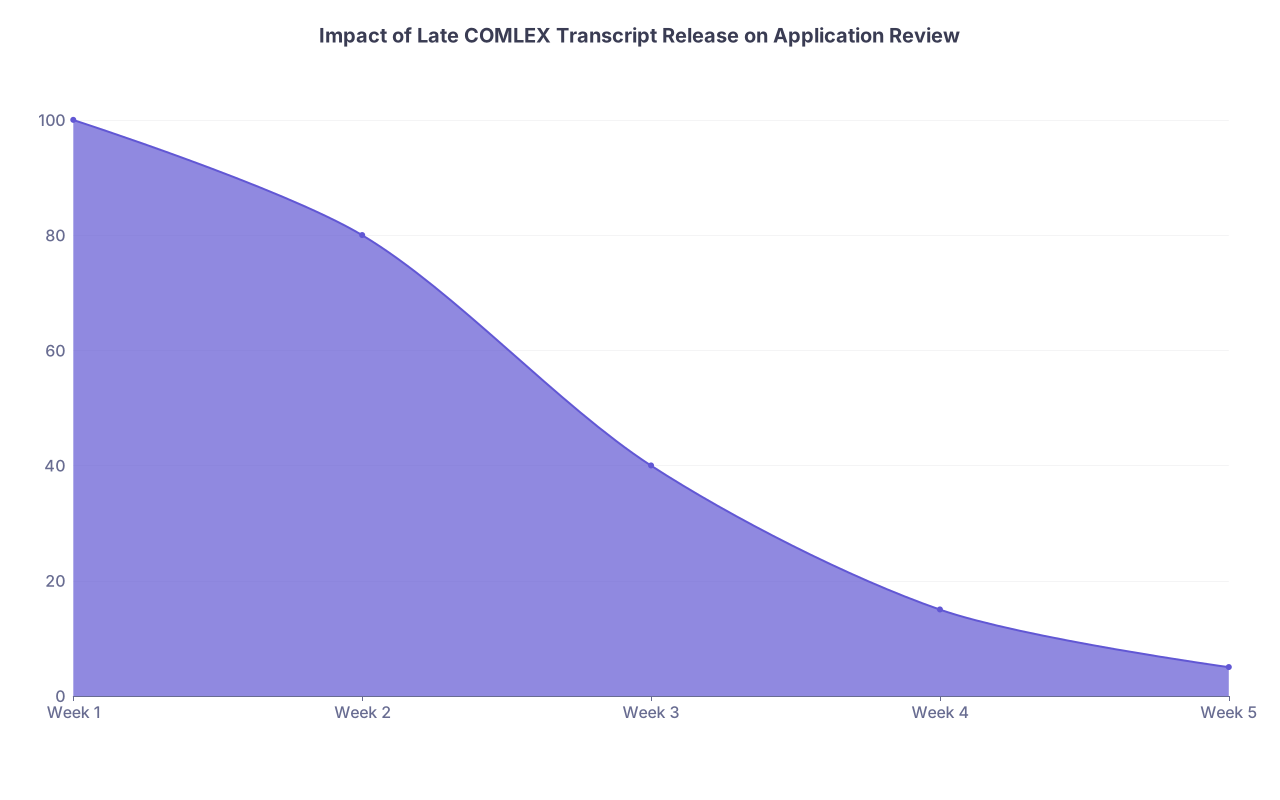
| Category | Value |
|---|---|
| Week 1 | 100 |
| Week 2 | 80 |
| Week 3 | 40 |
| Week 4 | 15 |
| Week 5 | 5 |
Those numbers aren’t exact data, but they capture the reality:
- Most serious program review happens in the first 2–3 weeks
- After that, they’re in “maybe” territory and interview slots are already disappearing
If your COMLEX transcript shows up in Week 4, you’re playing from behind. For no reason.
Do not:
- Assume “I’ll just submit ERAS and deal with COMLEX later”
- Count on programs to wait for you
Do instead:
- Plan backwards from ERAS opening
- Make sure your COMLEX scores are already released or will be released within a few days of application opening
- If your score release date is close, explicitly mention “COMLEX Level 2-CE score pending, expected [date]” in your application
If timing forces you to apply before Level 2 comes out, fine. But there’s no excuse for having existing scores sitting on NBOME while your ERAS goes out blank.
4. Confusing COMLEX vs USMLE Reporting Logic
This gets messy for dual-testers.
You took COMLEX and USMLE. You’re worried the USMLE isn’t as strong, or you failed a step. So you think, “I’ll show them just my COMLEX. That’s what matters for DOs anyway.”
Problem: many ACGME programs, especially competitive ones, explicitly ask for any USMLE scores if taken. Hiding them is a trust problem, not a number problem.
Here’s the mistake pattern I see:
- Student takes both exams
- They report only COMLEX to ERAS
- They mention “I’ve also taken USMLE Step 1” casually in their personal statement or to an interviewer
- PD pulls back: if you hid that on the official application, what else would you hide?
Let me be clear:
If a program’s website says “If you have taken USMLE, you must report those scores,” then withholding them is a red flag. Not a debate.
| Situation | What You Should Report |
|---|---|
| COMLEX only | All COMLEX levels available |
| COMLEX + USMLE, both passed | All COMLEX + all USMLE |
| COMLEX + failed USMLE attempt | All COMLEX + all USMLE (with context) |
| COMLEX only, considering USMLE later | Current COMLEX only |
A weak Step score is survivable with honesty and explanation. A perceived integrity issue is not.
Do not make this mistake:
- Don’t create a weird mismatch between what you say in person and what’s on ERAS
- Don’t cherry-pick Step vs COMLEX to “look better” in an obviously manipulative way
If you truly believe you should not report USMLE for a specific reason, you’d better discuss it with a dean, advisor, or mentor—and expect that some programs will auto-reject you for non-compliance with their stated requirements.
5. Misreporting Retakes, Fails, and Cancellations
Here’s where the fear factor kicks in. You failed Level 1 the first time, then passed on your second attempt. You’re afraid programs will see you as damaged goods.
So you:
- Don’t release Level 1 at all
- Or mis-enter the date/attempt count in the manual ERAS fields
- Or “forget” to update after a retake
The problem: NBOME’s official transcript will show every attempt. You cannot hide it. If the manual entries and transcript don’t match, guess who looks dishonest?
Common integrity-killing mismatches:
ERAS manual field: “First attempt pass”
Transcript: “Fail, then Pass”ERAS manual field: Date = June
Transcript: Actual test date = March, retake = JulyERAS doesn’t list any COMLEX Level 1 attempt
Transcript shows a fail months before
Programs are fine with imperfection. They are not fine with deception.
The right way to handle fails/retakes:
- Report every attempt accurately in ERAS
- Release the full COMLEX transcript from NBOME
- Use one of these places to provide context:
- MSPE/Dean’s letter (often best)
- Personal statement (briefly, not the whole essay)
- A supportive letter writer addressing your rebound
- Show an upward trend (strong Level 2-CE, solid clinical evals)
Trying to “airbrush” your COMLEX history is how you go from “borderline but maybe” to “absolutely not.”
6. Messing Up COMLEX Level 2-PE / OMM Expectations
Yes, the original Level 2-PE was discontinued. Many programs are still confused, and some descriptions haven’t been updated. DOs get caught in the crossfire.
Two landmines here:
- Not clarifying your PE status when older language is still on program websites
- Leaving any OMM/osteopathic competency section of ERAS half-empty, making you look disinterested in your own degree
Some older program pages and coordinators still ask about “COMLEX Level 2-PE.” You can’t provide what no longer exists, but you can absolutely avoid looking careless.
What not to do:
- Ignore questions about PE entirely on supplemental forms
- Leave ERAS osteopathic-specific fields blank because “I’m going all ACGME so it doesn’t matter”
What to do instead:
- If a form or email asks for Level 2-PE:
- Clearly state the exam was discontinued and what your school uses as the replacement assessment
- In ERAS, fill out all osteopathic-specific parts thoroughly:
- OPP/OMM experiences
- Osteopathic identity statements where applicable
You’re a DO. Programs expect you to act like one, not like an MD with a different logo.
7. Forgetting To Re‑Release Scores After New COMLEX Results
This one happens especially for early applicants:
- You apply in September with Level 1 only
- Level 2-CE comes out in October
- You naively assume ERAS will magically push the new score to all programs
Not necessarily.
Depending on timing and how you set it up, you may need to update your transcript release or at least confirm that ERAS has pulled in the new score. Many students don’t. Their applications sit there showing only Level 1 while they’re actually holding a 640 on Level 2.
Common self-sabotage sequence:
- Take Level 2-CE in August
- Apply Sept 6 with Level 1 only
- Level 2 score releases Oct 10
- You never log back into ERAS to check anything
- Programs review your file October 1–20
- You land fewer interviews than you should have
Do not:
- Assume your application “auto-updates” in every way
- Miss the window where a new strong score could change your tier
Do:
- Put a calendar reminder on your phone for your expected score release date
- Log into ERAS that day, confirm the new COMLEX score appears on the official transcript
- If it doesn’t, contact ERAS/NBOME support immediately
- If it does and it’s significantly better than your prior profile, consider a short update email to your top programs
8. Not Checking Program-Specific COMLEX Policies (And Getting Auto-Rejected)
Here’s the part students hate to hear: not every ACGME program treats COMLEX the same way.
Some:
- Accept COMLEX alone, no problem
- “Accept” COMLEX but clearly prefer USMLE
- Require USMLE and COMLEX for DOs (especially some surgical subspecialties)
- Use internal COMLEX cutoffs, even if not listed publicly
You hurt yourself badly when you:
- Apply to 40 programs without checking their stated exam requirements
- Throw money at programs that explicitly require USMLE Step scores you do not have
- Assume “they say USMLE preferred, but they’ll probably take my COMLEX” (sometimes false)
Here’s how expectations differ in practice:
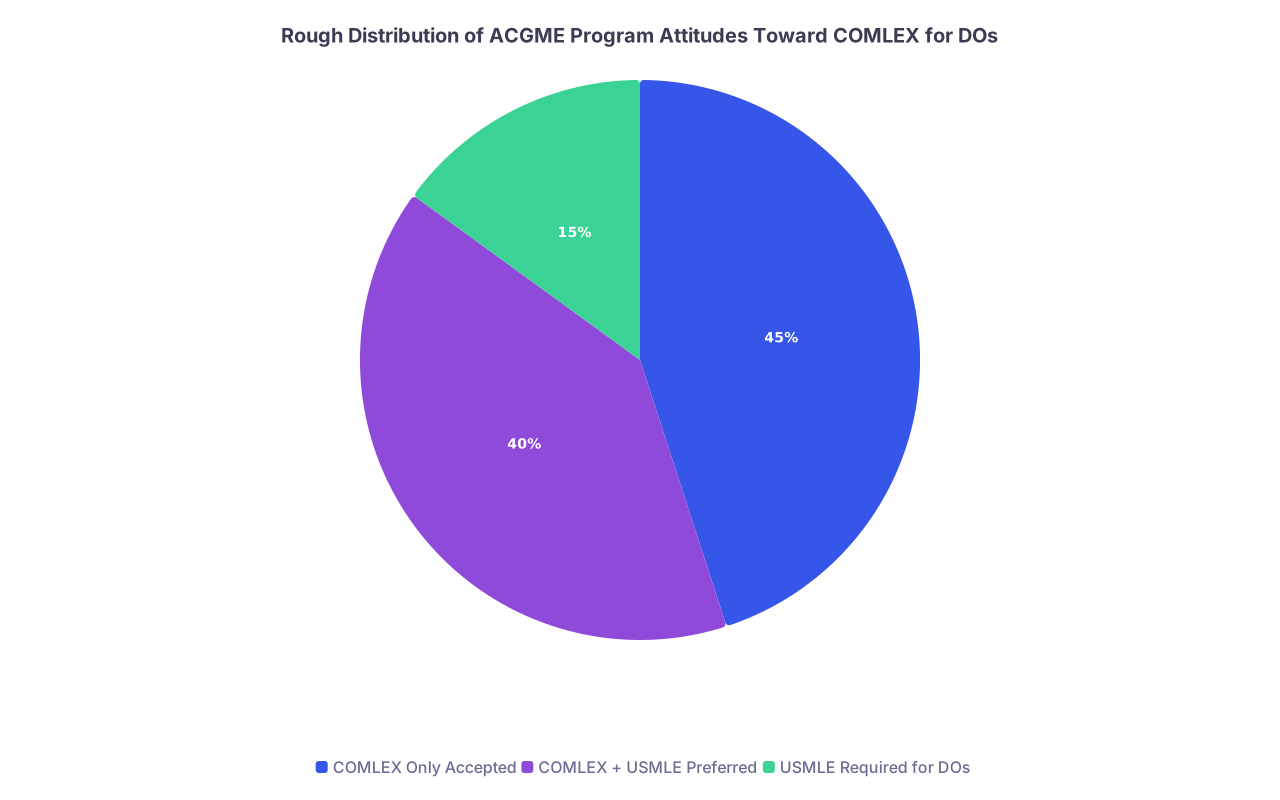
| Category | Value |
|---|---|
| COMLEX Only Accepted | 45 |
| COMLEX + USMLE Preferred | 40 |
| USMLE Required for DOs | 15 |
Again, not exact numbers, but the pattern is accurate.
Bad strategy:
- Blindly applying to highly competitive ACGME programs that require or heavily emphasize USMLE without having taken it
- Assuming your high COMLEX score will magically override clearly stated policies
Better strategy:
- Build a spreadsheet of target programs
- For each, record:
- “COMLEX accepted?”
- “USMLE required?”
- “Stated minimums or typical ranges?”
- Ruthlessly cut programs where you obviously don’t meet exam requirements
Throwing applications at inappropriate programs is not “casting a wide net.” It’s burning time and money.
FAQ (Exactly 4 Questions)
1. If my COMLEX Level 1 is weak but Level 2-CE is strong, can I just report Level 2 to ERAS?
No. That’s one of the biggest mistakes DOs make. Programs expect to see your full testing history. Hiding Level 1 looks dishonest, and the NBOME transcript will expose it anyway. Report both levels, release the full transcript, then use narrative tools (MSPE, letters, brief mention in personal statement) to explain the improvement and maturity between exams.
2. I failed USMLE Step 1 but passed COMLEX Level 1. Do I have to report the USMLE score to ACGME programs?
If a program’s website or ERAS listing says “All USMLE scores must be reported if taken,” then yes, you should report it. Failing and then improving is survivable; an integrity concern from hiding scores is much more damaging. For programs that don’t explicitly ask for USMLE, this becomes a judgment call—but you should discuss it with your dean or an advisor, and understand that any inconsistency between what you tell programs and what’s in ERAS is risky.
3. ERAS shows my COMLEX scores because I typed them in—do I still need to do anything with NBOME?
Yes. Manual entry is not enough. You must authorize NBOME to send an official COMLEX transcript to ERAS for the current application cycle. Programs trust only the official transcript. If you see scores listed in ERAS without an attached official transcript line, your file is functionally incomplete for many programs.
4. My Level 2-CE score is pending when ERAS opens. Should I wait to apply until it’s released?
Usually, no. Submit your application on time with your available scores (likely Level 1), clearly mark Level 2-CE as scheduled or pending, and then make sure the transcript updates as soon as the score releases. The bigger mistake is either applying late or forgetting to ensure the new score actually appears on the ERAS transcript once available. Put a reminder on your calendar for your results date and verify the update that day.
Open your ERAS application right now and click into the Standardized Tests section. Then click through to the COMLEX transcript view. Do you see an official NBOME transcript with every level and attempt, or just some numbers you typed yourself? If it’s not the former, fix that today—before a program silently decides you’re “incomplete” and moves on.