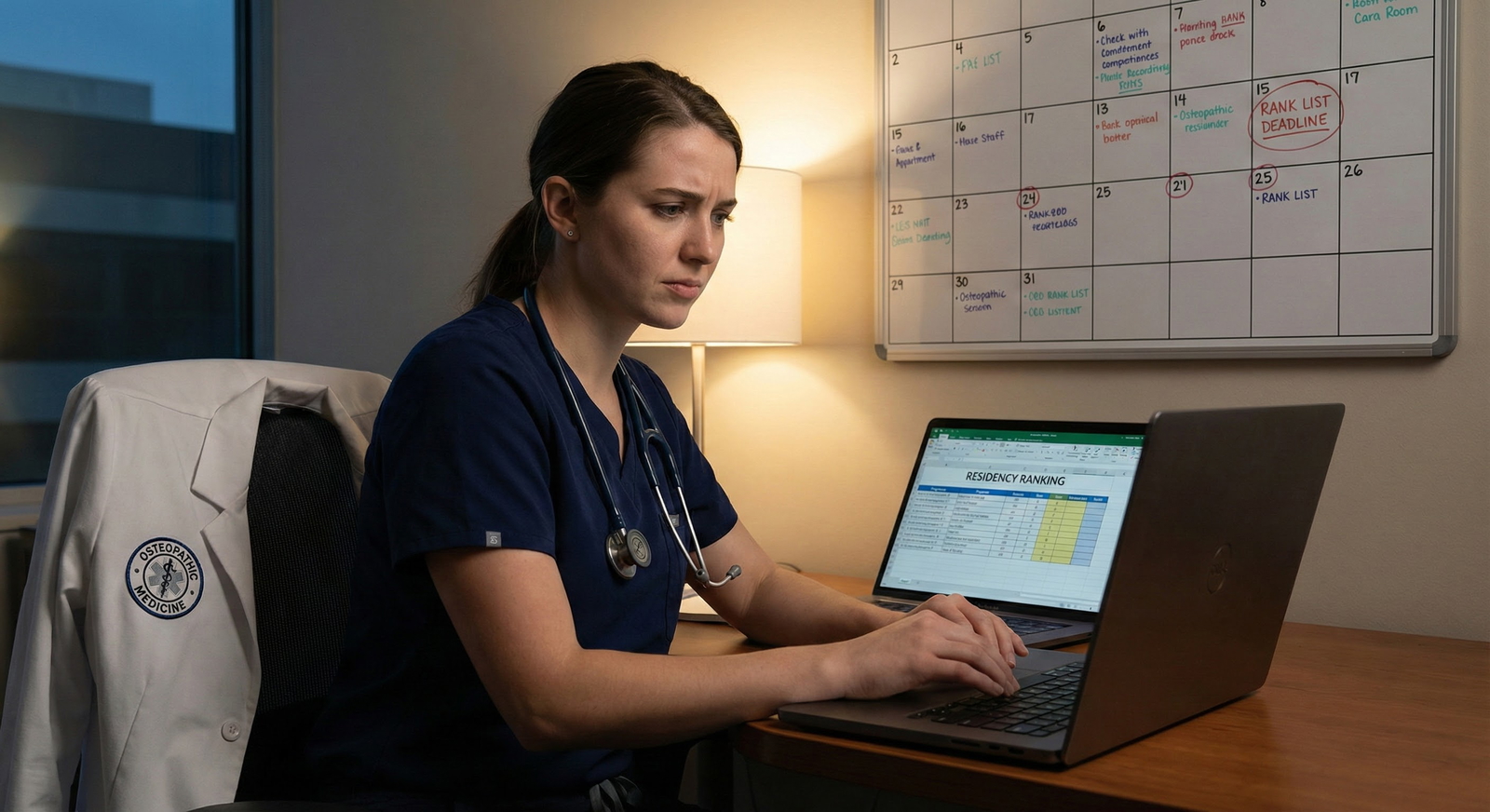
From DO to Match: Essential Steps for ACGME Residency Applications
For osteopathic medical students, matching into an ACGME (Accreditation Council for Graduate Medical Education) residency is a pivotal milestone that shapes your career trajectory. As the Match Process becomes more competitive and the expectations for residency applications continue to rise, DO students must understand not only the basic steps, but also the nuances that can distinguish a strong application from an average one.
This guide walks through every major phase of the ACGME Residency Application process for DO candidates—from self-assessment, to application strategy, to medical interviews, to the Match and beyond—so you can navigate this journey with clarity and confidence.
Understanding the DO–MD Landscape in the Single Accreditation Era
The context in which you apply as a DO matters. While the ACGME Residency and AOA systems are now unified under a single accreditation structure, subtle differences and perceptions still influence how programs evaluate applications.
Osteopathic Medicine vs. Allopathic Medicine
Training Philosophy
- DOs (Doctor of Osteopathic Medicine) are trained in osteopathic medicine, emphasizing whole-person care, prevention, and the interrelationship of structure and function. You receive additional training in osteopathic manipulative treatment (OMT) and often develop strong skills in communication and longitudinal patient relationships.
- MDs (Doctor of Medicine) follow the allopathic model, traditionally more disease- and pathology-focused, though in practice both pathways now share many curricular similarities.
Skill Set and Added Value
Your osteopathic training can be a genuine advantage in ACGME residency programs:- Experience with hands-on physical examination and OMT
- Holistic framework for managing chronic disease and functional complaints
- Strong grounding in primary care—valuable even in non-primary care specialties
Be prepared to clearly and confidently articulate what osteopathic medicine brings to patient care and how that translates into being an effective resident.
The Single Accreditation System and Its Impact on DO Applicants
Integration of Training Pathways
Historically, DOs had access to AOA-accredited residencies while MDs applied predominantly to ACGME programs. With the move to a single accreditation system, nearly all former AOA programs transitioned to ACGME accreditation, and:- Most programs now consider both MD and DO applicants.
- Many previously osteopathic-only programs have retained a strong DO presence and leadership.
Program Attitudes Toward DO Applicants
Although the landscape is more unified, attitudes vary:- Some programs have a long-standing tradition of training DOs and may explicitly welcome osteopathic applicants.
- Others may still have limited experience with DO grads and lean heavily on standardized metrics such as USMLE scores.
Your job is to identify DO-friendly programs, understand their expectations (e.g., COMLEX alone vs. COMLEX + USMLE), and apply accordingly.
Step 1: Evaluating Your Readiness for ACGME Residency
A successful Residency Application begins with honest, data-driven self-assessment. This step helps you decide which specialties and programs are realistic, and where you need to strengthen your profile.
Academic Metrics: COMLEX, USMLE, and Grades
Board Exams
- Many ACGME programs accept COMLEX alone for DO applicants, but competitive specialties and some historically MD-heavy programs may prefer or require USMLE Step exams.
- Review:
- COMLEX Level 1, Level 2-CE scores
- USMLE Step 1 and Step 2 CK (if taken)
- Compare your scores with:
- NRMP Charting Outcomes (for DO seniors)
- Program-specific statements on board score expectations
Clinical Performance and Clerkship Grades
- Honors, High Pass, or strong comments in core rotations (Internal Medicine, Surgery, Pediatrics, OB/GYN, Psychiatry, Family Medicine) are especially important.
- Narrative evaluations that highlight work ethic, clinical reasoning, professionalism, and teachability carry significant weight.
If your metrics are below average for your target specialty, consider:
- Broadening your specialty list (e.g., adding a less competitive specialty or a preliminary/transitional year).
- Strategically targeting programs that historically rank DOs and place more emphasis on holistic review.
Clinical Experiences and Specialty Exposure
- Core Rotations: Demonstrate competence across the foundational disciplines.
- Sub-internships / Acting Internships:
- Especially critical in competitive fields (e.g., Emergency Medicine, General Surgery, Anesthesiology, some IM subspecialty pathways).
- Ideally done at institutions or program types similar to where you hope to match.
- Audition Rotations (“Away Rotations”):
- Common in EM, Orthopedics, General Surgery, and some others.
- These allow you to:
- Experience the program culture firsthand
- Earn a specialty-specific letter of recommendation
- Show programs how you function as a “near-resident” on their team
If your exposure in a chosen specialty is limited, plan targeted electives early enough to obtain Letters of Recommendation (LoRs) before deadlines.
Research, Leadership, and Service
Research
- Necessary or strongly preferred in many academic or competitive specialties (e.g., Dermatology, Radiology, some IM subspecialties).
- For primary care–oriented specialties, research is beneficial but not always essential; quality and relevance matter more than volume.
Leadership & Service
- Positions in student organizations, community clinics, or public health projects show initiative and commitment.
- Longitudinal service—especially in underserved or rural communities—may strongly resonate with program missions.
Setting Realistic Goals and Application Scope
Once you understand your profile:
- Identify target specialties (e.g., FM, IM, EM, Surgery, Pediatrics, Psychiatry).
- Decide whether you need a “parallel plan” (e.g., applying to both Internal Medicine and Family Medicine if highly competitive).
- Estimate application volume:
- Less competitive specialties: often 20–40 programs may be enough.
- Moderately or highly competitive specialties: 40–80+ programs may be necessary, depending on your metrics and advising.
Write down:
- Your primary specialty goal
- Any backup specialties
- Your target number of programs by specialty and region
This upfront planning will guide every decision in your Residency Application cycle.
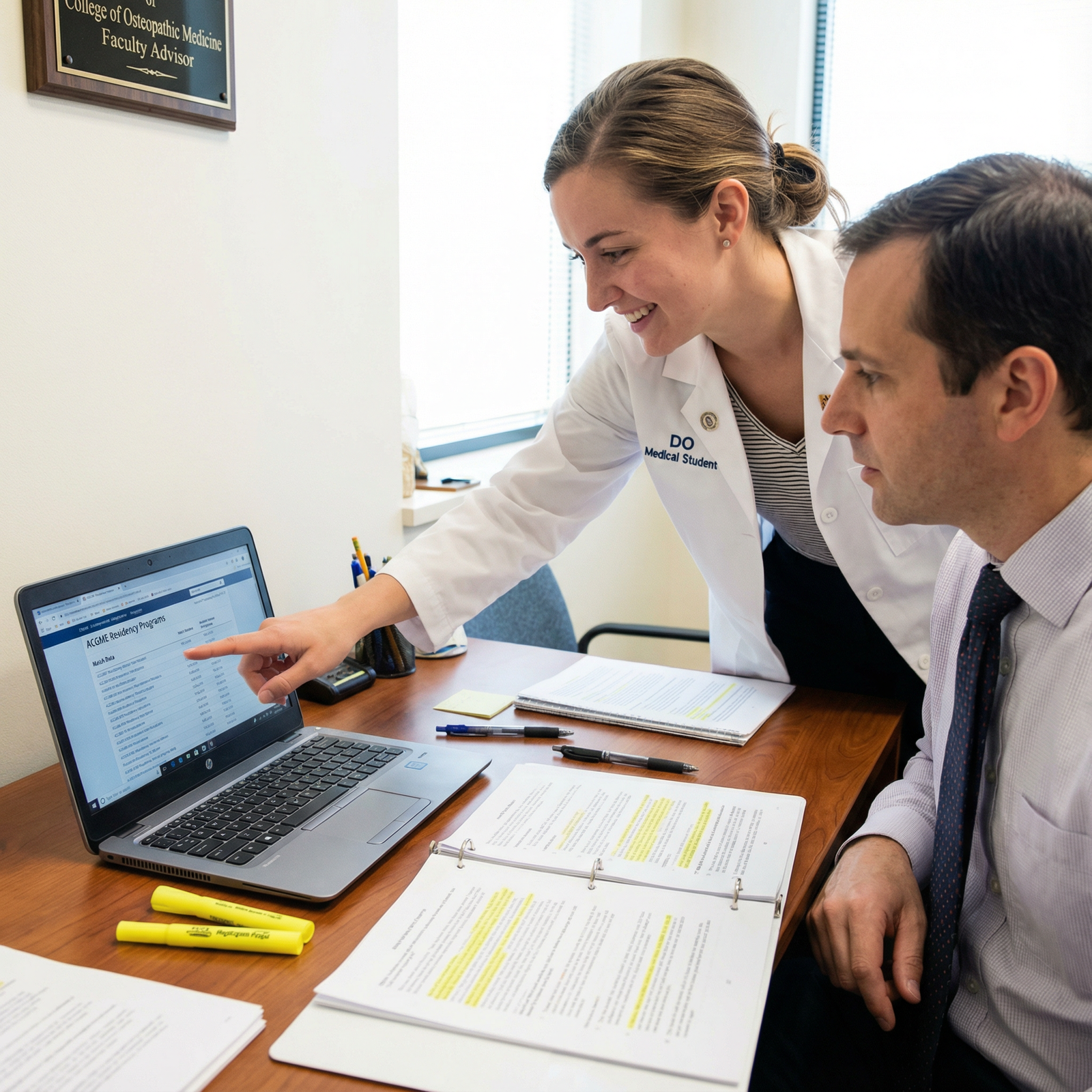
Step 2: Crafting a Strong and Cohesive ACGME Residency Application
Your Residency Application is your professional portfolio. Each component should reinforce a consistent, compelling picture of who you are as an osteopathic applicant.
Personal Statement: Telling a Focused, Authentic Story
Your personal statement should:
- Answer why this specialty and why you are a fit for it.
- Demonstrate how your osteopathic identity influences your approach to patient care.
Actionable tips:
- Open with a concise, specific clinical anecdote or defining moment—not a generic quote.
- Highlight:
- A formative patient interaction
- How OMT, holistic care, or continuity-of-care experiences shaped your outlook
- A challenge or failure that taught you resilience or humility
- Avoid:
- Overly casual or dramatic language
- Rehashing your CV in paragraph form
- Long descriptions of your childhood unless truly central to your story
End with a forward-looking paragraph describing:
- The kind of resident and colleague you aim to be
- The type of training environment in which you thrive
Curriculum Vitae (CV): Organized, Clear, and Impact-Focused
Your CV should be:
- Chronological and clearly formatted
- Easy to skim in under 1–2 minutes
Key sections:
- Education (with expected graduation date)
- Board exam scores (if asked; some programs reference ERAS directly)
- Clinical rotations and sub-internships
- Research (with roles, outcomes, and publications/posters)
- Leadership and volunteer activities
- Honors, awards, and scholarships
- OMT or osteopathic-specific activities (OMM fellowships, teaching roles, osteopathic clubs)
Where possible, add brief bullet points emphasizing impact:
- “Developed a quality improvement project to reduce ED boarding times; implementation decreased average time by 15%.”
- “Served as OMT tutor for first-year DO students, leading weekly sessions.”
Letters of Recommendation: Strategic and Specialty-Specific
Most ACGME Residency programs require 3–4 Letters of Recommendation (LoRs), often via ERAS.
Guidelines:
- Aim for at least two letters from your chosen specialty, ideally from:
- Attendings who directly supervised you
- Faculty known to be active in resident education or program leadership
- Use departmental or program director letters when standard in your specialty (e.g., EM uses SLOEs—Standardized Letters of Evaluation).
- Consider including one letter from:
- A primary care or core rotation highlighting your professionalism and teamwork
- A research mentor who can speak to your scholarly skills
Best practices:
- Ask early (4–8 weeks before deadlines).
- Provide:
- Your CV
- Personal statement draft
- Brief summary of key cases or contributions they observed
- A list of programs and your specialty goals
Kindly request a strong, supportive letter so potential lukewarm writers can opt out.
ERAS (Not AMCAS): The Residency Application Platform
The original text referenced AMCAS, which is actually used for medical school, not residency. For ACGME Residency Applications, you will use ERAS (Electronic Residency Application Service).
Key steps in ERAS:
- Register early, confirm deadlines for your specialty.
- Complete demographic, education, and experiences sections carefully.
- Enter your COMLEX and USMLE scores correctly and arrange official score transmission.
- Upload your personal statement(s); you can tailor different versions to different specialties.
- Assign LoRs to specific programs in line with their requirements.
Program selection strategy:
- Use tools like FREIDA, program websites, and NRMP data to identify:
- Programs with a track record of matching DOs
- Geographic preferences and visa policies (if applicable)
- Emphasis on primary care, research, community health, or academic medicine
Balance “reach,” “target,” and “safety” programs to create a rational list aligned with your readiness assessment.
Step 3: Excelling in Medical Interviews for ACGME Residencies
Once you secure interviews, your standing with programs can shift significantly based on how you perform in person or virtually.
Preparing for Residency Interviews: Content and Delivery
Know Your Application Cold
Anything on your CV or personal statement is fair game:- Be ready to discuss your research methods and results.
- Reflect on specific patient cases from sub-internships.
- Be able to explain any red flags (exam failures, leaves of absence) succinctly and honestly.
Master Common Question Themes Prepare structured responses (e.g., using the STAR method – Situation, Task, Action, Result) for:
- “Why this specialty—and why now?”
- “Why our program specifically?”
- “Tell me about a time you made a mistake.”
- “Describe a conflict with a team member and how you handled it.”
- “How does your training in osteopathic medicine influence your care?”
Ethics and Professionalism
Expect scenarios involving:- Disclosing errors to patients
- Navigating impaired colleagues
- Handling resource limitations or cultural differences
Show empathy, integrity, and a patient-centered mindset.
Showcasing Your Osteopathic Identity in Interviews
You may be asked:
- “Why did you choose osteopathic medicine?”
- “How do you see OMT fitting into your future practice?”
Be prepared to:
- Articulate the osteopathic principles you value (e.g., body unity, structure-function relationships).
- Give concrete examples:
- Using OMT in musculoskeletal back pain or headaches
- Applying a holistic approach when managing complex, multi-system patients
- Clarify whether you plan to actively incorporate OMT in residency, and how (clinic, sports medicine, inpatient when appropriate).
Asking Insightful Questions
Programs expect you to ask questions; it signals genuine interest and maturity. Consider asking about:
- The structure of supervision and feedback
- Opportunities for osteopathic-focused clinics or OMT continuity
- Resident wellness, call schedules, and culture
- Support for research, QI, or community engagement
Avoid questions easily answerable on their website; use your questions to explore fit and signal your priorities.
Logistics and Professionalism
- For virtual interviews:
- Test your audio, video, and internet connection beforehand.
- Use a neutral background and professional attire.
- Maintain eye contact by looking at the camera, not your own image.
- For in-person interviews:
- Arrive early.
- Be kind to everyone—coordinators, residents, staff. Their impressions matter.
- Take notes after each interview day to help later with your Rank Order List (ROL).
Step 4: Navigating the NRMP Match Process as a DO Applicant
The Match Process culminates in how you and programs rank each other through the National Resident Matching Program (NRMP).
Understanding the NRMP and Rank Order Lists
Rank Programs by Preference, Not Perceived Odds
The NRMP algorithm favors your authentic preferences. Rank:- Your dream program first, if you would truly prefer to train there.
- Then other programs in exact order of where you would want to match.
Creating Your Rank Order List (ROL)
Consider:- Training quality and board pass rates
- Resident satisfaction and culture
- Geographic location and support systems
- Program attitudes toward DOs and OMT
- Fellowship opportunities (if relevant)
Discuss your ROL with trusted advisors, but make your final decisions based on your priorities.
SOAP (Supplemental Offer and Acceptance Program)
If you are unmatched on Monday of Match Week:
- You will receive a list of unfilled positions.
- SOAP allows applicants to apply to and be offered positions in several structured rounds.
Preparation tips:
- Before Match Week, draft a SOAP-ready CV and a short personal statement tailored to likely backup specialties.
- Stay in close contact with your dean’s office or advising team; they often coordinate SOAP strategy and communications.
- Remain professional and responsive; SOAP proceeds quickly with tight deadlines.
Planning for Contingencies and Reapplication
If you do not match or accept a SOAP position:
- Debrief thoroughly:
- Evaluate your board scores, number of applications, interview performance, and specialty competitiveness.
- Seek honest feedback from program directors or faculty when possible.
- Consider:
- A structured research year
- Additional clinical experience (e.g., prelim year, observerships, community-based practice under supervision where allowed)
- Improving test performance (e.g., retaking COMLEX Level 2-CE/USMLE Step 2 CK if significantly below expectations)
Reapplicants can and do successfully match, especially when they use the interim year to clearly strengthen their application.
Step 5: Reflecting, Transitioning, and Growing After the Match
Regardless of outcome, the end of the cycle is an opportunity for reflection and growth.
Post-Match Reflection for Those Who Matched
Celebrate this milestone—but also prepare:
- Review your matched program’s curriculum and expectations.
- Brush up on common conditions and emergency management relevant to your specialty.
- If your program has osteopathic faculty or an OMT clinic, reach out early to explore involvement.
Set early residency goals:
- Aim to be reliable, teachable, and kind.
- Identify mentors in your program for career planning and potential fellowship guidance.
Reflection and Pivot for Those Who Did Not Match
- Allow yourself time to process disappointment, then move into analysis and action.
- Work with advisors to:
- Identify key weaknesses in your application.
- Construct a step-by-step remediation plan (research, clinical work, retesting, parallel specialty planning).
- Maintain professionalism in all communications; your behavior now can impact future opportunities.
Residency is a journey, not a single event. Whether your path is straightforward or requires a pivot, persistence and adaptability are critical professional skills.

Frequently Asked Questions (FAQs) about ACGME Residency Applications for DO Students
1. How can I improve my competitive edge as a DO applicant to ACGME programs?
To enhance your competitiveness:
- Strengthen your metrics:
- Aim for solid COMLEX (and USMLE if taken) scores, especially Step/Level 2.
- Improve clinical grades and secure strong narrative comments.
- Targeted clinical exposure:
- Complete sub-internships in your desired specialty.
- Consider audition rotations at programs or in regions where you hope to match.
- High-quality letters of recommendation:
- Seek letters from faculty who know you well and can speak to your clinical performance and professionalism.
- Engage in meaningful activities:
- Research, QI projects, leadership roles, and longitudinal service—particularly those aligned with your specialty’s priorities.
- Refine your storytelling:
- A compelling personal statement and confident interview performance that highlight your osteopathic perspective can set you apart.
2. How many programs should I apply to as a DO, and does this differ by specialty?
Application numbers vary by specialty, competitiveness, and your personal profile:
- For less competitive specialties (e.g., many Family Medicine and some Internal Medicine programs), well-advised DO applicants with solid metrics might apply to 20–30 programs.
- For moderately competitive specialties (e.g., Emergency Medicine, Pediatrics, Psychiatry), many DO applicants apply to 30–60 programs.
- For highly competitive specialties (e.g., Orthopedic Surgery, Dermatology, certain subspecialty tracks), numbers may exceed 60–80 programs, often with a parallel plan in a less competitive specialty.
Discuss your specific situation with advisors who know your metrics and current Match data. More is not always better; strategic, well-researched applications often outperform indiscriminate mass applications.
3. As a DO, do I need to take the USMLE in addition to COMLEX to be competitive?
Requirements vary by specialty and program:
- Many ACGME programs accept COMLEX alone, especially in primary care and at historically osteopathic-friendly institutions.
- Some competitive specialties and academic centers strongly prefer or require USMLE.
- If your target programs or specialty commonly request USMLE:
- Taking and performing well on USMLE Step 1 and/or Step 2 CK may meaningfully broaden your options.
- If your COMLEX scores are modest, a strong USMLE Step 2 CK can help offset concerns.
Always check individual program requirements and national specialty guidance, and make testing decisions as early as possible in your training.
4. Can I still apply for osteopathic-focused or formerly AOA programs through the Match?
Yes. With the single accreditation system:
- Nearly all former AOA residencies are now ACGME-accredited and participate in the NRMP Match Process.
- Many of these programs still:
- Have a strong DO presence
- Offer dedicated OMT or osteopathic recognition tracks
- Value osteopathic principles and training highly
You apply to these programs through ERAS and rank them in the NRMP, just like any other ACGME Residency.
5. How important are Letters of Recommendation compared to board scores and grades?
All are important, but they serve different roles:
- Board scores and grades often determine whether you receive an interview invite.
- Letters of Recommendation, personal statement, and interview performance often decide where you fall on the Rank Order List once you are in serious consideration.
Strong letters can:
- Validate your clinical acumen and work ethic.
- Differentiate you from applicants with similar scores.
- Reassure programs that you will function well as an intern and team member.
Invest time in earning strong letters from faculty who have supervised you closely and can speak in concrete terms about your strengths.
By understanding the current DO–MD landscape, accurately assessing your readiness, crafting a cohesive and polished ACGME Residency Application, preparing intentionally for medical interviews, and navigating the Match Process strategically, you can significantly increase your chances of matching into a residency that fits your goals and values.
Your osteopathic background is not just a credential—it is a framework for patient care that can be a genuine asset to ACGME residency programs. With thoughtful preparation, persistence, and self-awareness, you can move confidently from DO student to matched resident and onward toward a fulfilling medical career.